
Introduction
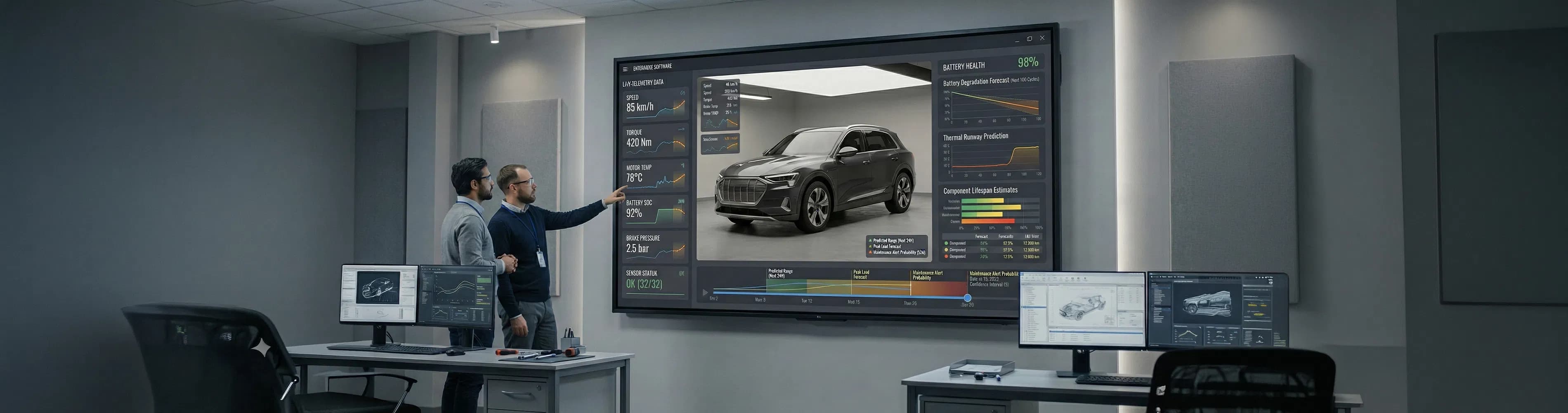
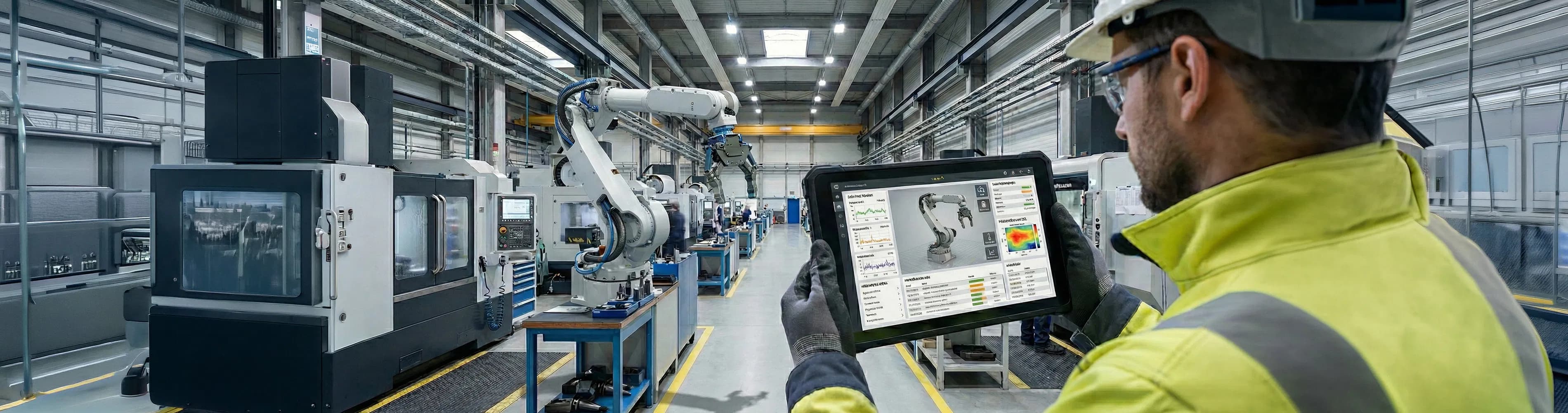
Manufacturing experiences a complete change in its fundamental processes. Smart factories now maintain their operational standards through intelligence which enables them to track and optimize business processes. The complete transformation of industries today bases its operations on digital twin technology. A digital twin exists as a digital duplicate of an actual physical object or complete operational system or industrial procedure. The system uses actual time sensor data together with machine data and operational system data to represent how things function in reality. Our AI-powered solutions enhance this process.
Digital twins in smart factories enable tracking of equipment performance and production output and system operational status. The system enables manufacturers to study their operational activities through scenario testing to achieve improved decision-making results which do not require any production process pauses. Digital twins have become necessary instruments for factories which operate through data-driven systems and maintain interlinked production equipment.
The system enables manufacturers to enhance their operational efficiency through downtime reduction and quality improvement together with faster innovation cycles. Digital twins connect physical production processes with digital systems which enable factories to achieve operational accuracy and system oversight while running their operations.
Why Smart Factories Need Digital Twins
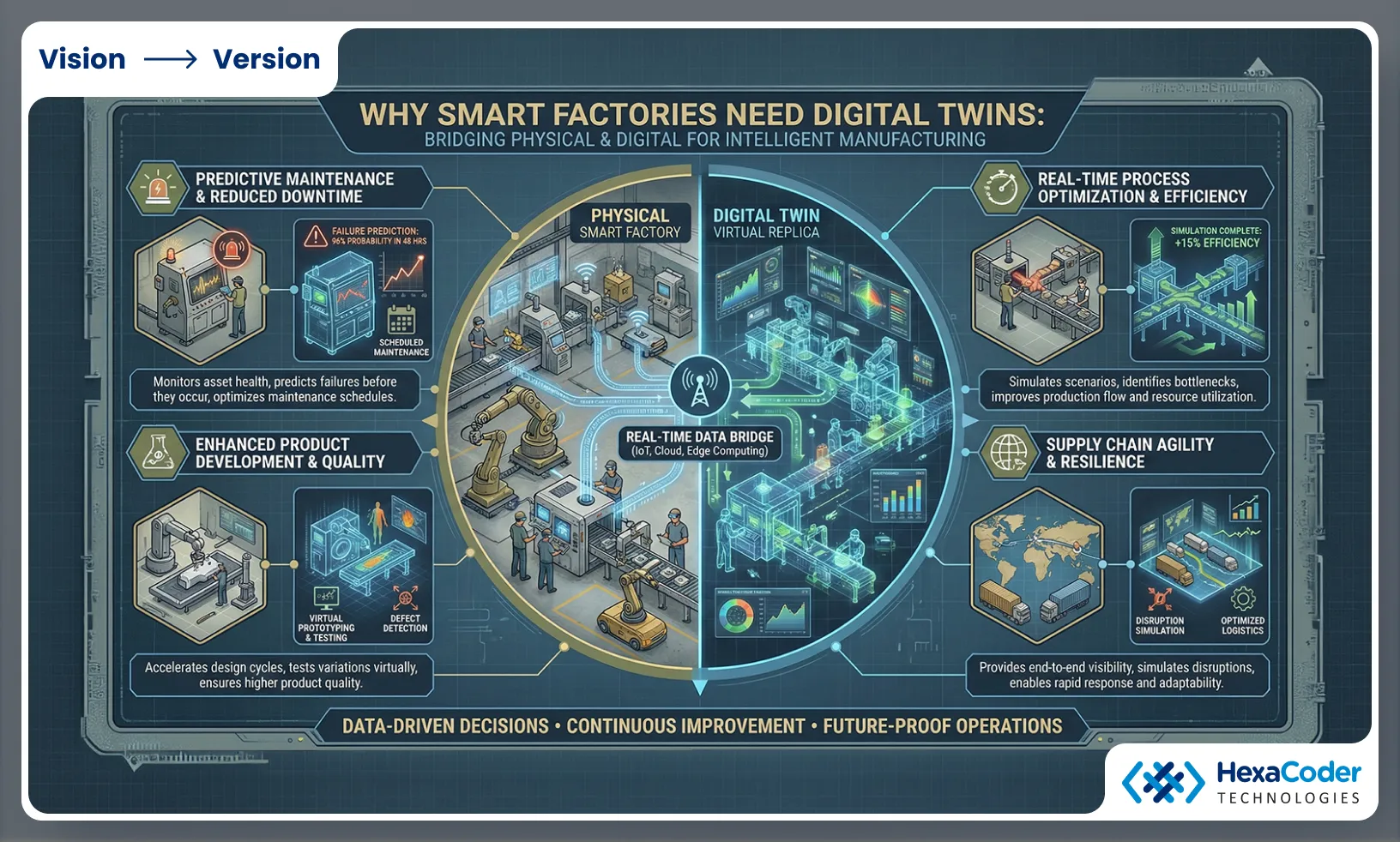
Factory monitoring systems from back in the past fail to deliver complete operational insights because they only present performance data without offering any better understanding of operational problems or future developments. Smart factories require systems that provide operational descriptions together with their root cause explanations and their capacity to forecast future events. Digital twins provide this depth.
Digital twins construct dynamic virtual models of machines and production systems and whole factory spaces through their ongoing process of collecting and studying actual data. This process enables manufacturers to detect operational inefficiencies while they can anticipate machine failures and enhance production efficiency through active measures instead of waiting to respond after issues occur.
Manufacturing downtime is costly because unexpected equipment failures result in production interruptions which cause delivery delays and higher expenses. Digital twins enable organizations to lower their operational risks through their ability to deliver early detection systems which support organizations to implement preventive measures. Digital twins enhance manufacturing operations by providing manufacturers with consistent performance maintenance features which help them achieve operational efficiency through increased productivity and decreased unpredictability.
What Is a Digital Twin in Smart Manufacturing
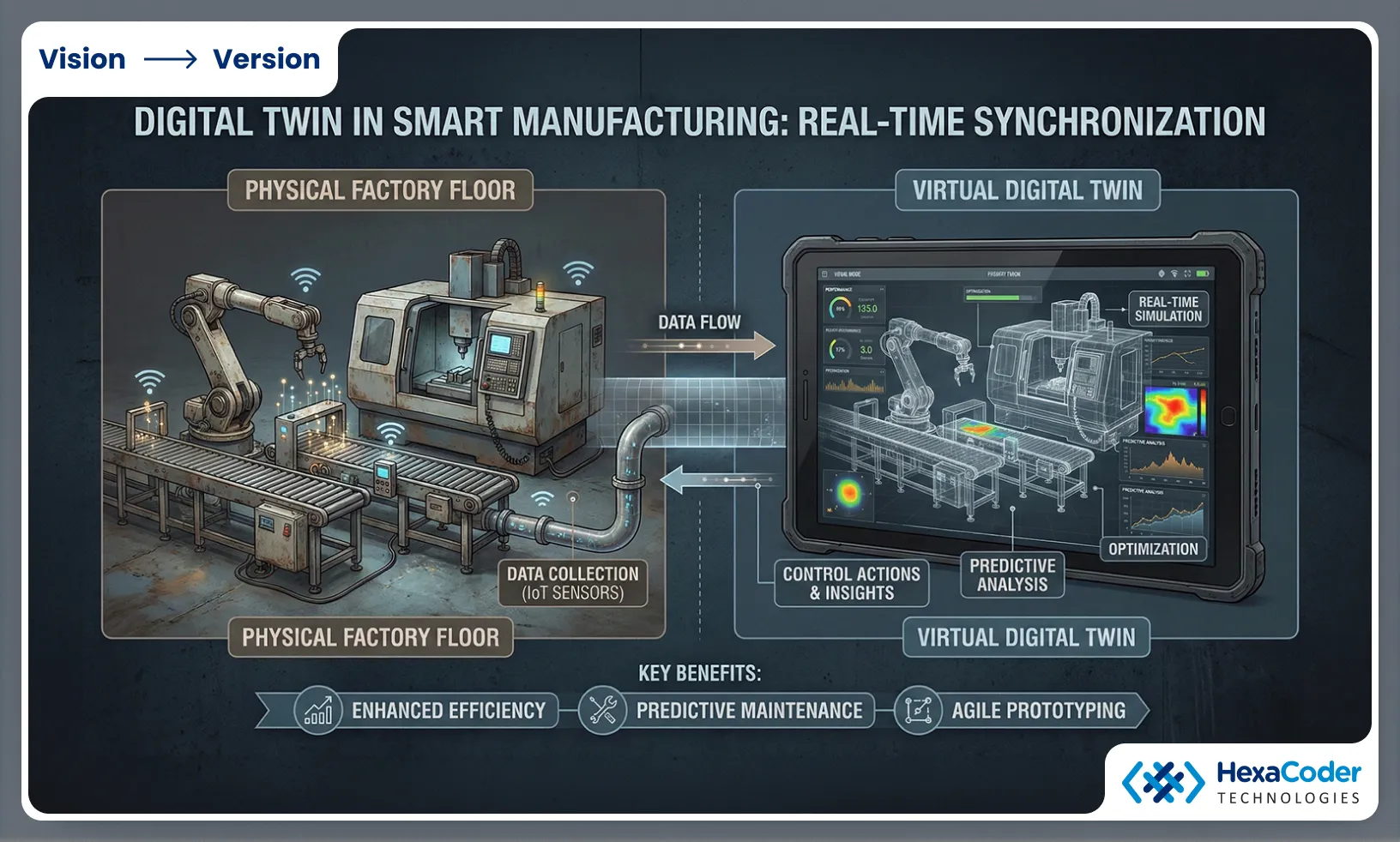
A digital twin creates an ongoing digital representation which updates to reflect changes in the physical asset and operational process and system function. The system uses sensor data from the present moment together with historical operational data and advanced analytical methods to create an accurate representation of actual environmental conditions. Digital twins can represent individual machines, production lines, entire factory environments, or even complex manufacturing ecosystems.
Equipment sensors capture real-time operational data which includes temperature measurements and vibration patterns and pressure values and speed readings and load conditions which they send to digital platforms for analysis and visualization. The digital models enable engineers and factory managers to track performance metrics and identify operational issues and assess equipment functionality.
Digital twins maintain an evolving nature because manufacturers continuously gather fresh operational data which enables them to keep their industrial processes accurately documented. The system delivers real-time system surveillance together with forecast capabilities which makes it a crucial asset for contemporary intelligent manufacturing facilities.
Best Digital Twin Applications for Smart Factories
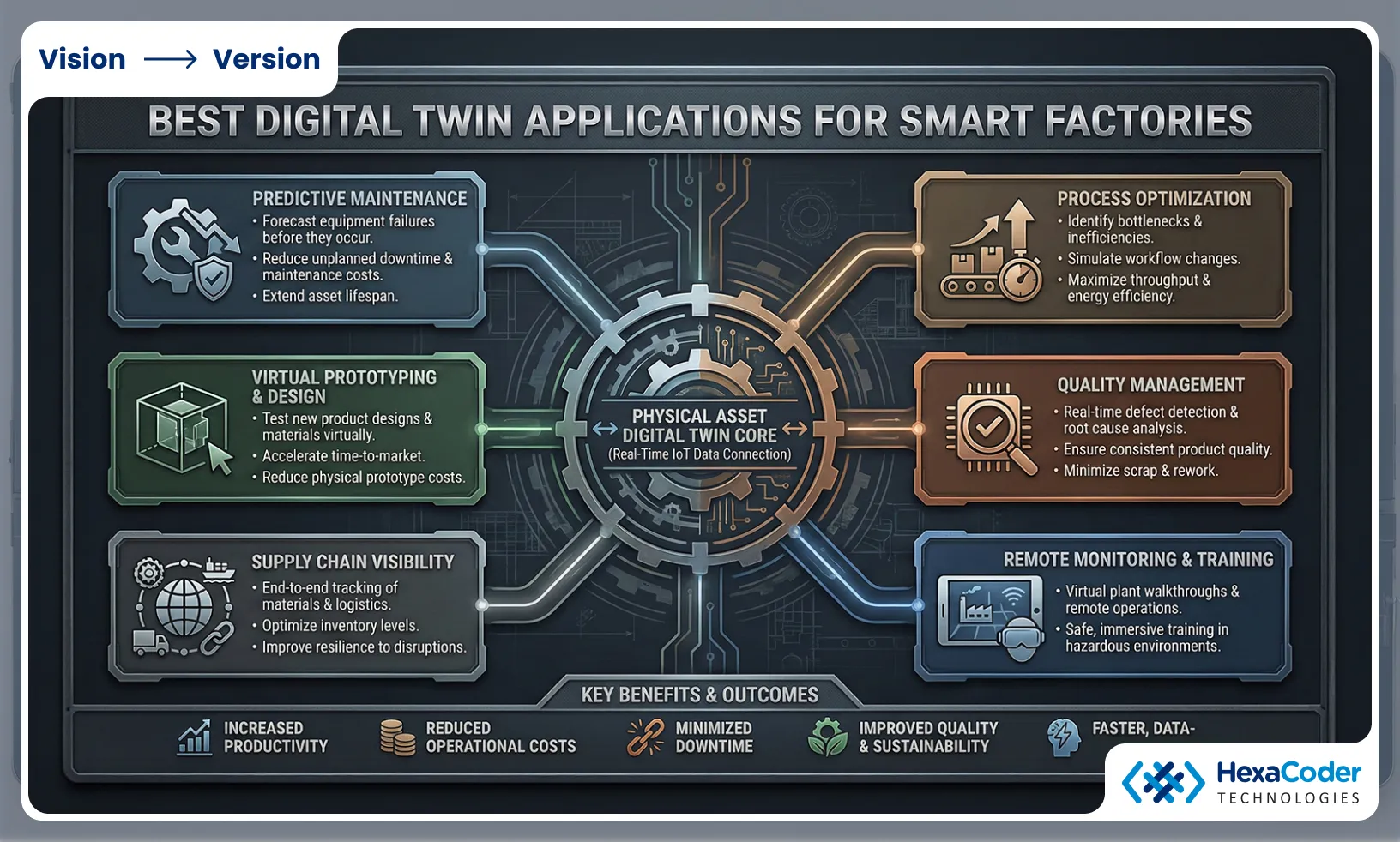
The most important uses of digital twin technology in smart manufacturing show its greatest power through these applications.
Predictive Maintenance:
Digital twins use real-time sensor data to monitor machine performance and identify equipment failures through their detection of operational anomalies. Factoring organizations can achieve substantial maintenance cost savings through planned maintenance which will extend their equipment operating time and actual equipment lifespan. The shift from maintenance which responds to equipment problems toward maintenance which predicts future equipment issues benefits both maintenance operations and resource distribution.
Production Line Optimization:
Digital twins create complete production workflow models which enable manufacturers to find process slowdowns and operational faults. Engineers use virtual environments to evaluate machine usage patterns and processing times and operational relationships before they put their actual improvements into practice. The system delivers enhanced efficiency through waste reduction to create better business results while preserving functions required for product manufacturing.
Real-Time Equipment Monitoring:
Digital twin technology enables continuous visibility into the operational conditions of equipment, allowing factory managers to view metrics like speed, temperature, and load in real time. The system enables organizations to identify performance problems at an early stage which leads to immediate problem solving and breakdown prevention thus enhancing system dependability and production efficiency.
Factory Layout Planning and Simulation:
Digital twins enable manufacturers to create virtual factory layouts which they can use to test production systems before they implement actual modifications. Engineers need to test various equipment setups and operational patterns to discover the best design which achieves operational efficiency and security improvements while minimizing unnecessary employee movements and optimizing material distribution throughout the facility.
Quality Control and Defect Reduction:
The digital twin system enables manufacturers to monitor production conditions which help them discover production factors that decrease product quality. The system generates alerts for engineers to implement corrective measures when operational standards exceed acceptable limits because it protects against production of defective items. This method enhances product uniformity while decreasing material waste which enables manufacturers to achieve superior protection of product quality.
Energy Efficiency and Resource Optimization:
Digital twins enable manufacturers to track their energy consumption throughout the day while discovering equipment and operational processes which create unnecessary power usage. The evaluation of energy usage patterns combined with operational optimization enables manufacturers to decrease both their energy expenses and their ecological footprint. Energy-efficient practices enable organizations to progress toward sustainability objectives which have become critical for manufacturing businesses worldwide.
Process Simulation and Testing:
Engineers can use digital twin environments to test new workflows and assess equipment improvements and evaluate process changes without interrupting existing manufacturing operations. The virtual assessment of modifications enables manufacturers to implement new systems with decreased risk while advancing their innovation processes efficiently.
Remote Monitoring and Factory Management:
Digital twins provide managers and engineers with the ability to view operational data from any location which enhances their ability to monitor all company locations. The system enables users to monitor their actual locations while assessing their activities through the implementation of monitoring capabilities.
Digital Twin Applications Across Manufacturing Industries
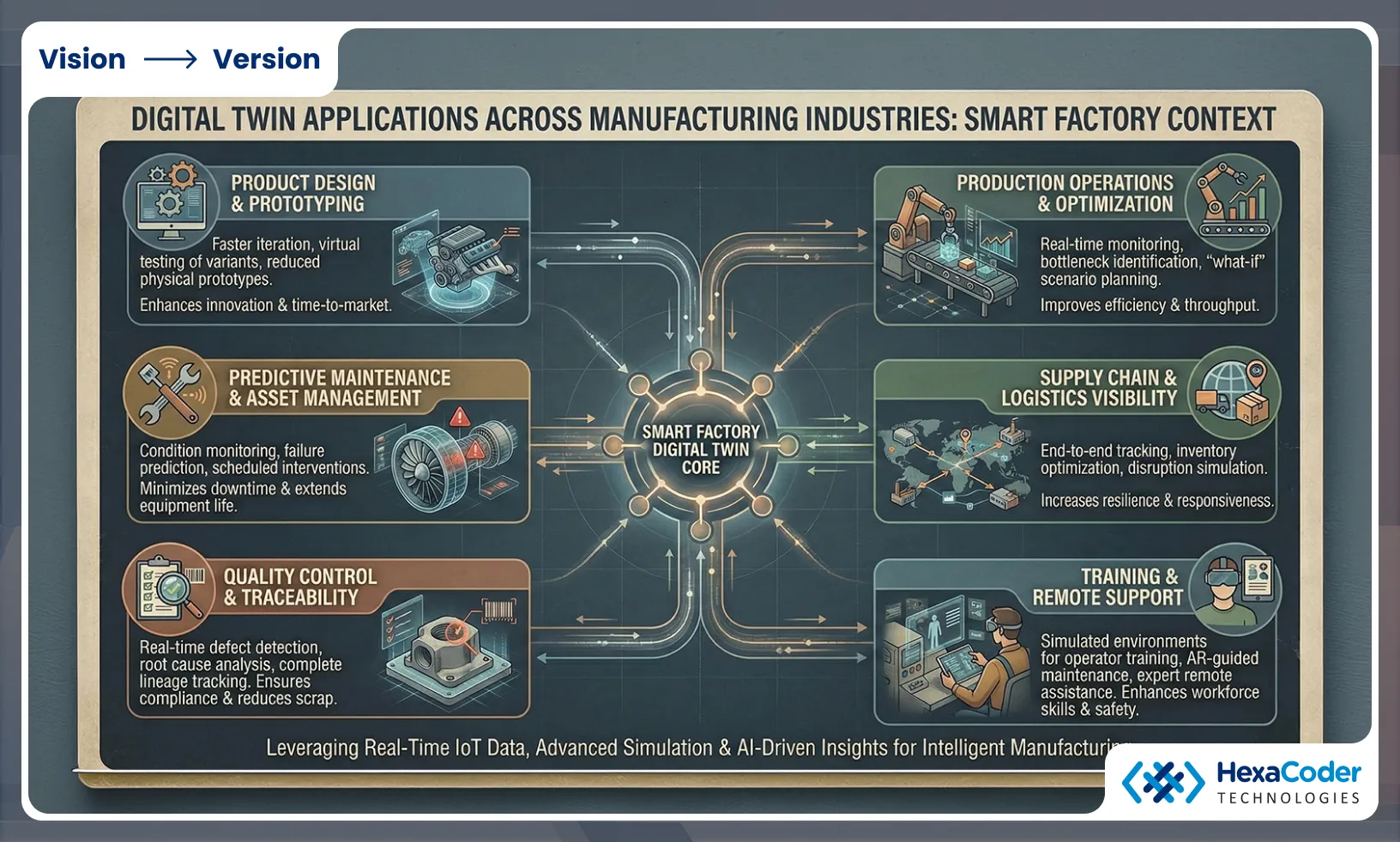
Digital twin technology is a flexible technology which manufacturers use in various manufacturing industries. The main industrial uses of this technology include the following applications.
Automotive Manufacturing:
Automotive factories use digital twins to track their robotic assembly lines and welding systems and paint shops and production workflows. The use of digital twins allows manufacturers to enhance their assembly accuracy while they decrease production delays and improve their manufacturing throughput. Digital twins enable the testing of new vehicle model production lines which helps manufacturers achieve faster setups and lower operational risks during product launches.
Electronics Manufacturing:
Electronics production requires extreme precision as its most important factor. Digital twins help maintain strict control over sensitive production conditions such as temperature and alignment. Digital twins provide manufacturers with tools to monitor environmental conditions which affect product components and operational machinery. Digital twins enable organizations to organize new product launches by creating transition plans which allow them to keep their operational standards.
Aerospace Manufacturing:
The aerospace manufacturing industry needs complete defect-free production because it operates under strict quality control standards. Digital twins enable equipment monitoring through process simulation and they ensure machine operation meets safety and operational accuracy standards. The system decreases operational hazards and increases system dependability through its ability to model complex production processes and assembly operations.
Pharmaceutical Manufacturing:
Pharmaceutical production requires rigorous compliance and precise environmental control. Digital twins monitor essential production factors which include humidity and temperature and machinery operational functions. Product quality and regulatory standards will be maintained through this data which enables simulation to enhance both batch production and process validation.
Integration with IoT and Automation Systems
Digital twins require precise real-time information which industrial Internet of Things (IoT) sensors and automation systems collect through their sensor networks. The sensors measure operational parameters which include temperature and vibration and pressure and speed and energy usage and transmit this information to digital twin platforms for processing and analysis.
The digital twin receives operational data from automation systems which include programmable logic controllers and supervisory control and data acquisition systems. The system integration provides complete factory operational details which enable ongoing operation tracking and simulation testing and predictive system assessment.
The combination of IoT data and digital twin models allows manufacturers to analyze their operational processes and track their performance developments.
Benefits of Digital Twin Technology
The implementation of digital twins brings important advantages to manufacturing processes.
Enhanced Operational Efficiency
The system detects operational weaknesses which enable process enhancement to achieve quicker production times and higher manufacturing volumes.
Predictive Maintenance Capabilities
The system predicts equipment breakdowns which allows maintenance teams to create maintenance schedules based on potential problems.
Improved Decision Making
The system delivers current operational information together with simulation findings which help organizations reduce danger while enhancing their functional strategies.
Cost Reduction
The system helps businesses save expenses by reducing unneeded repairs while maintaining their equipment performance.
Quality Enhancement
The system helps businesses identify product excellence through its ability to detect faults and production process errors at an early stage.
Innovation Acceleration
The system provides manufacturers with the capacity to assess and test their product development concepts through virtual testing before executing their physical implementations.
Safety Improvement
The system detects possible hazards while it demonstrates how emergency situations will develop.
Competitive Advantage
The system provides operational advantages which strengthen the organization through enhanced operational performance and advanced sustainability initiatives.
Implementation of Digital Twins in Smart Factories
The implementation of digital twins requires multiple essential procedures. The first stage of the process requires scientists to gather data by installing monitoring equipment and sensors which will record system performance information throughout the day.
The engineers begin the next step by building digital models which represent the actual systems they intend to copy in their virtual environment. The system uses virtual models which receive real-time information from its operational systems and data analysis tools.
The digital twin system undergoes testing and validation to guarantee its operational precision and dependable performance. The digital twin system operates continuously after deployment to track business activities and deliver operational insights which enable manufacturers to enhance their production efficiency.
The insights which manufacturers obtain from the system enable them to discover improvement possibilities while solving issues and achieving operational excellence.
Digital Twin Adoption Challenges
The complete implementation of digital twin technology presents manufacturers with multiple difficulties which they must tackle throughout the implementation process.
Data Integration Complexity
The main barrier that factories face involves acquiring data from various sources. Smart factories operate their systems through a combination of outdated equipment and contemporary devices and different software applications. The process of uniting these separate systems into a unified digital twin system presents technical difficulties.
The system requires standardized data formats to process different data types which include incompatible sensors and historical records that need to be transformed for use in the real-time model. The digital twin requires complete data flow because any data loss or inaccuracy will decrease its performance while impacting its ability to make predictions.
Financial Investment Requirements
Organizations need to make substantial financial commitments. The deployment of digital twins requires organizations to install sensors and advanced analytics platforms and cloud infrastructure and edge computing solutions. The first capital investment for manufacturing companies appears to be extremely high.
Digital infrastructure expenses extend beyond hardware and software costs because they encompass expenses for system configuration work, calibration procedures, and digital system maintenance activities. Financial planning needs to happen before implementation begins because stakeholders require evidence that benefits exceed costs to approve the investment.
Personnel and Expertise Requirements
Personnel and expertise represent a further consideration. Digital twins require skilled engineers, data scientists, and IT professionals capable of managing, analyzing, and interpreting complex operational data. Many organizations face a skills gap in this area, which may necessitate hiring specialized staff or providing additional training to existing teams.
The success of a digital twin depends not only on technology but also on the human capability to leverage it effectively. To achieve maximum benefit from the digital twin, teams need to understand both operational conditions and analytics study.
Infrastructure Requirements
The infrastructure of a system needs permanent improvement. The process of real-time data transmission and analysis relies on three key elements, which include robust network connectivity and secure cloud storage solutions and dependable edge computing systems.
Factories with outdated automation systems and weak connectivity need to update their networks and install new sensors to achieve constant data transmission. The infrastructure needs proper establishment because without it, the digital twin fails to deliver reliable assessments, which diminishes its ability to support predictive maintenance and production optimization and quality control.
The operational and financial benefits of digital twins return to organizations at higher value than the first obstacles they encounter. Organizations that implement digital twins successfully achieve operational efficiency, cost savings, decreased operational interruptions, and better product performance.
The development of digital twin platforms leads to standardization of integration tools and best practices which decreases obstacles to implementation. The accessible nature of digital twin technology has improved which enables manufacturers to achieve its complete transformative benefits.
Digital Twins and Industry 4.0
Digital twin technology serves as a fundamental component for Industry 4.0. The system links actual factory operations with digital technology which enables automatic operations and forecasting analysis and ongoing system observation and smart selection processes.
Digital twins help factories become smarter, more efficient, and more adaptable. The system provides enterprises with practical insights which enable them to enhance their operational activities and production scheduling and process efficiency.
The development of interconnected manufacturing environments will enable digital twins to drive industrial development and operational efficiency for forthcoming industrial advancements.
The Future of Digital Twins in Smart Factories
Digital twin technology continues to evolve at a fast pace. The combination of artificial intelligence with cloud computing and edge processing and real-time analytics will create digital twins with enhanced functionality and rapid response capabilities.
Future smart factories will depend on sophisticated digital twins which will enable self-sufficient system optimization and flexible operational choice and ongoing system enhancement. The manufacturing industry will gain the ability to create complete factory models which will enable them to assess multiple operational conditions and enhance operational efficiency at an unmatched rate.
Digital twins will enhance manufacturing operations through their innovative capabilities while establishing themselves as essential components for industrial advancement and operational excellence.
Conclusion
Digital twin technology represents a fundamental transformation in how smart factories operate and optimize their processes. The system provides manufacturers with unprecedented capabilities for monitoring, predicting, and enhancing their operations through virtual representations that mirror physical reality.
The applications span from predictive maintenance and production optimization to quality control and energy efficiency, delivering measurable benefits across all aspects of manufacturing. While implementation challenges exist, the long-term advantages of operational efficiency, cost reduction, and competitive advantage make digital twins an essential investment for modern manufacturing facilities.
As technology continues to advance, digital twins will become increasingly sophisticated, enabling factories to achieve new levels of automation, intelligence, and sustainability. Organizations that embrace this technology today will position themselves at the forefront of Industry 4.0 and manufacturing excellence.