

Introduction
Traditionally, pergolas have been sold through catalog photography, standard package options and the ability of a salesperson to explain what a finished structure could look like in a customer's own backyard.
That model is getting harder and harder to scale.
Pergolas and Gazebos are in an unusual category visually. Roof style, material, dimensions and finish all interplay across an entire outdoor space and a static brochure photo can only ever show one specific combination out of the many a customer may actually want.
A good configurator can evolve into a digital sales environment in which customers can explore products, make informed decisions and create project concepts, while manufacturers control the product rules, available options, pricing and brand presentation.
And the opportunity is even bigger for CEOs and business leaders. The right technology can reduce the number of steps to move from inspiration to specification, eliminate repetitive sales conversations, enhance product understanding and provide a more scalable way to sell customized Outdoor Structures.
But not all configurators deliver the same value.
Basic visualization tools might enable users to change a color, or to rotate a model. A modern solution should do much more.
8 Features Pergola Manufacturers and Gazebo Manufacturers Should Look for in a Real 3D Configurator
Real-Time 3D Visualization
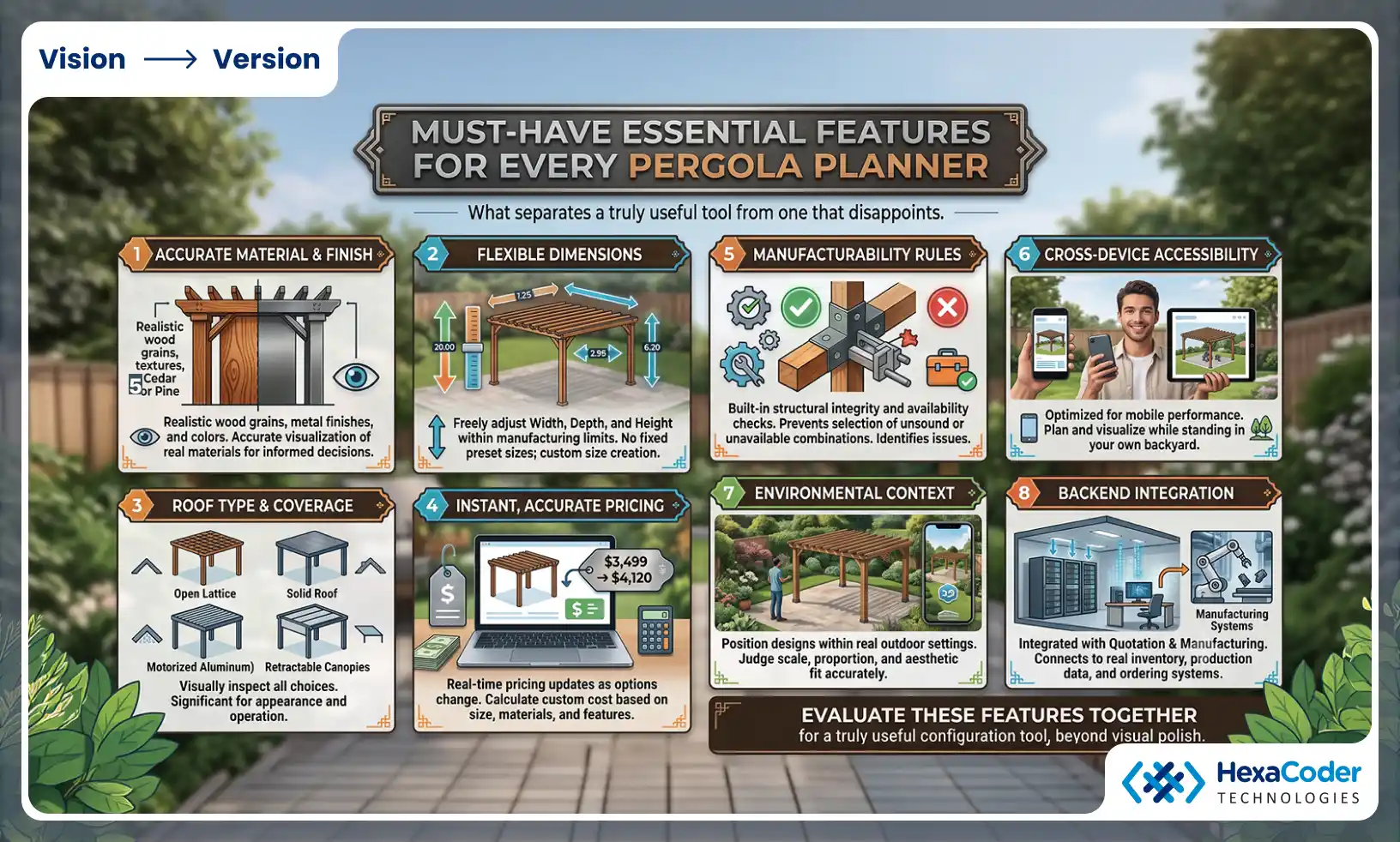
The first requirement is obvious, but also fundamental: customers must see what they're building.
Static product photos show what a pergola looks like in one particular setting. Customers can dynamically explore different options with a modern Pergola Planner.
Users should be able to modify the dimensions, roof style, material, color and accessories and see the result immediately.
This transforms the buying experience from:
Which of the pergolas do you prefer?
to:
What do you want to build?
A well designed configurator can be more than a visualization layer. It can connect customers, sales teams and enterprise systems as part of a broader digital product experience.
The technology should also support seamless rotation, zooming, camera controls, and high-quality rendering without overcomplicating the experience.
The aim here isn't to dazzle users with 3D tech. We want to make it easier to decide on products.
Parametric Pergola Configuration
No two pergola and gazebo projects are alike.
Dimensions shift. Roof styles vary. Things change. Consumer tastes evolve.
This means that the modern configurator cannot rely only on fixed 3D models.
A good Pergola Configurator must therefore have rules that define the behavior of products when dimensions or selections are changed.
- The posts can be spaced to fit the dimensions of the project.
- Depending on the size of the structure, roof sections can vary.
- Components may be available depending on the configuration selected.
- Some accessories may only be available when compatible products are chosen.
- Invalid combinations can be avoided automatically.
When evaluating a configurator, manufacturers should consider capabilities like parametric models, configuration rules, dynamic pricing, backend connectivity and multi-device compatibility.
This provides an important control layer for a manufacturer. The customer gets flexibility and the business gets product accuracy.
Customization of Material & Finish
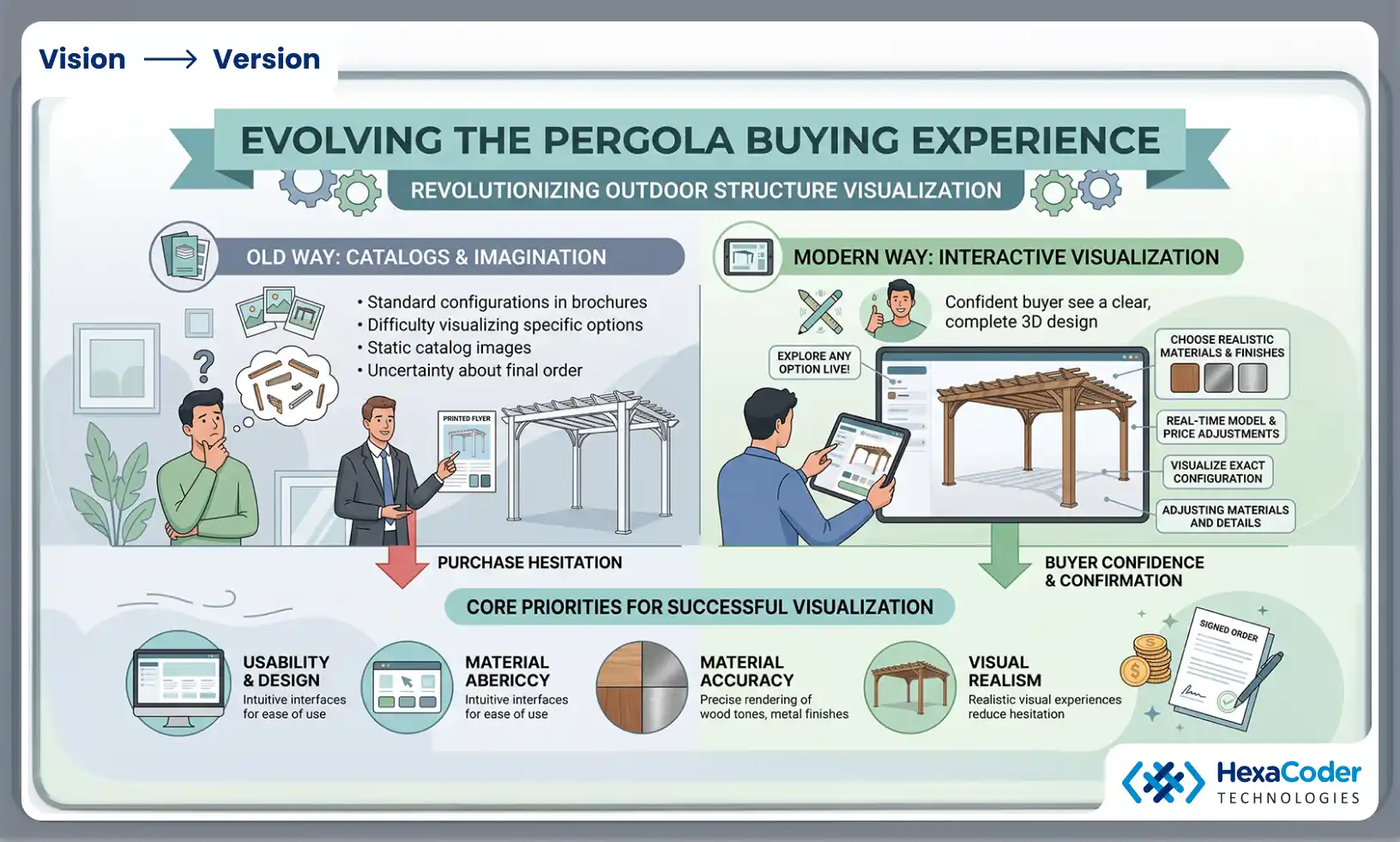
A pergola or gazebo is a very visual buy.
Color, texture, finish, profile, roof style and accessories can make or break a buyer's decision. So a modern configurator should make the Pergola Design customization easy to use.
Customers should be able to play with different material and finish options for Custom Pergolas and instantly see how each option will affect the overall look.
Instead of a static swatch gallery, a real 3D Product Configurator allows customers to apply finishes to their configured structure directly. Manufacturers can avoid showing dozens of swatches individually.
- Post & Beam Material
- Surface Finishings
- Roof and canopy selections
- Hardware and Trim
- Lights & Accessories
This takes away much of the guesswork for buyers. For manufacturers, it's easier to communicate product differentiation whether the structure underneath is built from wood, aluminum, or some other Building Materials category entirely.
Smart Product Rules
A sophisticated configurator should do more than display options. It should know about the relationships between them.
This is one of the biggest differences between a visual tool and a real Pergola Configurator.
Suppose a customer chooses a particular type of roof. The configurator should be aware of which posts, connectors, panels or accessories are compatible with that choice.
In the same way, if a customer chooses a certain structural size, the system can automatically filter out components that are incompatible.
This leads to a guided configuration process. Rather than show every possible combination and leave it to the customer to work out if it will work, the system is able to set rules in the background.
This helps manufacturers avoid configuration errors and prevents sales teams from quoting combinations that can't actually be built, which can turn what should have been a simple order into an expensive, delayed correction once the mistake is caught in production.
This is especially true of structures with wider dimensions or heavier roof options, where a truly incompatible combination is a real structural risk, not just a cosmetic mismatch.
Accurate Quantities & Project Estimation
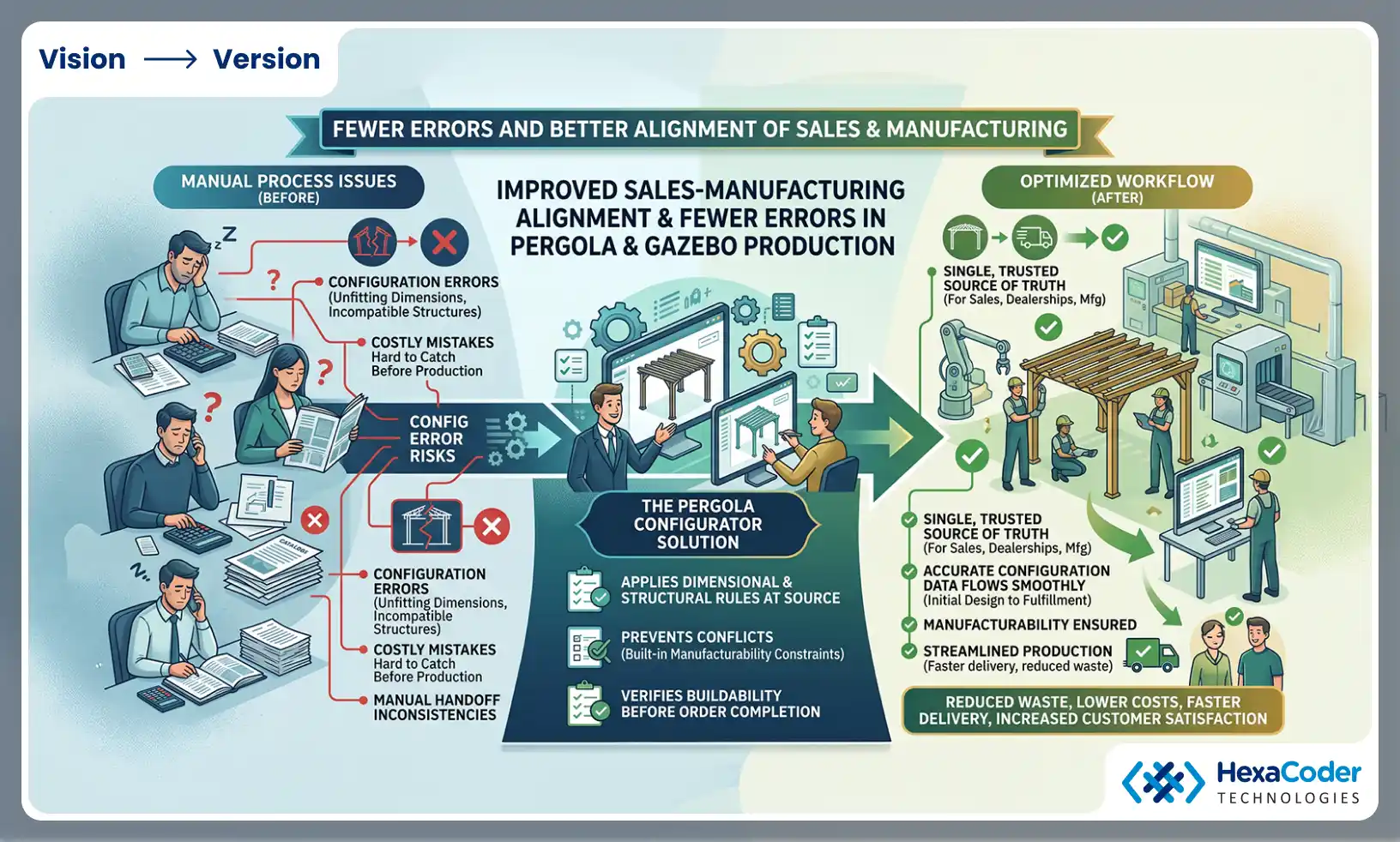
Visualization attracts attention. Adoption becomes a commodity utility.
One of the most valuable capabilities for a pergola manufacturer is to translate a visual concept into useful project information.
A modern configurator should be capable of computing quantities based on the configured project wherever the underlying product rules and dimensions permit.
| Component | Objective |
|---|---|
| Posts | Required posts computation data |
| Rafters and beams | Estimate the building requirements |
| Canopy or roof panels | Calculate required quantity |
| Hardware and connection | Identify configuration requirements |
| Footings and anchors | Include the structural parts |
| Accessories | Choose your extras |
That turns a visual experience into a commercial process.
The link between visualization and commercial workflows is especially important for B2B manufacturers where a configuration could go from customer exploration to quoting, sales and production or fulfillment.
Immersive Design & Context Visualization
A pergola is not an island. It sits in a particular backyard, next to a home, a patio or a pool. Customers have to judge how it will actually look in that setting, not against a plain white background.
The best 3D configurators allow customers to place their configuration into a representative environment, so they can judge scale, proportion and how the structure fits their existing landscaping far more accurately than a standalone product render allows.
This is especially true for metal and glass roof options, where reflectivity and shadow patterns can change dramatically depending on the lighting and surroundings.
Contextual visualization also allows landscape product companies and outdoor living designers to convey a concept to clients better than a catalog photo ever could.
Web Accessibility for Mobile-First
A sophisticated configurator is no good if the customers can't use it.
Today's buyers are moving between devices and buying environments. Someone may see a pergola product on a phone, then return to the website on a laptop, then discuss the design with a contractor on a tablet, all while standing in the very backyard where it will be installed.
So the experience needs to work cross device.
The online 3D pergola configurator should ideally be in-browser, responsive, fast and easy to access without complicated software installation.
Especially distributors, dealers and landscape companies should be able to access and present the configurator independently, without always having to rely on support from the manufacturer.
Connectivity with the Sales and Product Ecosystem
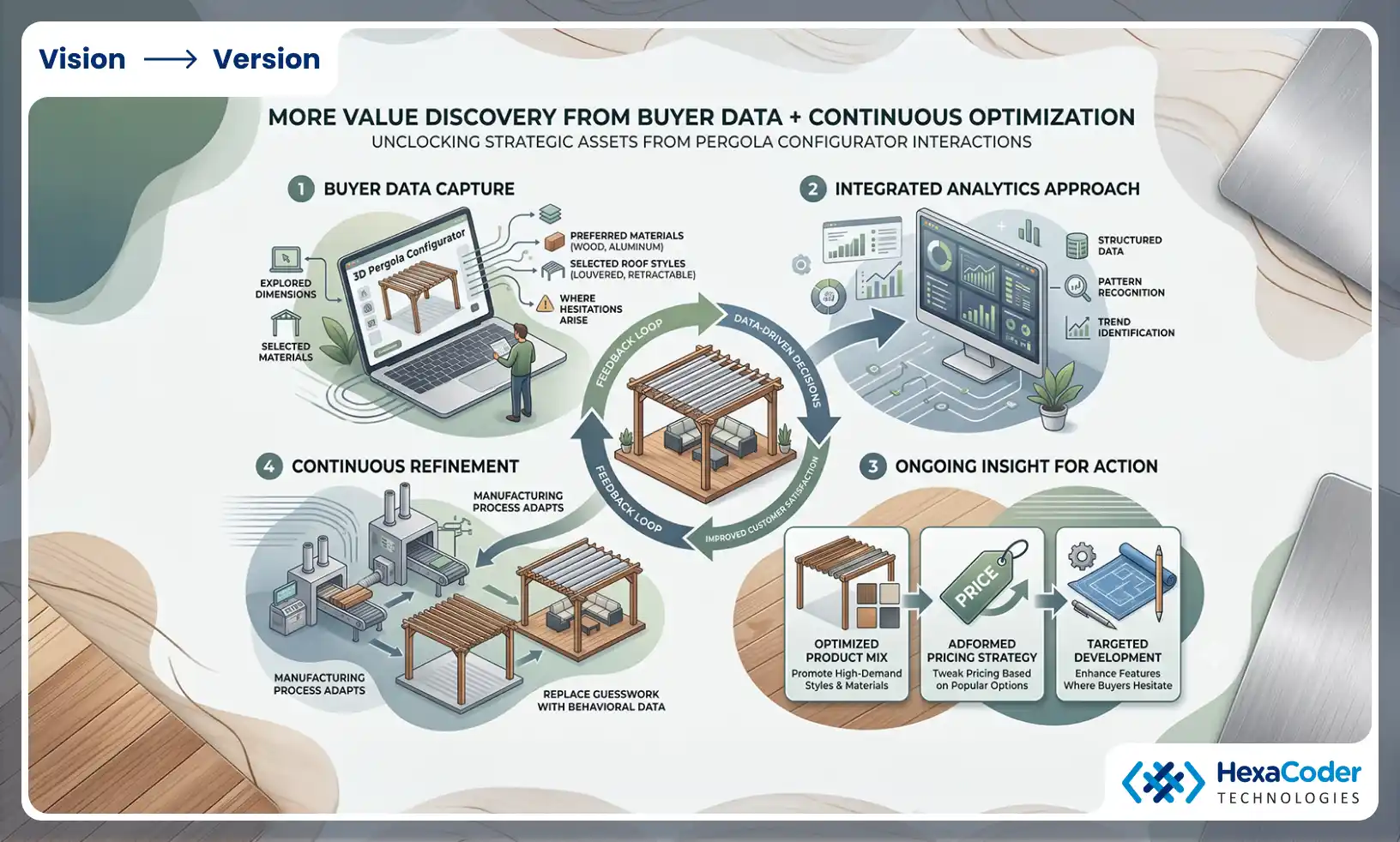
The last one is possibly the most important feature from a CEO's point of view.
A configurator should not turn into another isolated digital tool. It should integrate into the existing business ecosystem.
Modern Pergola Visualization Software can potentially connect the customer experience with systems used by marketing, sales, product management, estimating, CRM, e-commerce and enterprise operations.
What can a pergola configurator connect to?
| Integration | Support |
|---|---|
| Product information | Details of the product |
| Dynamic Price | Price |
| CRM | Lead and customer processes |
| E-commerce | Purchasing online |
| ERP / CPQ (Configure Price Quote) | Business activities |
| Web Analytics | Performance insights |
The integration-first approach is particularly important for B2B manufacturers. A configurator should support the commercial and operational ecosystem, not be another front-end application that is disconnected.
What to Look for in a 3D Configurator for Pergola Manufacturers?
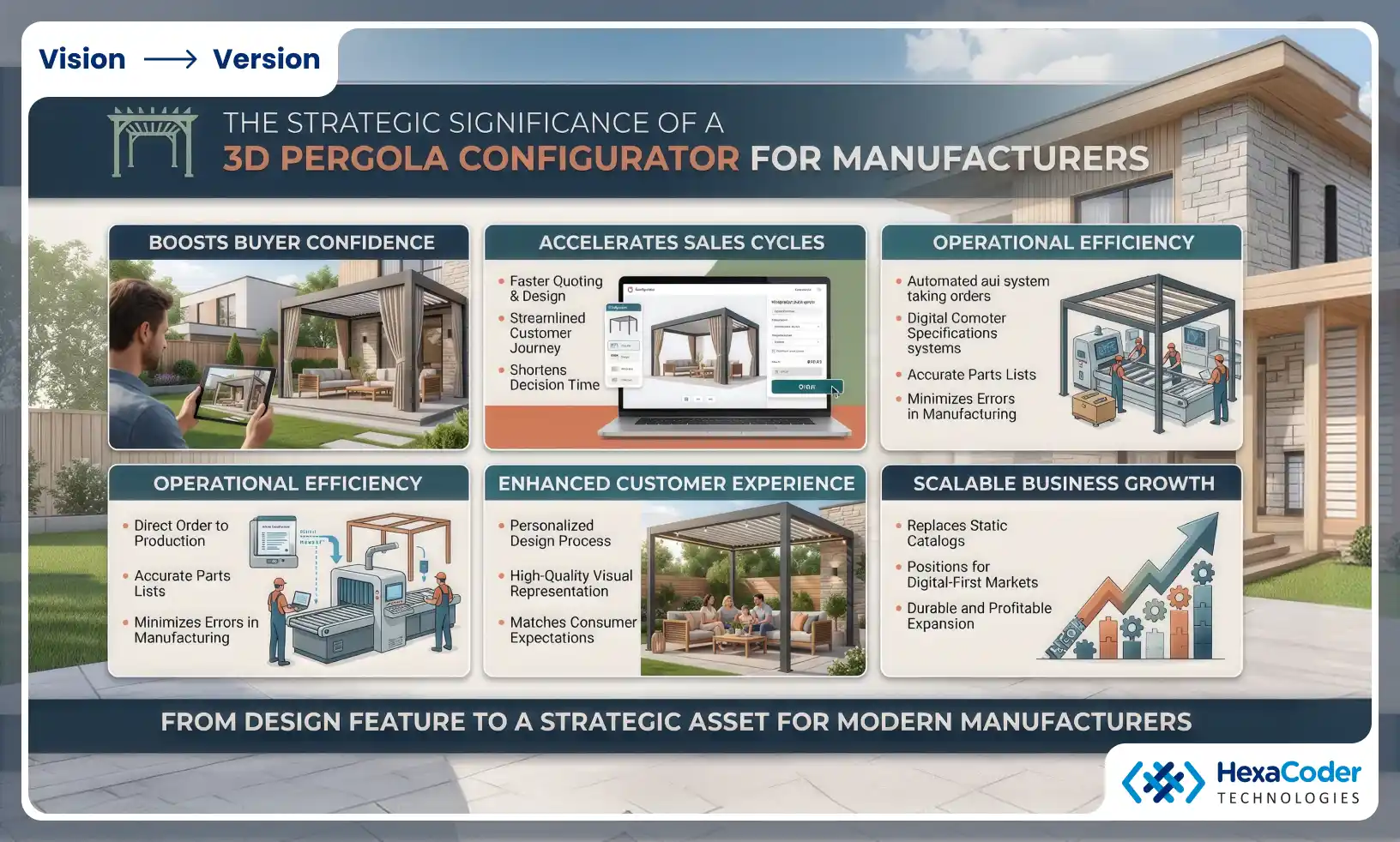
Mostly, the biggest mistake is to judge configurators by their appearance. A good looking interface is great, but not enough.
In evaluating the platform, decision-makers should ask five broader questions:
- Does it really speak to our products? The system needs to handle the sizes, variations, finishes, components and rules that make the manufacturer's product portfolio unique.
- Can the customers set it up by themselves? The interface should be intuitive enough that a buyer can walk into a sales conversation knowing what they want.
- Does it support our sales process? The configuration should include a path for lead capture, quoting, product selection, or other commercial actions.
- Can it scale with our catalog? The platform has to handle new products, finishes, accessories and structural options without a rebuild.
- Will it work dependably on different machines? Manufacturers need to test mobile performance in real-world situations.
Why This Matters for CEOs and Decision Makers
For CEOs considering this type of investment, the pitch often focuses on tangible results, not just a vague sense that visualization should look contemporary.
Shorter sales cycles are revenue, directly, because a buyer who can confidently explore a pergola configuration moves toward a decision faster than a buyer who has to rely on imagination and a brochure photo, especially during peak outdoor living season.
Fewer returns and disputes protect margin because a buyer who has already seen an accurate representation of their exact configuration is far less likely to be disappointed once it is installed.
Sales and dealer capacity can increase without a corresponding increase in head count, because distributors and landscape companies can display products on their own without needing constant manufacturer support.
Cleaner interaction data is better for product and pricing decisions, because each configuration session uncovers real buyer preference and gives leadership a clearer picture of demand across the product portfolio.
The Strategic Opportunity Beyond Visualization
The future of configurators isn't just about making products look three-dimensional. It ties together visualization, configuration, product intelligence and commerce.
For pergola manufacturers, the next generation of digital experiences should help customers through the entire journey:
Configure → Validate → Estimate → Share → Request → Buy
A 3D Pergola Configurator for manufacturers can be the digital layer of connection between those stages.
The business case is especially attractive when the configurator is based on the manufacturer's real product architecture and sales process, rather than an off-the-shelf visual gimmick.
That same technology can also support distributors, dealers, contractors and internal sales teams, creating a common digital language around the product portfolio.
Summary
The outdoor structures industry is trending toward a more visual, interactive and digitally assisted buying experience.
Consumers want more than product images. They want to be sure of what they are choosing.
Landscape companies and dealers want tools to have better project discussions.
Manufacturers need scalable ways to display complex product portfolios for both pergolas and gazebos.
And CEOs want digital investments that drive measurable business outcomes.
A modern 3D pergola visualizer can satisfy all three requirements by combining realistic 3D visualization with parametric configuration, material customization, intelligent rules and true commercial integration.