
Introduction
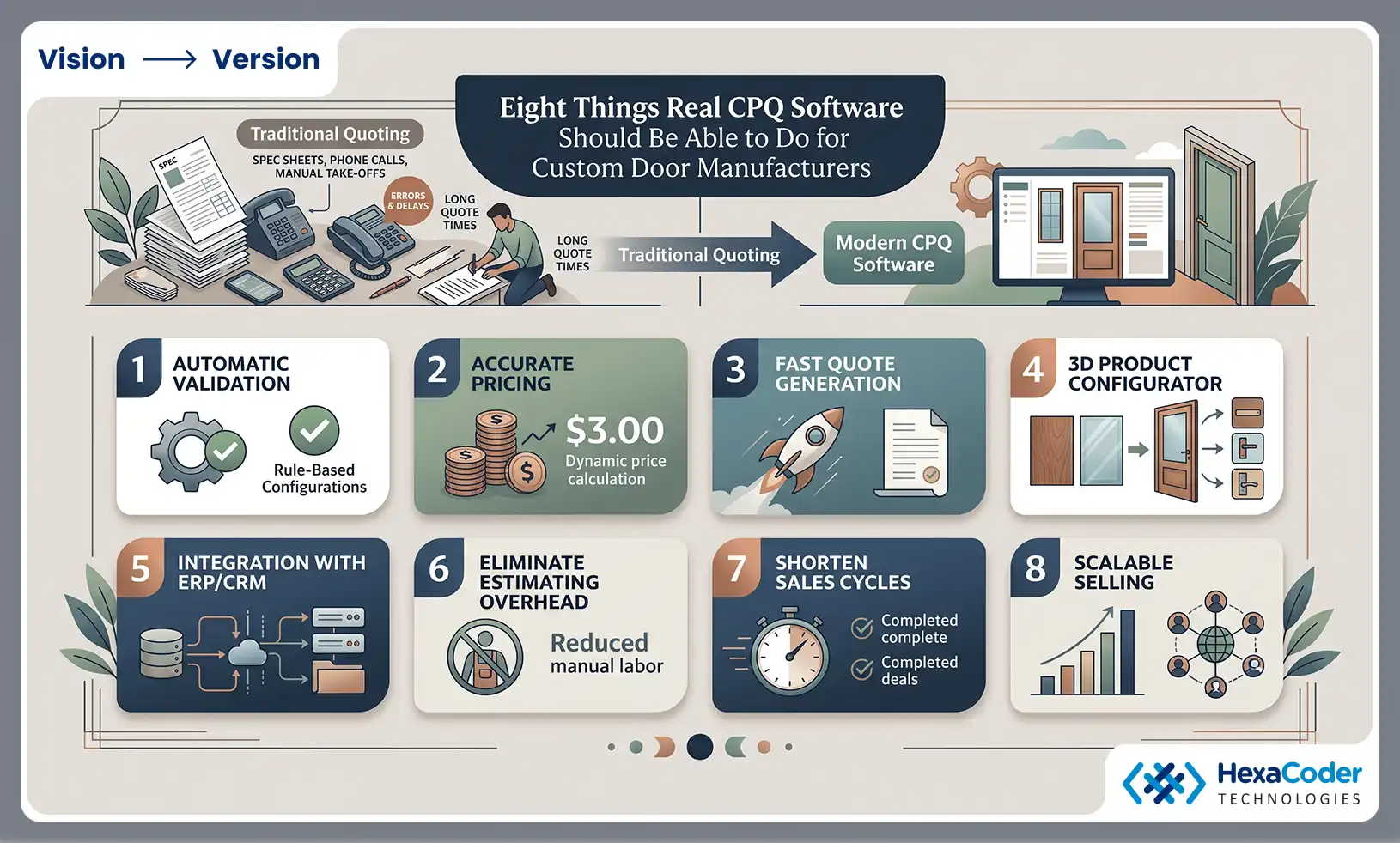
Selling Custom Doors has traditionally relied on spec sheets, phone consultations and manual take-offs.
A buyer has an idea of what they want, panel style, wood species, glass inserts, hardware finish. An estimator reviews specifications. Someone does pricing by hand. Days later you get a quote that sometimes requires a second round of corrections just to be accurate.
That model is getting harder to keep.
Doors have become more configurable, not less. Now, there are dozens of material, dimension and finish variables for custom doors, each impacting the others in ways that are genuinely hard to keep track of manually.
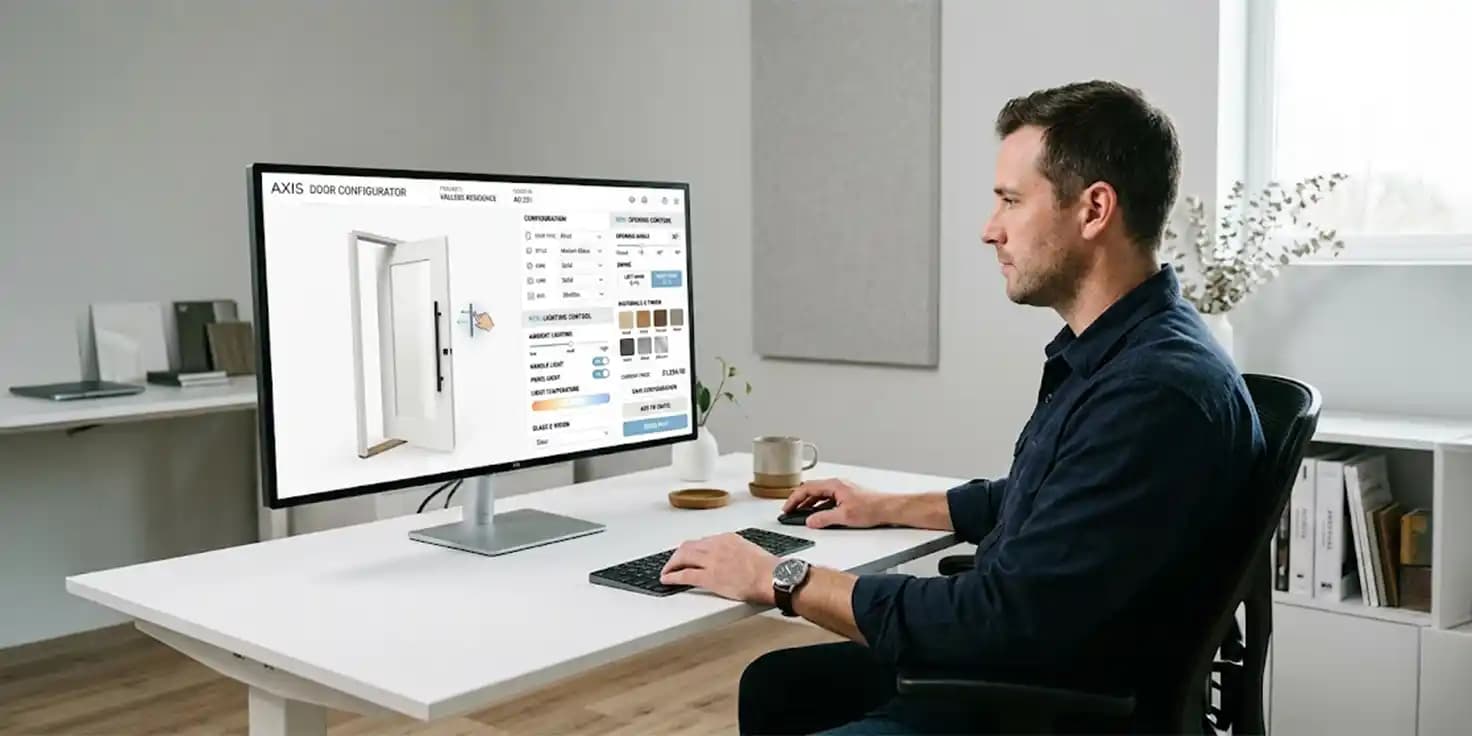
CPQ Software (Configure, Price, Quote) deals with this head on. A connected system will allow the automatic validation, pricing and quoting of a door build rather than routing every configuration through manual review, often in conjunction with a 3D product configurator that allows buyers to see exactly what they are ordering.
The opportunity goes even further for CEOs and business leaders. The right CPQ platform can help reduce estimating overhead, shorten sales cycles, avoid costly configuration errors and create a scalable way to sell increasingly complex Building Materials.
But not all CPQ solutions are created equal.
A simple quoting tool could price it. A modern solution should go much further.
Here’s eight things real CPQ Software should be able to do for custom door manufacturers.
Live Configuration & Instant Quote
The first requirement is basic: buyers and sales teams need a price when a configuration changes.
Quoting manually introduces a delay just when speed is most important. A buyer looking at custom door manufacturers doesn’t usually wait days for a quote and then go to a competitor.
As panel style, wood species, glass and hardware change, quoting software instantly calculates pricing. No extra step to estimate, no waiting on a spreadsheet, no follow-up call just to confirm a number.
This shifts the sales conversation from: “We’ll get back to you on the price.”
To: Build, and we’ll figure out your price.
That alone often decides which manufacturer a buyer looks at first.
Rule-Based Door Configuration
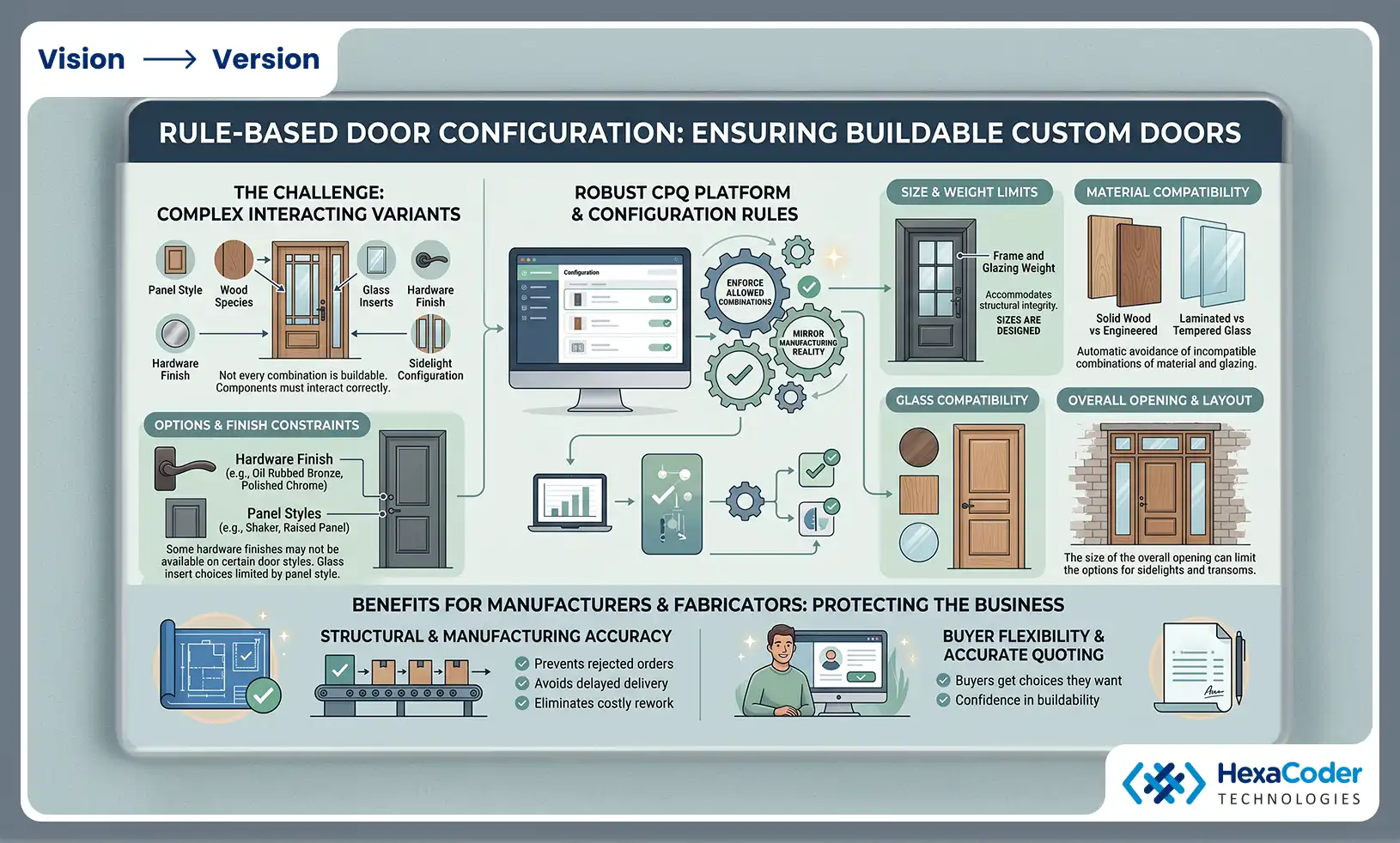
Custom Doors are seldom simple one variant items.
Panel style, wood species, glass inserts, hardware finish and sidelight configuration all interact, and not every combination is actually buildable.
So, a robust CPQ platform needs to enforce Door Configuration rules that specify what combinations are allowed.
For instance:
- Door sizes are designed to accommodate frame and glazing weight.
- Glass insert choices are limited by panel style.
- Some hardware finishes may not be available on certain door styles.
- Automatic avoidance of incompatible combinations of material and glazing.
- The size of the overall opening can limit the options for sidelights and transoms.
Custom door manufacturers and door fabricators need to look past the interface of a platform and ask whether the underlying rules engine truly mirrors manufacturing reality.
This is more important than you might initially think. A configurator that allows an incompatible glazing and panel combination is not only an inconvenience, it can result in a rejected order at the production stage, a delayed delivery, or a costly rework once fabrication has already begun.
This is an important layer of protection for a manufacturer. Buyers get flexibility and the business keeps structural and manufacturing accuracy.
Rule-Based Pricing at Work
Pricing complexity is one of the biggest reasons custom door quoting remains manual for so long.
The final number depends on wood species, glass upgrades, hardware finishes and dealer agreements. All of this should be handled automatically by a modern CPQ solution, without the need to create a separate spreadsheet or lookup table manually.
The same principle holds across:
- Standard Door & Frame Pricing
- Wood species and finish upgrades
- Add-ons for Glass and Hardware
- Discount tiers for distributors and dealers
- Transoms and side lights
This turns pricing from a manual bottleneck into an automated, consistent part of every quote, no matter who is working on it.
3D Product Configurator Integration & Custom Door Visualization
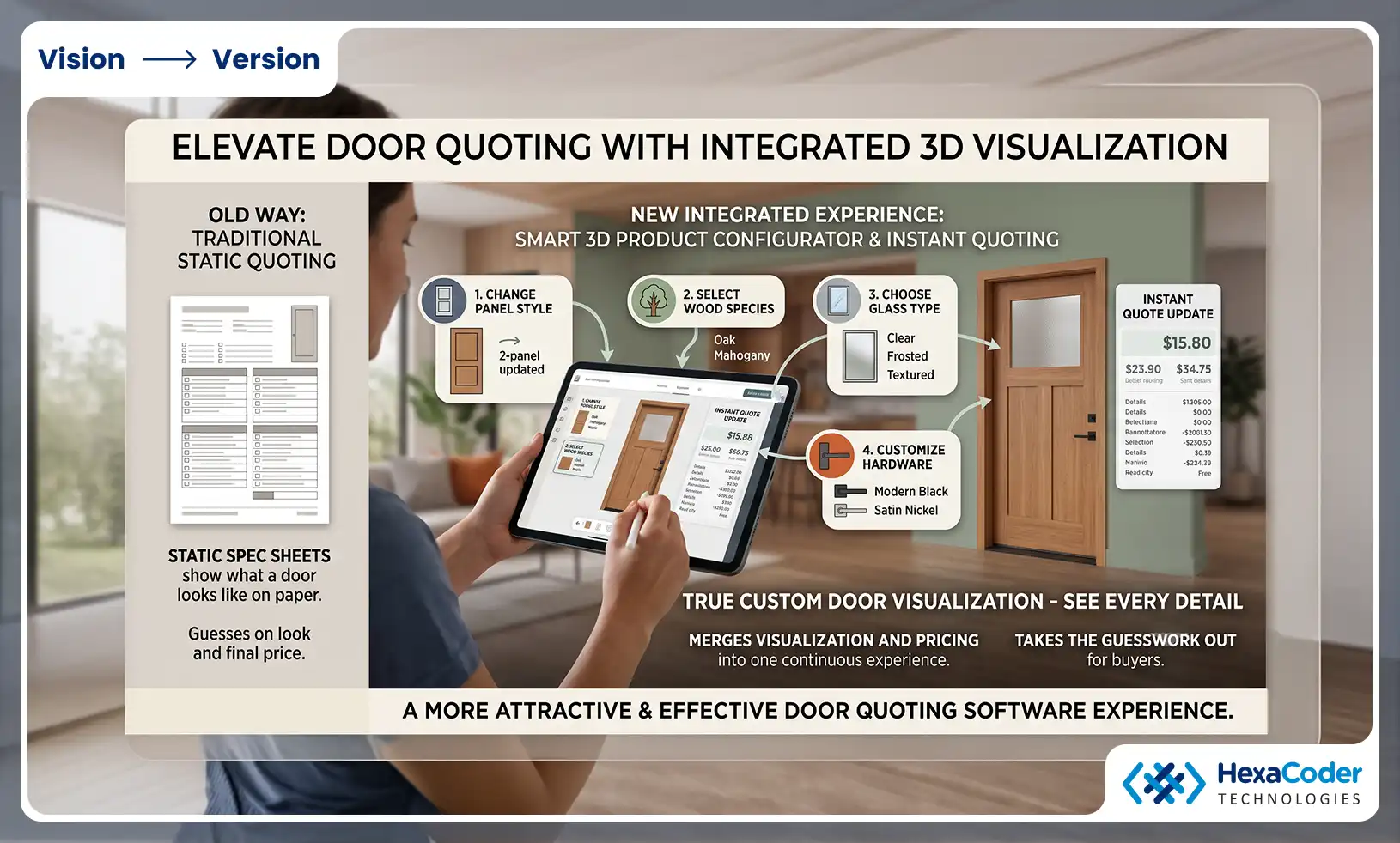
The visual configuration makes Door Quoting Software much more attractive.
Static spec sheets show what a door looks like on paper. Buyers can view it via a connected 3d product configurator.
Buyers should be able to change the panel style, wood species, glass and hardware, and see a true model update in real time, and the quote updates along with it providing true Custom Door Visualization, not just a flat catalog photo.
It merges two things that are traditionally separate, visualization and pricing, into one continuous experience.
The quoting tool is not meant to be impressive.
We are trying to take the guesswork out of what buyers have had to accept for a long time.
Accurate Quantities & Material Estimation
Visualization grabs attention. Adoption achieves operational accuracy.
One of the most valuable capabilities for a custom door manufacturer is to convert a configured door into usable production information.
Modern CPQ platforms should, where underlying product rules allow, determine material quantities directly from the configuration.
| Ingredient | Purpose |
|---|---|
| Door leaves | Calculate needed panels |
| Wood or compo | Estimate material requirements |
| Glass insets | Number required |
| Hardware Kits | Calculate requirements configuration |
| Seals & Weatherstripping | Add final materials |
| Sidelights & Transoms | Choose extras to add |
That turns a sales conversation into a production run.
This link between quoting and estimating is especially useful for manufacturers where a configuration needs to move from sales into production planning without the need for manual re-entry.
Selling With No Mistakes
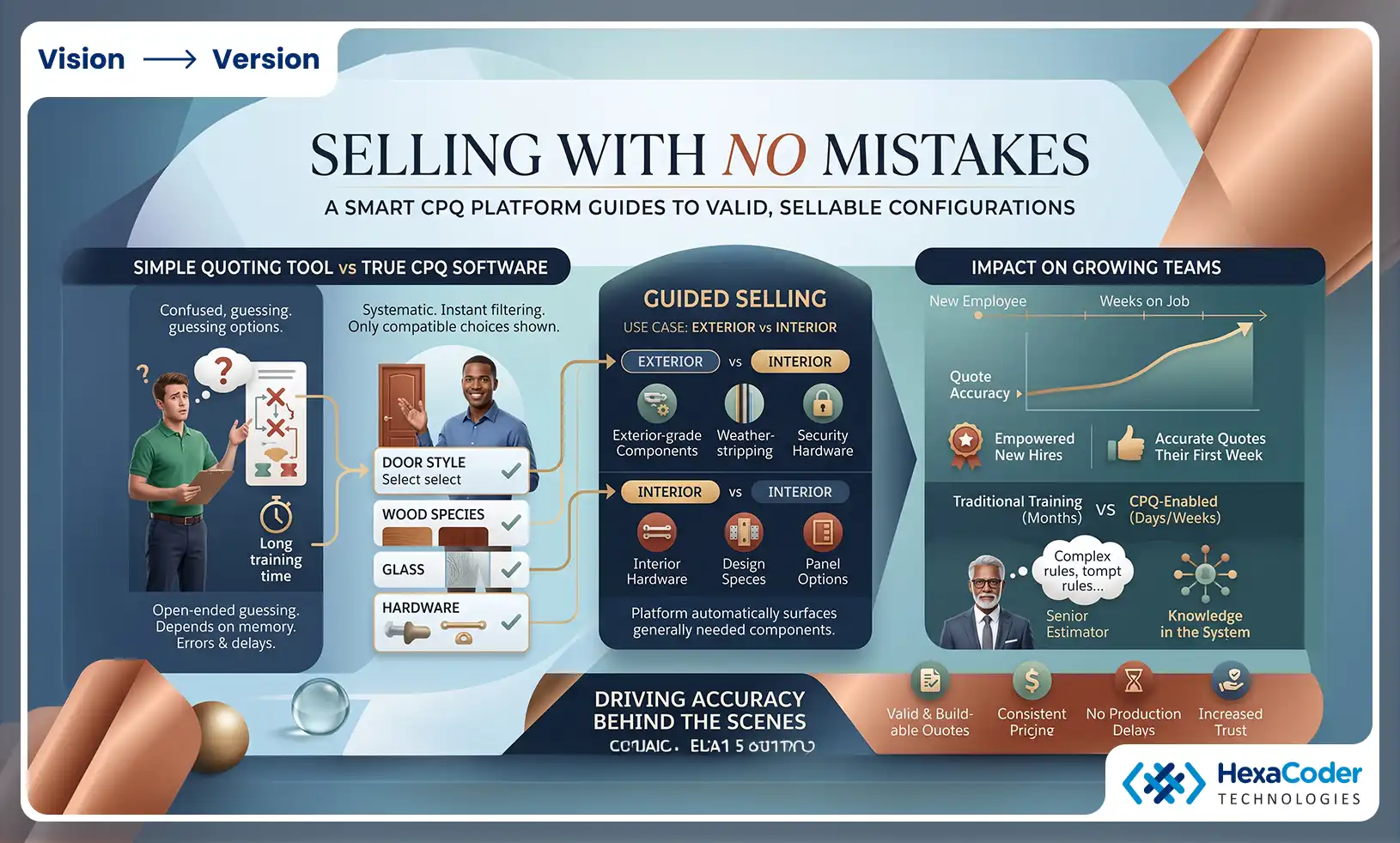
A smart CPQ platform should do more than calculate prices. It should get the person building the quote to a valid, sellable configuration.
That is one of the main differences between a simple quoting tool and a true CPQ Software.
Think of a sales rep selecting a door style. The system should filter wood species, glass and hardware immediately to only what would be compatible.
Similarly, when a buyer chooses a specific use case, such as exterior versus interior, the platform can automatically surface the components that are generally needed.
This allows guided selling as opposed to open-ended guessing.
Instead of depending on a senior estimator’s memory for every odd configuration, the system drives accuracy behind the scenes, for every rep, on every quote.
This is particularly relevant for growing sales teams. New employees can provide accurate quotes their first week on the job, not after months of product training before being trusted with anything more than the simplest configurations.
Multi-Device Access & Web-Based
The value of a CPQ platform depends entirely on how well it can be used by the people who need it.
Buyers, dealers, field sales teams are constantly moving between devices. Someone might view a quote on a laptop in a showroom, refer back to it on a tablet in a client meeting and complete it on a phone from a job site.
That experience has to be able to work everywhere.
Ideally, a modern CPQ platform should be browser-based, responsive, and snappy without complicated software installation on every device that touches it.
Specifically, door dealers and distributors should be evaluated on their ability to access the platform and use it on their own without having the manufacturer holding their hand all the time.
Smooth Integration with Sales and Production Ecosystem
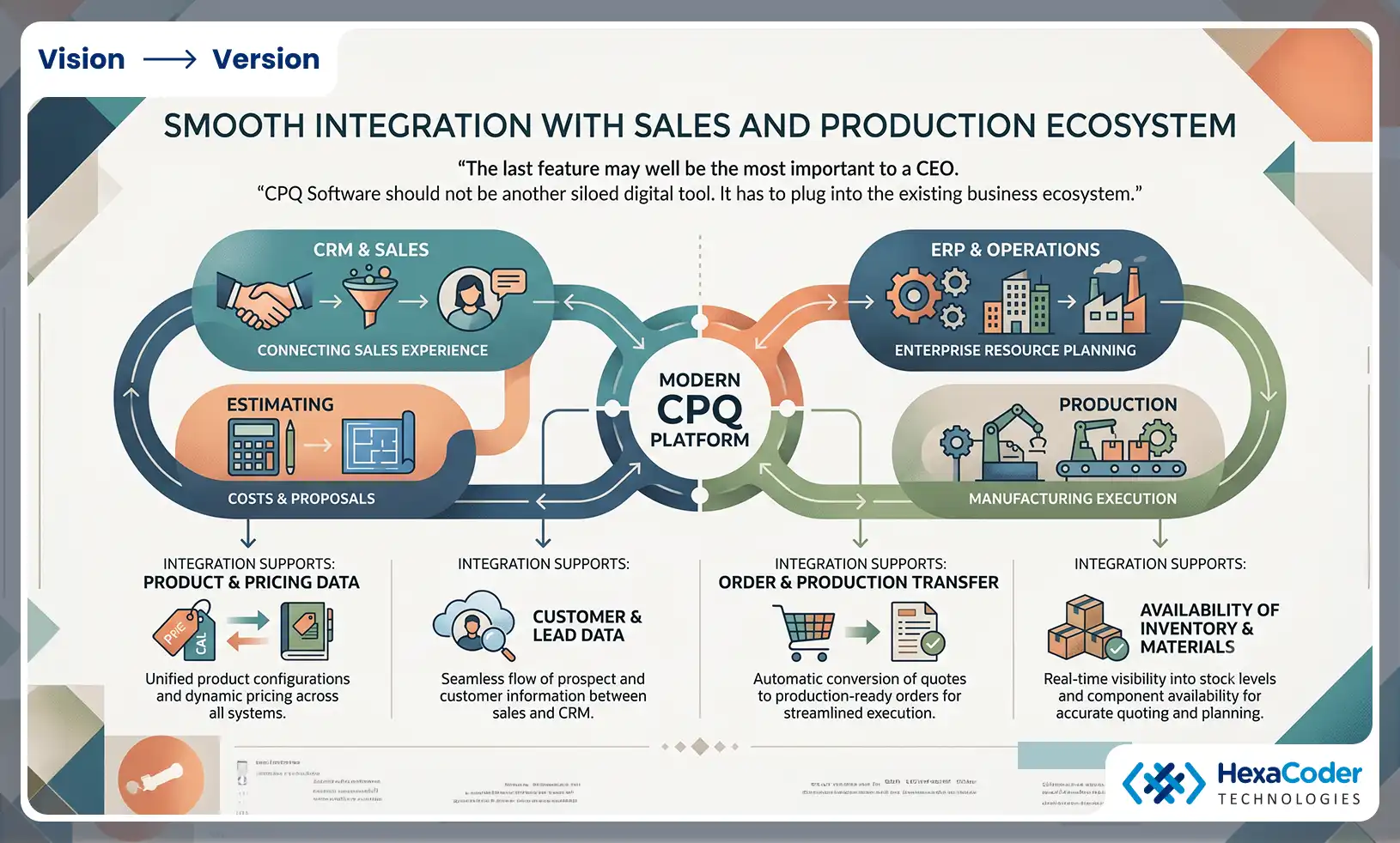
The last feature may well be the most important to a CEO.
CPQ Software should not be another siloed digital tool.
It has to plug into the existing business ecosystem.
Today’s CPQ platforms can potentially connect the sales experience to the systems used by production, estimating, CRM, ERP and enterprise operations.
Integrations could support depending on business needs:
- Product & Pricing Data
- Customer and lead data
- Order and Production Transfer
- Availability of inventory and materials
What can custom door CPQ software integrate with?
| Integration | Supports |
|---|---|
| ERP | Production and inventory information |
| Customer Relationship Management | Lead and customer flows |
| Systems estimate | Material and cost estimates |
| Production Schedule | Handoff Procedure |
| Information Analytics | Performance insights |
That integration-first approach is especially important for custom door manufacturers. A CPQ platform must serve the commercial and operational ecosystem, not be another disconnected front-end app that silently recreates the very fragmentation it was meant to address.
What to Look for in CPQ Software for Custom Door Companies
Do not judge CPQ platforms by how shiny the interface is. That is the worst thing you can do.
A clean quote screen is useful but insufficient.
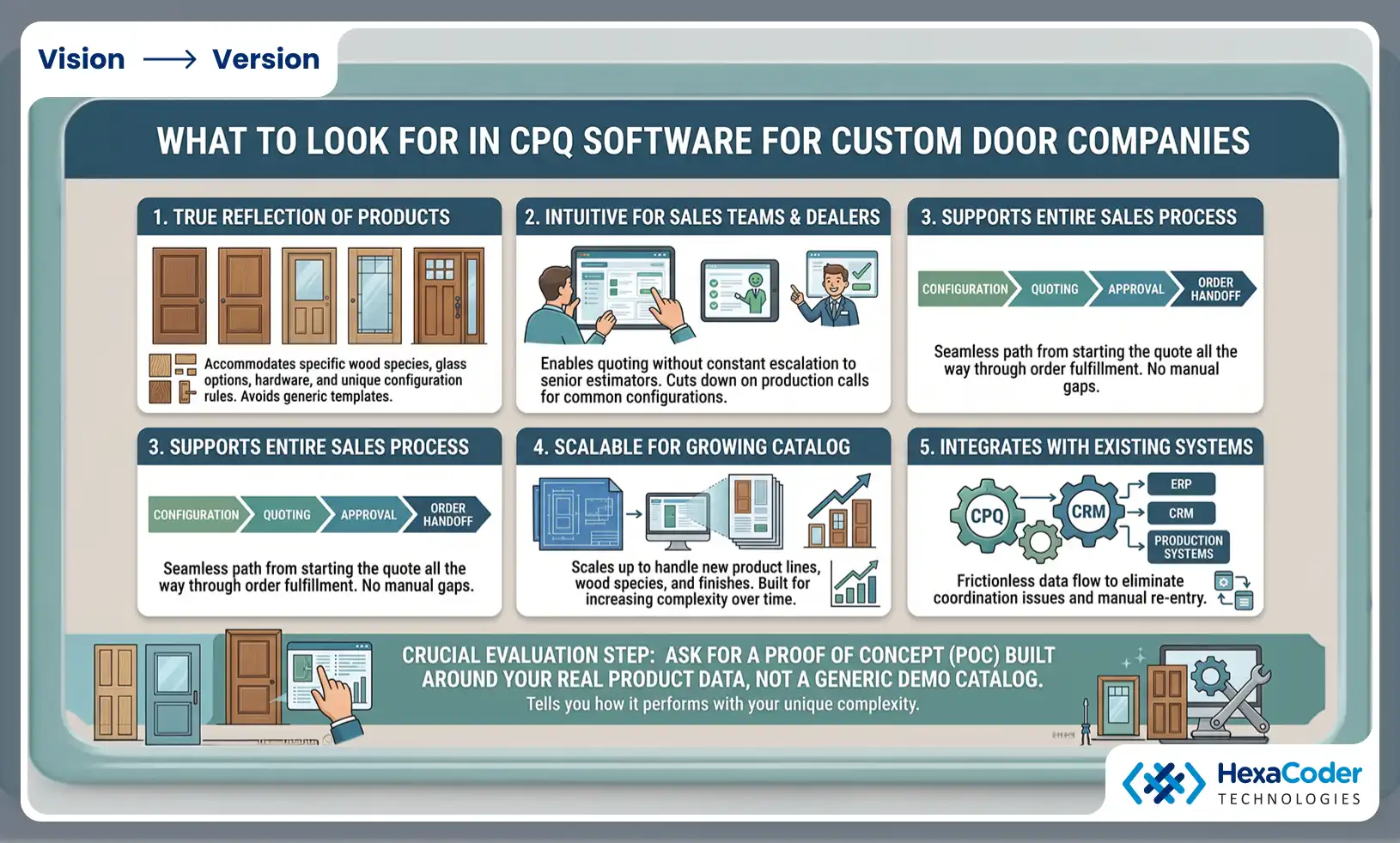
Decision makers should look at the platform on five broader questions:
- Will it be a true reflection of our products? The system has to accommodate the wood species, glass options, hardware and rules that make the manufacturer’s door lines unique — not a generic template stretched to fit.
- Can sales teams and dealers quote without an escalation? The interface should be intuitive enough to eliminate the need to involve senior estimators for common configurations. If you still have to call production for every 3rd quote, the platform isn’t really solving the underlying problem.
- Does it support the entire sales process? Rather than stopping at the quote and leaving everything else to manual coordination, the platform requires a clear path from configuration all the way through quoting, approval and order handoff.
- Can it scale to our catalog? Manufacturers are always adding products, species of wood and finishes. It’s a platform that has to be able to scale up with that complexity, instead of having to be rebuilt every time the catalog grows.”
- Is it able to integrate with what we already run? A CPQ platform that is not integrated with ERP, CRM and production systems creates the same amount of friction as the manual process it was intended to replace, quietly reintroducing the same coordination issues in a new form.
One useful evaluation step is to ask for a proof of concept built around the manufacturer’s own real product data, rather than a generic demo catalog. This tells a lot more about how a platform will actually perform when deployed on a real-world level of complexity.
Why It Matters For CEOs And Decision Makers
For CEOs considering this type of investment, the case is more often made on the basis of specific measurable outcomes rather than on a general feeling that quoting should be modern.
Less time in the sales cycle = More revenue. What used to take days to get a quote now takes minutes, and buyers respond to speed, especially when they are comparing multiple custom door manufacturers for the same project.
Fewer mistakes protect margin. Every time an order is misconfigured, whether it means scrapping materials, rejecting a quote or a costly rework once production has started, profitability is directly eaten into, and this compounds across a year’s order volume.
Sales capacity expands without having to grow headcount proportionally, because reps and dealers can generate accurate quotes themselves, instead of sending every non-standard request to a small team of senior estimators.
And cleaner data means better planning, because every quote generated using a connected CPQ platform reflects real demand patterns, not anecdotal sales reports scattered across individual reps and territories.
There is also a less visible but very important benefit: buyer trust. A buyer who gets a quick, accurate, professional quote makes a different impression of a manufacturer than one who waits days for a number that may still be subject to tweaking.
The Strategic Opportunity Beyond Configure-Price-Quote (CPQ)
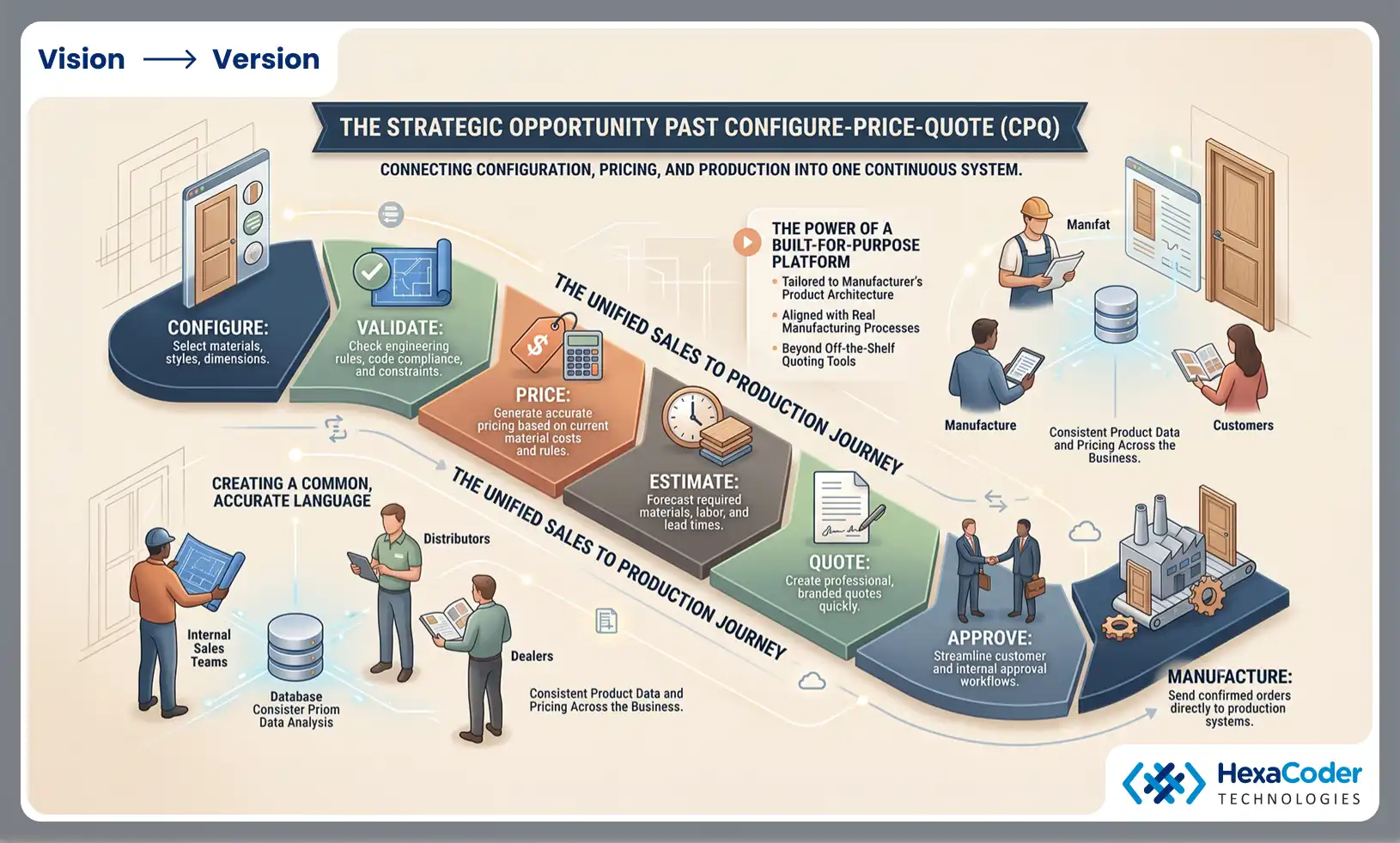
The future of custom door sales technology isn’t just about making quoting faster.
It’s about connecting configuration, pricing and production into one continuous system.”
For custom door manufacturers, that means the next generation of sales tools should support the entire journey:
Configure, Validate, Price, Estimate, Quote, Approve, Manufacture.
Custom Door Manufacturers can use CPQ software as the digital layer connecting those stages.
The business case is particularly strong when the platform is built around a manufacturer's actual product architecture and manufacturing process, rather than an off-the-shelf quoting tool.
The same technology can also help distributors, dealers and internal sales teams, creating a common, accurate language around pricing and product configuration across the whole business.
Conclusion
The custom door manufacturing industry is evolving to a faster, more accurate and more connected sales process.
Buyers want quotes they can trust today, not in a couple of days.
Sales teams and dealers need tools that enable them to quote with confidence without having to escalate every configuration question.
Manufacturers want a scalable way to sell more and more complex Doors and Building Materials, without needing to hire more estimators for every new product line.
And CEOs want technology investments that deliver measurable business outcomes, not just a fancier looking quoting screen.”
Custom Door Visualization & Configuration Software solves all of these needs when it combines real-time configuration, rule-based validation, dynamic pricing and true production integration into a single, connected system – one built around a manufacturer’s actual products, not a generic template stretched to fit.