
Introduction
Spec sheets, phone calls and manual estimating have been the backbone of Prefabricated Buildings sales.
The buyer describes what they want. An estimator verifies specifications. Someone does the pricing manually. A quote follows days later.
That model is getting harder to sustain.
Prefab Construction has become less configurable, not more. These days, metal buildings, modular building systems and structural components have dozens of size, material and finish variables, all interacting with each other in ways that are really hard to track manually.
Every additional option adds to complexity. A single product line with a few spans, materials and finishes can mean thousands of valid combinations, and thousands of invalid ones.
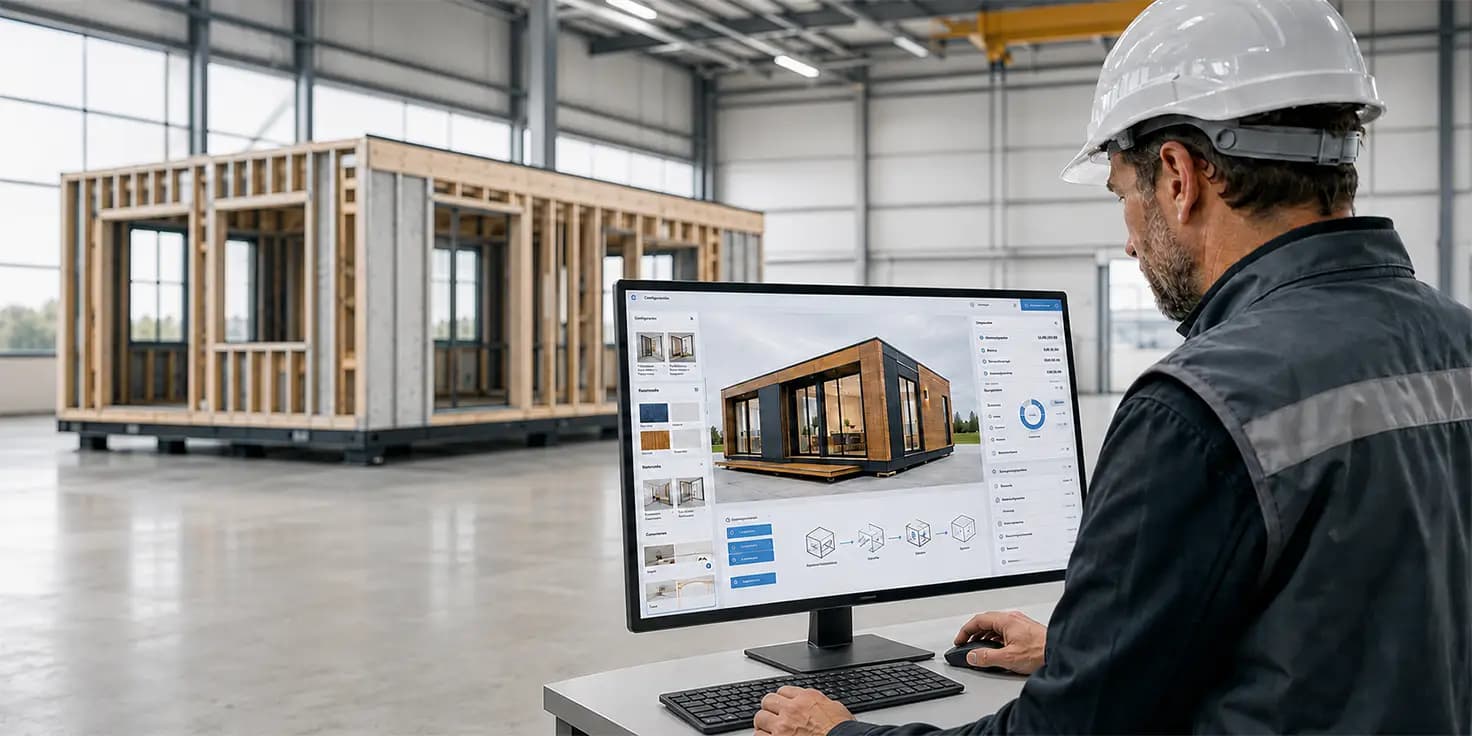
CPQ Software, Configure, Price, Quote, takes care of this. Instead of sending every configuration to a manual review, a connected system automatically validates, prices and quotes a build, often with a 3D product configurator, that allows buyers to see exactly what they’re ordering.
The opportunity is even bigger for CEOs and business leaders. The right CPQ platform will shorten sales cycles, reduce estimating overhead, eliminate costly configuration errors and provide a scalable way to sell ever more complex Construction Materials.
But not all CPQ solutions deliver equal value.
A simple quoting tool could give you a price. A modern solution should go a lot further.
Here are 8 features to look for in real CPQ Software that every prefab manufacturer should have.
Instant Real Time Configuring & Quoting
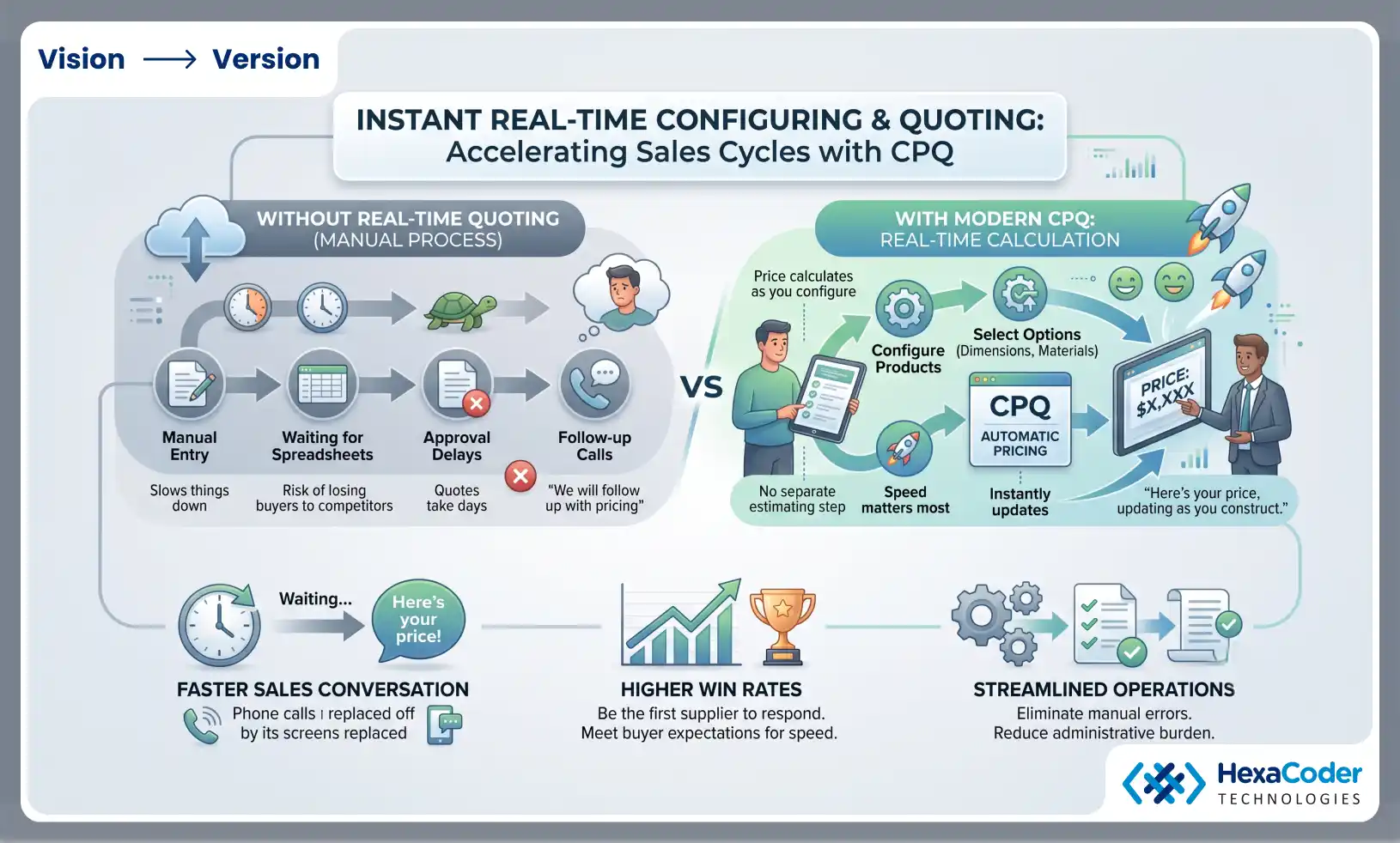
The first requirement is simple: The buyer and the sales team need to have a price as soon as the configuration changes.
Manual quoting slows things down exactly where speed matters most. When a buyer is comparing suppliers, they rarely wait several days for a quote before moving on to a competitor.
A modern CPQ platform calculates pricing in real-time as dimensions, materials and options are modified. There is no separate estimating step, no waiting on a spreadsheet, no follow up call to confirm a number.
This shifts the sales conversation from:
“We will follow up with pricing.”
to:
“Here’s your price, updating as you construct.”
That change alone will often determine which supplier a buyer will visit first.
Parametric Product Rules & Manufacturability Validation
Prefabricated buildings are seldom simple products of single variants.
Span width, bay spacing, roof pitch, structural grade and finish all interact and not every combination is actually buildable.
Hence, a good CPQ platform should have rules that define what combinations are valid.
For example:
- Span limits can vary based on the structural grade.
- Bay spacing may be limited by roof pitch and load requirements.
- Some finishes may not be available in all size ranges.
- Door and window openings may be limited due to structural bay layout.
When assessing a platform, Prefabricated Building Manufacturers should dig deeper than the interface and ask themselves if the underlying rules engine really reflects engineering reality.
That’s more important than it might seem at first. Not only does it cause an inconvenience to allow a structurally invalid combination in a configurator, but it can also lead to a rejected quote at the production stage, a delayed order or, in the worst case, a structure that has to be reworked after the fabrication process has already started.
This gives the manufacturer an important layer of protection. Buyers have flexibility and business has structural accuracy and manufacturing accuracy.
Rules-Based Dynamic Pricing
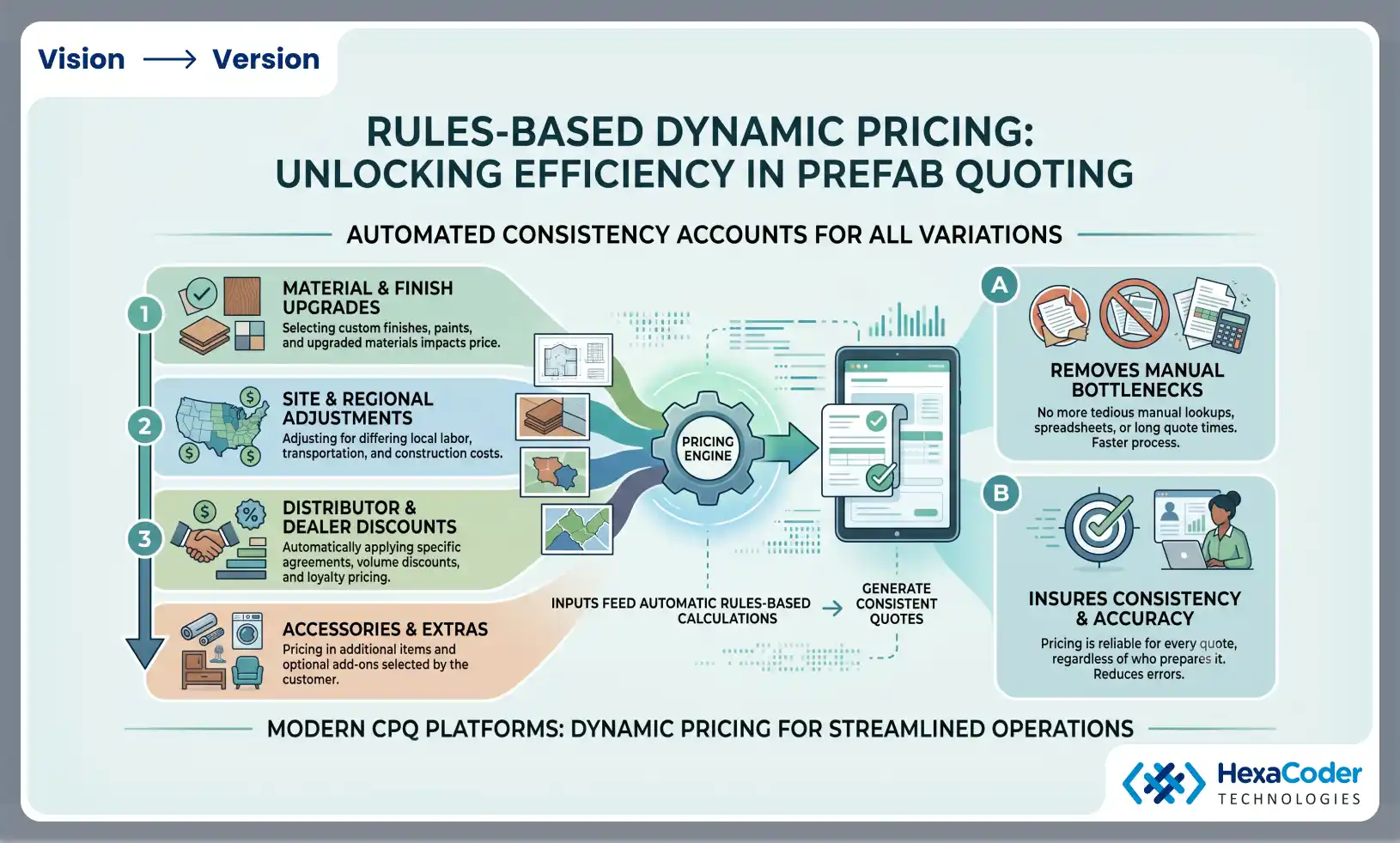
Pricing complexity is one of the main reasons why the quoted pricing for prefab remains manual for so long.
Material costs, regional variation, volume discounts and dealer specific agreements all impact the final number. A modern CPQ platform should be able to calculate all of this automatically, without the need for a separate spreadsheet or manual lookup table.
- Base construction prices
- Material and finish enhancements
- Site or regional cost adjustments
- Distributor & dealer discount levels
- Accessories & extras
This makes pricing an automated, consistent part of every quote, not a manual bottleneck, no matter who is estimating.
3D Product Configurator Integration
You can make the quoting software more persuasive by configuring the visuals.
Static spec sheets show what a structure is on paper. Customers can see it in a connected 3D product configurator.
Buyers should be able to change span, roof line, siding and finish, and watch an accurate structure update in real time, with the quote updating right along with it.
This combines in one continuous experience two things which are normally handled separately: visualization and pricing.
The purpose isn’t to make the quoting tool look good.
The idea is to take out the guesswork that buyers have had to live with in the past.
Correct Calculation of Material and Quantity
Visualization has attention. Acceptance brings operational accuracy.
One of the most valuable capabilities for a prefab manufacturer is the ability to translate a configured structure into usable production information.
A modern CPQ platform should be able to derive the required material quantities from the configuration, if the relevant product rules allow it.
| Component | Purpose |
|---|---|
| Structural steel or framing | Quantity calculation required |
| Cladding and panels | Forecast materials requirements |
| Joining and fastening elements | Determine the count needed |
| Openings, windows and doors | Define configuration needs |
| Roofing elements | Final elements |
| Accessories | Add extras |
That turns a sales conversation into a production order.
This is especially valuable in organizations where a configuration is to be transferred from sales to production planning without manual re-entry, creating a link between quoting and estimating.
Guided, Error-Free Sales
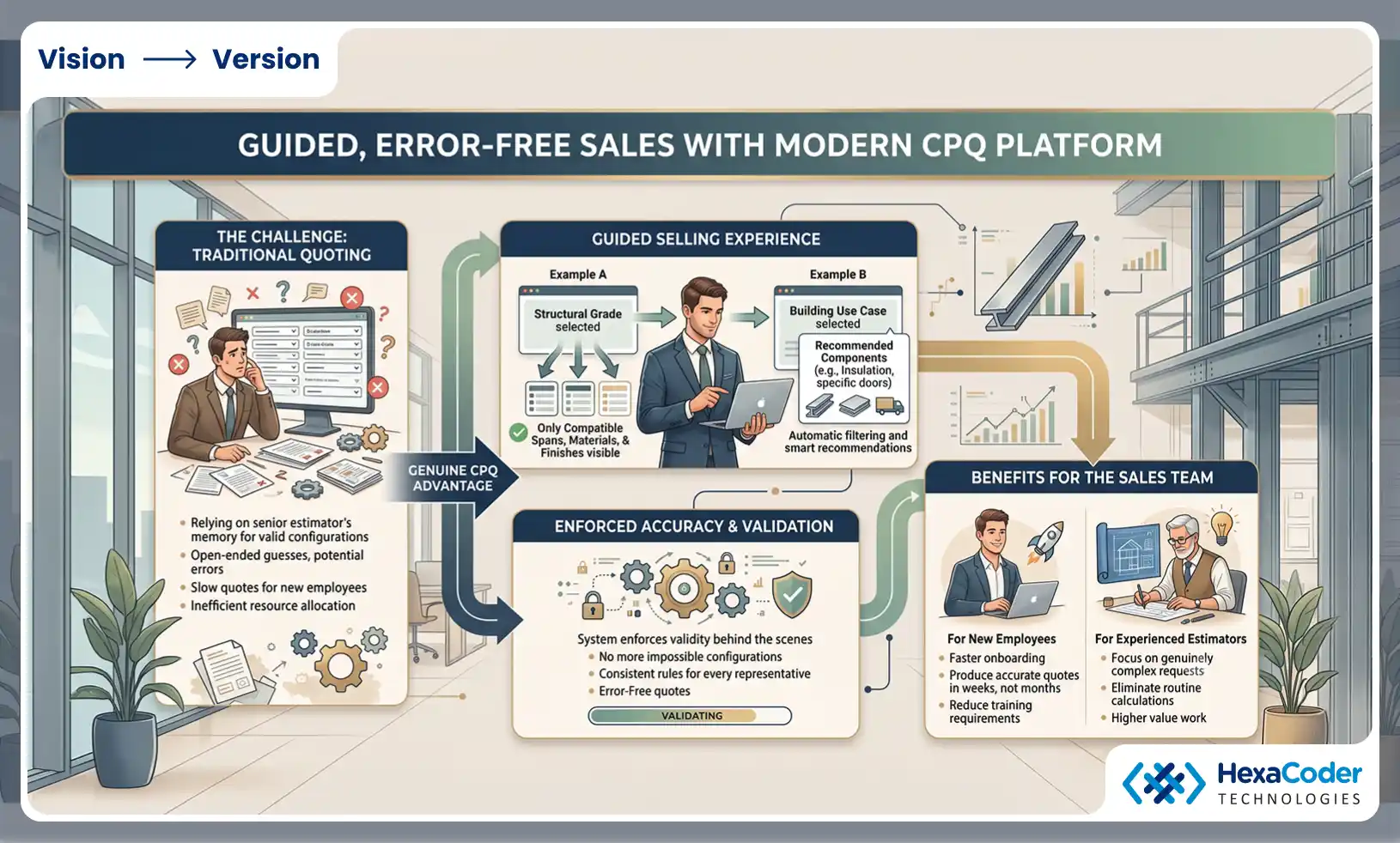
A good CPQ platform is more than just setting a price. It should guide the person building the quote to a valid, sellable configuration.
This is one of the biggest differences between a basic quoting tool and real CPQ Software.
Let’s say you’re a sales rep, and you have to choose a particular structural grade. The system should automatically filter the available spans, materials and finishes down to just the compatible options.
In the same way, if a buyer chooses a specific building use case, the platform can automatically surface the components that are typically needed for it.
This results in guided selling, rather than open-ended guesswork.
It’s about enforcing accuracy behind the scenes, on every rep, on every quote, rather than relying on a senior estimator’s memory for every unusual configuration.
This is particularly important for growing sales teams. No more new hire product training – accurate quotes from the first week of employment, not months of product training before they’re trusted with anything beyond the simplest of configurations. This means that experienced estimators can focus on the really complex or unusual requests, instead of performing the same routine calculations dozens of times a week.
Access via Web and Multiple Devices
A powerful CPQ platform is only as good as the people who actually use it.
Dealers and field sales teams are always on the go, switching between devices. Someone might see a quote on a laptop in the office, then go back to it on a tablet during a site visit, and finally complete it on a phone from a job site.
And so the experience has to work everywhere.
A modern CPQ platform should ideally be browser-based, responsive and fast, with no complicated software installation on every device that touches it.
In particular, distributors and dealers should be assessed on their ability to access and use the platform independently, without continuous support from the manufacturer.
Integration with Production, ERP and Sales Systems
The last feature is probably the most important for a CEO.
CPQ Software shouldn’t be another siloed digital tool.
It needs to fit within the current business ecosystem.
Modern CPQ platforms can potentially link sales experience with systems used by production, estimating, CRM, ERP and enterprise operations.
Integrations could support, depending on business requirements:
- Product and price information
- Customer and prospect information
- Order and production hand-off
- Availability of inventory and materials
What can prefab CPQ software integrate?
| Integration | Supports |
|---|---|
| ERP Production | Inventory information |
| CRM Lead | Customer workflows |
| Cost calculations | Material calculations for estimating systems |
| Production Scheduling | Order handover |
| Analytics | Performance transparency |
For the makers of prefab, that integration-first approach is even more important. A CPQ platform should support the commercial and operational ecosystem and not be another disconnected front-end application that quietly replicates the very fragmentation it was supposed to solve.
What to Consider in CPQ Software for Prefab Manufacturers?
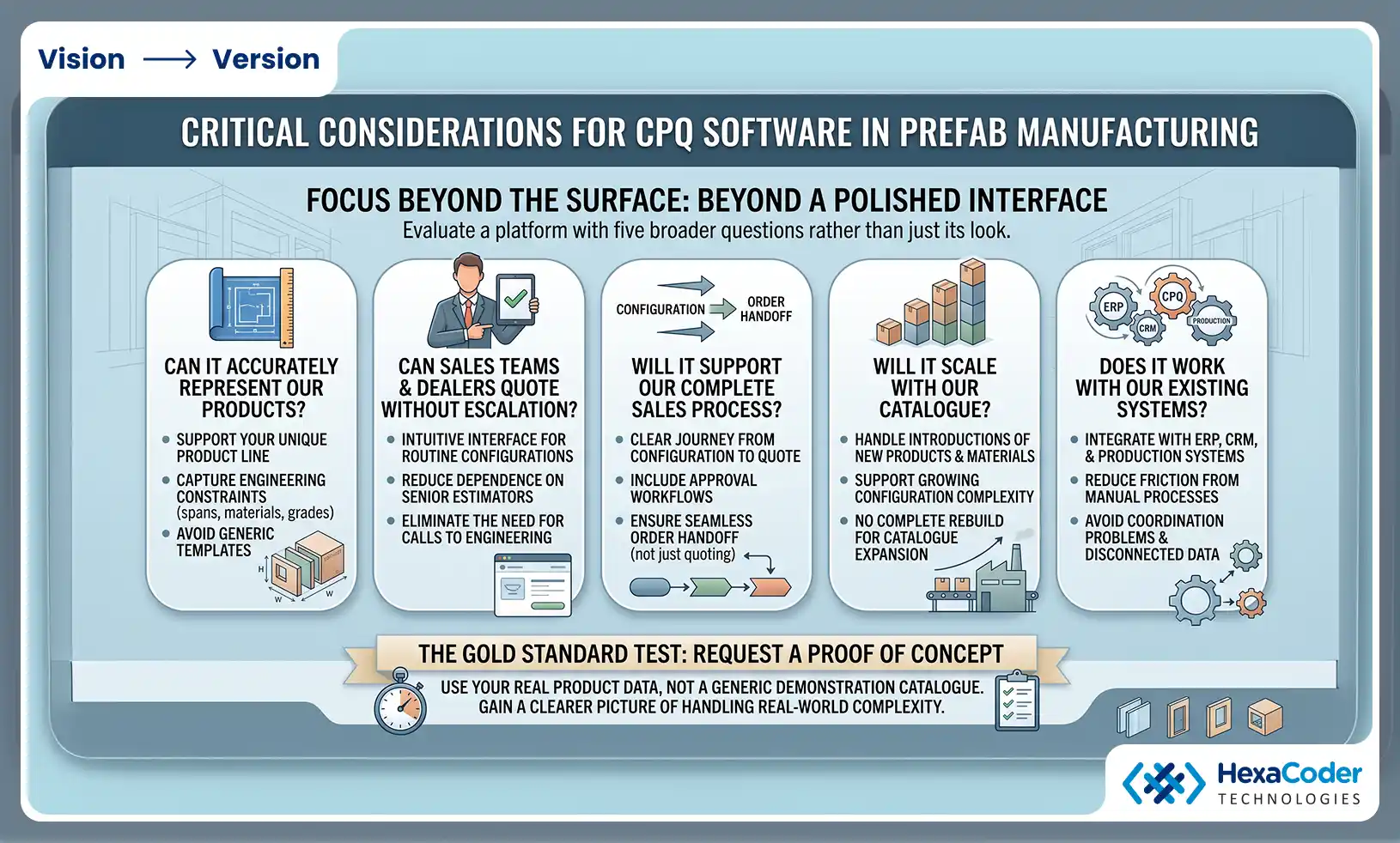
“The biggest mistake is judging CPQ platforms based primarily on the shininess of their interface.
A clean quoting screen helps, but is not enough. Decision makers should assess the platform against five broader questions:
- Can we represent the accuracy of our products? The system should be able to support the manufacturer’s product line with unique spans, materials, structural grades and rules. A generic template rarely captures the specific engineering constraints that differentiate one manufacturer from another.
- Can sales teams and dealers quote without escalation? The interface should be intuitive enough to allow senior estimators to avoid routine setups. If every third quote still requires a call to engineering, the platform hasn’t really solved the root of the problem.
- Will it do our whole sales process? The platform needs to have a clear path from configuration through quoting, approval and order handoff, not stop at the quote and leave everything after that to manual coordination.
- Will it scale for our catalog? Manufacturers add products, materials and configuration options. The platform must grow to that complexity, not require a rebuild each time the catalog grows.
- Does it work with what we already run? A CPQ platform that is not integrated with ERP, CRM and production systems creates just as much friction as the manual process it is meant to replace, quietly bringing back the same coordination issues in a different form.
A good test is to ask for a proof of concept using the manufacturer’s real product data, not some generic demo catalog. This gives us a much better view of how a platform will really work in the real world of complexity.
Why It Matters to CEOs and Decision Makers
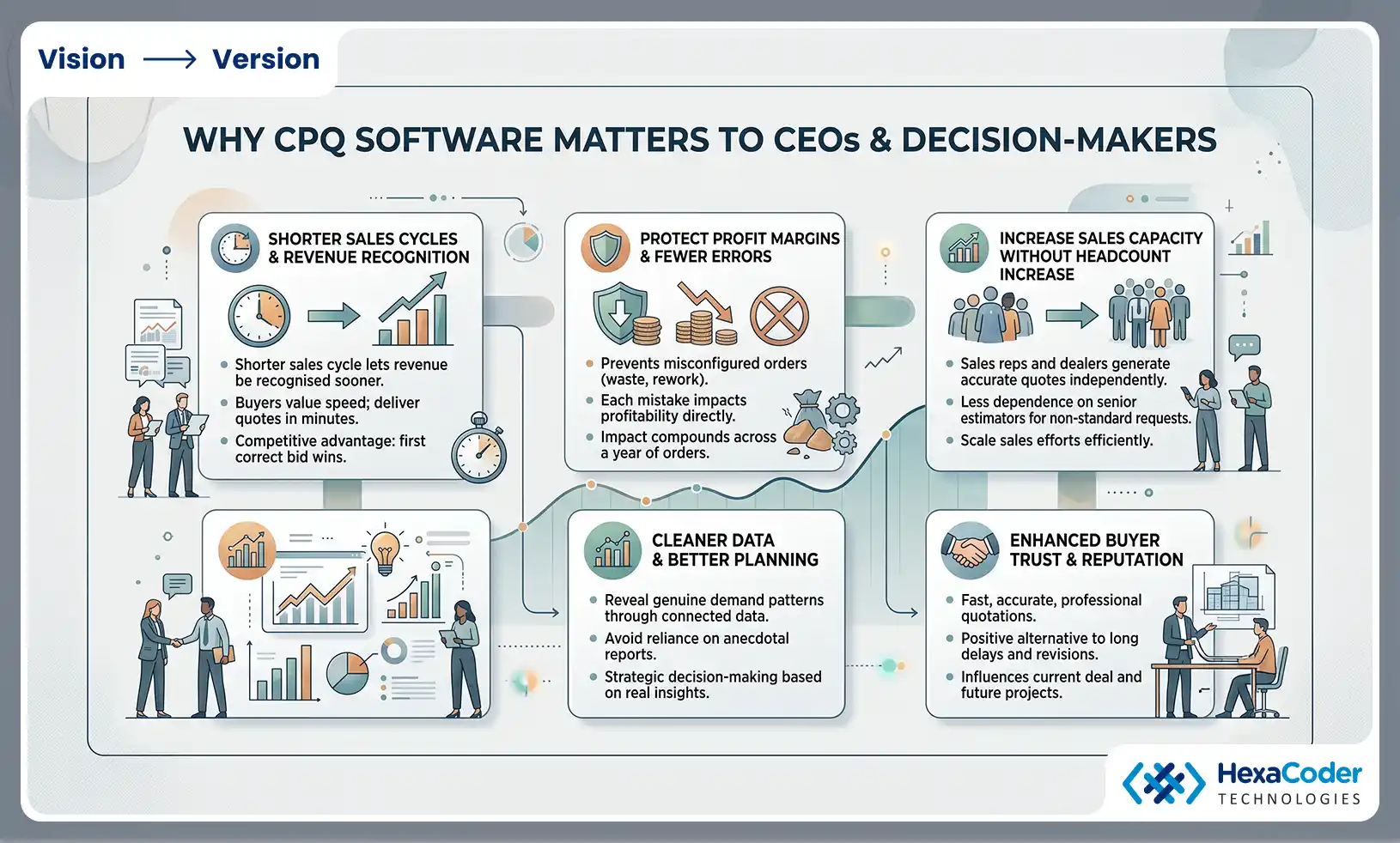
The case for CEOs to look at this kind of investment is usually around a few measurable outcomes, not just a feeling that quoting should be modern.
Shorter sales cycles mean revenue is recognized sooner. Buyers like speed. Getting a quote used to take days; now it takes minutes. In a competitive bidding situation, the first correct bid often wins the deal.
Less mistakes protect margins. Any misconfiguration in an order, even if it leads to scrapped material, a rejected quote or an expensive rework after production has already started, directly eats into profitability that compounds across a year of order volume.
Sales capacity can increase without increasing headcount as reps and dealers can generate accurate quotes on their own, rather than sending every non-standard request back to a small group of senior estimators.
And cleaner data means better planning, as every quote generated through a connected CPQ platform reveals real demand patterns, not anecdotal sales reports from individual reps or territories.
There’s another benefit that’s less obvious but is really important: buyer trust. A fast and accurate professional quote makes a very different impression of a manufacturer to a buyer than having to wait for days to get a number which may need to be revised. That impression will impact not just this deal, but whether that buyer, or the contractor and architect they hire, will come back for the next project.
Strategic Opportunity Beyond CPQ
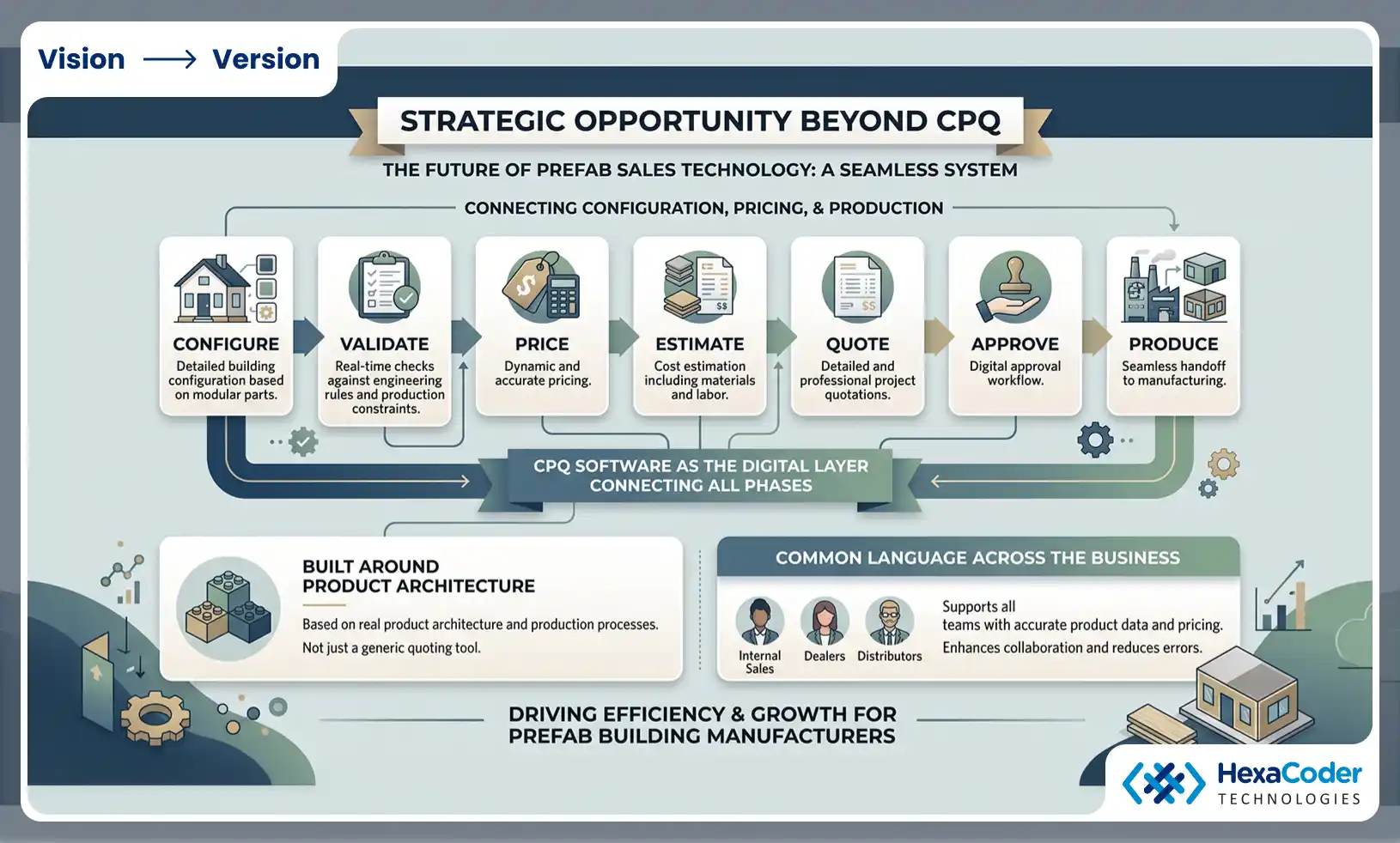
The future of prefab sales tech is more than just faster quoting.
This is about connecting configuration, pricing and production in a seamless system.
For Prefab Building Manufacturers, the next generation of sales tools needs to support the whole journey:
Configure → Validate → Price → Estimate → Quote → Approve → Produce
CPQ Software for Prefabricated Buildings can be the digital layer that connects those phases.
The business case is especially compelling when the platform is built around a manufacturer’s real product architecture and production process versus a generic quoting tool.
The same technology can also support distributors, dealers and internal sales teams, speaking a common, accurate language on pricing and product configuration across the whole business.
Summary
Prefab Construction is moving to a quicker, more precise and more interconnected sales process.
Buyers want reliable quotes immediately, not a few days later.
Sales teams and dealers want tools that give them the confidence to quote without having to escalate every configuration question.
Manufacturers want a scalable way to sell more complex Construction Materials and Building Materials, without needing to hire additional estimators for each new product line.
And CEOs want technology investments that deliver measurable business outcomes, not just a modern looking quoting screen that never quite translates into faster sales cycles.
Prefabricated Building Quoting Software can meet all of these requirements by combining real-time configuration, rule-based validation, dynamic pricing and true production integration within a single interconnected system – a system built on a manufacturer’s actual products rather than a generic template that has to be forced to fit.