
Most vendors use nearly the same language to describe their tools, but not every 3D Product Configurator on the market in 2026 offers the same value. Some platforms really take down sales friction and production errors, while others are little more than a spinning model with a price tag.
For business owners and manufacturers looking at options this year, knowing which features truly matter is the difference between a real investment and an expensive experiment that ends up gathering dust after the initial demo excitement wears off.
In this article, we’ll take you through the best 3D product configurator features in 2026, what separates capable Product Configurator Software from a superficial visual demo, and how a platform like Hexacoder Technologies ties these features together into one connected system rather than a scattered set of tools that only look impressive in a sales pitch.
Top 10 Features to Consider When Choosing a 3D Product Configurator
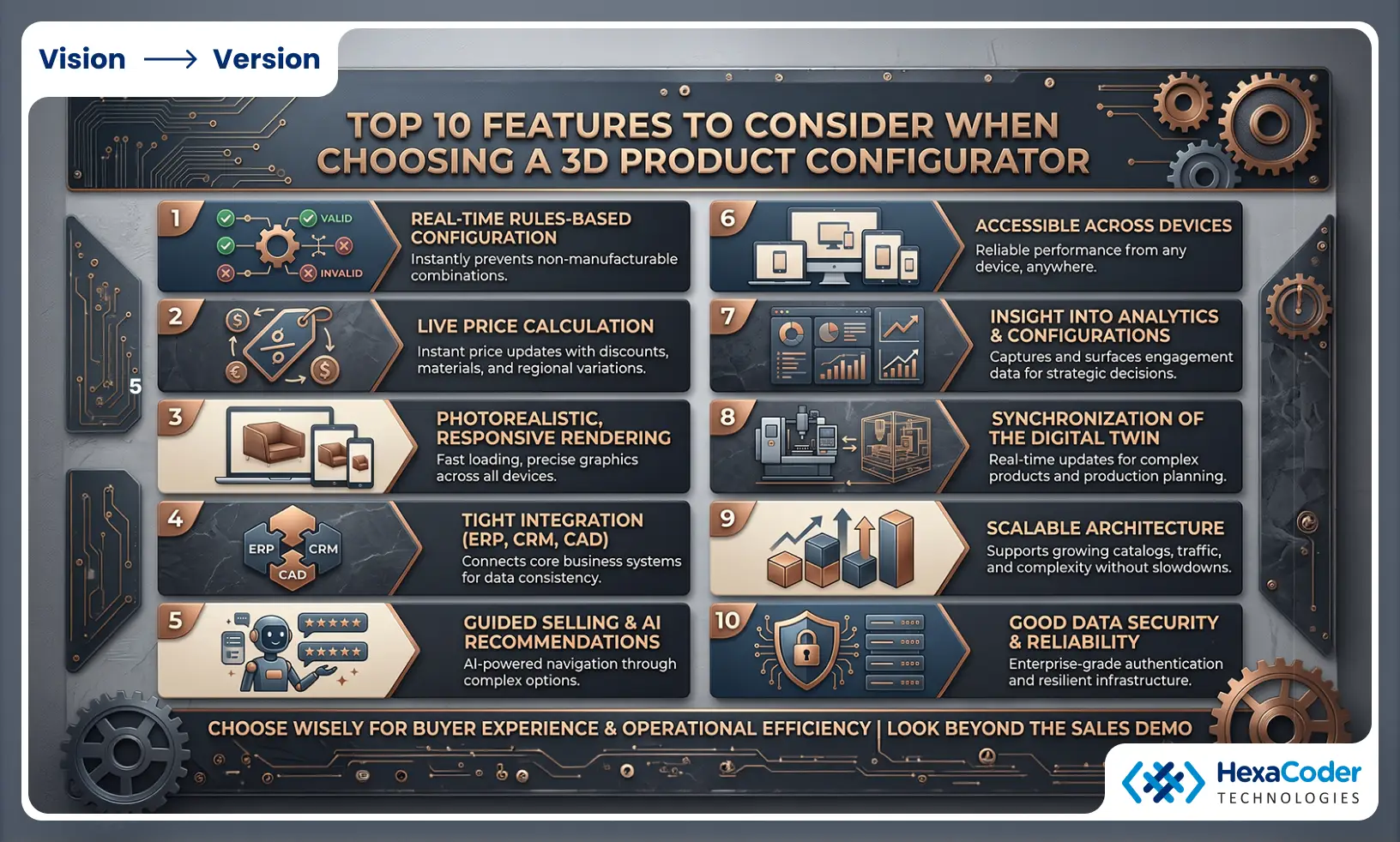
Knowing what to look for makes evaluating a configurator far easier than relying on a slick sales demo that might not show how the platform performs in the real world. So, here are the ten features that continue to separate great platforms from the rest as we head into 2026.
- Real-time rules-based configuration: A buyer should not be able to select components that are not compatible or manufacturable, but the platform should automatically prevent invalid combinations, catching problems before they ever reach a quote.
- Live price calculation: Pricing should update instantly when configuration options are selected, taking into account discounts, materials, and regional variation without requiring a manual recalculation or a lag that kills the buyer’s momentum.
- Photorealistic, responsive rendering: Product Visualization needs to be fast and precise on desktop and mobile, without long loading times or a big reduction in quality on smaller screens, because a slow experience quickly erodes buyer confidence.
- Tight integration of ERP, CRM, and CAD: A configurator that is not tied into core business systems leads to duplicate work and inconsistent data. Real integration is critical, not optional, and should be carefully evaluated during any vendor demo.
- Guided selling and AI-assisted recommendations: Strong Product Configurator Software enables buyers and sales reps to intelligently navigate through complex option sets and find relevant configurations based on buyer behavior rather than forcing the buyer to sort through every option on their own.
- Cross-device accessibility: Buyers and sales teams increasingly expect to be able to configure products from any device at any point in their day. This means a configurator must work reliably on desktop, tablet, and mobile.
- Analytics and configuration insight: The platform should not just be processing transactions in the background. It should be capturing and surfacing data on what configurations, options, and price points buyers are actually engaging with.
- Digital twin synchronization: For complex products, a configurator that updates digital twins in real time as configurations change can provide significant long-term value for manufacturers, especially for production planning.
- Scalable architecture: As a business expands into new markets or product lines, the platform needs to be able to support growing product catalogs, increasing traffic, and expanding option complexity without performance degradation.
- Strong data security and reliability: Enterprise-grade authentication and resilient infrastructure are non-negotiable, especially for manufacturers handling proprietary product specifications, sensitive pricing, and business data.
When all of these ten capabilities are built into one connected system, rather than cobbled together from disparate tools, the platforms consistently deliver the best results for business owners and manufacturers, both in terms of buyer experience and internal operational efficiency.
3D Product Configurator as a Key Sales Competency
With a 3D Product Configurator, buyers can build their exact product visually, changing dimensions, materials, and components within a realistic model that updates visually in real time. That alone changes the way buyers interact with a brand, but the deeper value lies in what happens behind the scenes.
Behind the scenes, running quietly beneath the visual experience are configuration rules, pricing logic, and manufacturability constraints that ensure whatever a buyer builds is valid and buildable. This provides a single source of truth for product configuration and removes the inconsistency that comes with manual quoting or out-of-date option sheets.
Hexacoder Technologies develops 3D Product Configurators that are true sales infrastructure, not siloed visual gimmicks. We link configuration logic to real pricing and production data so that Product Configurator Software is a dependable, scalable business capability.
Revolutionizing the Buyer Experience with Product Visualization
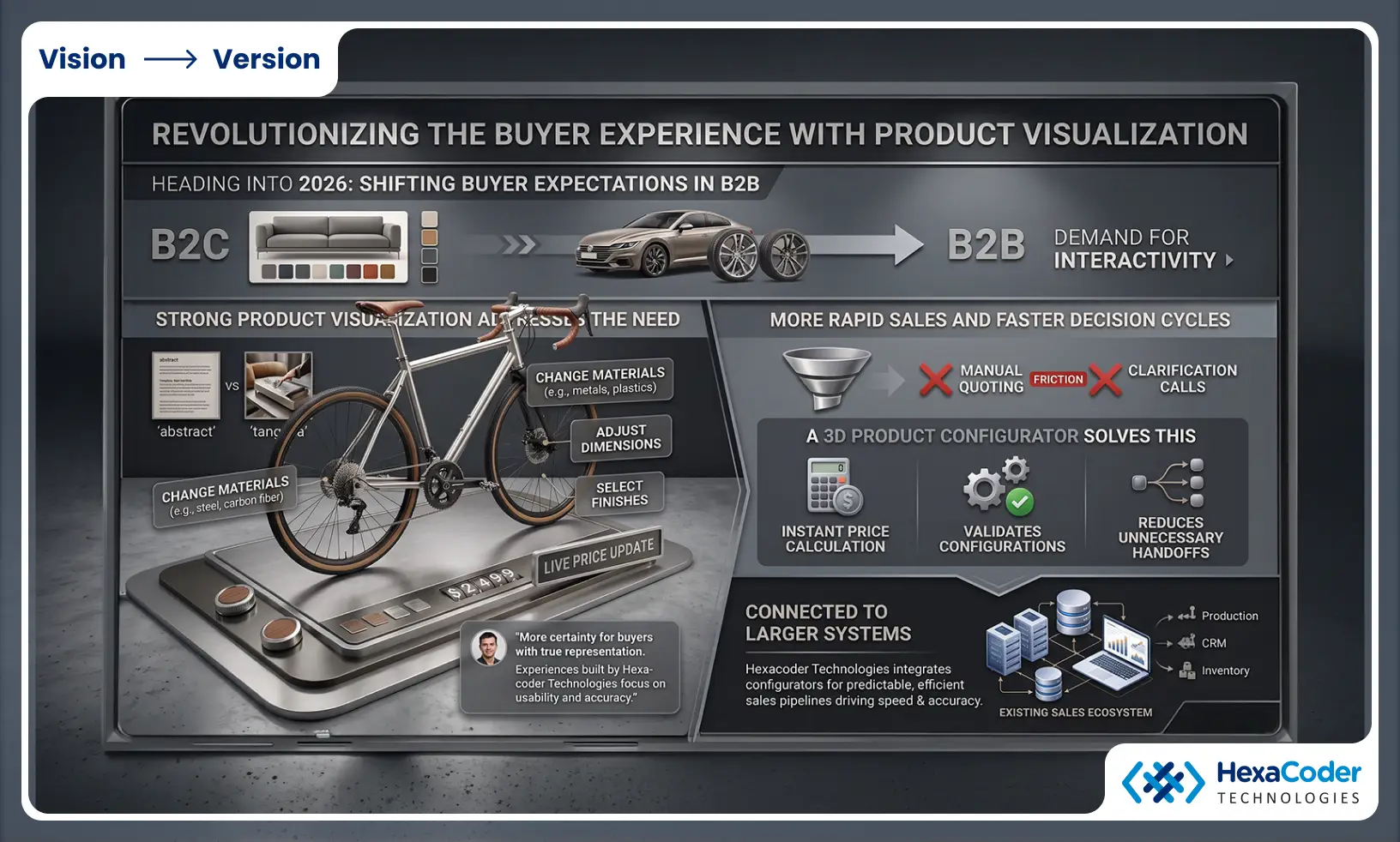
Heading into 2026, buyer expectations for configuration have shifted dramatically. Business buyers today are demanding the same degree of interactivity from industrial and manufactured products as consumers have come to expect from configurable cars and furniture, and they’re bringing those expectations right into B2B purchasing decisions.
Strong Product Visualization addresses that need head-on. Buyers see their choices come to life instead of being described in text or static images, with the ability to change materials, dimensions, and finishes while watching the model and the price update in tandem. This turns configuration from an abstract process into something tangible and immediate.
That provides real confidence. There’s a lot more certainty for buyers when they’ve seen a true representation of what they’re ordering. These experiences are built by Hexacoder Technologies with extreme emphasis on usability, responsiveness, and visual accuracy so that Product Visualization is truly a value add to the buying journey.
More Rapid Sales and Faster Decision Cycles
Sales speed is a true differentiator for companies selling configurable products in 2026. Manual quoting, multiple clarification calls, and slow responses to buyer questions all add friction, and every additional day increases the risk of losing a buyer to a competitor with a faster, more transparent configuration experience.
A 3D Product Configurator solves this by validating configurations and instantly calculating prices. Buyers can browse options, compare combinations, and make a final decision without waiting for a sales rep or production team to manually review.
Connected to larger sales and production systems, this same setup also reduces unnecessary handoffs and duplicate communication. Hexacoder Technologies integrates configurators into a business’s existing sales ecosystem for more predictable and efficient sales pipelines, driving real speed without sacrificing accuracy.
Better Alignment of Sales and Production, Reduction of Errors
Configuration errors continue to be one of the costliest issues for manufacturers and product businesses, whether that’s an order made with an incompatible mix of materials or a manufactured product built with incorrect components. It is practically guaranteed that manual configuration, or verbal communication of configuration, will introduce errors.
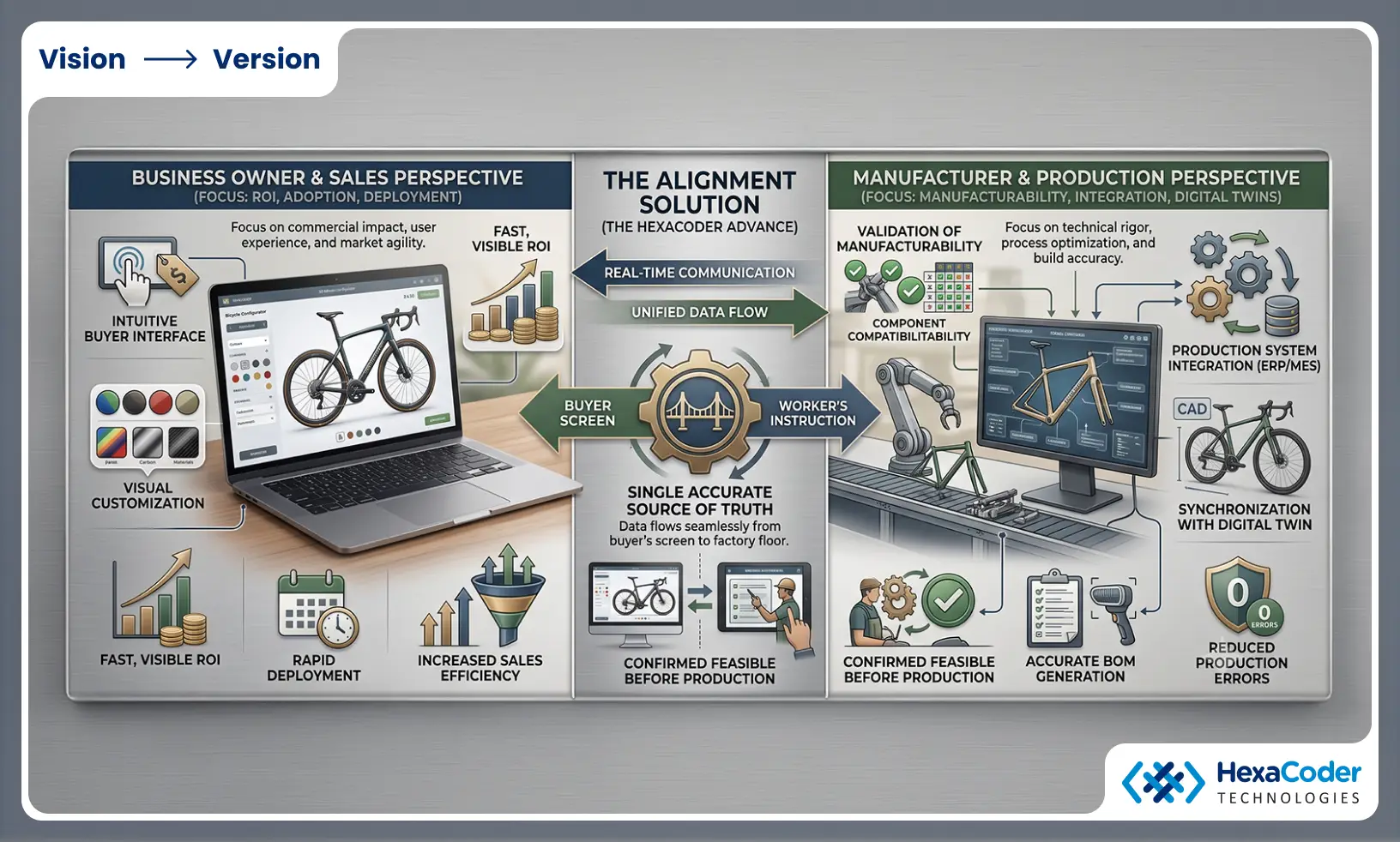
This is solved by strong Product Configurator Software which applies configuration logic at the source. A set of rules ensures that only valid and manufacturable combinations are allowed, so that each order that gets to production has already been confirmed feasible before it even leaves the buyer’s screen.
This offers a single, accurate source of truth for sales and production teams to share, avoiding the discrepancies found with manual coordination. Hexacoder Technologies creates configurator systems embedded directly within a business’s existing production and order management workflow to ensure accurate configuration data flows smoothly from the initial point of buyer interaction to fulfillment.
Assistance for Business Owners and Manufacturers in Assessing Configurator Software
When business owners and manufacturers consider Product Configurator Software in 2026, they will often consider a different set of factors depending on where they are. Business owners tend to focus on ROI, ease of adoption, and how quickly a platform can be deployed without disrupting existing sales operations. A long implementation timeline can quietly eat away at the anticipated benefit, even before the tool goes live.
However, manufacturers are more concerned about validation of manufacturability, integration with production systems, and synchronization with a digital twin. This is because configuration errors on the manufacturing side have direct operational and financial consequences that a business owner concerned only with marketing outcomes might not take as seriously.
A powerful 3D Product Configurator must satisfy both perspectives at the same time, giving business owners fast, visible return while still meeting the technical rigor manufacturers demand. Vendors that focus on just one side of this equation, be it a beautiful buyer interface with no real production logic behind it, or a technically robust rules engine with a clunky, unappealing front end, ultimately fall short of what either audience actually needs. Hexacoder Technologies develops configurator systems with both audiences in mind, balancing usability and commercial impact with manufacturability and integration depth that serious manufacturing operations demand.
Extracting More Value from Your Buyer Data and Ongoing Optimization
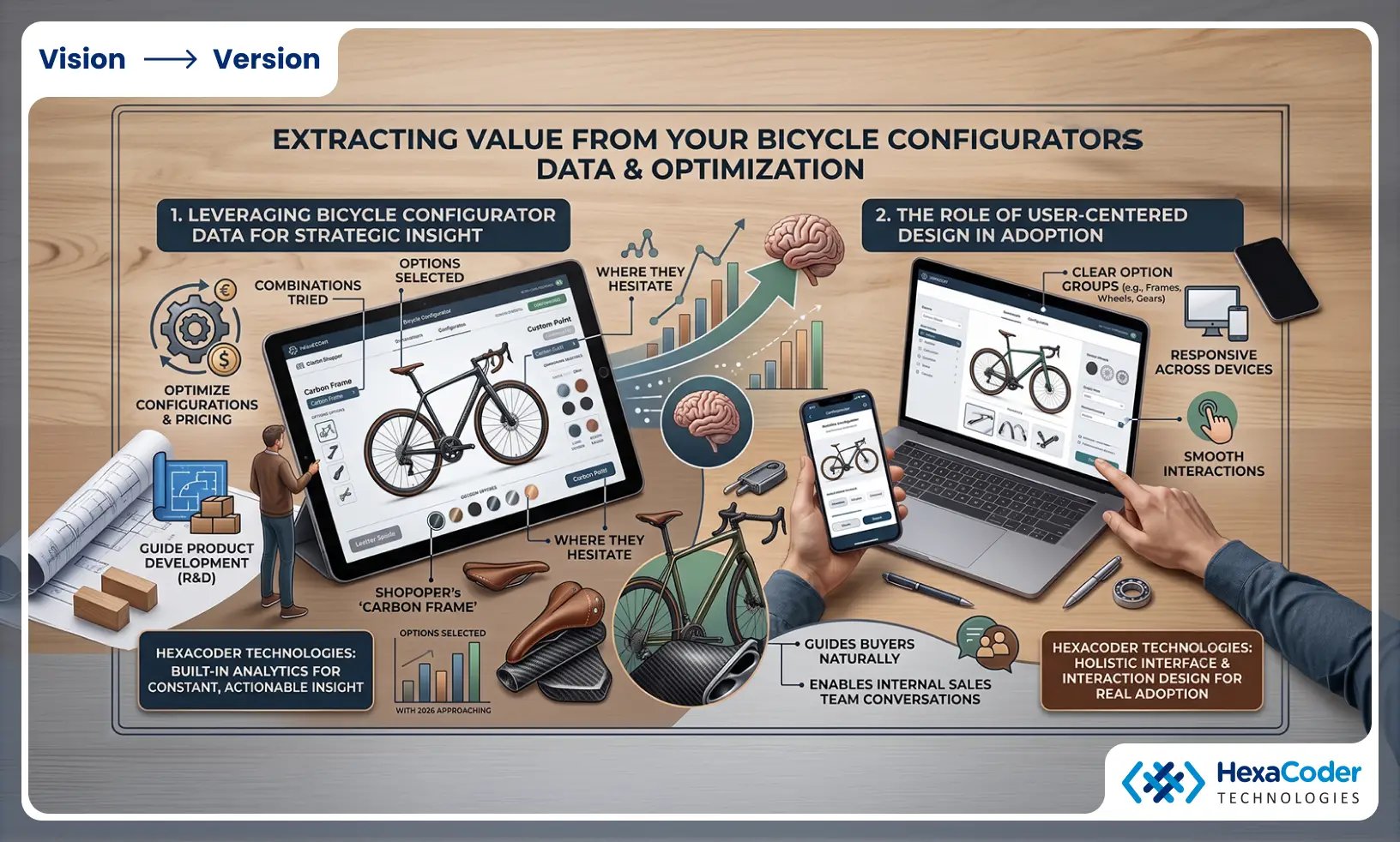
With 2026 approaching, configurator interaction data is more and more seen by companies as a competitive advantage. Each time a shopper uses a 3D Product Configurator, it generates data on the combinations they try, the options they select, and where they are likely to hesitate.
When used correctly, this data informs you of the materials or configurations to push, where you should consider adjusting pricing, and which options are worth further development, taking the guesswork out of buyer behavior. Hexacoder Technologies organizes this data and captures it with a built-in analytics approach, providing businesses constant, actionable insight instead of a one-time snapshot.
The Role of User-Centered Design in Adoption of Product Configurator Software
It doesn’t matter how sophisticated the underlying technology for Product Configurator Software is; usability decides whether it’s actually used or not. No matter how accurate or visually impressive the 3D model is, it’s housed in a confusing interface that discourages exploration.
Well-designed configurators guide buyers naturally through the customization process, with clear option groups and responsive interactions that work smoothly across devices. This is just as true for internal sales teams who need tools that make buyer conversations easier, not harder.
In configurator development, Hexacoder Technologies takes a holistic approach to interface and interaction design. Usability decisions are based on real buyer behavior to enable real adoption rather than a feature that looks impressive but goes unused.
Enterprise-Grade 3D Product Configurator Technology Foundations
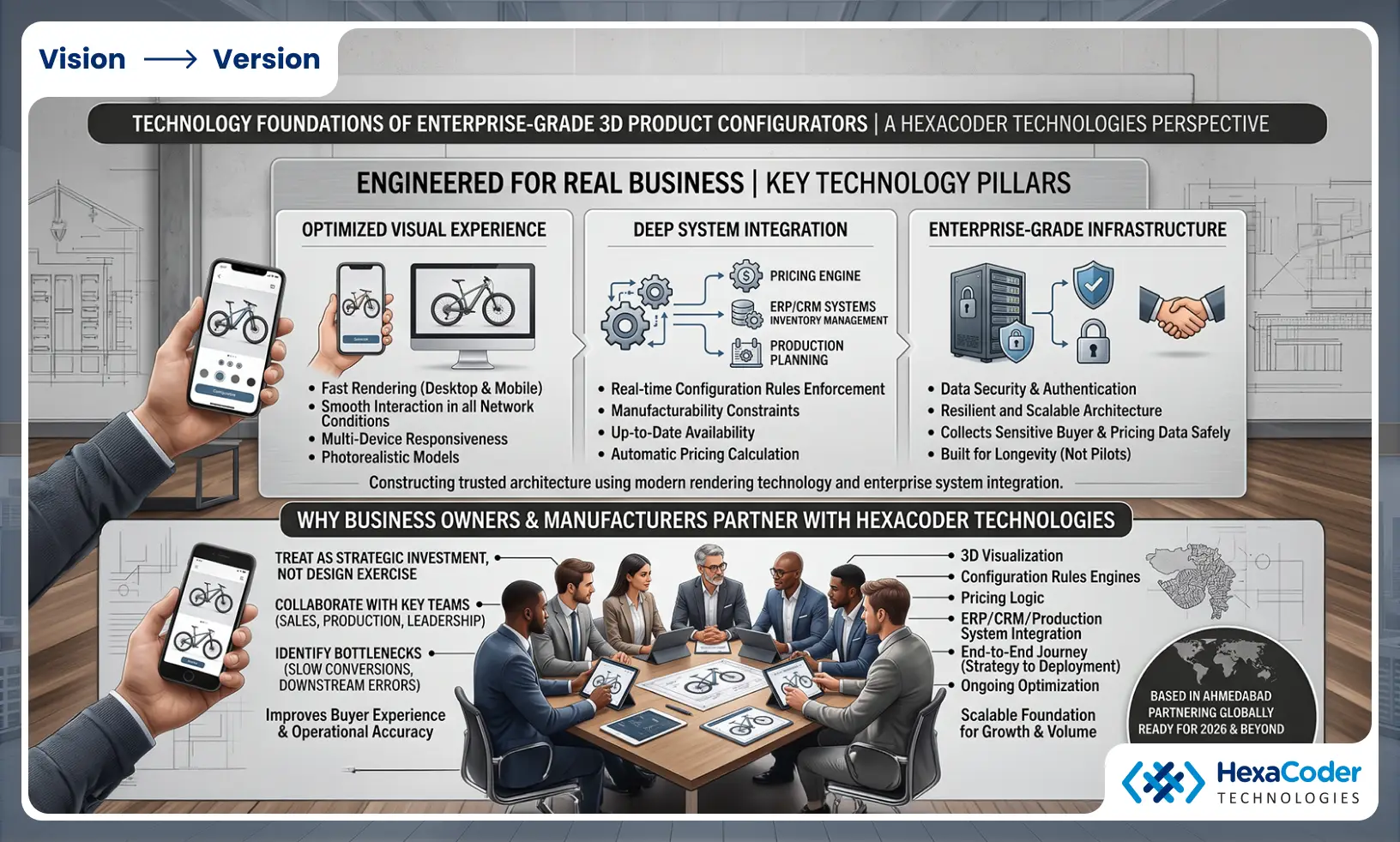
An enterprise-grade 3D Product Configurator must be technically sound, not just a pretty model. Buyers use these tools on different network conditions, so rendering needs to be fast and responsive on desktop and mobile for a smooth experience, no matter what device they are using.
Equally important is deep integration with pricing, inventory, and production systems, so configuration rules, availability, and manufacturability constraints are enforced in real time rather than being an isolated visual tool disconnected from the rest of the business.
Data security and reliability complete the foundation given that these platforms collect sensitive buyer and pricing data that needs to be properly authenticated and resilient infrastructure. Hexacoder Technologies constructs this kind of trusted architecture using modern rendering technology and enterprise system integration, engineering each configurator for real business use, not as a short-lived pilot project.
Why Business Owners and Manufacturers Collaborate with Hexacoder Technologies
Why do business owners and manufacturers partner with Hexacoder Technologies? Because we treat 3D Product Configurators as a strategic business investment and not a design exercise. We work with sales, production, and leadership teams to understand what is really slowing conversion or creating downstream errors.
Our capabilities include 3D Visualization, configuration rules engines, pricing logic, integration with existing ERP, CRM, and production systems, and supporting businesses through the entire journey from initial strategy to deployment and ongoing optimization. This end-to-end capability ensures that the resulting configurator improves the buyer experience as well as internal operational accuracy.
At Hexacoder Technologies, we build every solution with a scalable foundation that is ready for the changes as product lines grow and order volumes increase. We are based in Ahmedabad and work closely with clients across manufacturing and product businesses, combining close collaboration with the technical depth business owners and manufacturers need heading into 2026.
Why Choosing the Right Configurator is Strategic in 2026
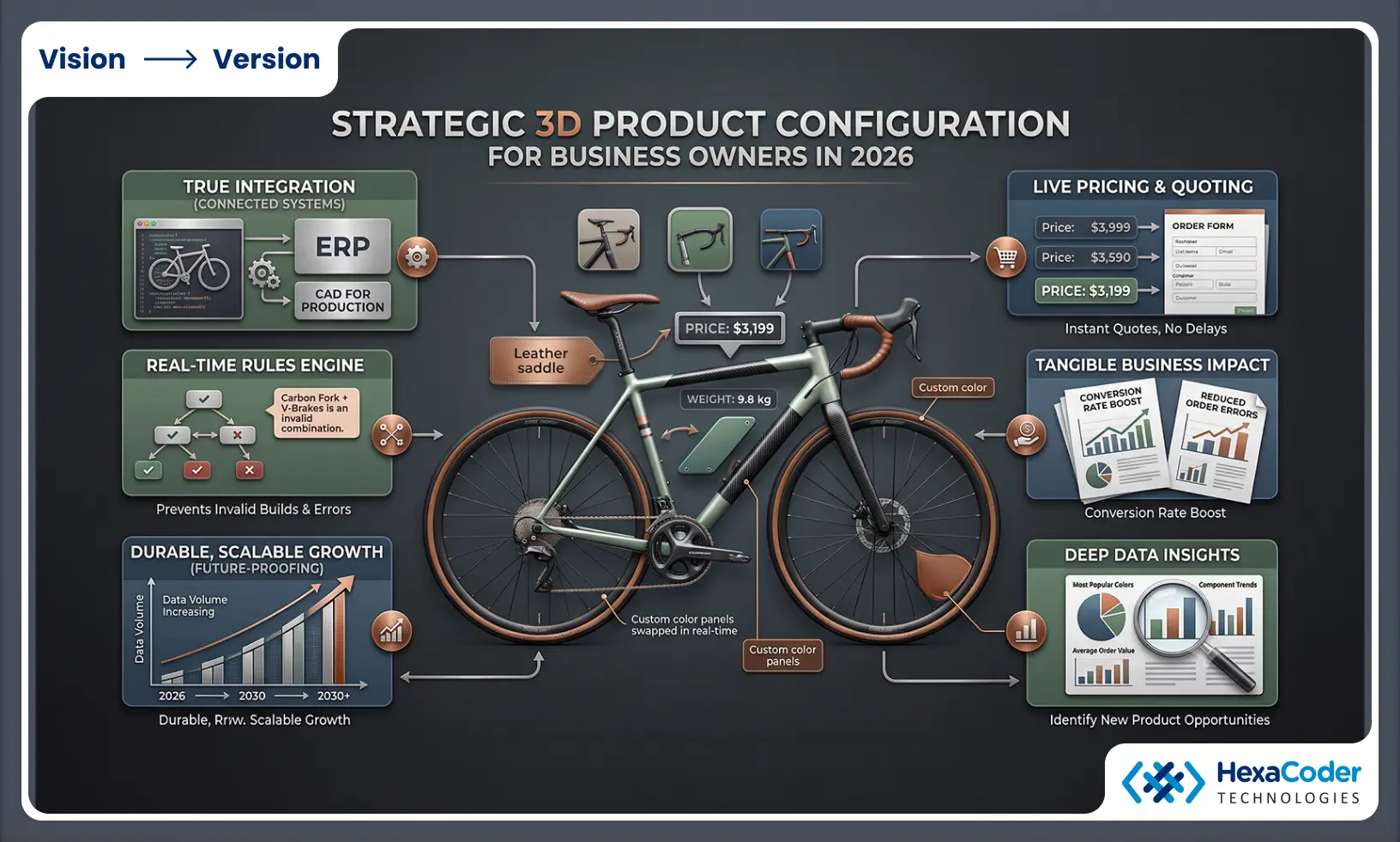
For business owners and manufacturers, selecting the right 3D Product Configurator is no longer a software purchase but a strategic decision. The leading 3D product configurator features in 2026 reveal a market that has evolved far beyond the era of simple rotating models and now requires true integration, authentic data, and tangible business impact rather than a flash-in-the-pan that appears impressive in a demo but doesn’t survive real sales volume.
As buyers’ expectations for digital customization continue to grow, companies that choose platforms that include all ten of these features generally outperform competitors still using partial or disconnected tools, whether that gap is in conversion rates, error rates on the production floor, or just how current the buying experience feels relative to competitors. Hexacoder Technologies helps business owners and manufacturers build fully connected configuration systems that set them up for durable, scalable growth instead of a short-term marketing win.
Conclusion
In 2026, the best way to select a 3D Product Configurator is to look beneath the surface visuals and evaluate the features that drive real business results, including real-time rules, live pricing, deep integration, and true data insight. A clear starting point for what strong Product Configurator Software should deliver for business owners and manufacturers alike is this checklist.
Hexacoder Technologies builds configurators around these very capabilities, helping businesses turn Product Visualization into measurable, lasting commercial results.