
Introduction
The customer comes to your shop with a dream. He wishes to make his car a reflection of his character, his style, his dreams. The only thing is that he doesn't have an idea of how it will look in reality. You talk to him about combinations of components, paint colors, wheels, and other modifications, but he can't picture them in his head. When the conversation is over, he either leaves for a competing shop or buys the goods he doesn't feel passionate about.
In other words, such situations drain your budget, reputation, and sales volume.
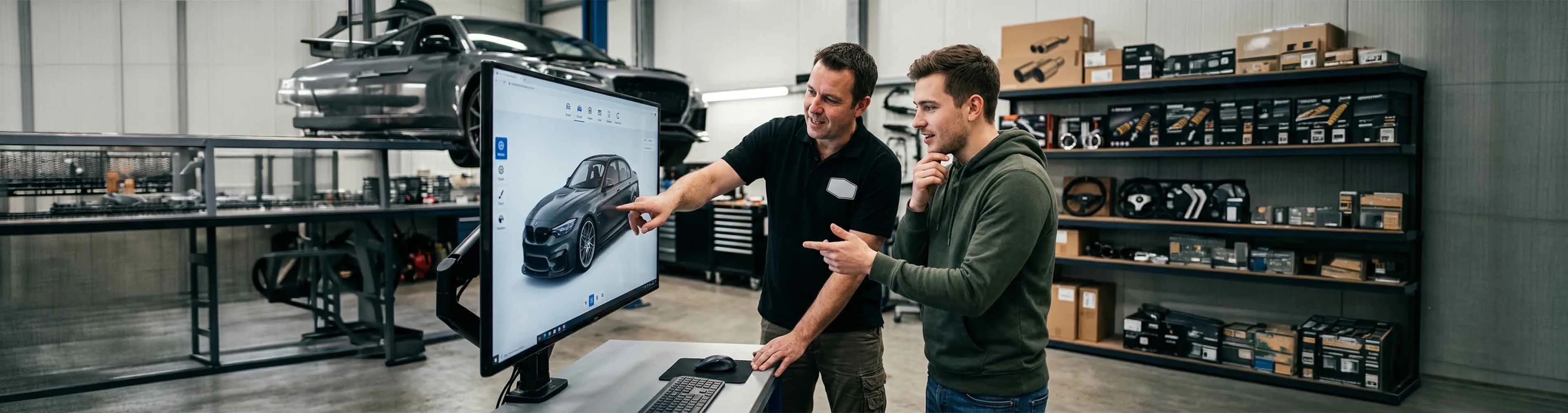
However, imagine your clients being able to see every possible modification in real-time mode. Imagine them being able to rotate a 3D model of their car, experiment with various color combinations, view customized wheels, and get acquainted with exhaust systems, body kits, and other upgrades even before they spend a penny on them. This isn't a myth. This is the potential of an advanced 3D configurator for automotive and aftermarket businesses.
The Customization Moment That Changes Everything
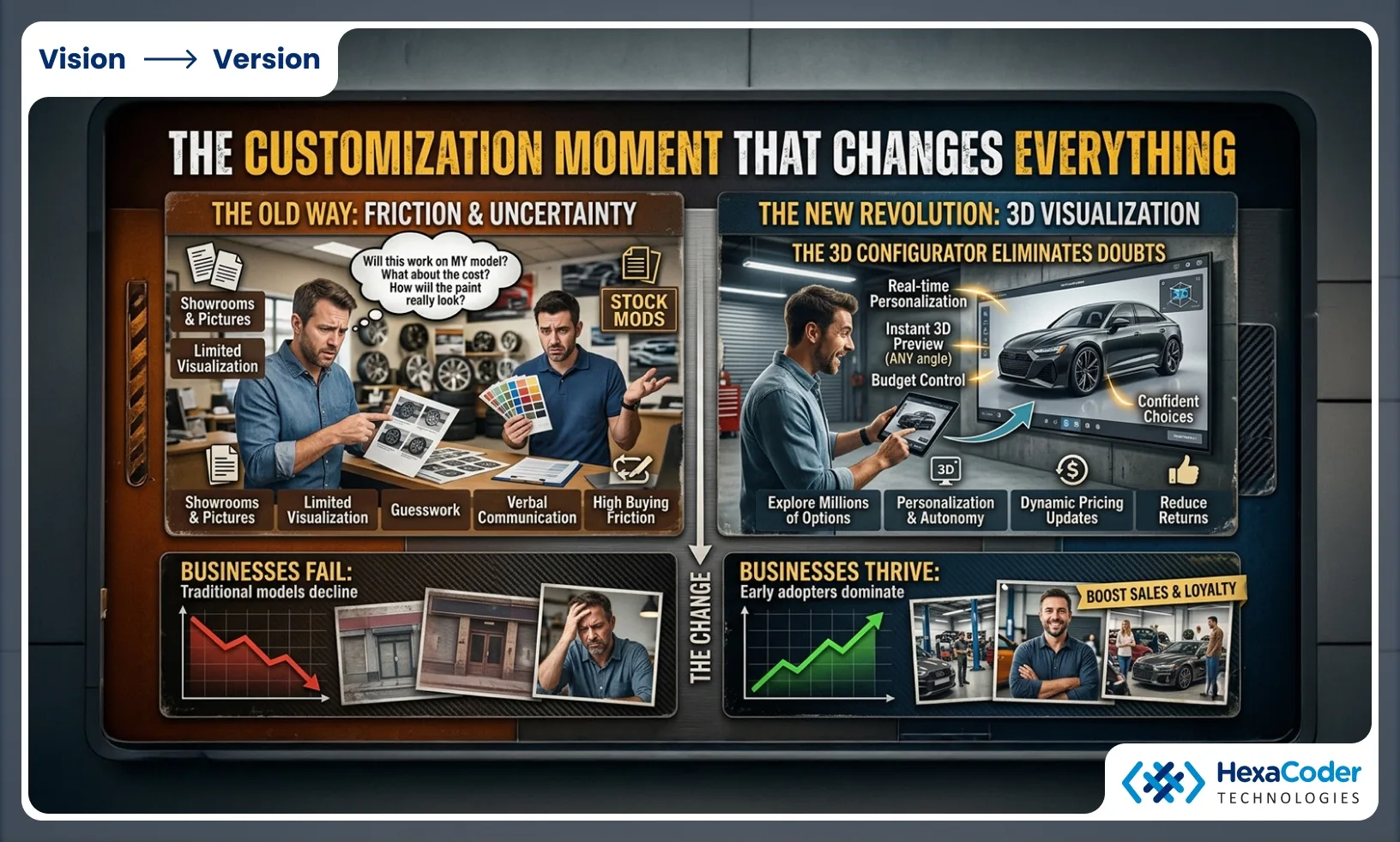
There is a revolution taking place in the world of automotive aftermarket. Customers today do not settle for a generic approach anymore. They seek personalization. They seek autonomy. They seek visualization before making any purchase.
This is not just an insignificant preference. This is the very way in which businesses can thrive or fall behind. Traditionally, companies would use showrooms, pictures, and verbal communication to present their products to customers. However, such an approach tends to create some friction within the buyer's mind. For instance, when looking at a picture of a modified car, one might ask himself: How will mine look like? Will this particular shade be available for my car? Will it impact my budget significantly?
A 3D configurator eliminates these doubts and concerns.
The Technology Behind Real-Time Visualization
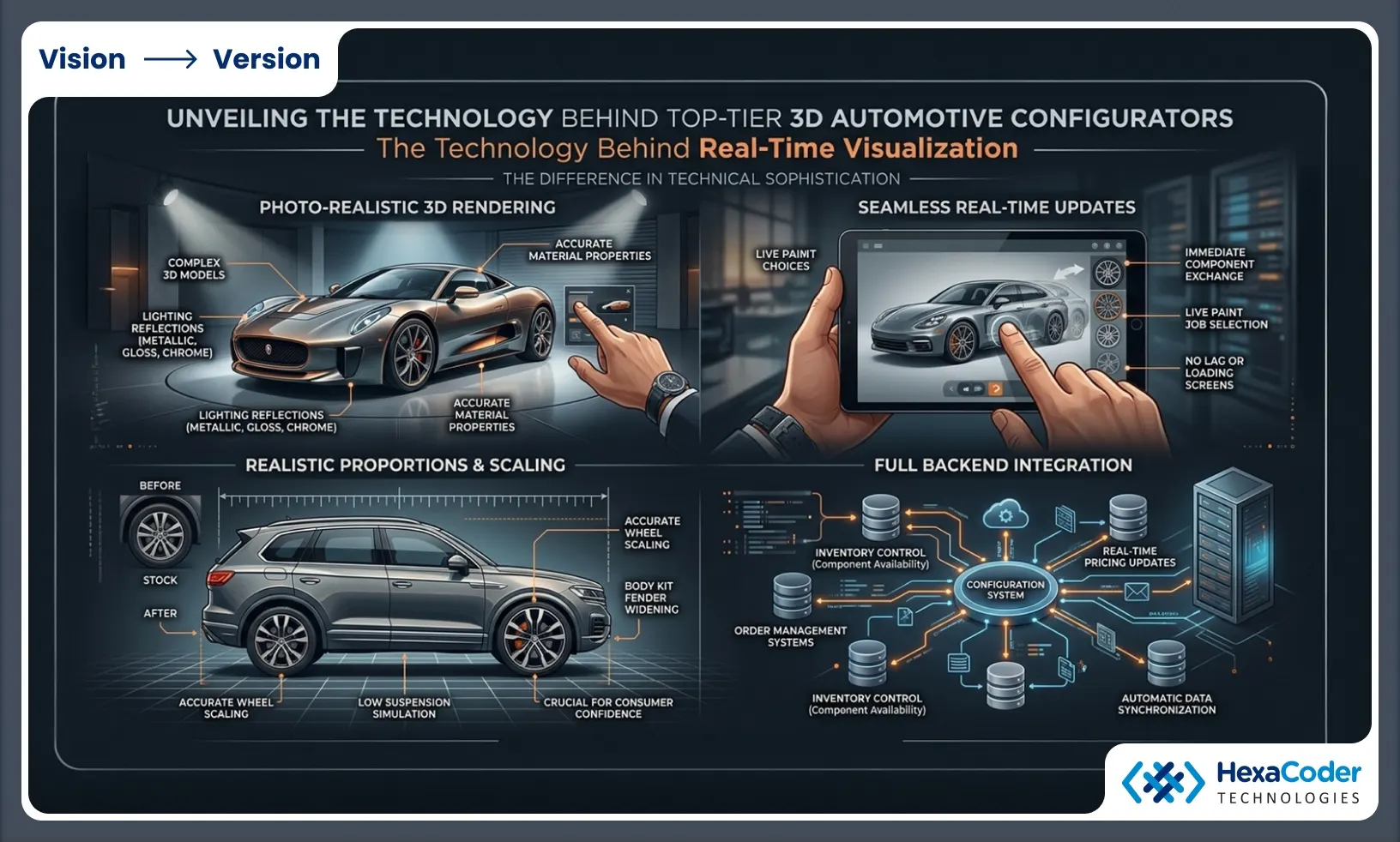
All 3D automotive configurators are not created equal. The difference between a top-of-the-line product and an ordinary tool lies in its technical sophistication and overall quality of experience.
An advanced 3D car configurator must perform many tasks at once. Firstly, it renders complex 3D models of cars with photo-realistic lighting and material properties. It must reproduce accurately the reflection of light off metallic surfaces, the color shades and gloss levels of paints, and the reflective properties of chrome and matte finishes.
Secondly, it exchanges components in real-time. When a consumer selects a certain design, the configurator replaces the previous wheel or body component with the new choice immediately and seamlessly. They can see how different kits fit together with their vehicle and how it will look with a new paint job. All this must happen without lag times or loading screens.
Thirdly, the configurator must maintain realistic proportions. A 22-inch wheel must be scaled accurately on the vehicle. A low suspension must make the car shorter virtually. A body kit must widen the fenders accordingly. This may seem like unnecessary perfection, but realism is precisely what gives the consumer confidence in virtual customization.
Finally, it works with your existing infrastructure. A good configurator is more than something pretty to look at; it connects with your inventory control system, pricing, and order management systems. If a customer picks an option, the configurator will automatically know whether the components you have selected for them are available, how much they cost, and when they will be delivered.
What Makes a Best-in-Class 3D Configurator
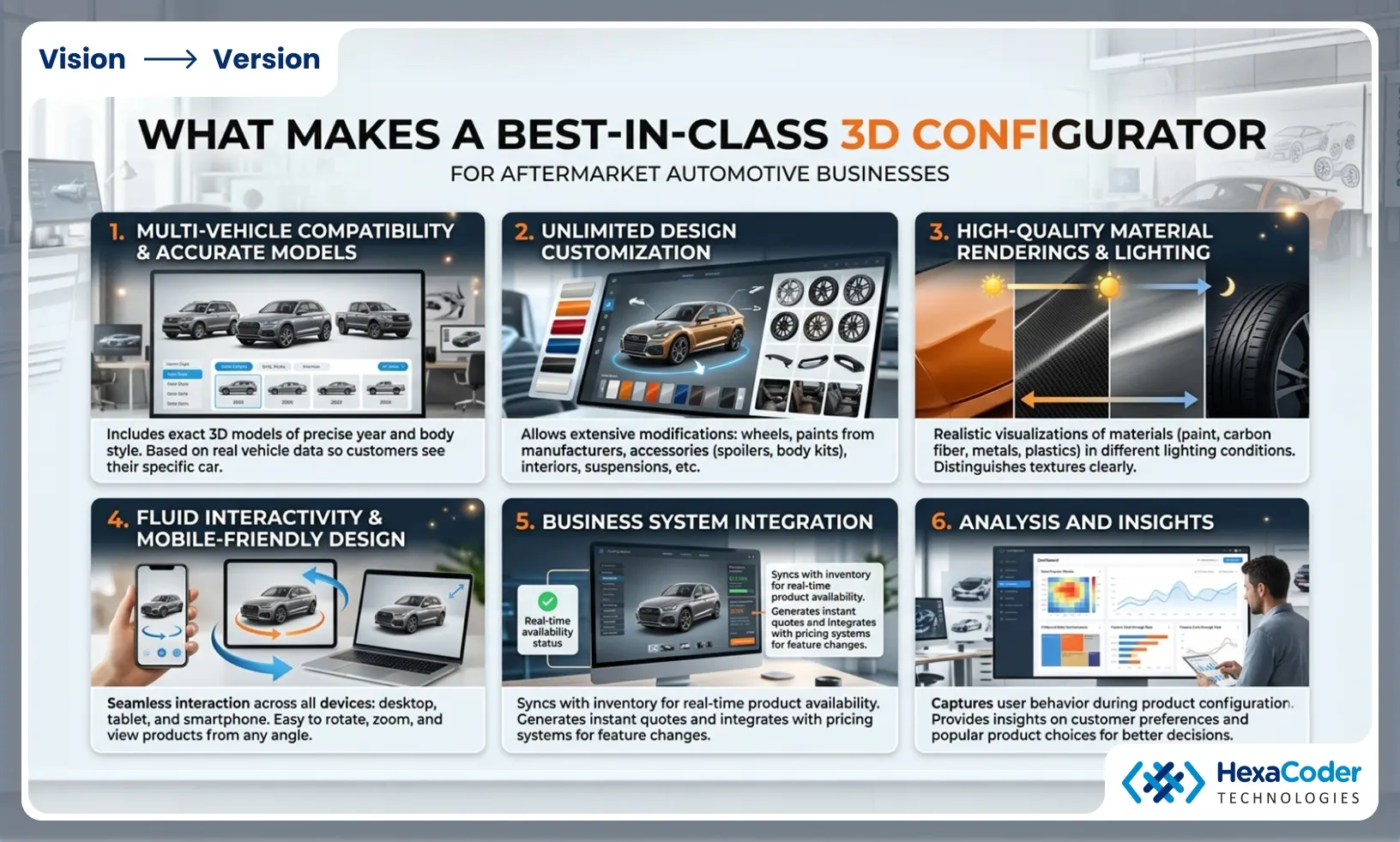
These are the features you should look out for in configurators for your aftermarket business:
1. Multi-Vehicle Compatibility and Accurate Models
Your business will require a configurator that offers 3D models of vehicles. However, this is not just any type of model but one that is accurate and corresponds to a precise year and type of body style. Having a configurator that is based on real vehicle data means that your client will only see his/her exact car.
2. Unlimited Design Customization
The configurator should be able to allow all sorts of customization choices. This includes the customization of wheels (in various diameters, finishes, and types), paints available from the main manufacturers, accessories such as spoilers, body kits, diffusers, interiors, and suspensions among others.
3. High-Quality Material Renderings and Lighting
The 3D visualization needs to be accurate with regard to the materials being visualized. This includes having realistic renderings of paint, plastics, metals, and carbon fiber. The lights need to represent the appearance of those materials during different lighting conditions, from daytime sun to nighttime or shadows. A matte black tire would have to appear entirely different than a shiny chrome tire.
4. Fluid Interactivity and Mobile-Friendly Design
The interactivity of your product configurator must be smooth on all devices. This means that customers are able to rotate, zoom, and interact with your visualization easily no matter whether they're using a desktop computer, tablet, or smartphone. Customers should be able to move objects around so they can view the product from different angles and zoom into details.
5. Configuration and Your Business
The system should be configured with the inventory system to give real-time availability of the products. When a customer creates a product configuration, he/she knows whether you have that particular item in the inventory. The configuration tool will generate quotes for customers and will integrate with the pricing system, giving real-time updates on the price of an item depending on additional features chosen by the customer.
6. Analysis and Insights
A good configuration tool helps capture customer behavior during the process of creating products. You will know what wheels attract many clicks or which color combinations customers prefer. These details will give insight into customer behavior and preferences.
Why This Matters for Your Aftermarket Revenue
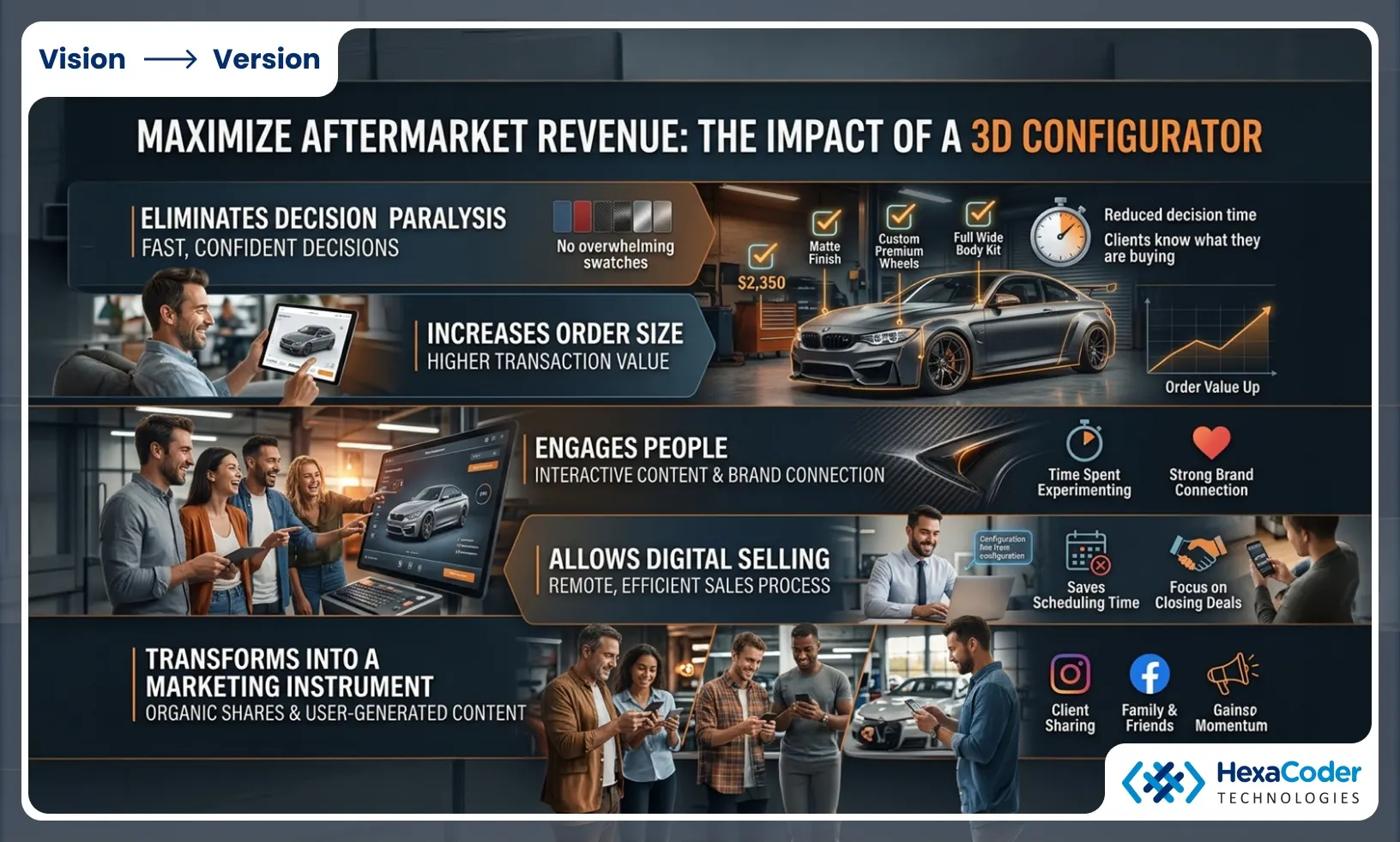
The effects of a 3D configurator on business are very tangible and they have a direct impact on metrics.
It eliminates the phenomenon of decision-making paralysis. Clients that are able to view their custom vehicle in a 3D format will make decisions much quicker than before as they would know exactly what they were buying into since they would visualize the result.
It results in an increase in order size. Having the means for experimenting with different configurations allows customers to indulge in some extra add-ons. For example, adding the matte finish to their car or a more pricey set of wheels or even installing the entire wide body kit. With visualization at hand, clients feel more comfortable spending money.
A configurator helps engage people. It represents a type of interactive content and therefore, people will spend a considerable amount of time experimenting with it, which establishes a kind of connection with the brand itself.
It allows digital selling. Your sales team just sends a configurator link to your client and allows him to browse different combinations whenever he wants, where he wants. It will save time for scheduling appointments and showcasing all of the possible configurations. You only work towards closing deals.
It transforms into a marketing instrument. A good configurator tool will become a product worth sharing by your clients. They send links to their family members and friends and publish pictures of their personalized vehicles in social networks. Your tool gains its momentum through customer-generated content.
The Efficiency Gains Nobody Talks About
Not only does the 3D configurator improve customer satisfaction, but it will streamline your processes behind the scenes as well.
Your sales staff saves time on verbally communicating changes, or searching through images looking for similar configurations. The 3D configurator is the universal language. A customer asks that they receive the product they created in the system, and there's no misunderstanding whatsoever. Order errors, mistakes, and upset customers receiving products that were not what they wanted are avoided.
You'll have a more scientific approach to inventory management. Gone is the guesswork as to which wheels and colors will be popular. You can easily track what configurations the customers are designing and stock accordingly. This will allow you to reduce dead inventory while stocking popular options.
Your installations teams will have clear specifications. Once a customer's custom creation arrives at the install station, your team is able to build it with no trouble whatsoever. A 3D design can be printed or displayed and all the details are known in advance.
Finally, fewer people will call into customer service. No more customers asking if their customization will work properly because it's clearly shown. No disputes regarding what was ordered since customers made it themselves.
The Honest Challenges of Implementation
The ideal configurator is not a plug and play system. Here are some difficulties faced when developing the right one.
Creation of an accurate 3D model of your vehicle range is a challenge. You will require actual 3D scanning of your supported vehicle range. You must develop all customization options that your business can offer. This is an ongoing process because of the continuous growth in your product portfolio.
Involvement in your business systems is another issue. Your configurator must be integrated with the other systems used by your business. This includes inventory, pricing, and order processing. In case there are issues with these systems, it becomes important to correct them first.
Maintenance of the system is a process that you cannot overlook. The range of vehicles will change. You will expand your product line. Technologies will change. It is essential to have a development partner who can grow along with you.
Adoption by customers is not a smooth process either. You will need to actively market your configurator. Your sales staff needs to learn how to make good use of it. Your marketing efforts should highlight its usage. It should be prominently featured on your website.
The Competitive Edge You Actually Get
This is how things look when you introduce a state-of-the-art 3D configurator before your rivals:
You automatically become the default destination for all those customization-oriented customers.
The customer wants to customize his/her car at a shop. You show up on the radar of that customer. He/she plays around with the 3D configurator for about ten minutes, building the desired setup. Then he/she notices the price. Next comes saving the configuration and then sending it to a friend. All the while, your competitor only boasts a static image gallery and a physical visit. The choice is clear.
This cycle repeats itself and each new user speaks of the configurator. Soon enough, everyone knows that you give clients the possibility to see the result of their customization efforts. This makes you popular among high-quality customers - people passionate about modifying their cars and understanding exactly what they want to achieve. More money and loyalty follow.
You build a reputation as a tech-savvy establishment. On an aftermarket that is all about customization, you gain additional value through using the configurator.
How to Choose the Right 3D Configurator for Your Business
Every 3D configurator solution does not suit all aftermarket businesses. There are many aspects that need consideration – size, budget, and product catalog among others. Consider these criteria:
The configurator needs to support several vehicles; it's unlikely you'll remain limited to only two or three models in the future. Partner with an expert who has several different 3D libraries for different vehicles and whose collection continues to expand.
Ask for specifics about customization possibilities. The tool should be able to support as many changes in configuration as possible. Whether you want to customize suspension components or engine modifications, a good tool must accommodate all that.
Visual quality is key. You have to test the visual appeal of the model to your target customers. It must be as detailed as possible; you don't want something that looks cheap and ordinary, you need high-end, premium-looking renderings.
Finally, test integration. Ask about the level of integration with current systems. For example, can the software provide you with real-time price updates? What about inventory levels? How does customer engagement work? Customers have to be able to save their configurations and export them to management software.
Be aware of how support is provided. Development of the 3D configurator is collaboration-based. You will require vendors who will continuously update the list of newly released models of vehicles. You should also find out how you will be provided technical support when necessary. It's important to note that building a 3D configurator isn't like purchasing any other piece of software.
Assess the information. The best configurator provides useful insights on your customer. Find out what kind of data they will give you access to. Do you get to know which components people choose the most? Which ones generate the highest conversion rates? Which ones are in most demand?
Where 3D Configurators Are Heading
Next steps for automotive configurators can be associated with the integration of augmented reality (AR). Just imagine a potential client aiming their smartphone at their car while seeing the result of customization through an AR overlay – no longer a separate visualization, but the exact vehicle, customized by your client's preferences, in front of his/her eyes.
Another step forward can include artificial intelligence. It's possible to use a customer's preferences as a basis to recommend additional products. In case one decides to install a lowered suspension, the software automatically offers wheel sizes and brake modifications.
The synchronization of prices and inventory information with instant updates becomes a standard feature. Potential clients know immediately whether all the chosen items are available and whether there will be any delays with delivery of the order.
Finally, the separation between online and offline services is eliminated. With a 3D configurator, you get a chance to create your product online and then come to your shop for installation. There will be no unpleasant surprises for you since you'll know everything beforehand.
Conclusion
It is not a choice any more whether to have a 3D automotive configurator in your shop or not. This technology is starting to become a requirement in the after-market. Buyers need to see what customizations they can choose before actually buying anything. Buyers need time to browse through the offered products, and buyers need to be in control of the process.
Those shops providing this service are taking market shares away from competitors. They will close sales faster; they will get higher orders and most importantly customers will be loyal to them.
What you need to think about is whether you can afford not having such a service or not, and whether you will be the first shop providing this option to your buyers. Buyers are going to the shops which can show them their customizations in a high quality 3D image, which means that they will create the desired cars on the internet.