

Selecting 3D Configurator Software is seldom a simple purchasing decision. It touches sales, engineering, IT, and customer experience all at once, so a bad choice does not just waste budget; it creates friction across multiple departments for years to come.
The challenge for decision makers and CTOs looking at vendors is how to differentiate between platforms with real technical depth and platforms that look impressive in a sales demo but fall apart under real production conditions as soon as product complexity and order volume start testing every assumption the demo conveniently avoids.
In this buyer's guide, we break down the best 3D configurator software for manufacturers and ecommerce. We explore what really matters in a Product Configurator Platform, which questions decision makers should ask during evaluation, and how a platform like Hexacoder Technologies approaches configurator development as enterprise infrastructure rather than a standalone visual tool.
What is the Best 3D Configurator Software?
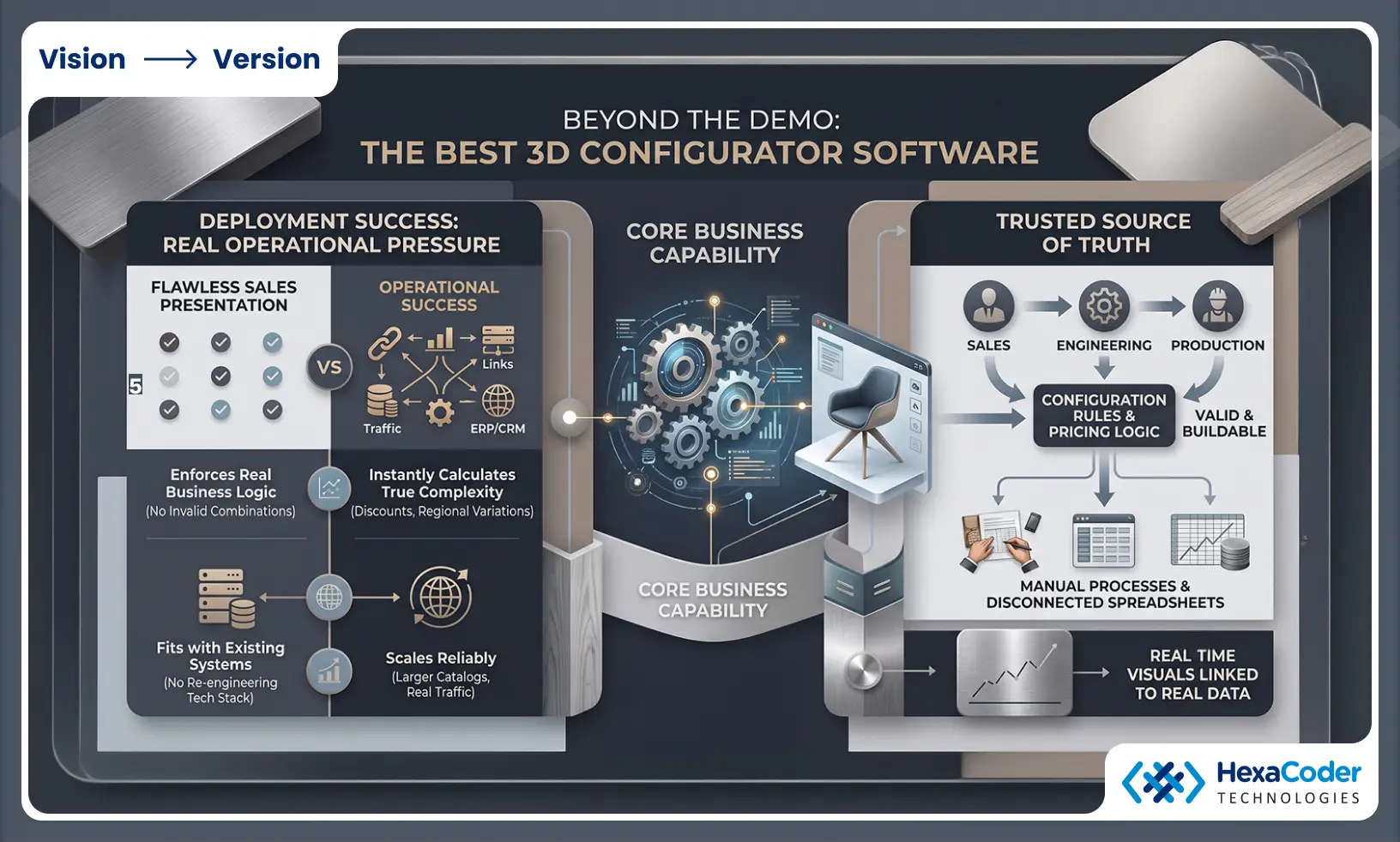
The best 3D Configurator Software is not defined by how good its demo looks, but by how well it works when deployed against real product complexity, real traffic, and real integration requirements. A platform that looks good in a controlled sales presentation can also perform poorly when connected to an actual company's ERP, CRM, and inventory systems. The gaps appear only when real operational pressure is applied.
A strong platform does several things well at the same time. It enforces real business logic rather than just displaying options on screen, so invalid product combinations are prevented. It calculates discounts, materials, and regional variations accurately. It fits into existing systems rather than requiring a company to re-engineer its technology stack around the limitations of a single vendor. And it scales reliably as the business grows.
A truly interactive configurator that only meets one or two of these qualities will likely disappoint after the initial launch when real buyers and real order volume reveal gaps the demo never showed. Decision makers should evaluate technical depth as carefully as visual polish because those two qualities do not always come from the same vendor.
3D Configurator Software: A Core Business Capability
The 3D Configurator Software allows buyers to set their exact product in real time, while the model and price change as they adjust dimensions, materials, and components. What really matters to decision makers is what is happening beneath that visual experience.
In the background, configuration rules, pricing logic, and manufacturability constraints are constantly running to ensure that whatever a buyer configures is valid and buildable. This gives teams a single, trusted source of truth across sales, engineering, and production, removing inconsistency caused by manual processes or disconnected spreadsheets.
Hexacoder Technologies creates 3D Configurator Software that functions as core business infrastructure, not just a visual feature. It links configuration logic directly to real pricing and production data so a Product Configurator Platform becomes a reliable, scalable capability rather than a marketing experiment.
An Interactive Configurator That Transforms the Buyer Experience
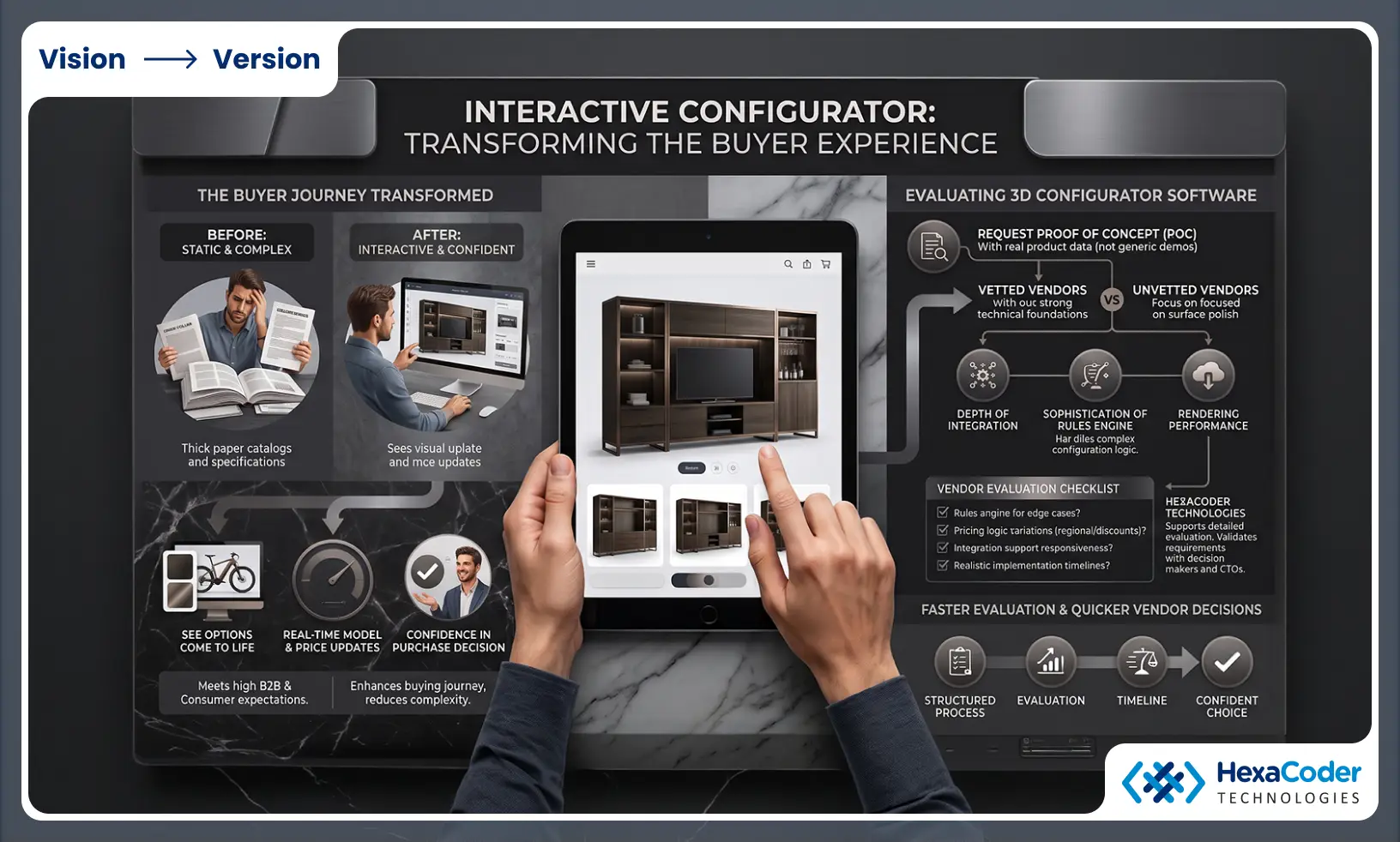
In both manufacturing and ecommerce, customer expectations around digital configuration have risen dramatically. Business buyers expect the same level of interactivity for complex, configurable products that consumers have come to expect from cars, furniture, and consumer electronics. These expectations also carry over into B2B and enterprise purchasing decisions.
A well-built interactive configurator fulfills that expectation right away. Buyers no longer have to read static catalogs or long specification documents to understand their options. Instead, they can see their choices come to life as they adjust materials, dimensions, and finishes. The model and price update simultaneously in real time.
This creates real confidence in the purchase decision. Buyers are more comfortable when they have already seen an accurate representation of what they are ordering. Hexacoder Technologies develops these experiences with attention to usability, responsiveness, and visual fidelity so the interactive configurator improves the buying journey rather than adding complexity.
Faster Evaluation and Quicker Vendor Decisions
Choosing the right 3D Configurator Software vendor is important, but so is choosing the right evaluation process. A decision maker needs to be well informed about the things to look out for when evaluating configurator software. A structured evaluation process that balances integration depth, rules engine sophistication, and rendering performance usually yields better results than a decision based mostly on which demo looked the most polished during a sales call.
Requesting a proof of concept that uses real product data rather than a generic demo catalog gives far more insight into how a platform will perform in the real world. Vendors with a strong technical foundation are usually open to this type of evaluation process. Vendors that rely heavily on visual polish tend to resist deeper technical scrutiny or bristle when asked to demonstrate integration against a company's actual data structure.
A good evaluation checklist should ask how the rules engine handles edge cases, how the pricing logic accounts for regional and discount variation, how responsive the vendor's support team is to integration issues, and what the real implementation timeline looks like once a contract is signed.
Hexacoder Technologies actively supports this type of detailed evaluation, working with decision makers and CTOs to validate real integration requirements and configuration logic before any long-term commitment is made.
Reducing Implementation Risk and Improving Alignment Between IT and Sales
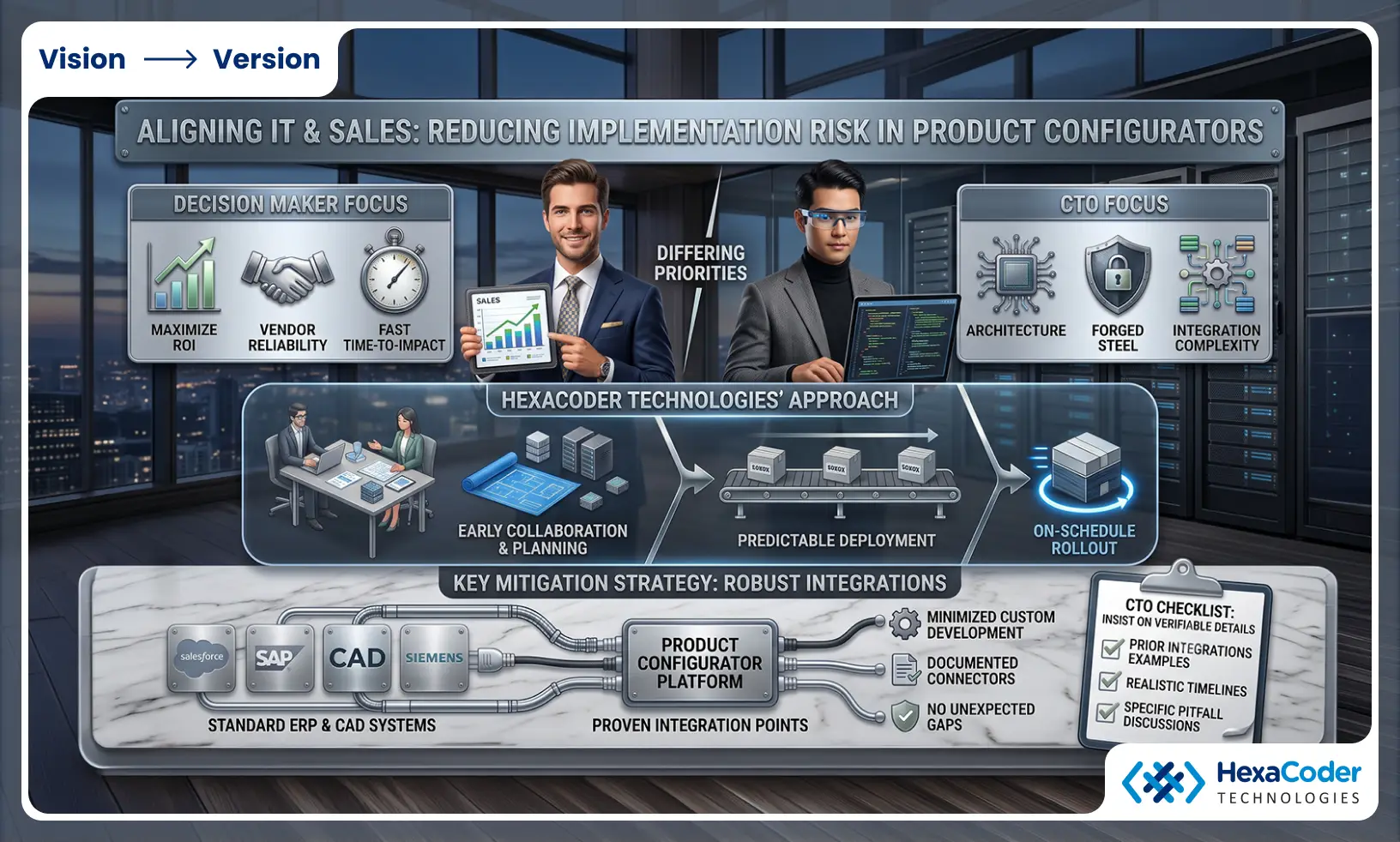
Implementation risk is one of the biggest concerns decision makers have when evaluating configurator software, and rightly so. A platform that requires significant custom development to integrate with existing systems can quietly consume far more budget and time than the original proposal suggested, often stretching a projected three-month rollout into something closer to a year.
A robust Product Configurator Platform mitigates this risk by offering proven integration with standard ERP, CRM, and CAD systems rather than forcing a company to build custom connectors from the ground up. This also helps keep IT and sales teams aligned during implementation because both teams can work from the same documented integration points rather than negotiating scope as gaps emerge mid-deployment.
CTOs should not be satisfied with vague promises that integration is possible in theory. They should require specific, verifiable details of prior integrations with similar systems. A vendor with real experience can usually speak concretely about timelines, common pitfalls, and realistic effort. A vendor without that experience tends to answer in generalities.
With this risk reduction in mind, Hexacoder Technologies uses a collaborative implementation methodology that brings technical and sales stakeholders together from the earliest planning stages to ensure predictable, on-schedule deployment.
Assistance for Decision Makers and CTOs in Evaluating a Product Configurator Platform
Even when they are working toward the same end decision, the criteria decision makers and CTOs use during evaluation tend to differ somewhat. Decision makers usually focus on return on investment, vendor reliability, and how quickly a platform can start delivering measurable sales impact. The business case usually needs to be justified in terms leadership and finance teams can easily understand.
CTOs tend to focus more on architecture, security, integration complexity, and long-term maintainability. A poorly architected configurator can become a technical liability that outlives its original business justification, quietly accumulating technical debt long after the initial rollout is declared a success.
A strong 3D Configurator Software vendor needs to meet both perspectives at the same time, delivering commercial impact for decision makers and the technical rigor CTOs expect for long-term stability. Hexacoder Technologies builds and supports configurator platforms for both audiences, from initial business case to technical architecture review.
Unlocking More Value from Buyer Data and Continuous Optimization
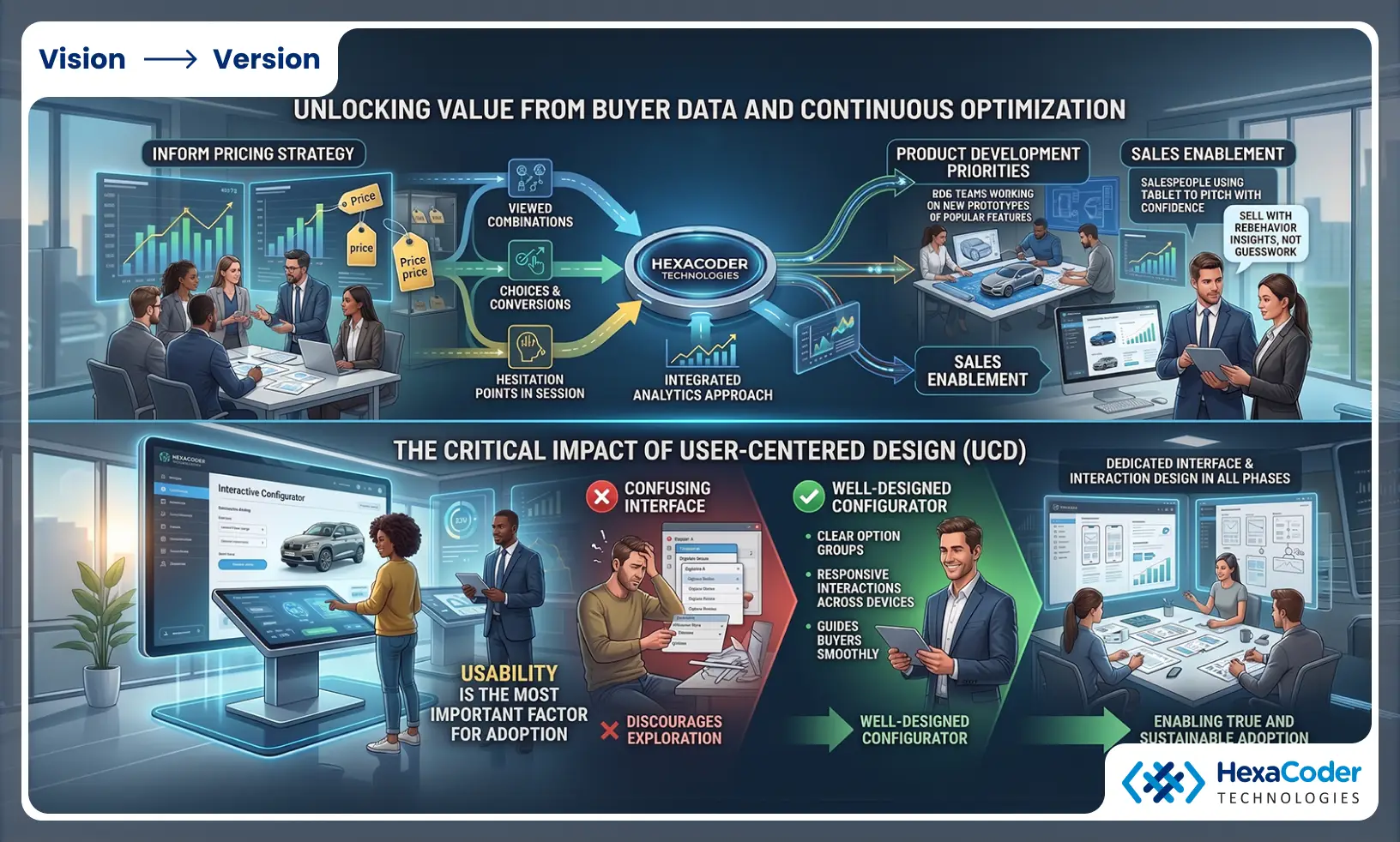
Once a platform is up and running, organizations are increasingly treating configurator interaction data as a strategic asset. 3D Configurator Software provides data on what combinations customers view, what choices lead to conversion, and where hesitation typically occurs in each session.
When properly analyzed, this data can inform pricing strategy, product development priorities, and sales enablement, replacing guesswork with insight into real buyer behavior. Hexacoder Technologies collects and organizes this data through an integrated analytics approach, providing decision makers with ongoing insight they can act on long after initial deployment.
How User-Centered Design Affects Configurator Adoption
Usability is the most important factor in the adoption of an interactive configurator by buyers and sales teams, regardless of the sophistication of the underlying technology. No matter how accurate or technically impressive the configuration logic, a confusing interface discourages exploration.
Well-designed configurators naturally guide buyers through the customization process with clear option groups and responsive interactions that work smoothly across devices. The same is true for internal teams that need tools that simplify daily work rather than make it more difficult.
At Hexacoder Technologies, significant resources are dedicated to interface and interaction design in every phase of configurator development. Usability decisions are based on real buyer behavior to enable true and sustainable adoption.
Enterprise-Grade 3D Configurator Software Technology Foundations
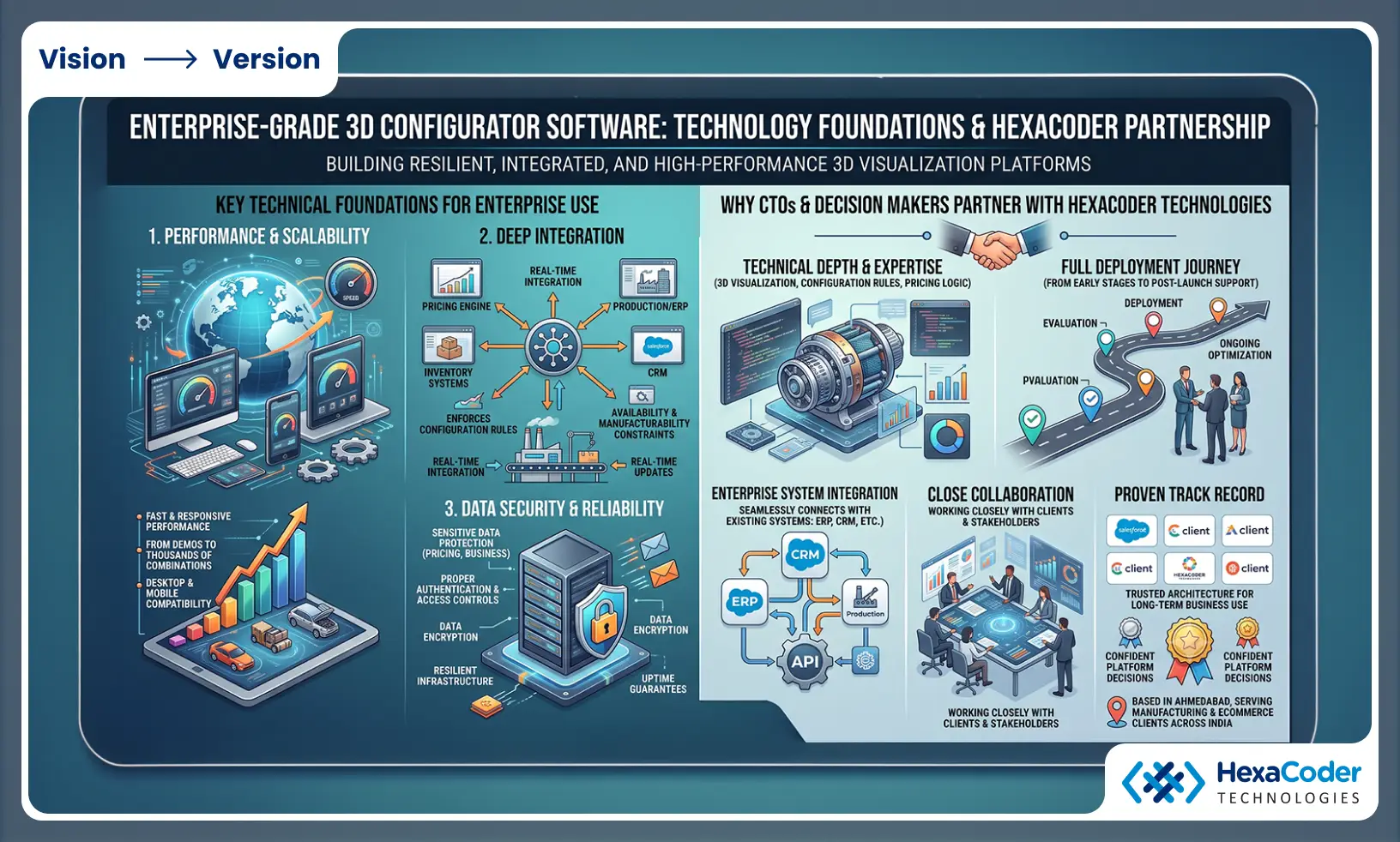
Enterprise-grade 3D Configurator Software needs strong technical foundations far beyond just a nice rendering engine. As product catalogs and configuration complexity increase, performance must remain fast and responsive on desktop and mobile. A platform that works well with a small demo catalog can slow down significantly when thousands of real configuration combinations are used.
Deep integration with pricing, inventory, and production systems is equally important, enforcing configuration rules, availability, and manufacturability constraints in real time rather than as an isolated tool disconnected from the rest of the business. Without that level of integration, a configurator can become a visually impressive front end on top of manual back-end processes, defeating much of the original purpose of the investment.
Data security and reliability complete the basics, since these platforms handle sensitive pricing and business data that require proper authentication and resilient infrastructure. CTOs should pay close attention to how a vendor handles data encryption, access controls, and uptime guarantees.
Hexacoder Technologies builds this type of trusted architecture for true long-term business use, using modern rendering technology and enterprise-system integration for every Product Configurator Platform.
Why Decision Makers and CTOs Partner with Hexacoder Technologies
3D Configurator Software is not a standalone design project but enterprise infrastructure that decision makers and CTOs choose to partner with Hexacoder Technologies. We work closely with business and technical stakeholders from the earliest stages of evaluation to ensure the platform delivered meets both commercial and architectural requirements.
We combine 3D visualization, configuration rules engines, pricing logic, and integration with existing ERP, CRM, and production systems. We support organizations throughout the full journey from evaluation through deployment and ongoing optimization. We are based in Ahmedabad and work closely with clients across manufacturing and ecommerce.
The Strategic Importance of Choosing the Right Configurator Platform
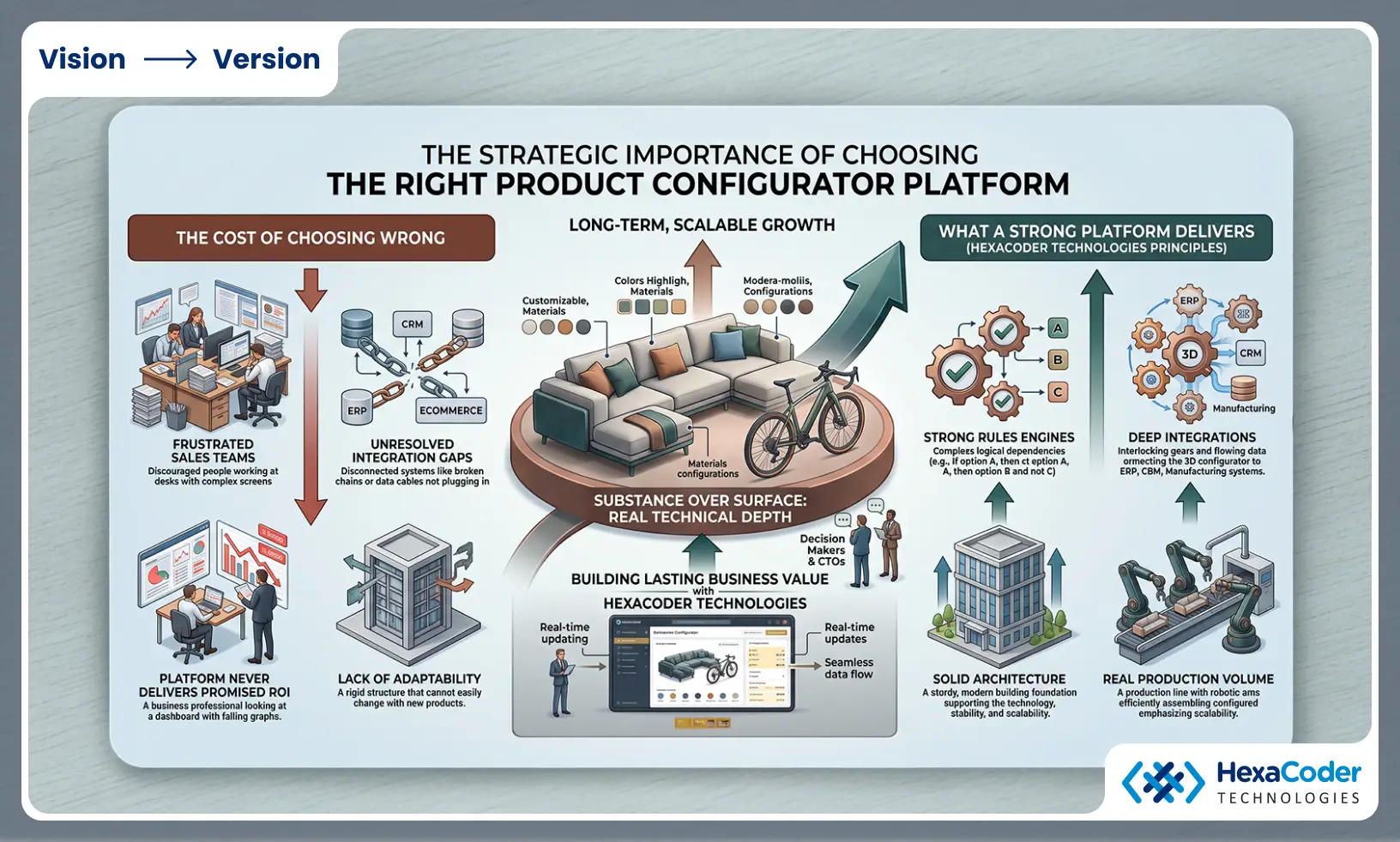
The right Product Configurator Platform has become a real strategic choice for decision makers and CTOs rather than a routine software purchase. The best 3D configurator software for manufacturers and ecommerce reflects a market that is increasingly interested in real technical depth rather than superficial visual polish, and the gap only grows more apparent when a platform is pushed against real production volume.
As buyer expectations for digital personalization continue to rise, organizations that choose platforms that combine strong rules engines, deep integrations, and solid architecture tend to see stronger long-term results than those pulled in primarily by a demo. The cost of choosing wrong is rarely immediate; it usually takes months to show up as frustrated sales teams, unresolved integration gaps, and a platform that never quite delivers the return promised in the original pitch.
Hexacoder Technologies empowers decision makers and CTOs to build fully connected configuration systems that position their organizations for long-term, scalable growth.
Abstract
The best 3D Configurator Software is not about a slick demo, it is about substance over surface, real integration, real rules enforcement, and real architectural stability. This buyer's guide provides decision makers and CTOs of manufacturing and ecommerce organizations with a clear framework for what a strong Product Configurator Platform should deliver.
That is precisely the set of principles on which Hexacoder Technologies builds configurator platforms, helping organizations turn an interactive configurator into lasting, measurable business value.