
Introduction
Spec sheets, phone calls and manual estimating have been the backbone of Prefabricated Buildings sales.
The buyer describes what they want. An estimator verifies specifications. Someone does the pricing manually. A quote follows days later.
That model is getting harder to sustain.
Prefab Construction has become more configurable, not less. Steel structures, modular buildings and Prefab Buildings now have dozens of span, material, and finish variables that interact with each other in ways that are really hard to track manually.
Each option adds complexity. A single product line with a few spans, materials and finishes can mean thousands of valid combinations, and thousands of invalid ones.
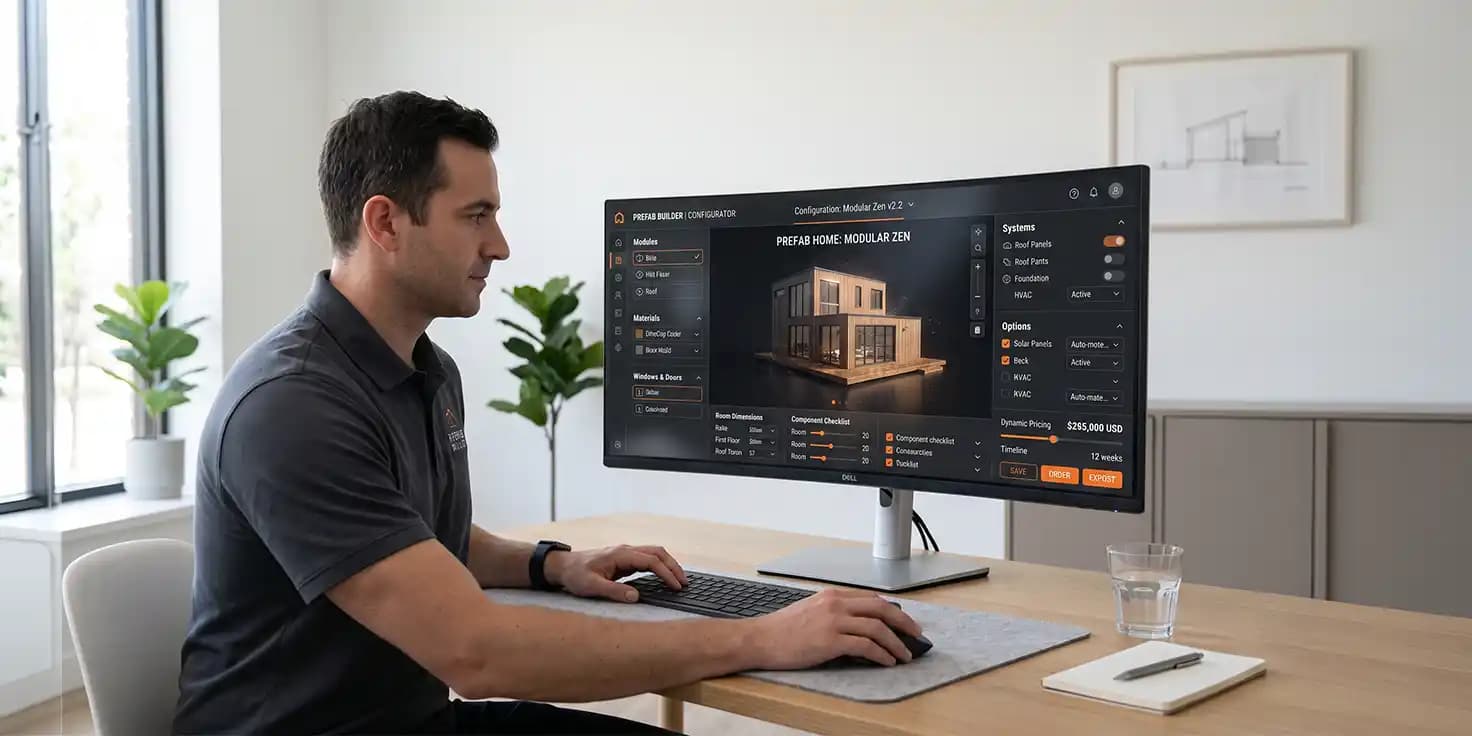
CPQ Software, Configure, Price, Quote, does this right. Rather than a manual review process for each configuration, a connected system automatically validates, prices and quotes a build. This is often combined with a 3d visualizer that allows buyers to see exactly what they are ordering before they commit.
CEOs and business leaders have even more opportunity. The right CPQ platform can help you shorten sales cycles, lower estimating overhead, avoid costly configuration errors and provide a scalable way to sell increasingly complex Building Products.
But not all CPQ platforms provide the same value.
A simple quoting tool could give you a price. A modern solution must be much more than that.
8 of the capabilities prefab builders should expect from true CPQ Software:
Real-Time Configuration & Instant Quotes
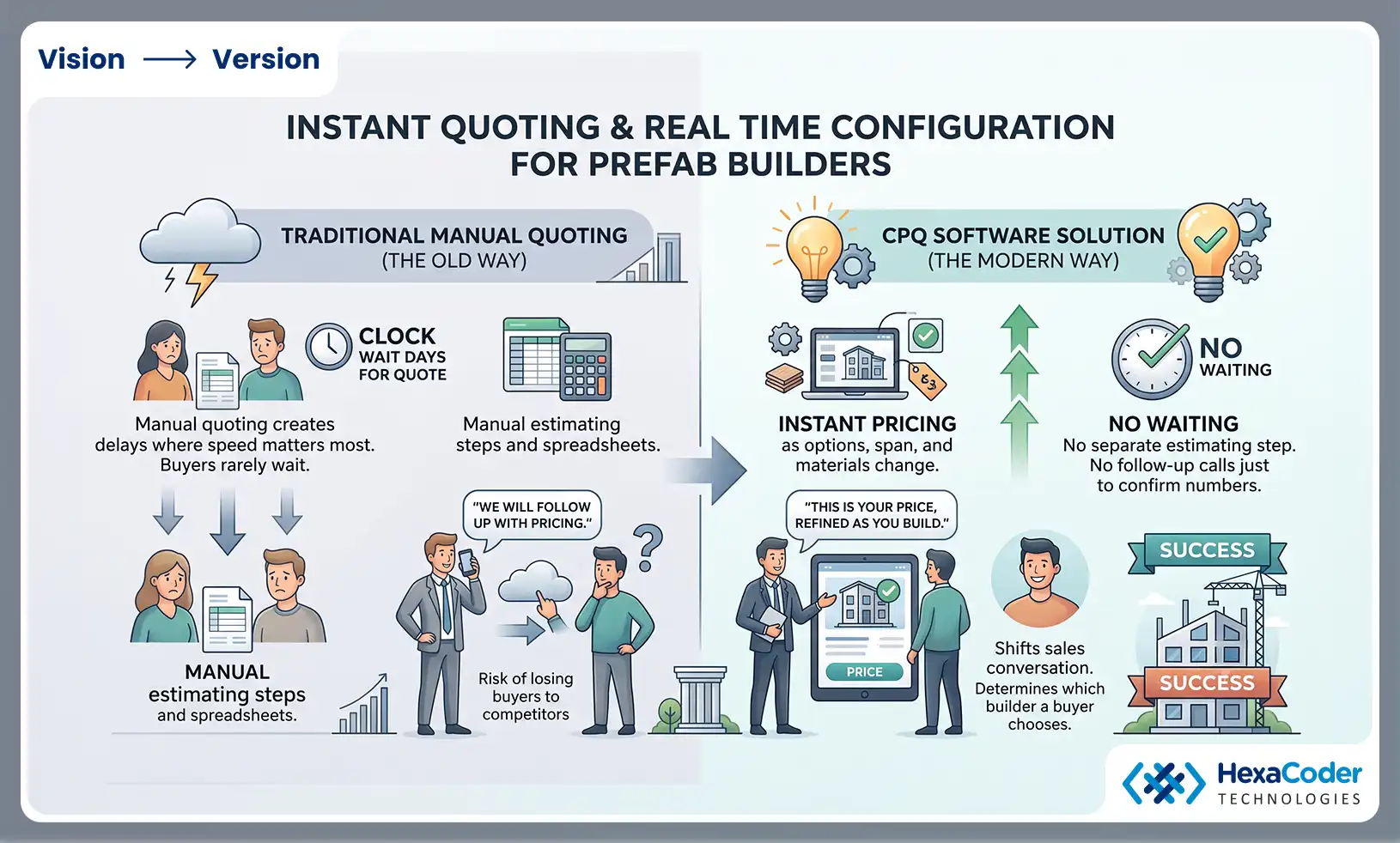
The first requirement is simple: The buyer and the sales team need to have a price as soon as the configuration changes.
Manual quoting creates delays at the one place where speed matters most. A buyer looking at prefab suppliers rarely waits days for a quote before switching to another supplier.
CPQ Solution offers instant pricing as options, span and materials change. No separate estimating step. No waiting on a spreadsheet. No follow-up call just to confirm a number.
This shifts the sales conversation from: We will follow up with pricing.
To: This is your price, refined as you build.
That shift alone often determines which builder a buyer will choose first.
Product Configuration with Rules
Prefabricated Buildings are seldom one type of simple product.
Span width, bay spacing, roof pitch, structural grade and finish all interact, and not all combinations are actually constructible.
Therefore, the rules for valid combinations should be specified in the Genuine Product Configuration.
For instance:
- Span limits can vary based on the structural grade.
- Bay spacing may be limited by roof pitch and load requirements.
- Some finishes may not be available in all size ranges.
- Automatically avoiding incompatible combinations of components.
- The structural bay layout can be the basis for restrictions to door and window openings.
Prefab builders and steel structure builders, when evaluating CPQ Software, should look beyond the interface and ask if the underlying rules engine reflects engineering reality.
This provides yet another important layer of protection for a builder. Buyers gain flexibility as the business maintains structural and manufacturing accuracy.
Real-time, accurate pricing
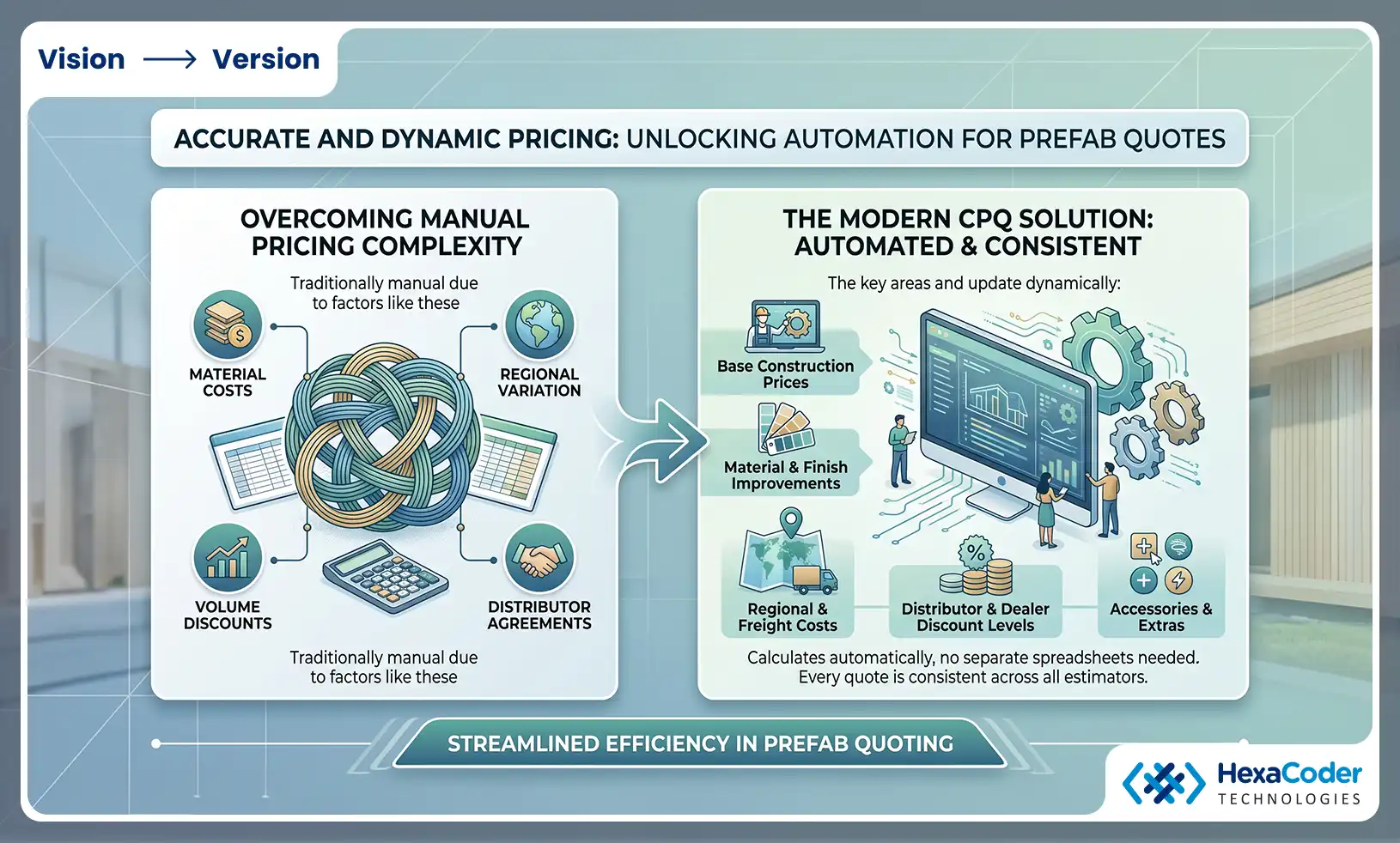
A big reason why prefab quotes stay manual for so long is complexity in pricing.
Material costs, regional variation, volume discounts and distributor specific agreements all impact the final number. A modern CPQ platform should do all of this automatically – no separate spreadsheet or manual look up table needed.
And the same with across:
- Construction Prices Base
- Material & Finish Improvements
- Regional or freight cost changes
- Distributor and Dealer Discounts Levels
- Accessories & Extras
This automates pricing and makes it consistent and automatic on every quote, no matter which estimator is doing it.
3D Configurator & Connected 3D Visualizer Technology
Visual configuration combined with quoting software is much more convincing.
Static spec sheets are what a structure looks like on paper. Connected 3d configurator lets buyers see it.
The buyer should be able to change the span, roofline, siding and finish and watch an accurate structure update in real time on a 3d visualizer. The quote should be updated alongside it.
It brings together two things that have traditionally been treated as separate, visualization and pricing, into one seamless experience.
The goal is not to make the quoting tool look good.
The goal is to take the guesswork out of buying a structure that cannot be seen, which has been accepted by buyers traditionally.
Material Quantity and Production Estimation
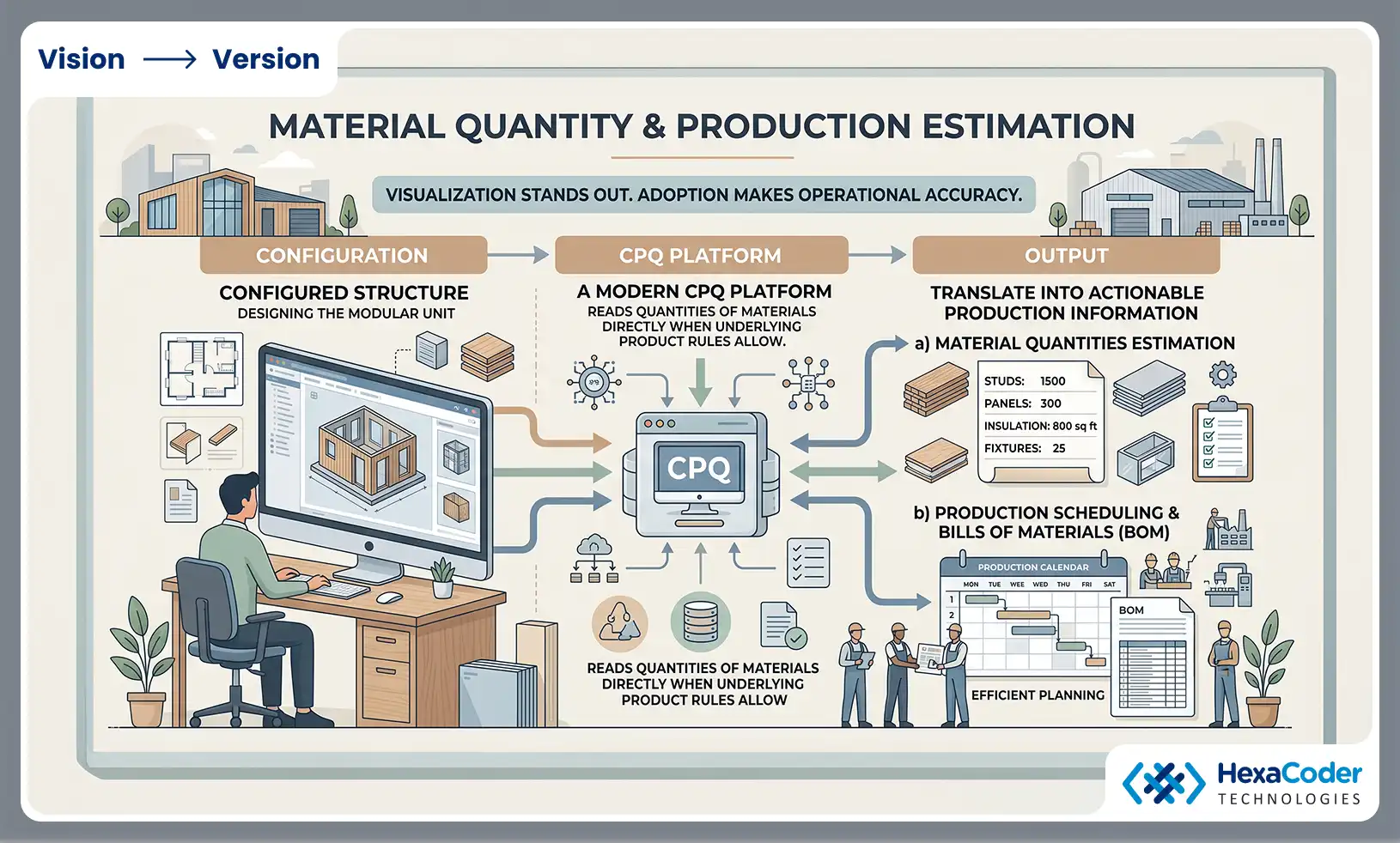
Visualization stands out. Adoption makes operational accuracy.
One of the most valuable capabilities of a prefab builder is to translate a configured structure into actionable production information.
A modern CPQ platform should be able to read quantities of materials directly from the configuration when the underlying product rules allow for this.
What Does Prefab CPQ Software Calculate?
| Component | Purpose |
|---|---|
| Structural steel or frame | Determine quantity needed |
| Cladding and panels | Estimate material requirements |
| Connectors and Fasteners | Calculate needed count |
| Openings – windows and doors | Determine configuration requirements |
| Roof components | Include finishing materials |
| Bags & Accessories | Add toppings as desired |
That makes a sales conversation a production-ready order.
This connection between quoting and estimating is especially helpful for builders where a configuration needs to go from sales into production planning without manual re-entry.
Guided Selling for Distributors and Sales Teams
An advanced CPQ platform should do more than just give you a price. It should guide the person building the quote to a valid, sellable configuration.
This is one of the biggest differences between a basic quoting tool and real CPQ Software.
Let’s say you’re a sales rep, and you have to choose a particular structural grade. The system should automatically restrict available spans, materials and finishes to those that are compatible.
Similarly, if a distributor selects a particular building use case, the platform can automatically bring up the components that are typically needed for it.
This means guided selling, not open-ended guesswork.
The system ensures accuracy behind the scenes for each rep on each quote, rather than relying on the memory of a senior estimator for every odd configuration.
This is especially important for expanding distributor networks. New salespeople can be giving accurate quotes in the first week with a builder, instead of spending months learning the product before they can be trusted to do anything more than the simplest configuration.
Access for Builders & Estimators Multi-Device
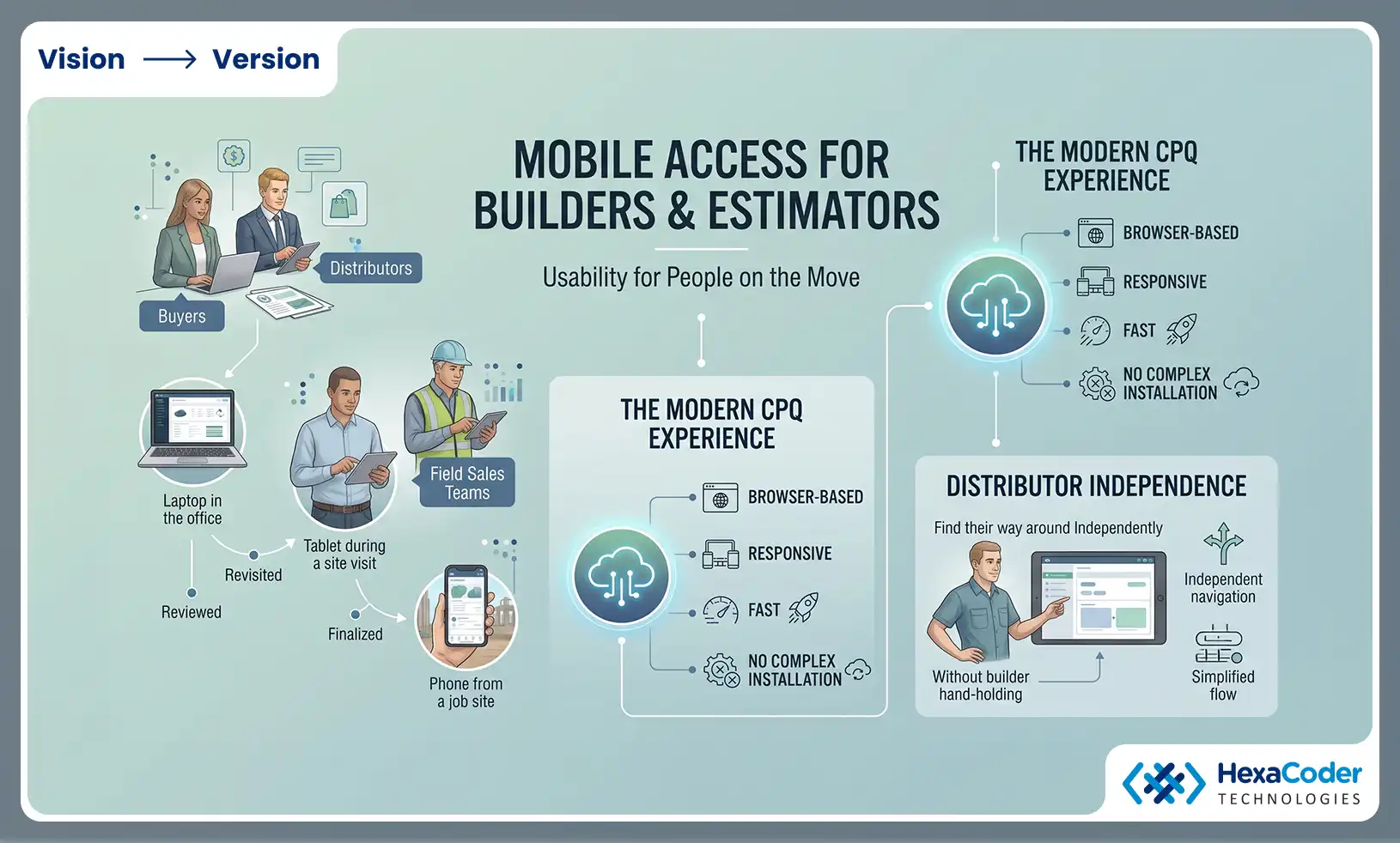
A powerful CPQ platform is only as good as it is usable by the people who need it.
Buyers, distributors and field sales teams are always on the move between devices. A quote can be reviewed on a laptop in the office, revisited on a tablet during a site visit, and finalized on a phone from a job site.
And so the experience has to work everywhere.
Ideally, a modern CPQ platform should be browser-based, responsive and fast and not require complex software installation on each device that touches it.
Distributors, in particular, should be evaluated on their ability to find their way around the platform, independently, without having to rely on the builder’s hand-holding.
Integration with Production, ERP and CRM Systems
The last feature might be the most important for a CEO.
CPQ Software shouldn’t be another siloed digital tool.
It needs to fit within the current business ecosystem.
Modern CPQ platforms can potentially link sales experience with systems used by production, estimating, CRM, ERP and enterprise operations.
Integrations could support, depending on business requirements:
- Product and price information
- Customer and prospect information
- Order and Production Hand-off
- Availability of inventory and materials
What Can Prefab CPQ Software Integrate With?
| Integration | Supports |
|---|---|
| ERP | Production and stock data |
| CRM | Lead & customer flow |
| Estimation Systems | Material and Cost Calculation |
| Planning of production | Order transfer |
| Data analysis | Performance insights |
The integration-first approach is especially important for pre-fabs builders. CPQ is not simply another disjointed front-end application that quietly reproduces the fragmentation it was designed to solve, it has to support the commercial and operational ecosystem.
What to look for in CPQ Software as a Pre-Fab Builder
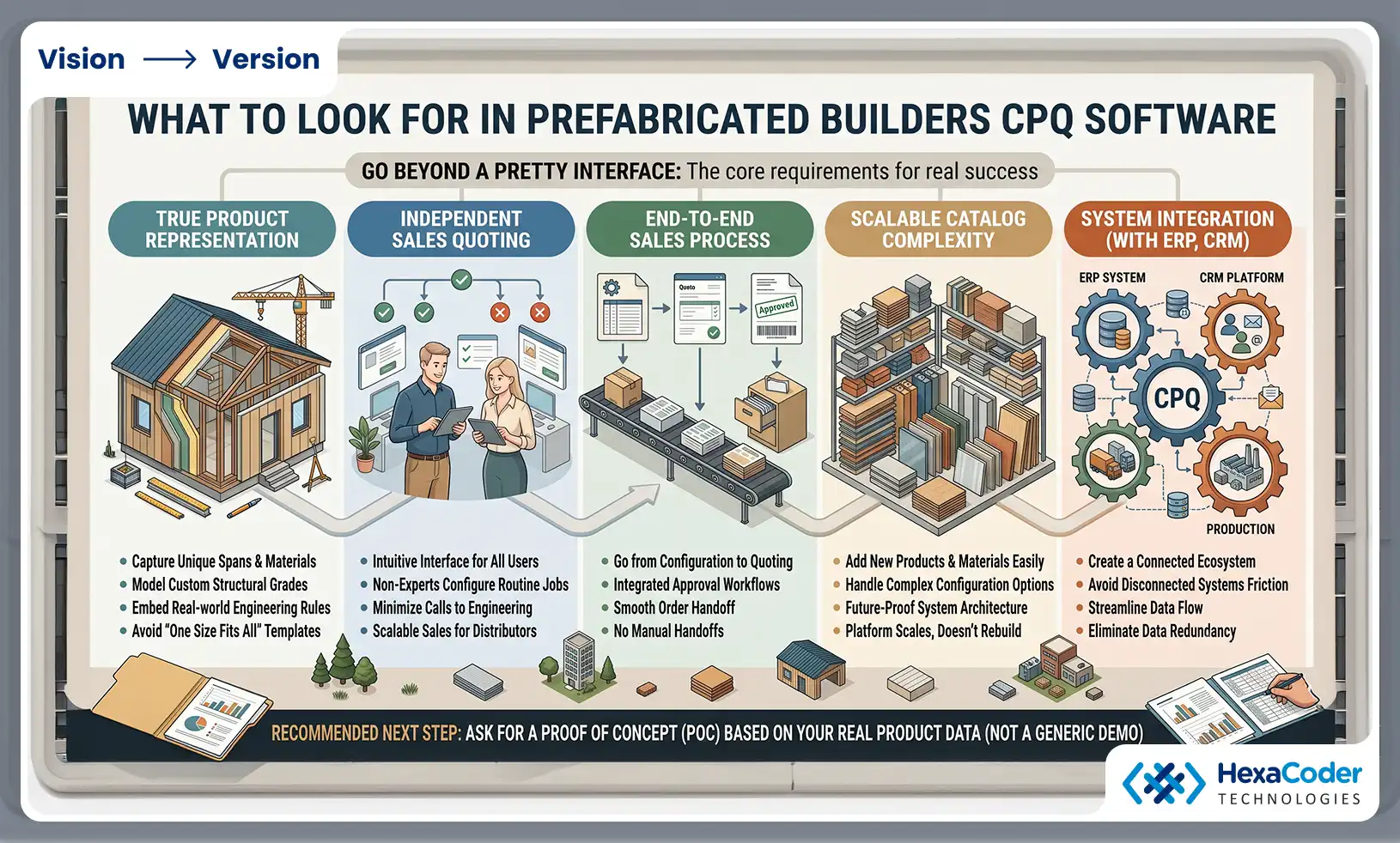
The biggest mistake is to judge CPQ platforms by the prettiness of their interface.
A clean quoting screen helps, but it’s not enough.
Decision makers should consider the platform in light of five broader questions:
- Will it be a true representation of our products? The system should represent the spans, materials, structural grades and rules that make the builder’s product line unique, not a one size fits all template that is stretched to fit.
- Are sales teams and distributors able to quote without escalation? The interface should be intuitive enough so that routine configurations do not require a senior estimator. When every third quote still requires a call to engineering, the platform hasn’t really solved the root of the problem.
- Will it do our whole sales process? The platform needs a clear path from configuration to quoting, approval and order handoff, not just ending at the quote and leaving all subsequent steps to manual coordination.
- Can it scale with our catalog? Builders add products, materials and configuration options. The platform should be able to scale with that complexity, and not have to be rebuilt every time the catalog grows.
- Can it run with what we have already? Disconnected CPQ Software from ERP, CRM and production systems creates as much friction as the manual process it was intended to replace.
It helps to ask for an evaluation step – a proof of concept built around the builder’s own real product data instead of a generic demo catalog. This says a lot about what a platform will really do when it is out there against real complexity.
Why CEOs and decision makers should care
The case for CEOs to look at this kind of investment is usually around a few measurable outcomes, not just a feeling that quoting should be modern.
The shorter the sales cycle, the sooner revenue is recognized. Buyers like speed. Getting a quote used to take days, now it takes minutes. In a competitive bidding situation the first correct bid often wins the deal.
Less mistakes keep margins. Whether it’s scrapped material, a rejected quote or costly rework once production is already underway, every misconfigured order has a direct impact on profitability that compounds over a year of order volume.
Sales capacity increases without a corresponding increase in headcount, as reps and distributors can now create their own accurate quotes, rather than sending every non-standard request back to a small group of senior estimators.
And cleaner data means better planning, because each quote that flows through a connected CPQ platform reveals real demand patterns, not anecdotal sales reports bouncing around the reps and territories.
Less obvious but no less important is the trust of the buyer. The impression a builder makes on the buyer by giving a quick, accurate, professional quote is very different from one who has to wait days for a figure that may need to be changed. That impression is not only for the current deal but whether that buyer — or the contractor and architect they hire — come back for the next project.
Strategic Opportunity Outside of CPQ
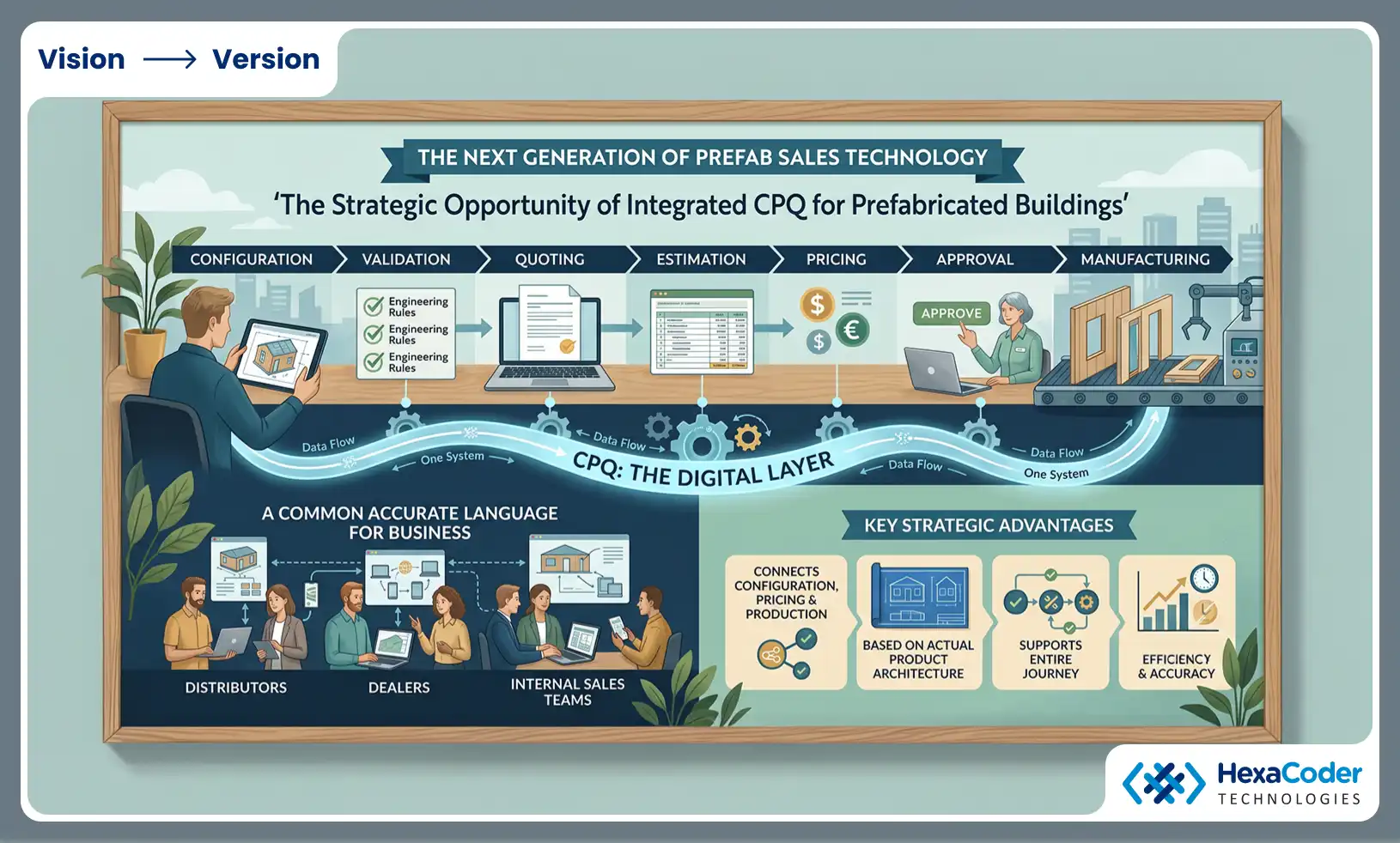
The future of prefab sales technology is more than just faster quoting.
It’s about connecting as one system configuration, pricing and production.
The next generation of sales tools must support the entire journey for pre-fabricated building manufacturers:
Configure → Validate → Quote → Estimate → Price → Approve → Manufacture
CPQ for Prefabricated Buildings can be the digital layer linking these stages.
The case for doing so is especially strong when the platform is based on the builder’s actual product architecture and production process, not some off-the-shelf quoting tool.
That same technology can also be used to empower distributors, dealers and internal sales teams to create a common accurate language for pricing and product configuration across the whole business.
Final thoughts
Prefab Construction is changing its sales process to be faster, more accurate and more connected.
Buyers want quotes they can trust right away, not days later.
Sales teams and distributors are looking for tools that give them the confidence to quote without having to ask every configuration question.
Builders want to be able to sell more and more complex Building Materials and Building Products without having to hire more estimators for each new product line.
And CEOs want technology investments that deliver real business outcomes, not just a better-looking quoting screen that doesn’t quite translate into faster sales cycles or fewer mistakes.
When real-time configuration, rule-based validation, dynamic pricing and real production integration are all brought together in one connected system – a system built around a builder’s actual products and processes, not a generic template stretched to fit an industry it was never designed for – Prefabricated Building Configuration Software can satisfy all of the above requirements.