
Why the Digital Twin Metaverse Is the Future
The virtual world allows complete cities and complete factories and complete power grids to exist as exact digital copies of their actual existence before any construction work begins or any equipment starts operating. Engineers use this platform to assess infrastructure performance during severe weather events while urban planners create models that predict traffic patterns until the year 2050 and business leaders discover new operational methods through this complete digital simulation of real-world environments. The Digital Twin Metaverse exists as a real-world system that combines digital twins and virtual environments to create a new method of interacting with physical and digital spaces.
The digital twin metaverse combines exact data-based virtual representations of real-world objects with unlimited interactive possibilities that immersive environments provide. The virtual twins operate in real time because they receive continuous updates from sensors and IoT devices and connected systems which distinguishes them from traditional simulations and CAD models. Organizations use metaverse technology to create interactive workspaces that allow users to make decisions and develop new ideas while conducting experiments in a secure and efficient way which leads to faster progress.
The entire construction industry and manufacturing sector and healthcare field and energy industry and retail sector have started to understand their potential benefits. The system enables businesses to forecast future issues while creating virtual customer interactions and providing employees with complete secure training scenarios. The government uses special tools to create accurate models of city development and to determine the most effective methods for managing traffic and controlling energy usage. The integration of physical elements with digital systems creates new operational methods which enable organizations to achieve greater creative output and operational productivity and environmental responsibility.
Throughout this article, we will demonstrate the operational functioning of the digital twin metaverse through the examination of its enabling technologies which prove its potential to transform industrial operations and business practices and societal development. The digital twin metaverse has become an essential business requirement because it supports industrial processes and consumer experiences which transform production methods and energy usage and complete retail and educational environments.
The study will explain how this convergence creates transformative effects for various industries while identifying essential business prospects which companies will achieve through their current adoption of this practice.
Understanding Digital Twins and the Metaverse
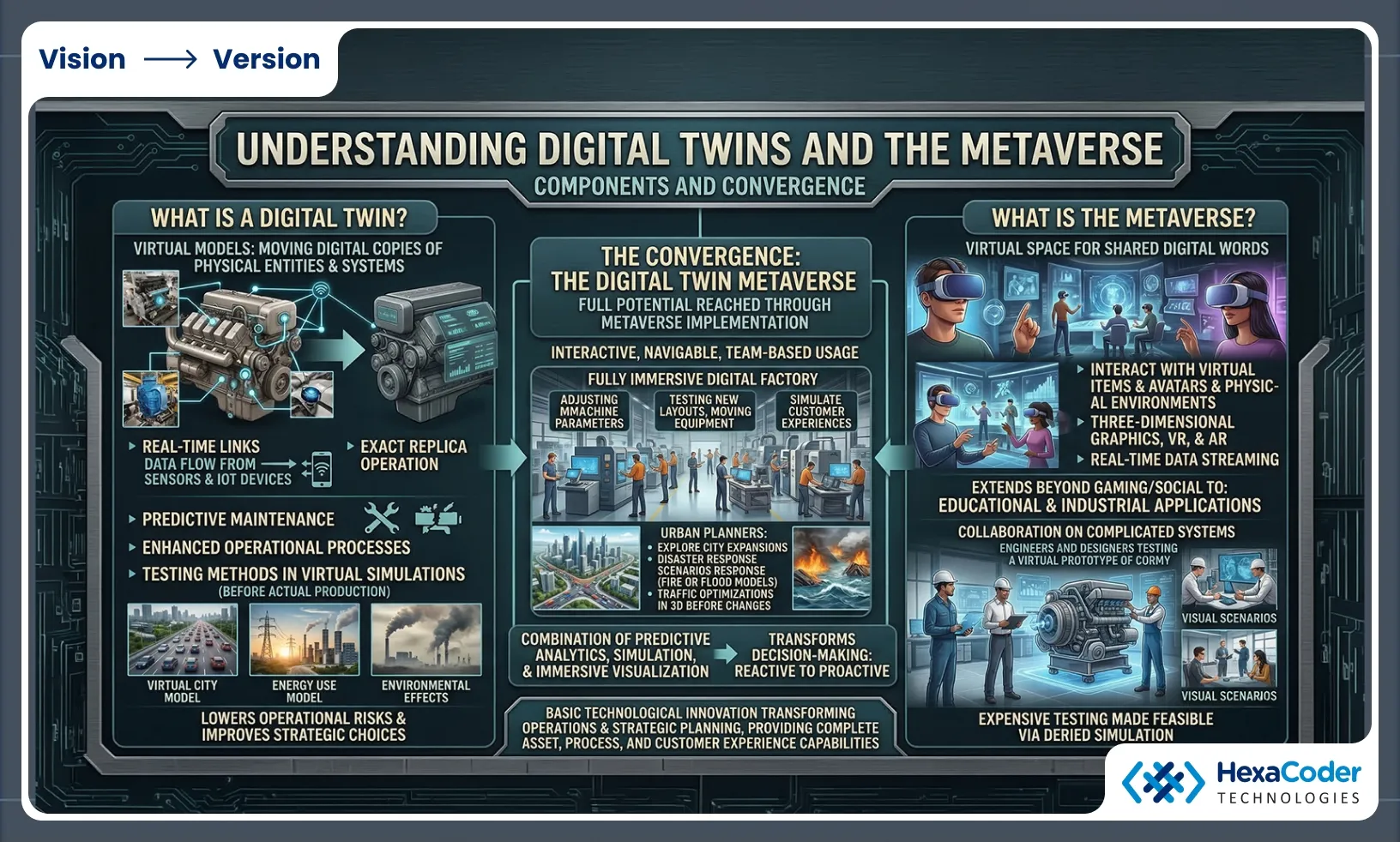
The digital twin metaverse reaches its full potential after people first comprehend its two basic components which are digital twins and the metaverse. Digital twins function as virtual models which create moving digital copies of actual physical entities and operational systems and industrial processes. Digital twins establish real-time links to their physical counterparts through continuous data acquisition from sensors and IoT devices and networked systems. The system uses this data to create an exact replica of its physical system which operates in a similar way to the actual machine. The digital twin system allows manufacturing plants to predict machine breakdowns while enhancing operational processes and testing various production methods through virtual simulations before starting actual production. Digital twins enable urban planners to create virtual models of buildings and their surrounding systems which display energy use and traffic flow and environmental effects. The operational effectiveness of digital twins enables organizations to make better choices which decrease their operational risks while achieving their business goals more effectively.
The metaverse provides users with a virtual space that enables them to experience shared digital worlds through which they can engage with virtual items and human avatars and physical environments. The metaverse uses three-dimensional graphics and virtual reality and augmented reality technologies together with real-time data streaming to create an interactive environment which extends beyond gaming and social functions to educational and industrial applications. The metaverse enables engineers and designers and managers to work together on complicated systems by creating visual scenarios which they can test through simulations which would be too expensive to conduct in actual environments.
The Convergence: Digital Twin Metaverse shows that digital twins achieve their highest potential through metaverse implementation. The digital twin functions as a real-time model based on actual data until users access its metaverse version which enables interactive and navigable and team-based usage. Stakeholders can walk through a digital factory, adjust machine parameters, test new layouts, or simulate customer experiences in a fully immersive environment. Urban planners can explore city expansions, disaster response scenarios, or traffic optimizations in 3D before any physical changes are made. The combination of predictive analytics, simulation, and immersive visualization transforms decision-making from reactive to proactive, which enables organizations to achieve innovation at an extraordinary rate.
The digital twin metaverse functions as a basic technological innovation which transforms all organizational methods of operation and strategic planning and their interaction with both real-world and digital spaces. The metaverse provides organizations with complete asset and process and customer experience capabilities through real-time digital twins and immersive metaverse interactivity.
Key Technologies Enabling the Digital Twin Metaverse
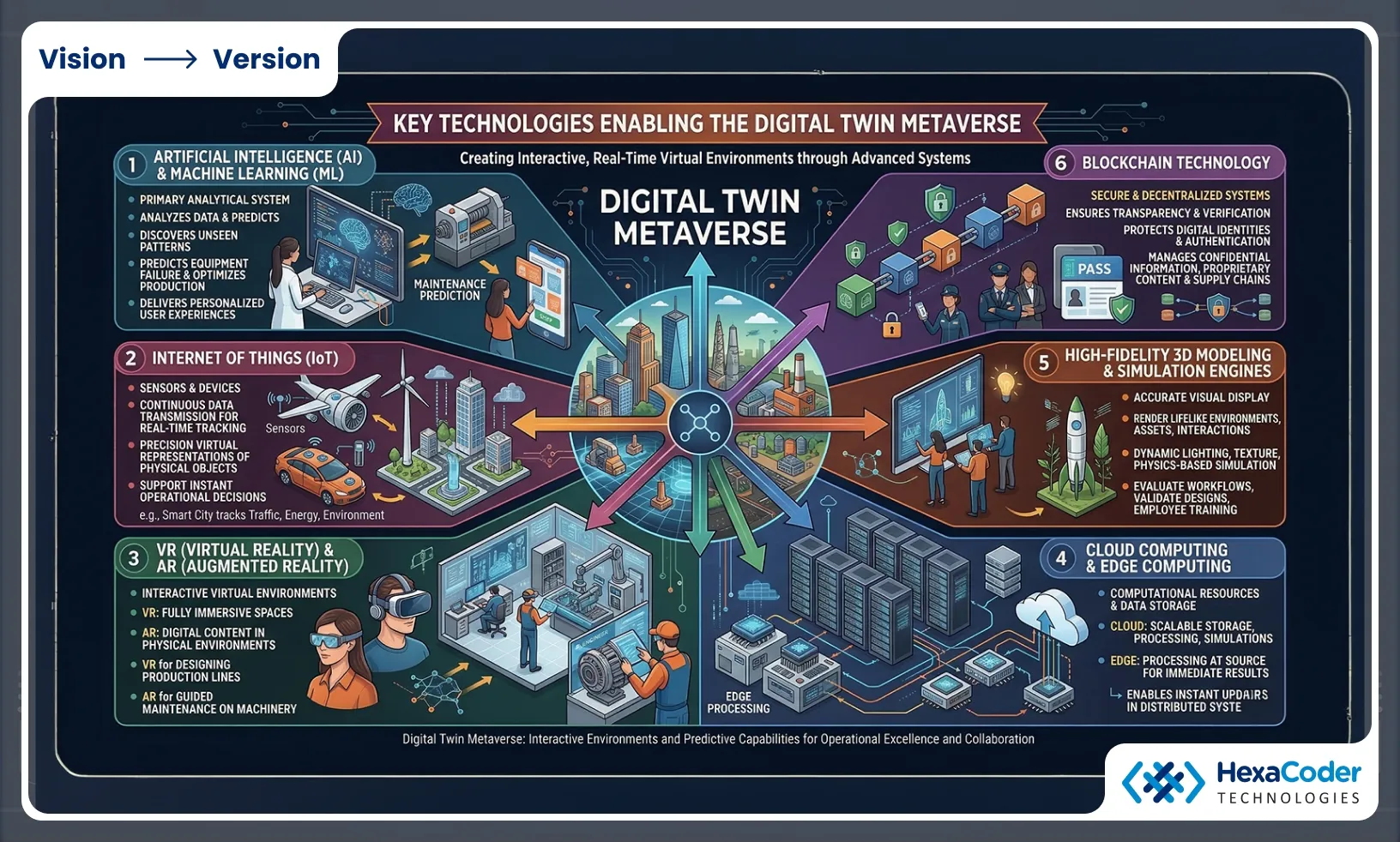
The digital twin metaverse uses multiple advanced technologies which combine to produce interactive experiences that enable users to explore virtual environments in real time. The digital twin metaverse uses these essential elements to transform business operations through its implementation.
Artificial Intelligence (AI) and Machine Learning (ML)
The digital twin metaverse uses Artificial Intelligence (AI) and Machine Learning (ML) technologies as its primary analytical system. The system analyzes extensive sensor data together with operational information to create predictions which help business processes and discover previously unseen patterns. AI predicts when industrial equipment will fail and models different production methods while it also makes recommendations about how to best allocate resources. AI helps consumer applications deliver personalized experiences by predicting user preferences and adjusting virtual environments according to their preferences in real time.
Internet of Things (IoT)
The digital twin metaverse uses IoT devices which act as sensors that create digital twin systems. The sensors which exist in machines and vehicles and buildings and wearable devices continuously transmit data to the metaverse for real-time tracking. The IoT layer provides a system which allows every virtual model to show the actual condition of its real-world equivalent thereby creating precise virtual representations which support instant operational decisions. A smart city project uses IoT sensors to track traffic patterns and energy consumption and environmental factors which it uses to create a digital twin that tests urban development plans in a metaverse environment.
Virtual and Augmented Reality (VR/AR)
The metaverse uses VR and AR technologies to create an interactive virtual environment through its VR and AR systems. VR technology lets users completely immerse themselves in virtual spaces whereas AR technology shows digital content within the user's actual environment. The two technologies work together to provide users with an interactive experience of digital twin systems. Engineers can use VR to create digital models of production lines in manufacturing environments while technicians can follow AR-based maintenance instructions which display instructions on physical machinery.
Cloud Computing and Edge Computing
The digital twin metaverse needs substantial computational resources together with extensive data storage capabilities. Cloud computing enables organizations to expand their storage capacity while processing extensive datasets and running simulations and maintaining virtual reality experiences. Edge computing processes information at its original location to deliver immediate results for time-sensitive applications. The combination of cloud and edge computing systems provides uninterrupted user experience across virtual environments which enables instant updates to function correctly under distributed system operations.
High-Fidelity 3D Modeling and Simulation Engines
The metaverse requires accurate visual display of its content for its proper operation. Advanced 3D modeling and simulation engines render lifelike environments, assets, and interactions. The engines create a realistic interactive environment which users can explore by supporting dynamic lighting and authentic texture and physics-based simulation and multiple users who can interact with each other. Industries ranging from aerospace to retail use these simulation tools to evaluate operational workflows while validating product designs and enabling employee development without incurring real-world expenses.
Blockchain Technology
Blockchain technology needs secure systems which provide both transparency and verification for its operations because increasing data exchange between connected systems creates new security requirements. Blockchain technology provides metaverse users with secure and permanent protection of their digital identities through its authentication system which safeguarding their virtual identity existence. The need for this system arises from the requirement of security for industries which manage confidential information and proprietary content and their operations in supply chain management.
The digital twin metaverse uses these technologies to create an interactive environment which responds to user actions while also providing users with predictive capabilities. The new system enables companies to achieve operational excellence through visualization of their complex systems which can be used for remote collaboration and decision-making based on their operational simulations.
Top Use Cases of the Digital Twin Metaverse Across Industries
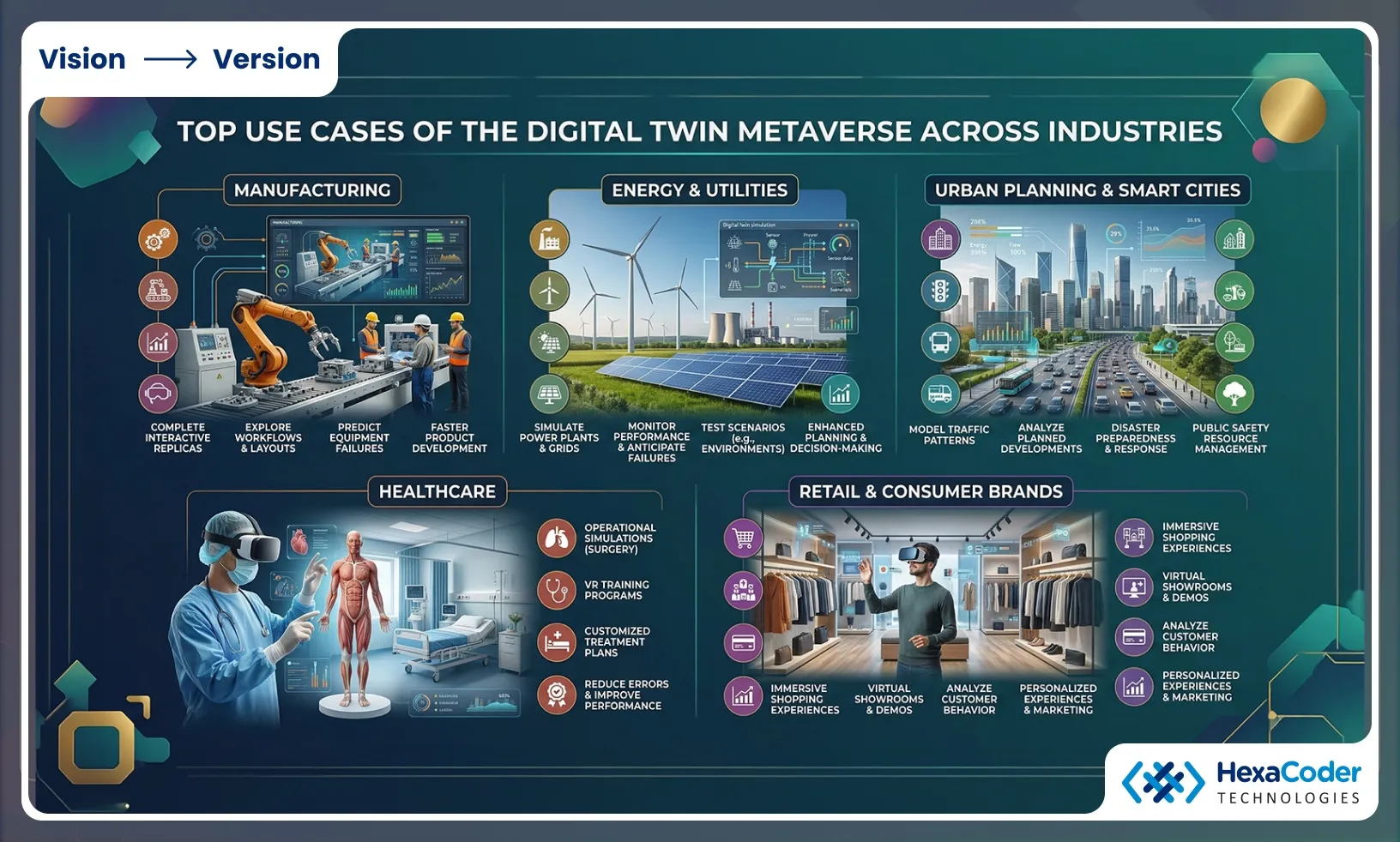
The digital twin metaverse creates a new operational model for business through its combination of physical processes and virtual reality technology.
Manufacturing and Industrial Operations
Manufacturing offers a practical example because production facilities now exist as complete interactive digital replicas. Engineers and managers can explore workflows, machinery, and material flows in real time, testing changes to layouts, schedules, or machine parameters without ever halting physical operations. The system enables organizations to predict equipment failures, which helps them maintain operations and boost productivity. The virtual collaboration capabilities between teams from different locations enable organizations to achieve faster product development while reducing both risk and operational expenses.
Energy and Utilities
Digital twin metaverses enable energy and utilities companies to create complete simulations of power plants and renewable energy farms and distribution grids. Operators use real-time sensor data to monitor equipment performance and anticipate failures while they manage energy distribution. Companies can assess wind turbines and solar panels and pipelines through virtual testing of various operating scenarios which enables them to handle environmental and operational changes. The system employs immersive visualization techniques which simplify complex system comprehension, thus enhancing planning, training, and decision-making processes.
Urban Planning and Smart Cities
Digital twin metaverses serve as essential tools for urban planning and smart city project development. City planners can use simulations to model traffic patterns and energy consumption and environmental effects which result from their planned infrastructure development. Virtual cities enable their stakeholders to examine their planned developments through pedestrian flow analysis while evaluating urban project impacts which were previously inaccessible. The simulations feature emergency situations which enable cities to establish disaster preparedness systems and major event response procedures while they manage their public safety resources.
Healthcare and Medical Training
The healthcare industry undergoes its most extensive changes at this time. The digital twin metaverses enable hospitals to develop operational simulations which include patient movement patterns and surgical execution. Medical professionals use virtual reality training programs to practice on authentic anatomical models and medical equipment which helps them decrease mistakes and attain better performance results. Digital replicas help patients by providing them with customized treatment plans that enable their rehabilitation progress to be tracked. Students and professionals can develop their educational and training skills through interactive simulations which create authentic real-world scenarios without endangering any person.
Retail and Consumer Experiences
Digital twin metaverses enable retail and consumer brands to design immersive shopping experiences which use virtual reality technology. Virtual showrooms combined with interactive product demonstrations and personalized experiences enable consumers to examine products through lifelike details before making their final purchase decision. Retailers acquire knowledge about customer behavior and preferences through customer engagement patterns which helps them develop effective marketing strategies and create new products. The metaverse changes shopping from an ordinary buying activity into an interactive experience which uses data to create shopping environments.
The digital twin metaverse provides businesses with more advanced capabilities than its visualization function because it enables them to perform predictive analytics and monitor their operations in real time while multiple users can work together at previously unattainable levels of efficiency. The program provides organizations with the ability to decrease risks while they use their resources more effectively and speed up their innovation process to create better experiences for their workers and customers. The digital twin metaverse will become a fundamental component for businesses that need to develop their operational frameworks and design their urban areas and create new healthcare solutions and handle customer interactions as more people begin to use it.
Benefits and Strategic Advantages of the Digital Twin Metaverse
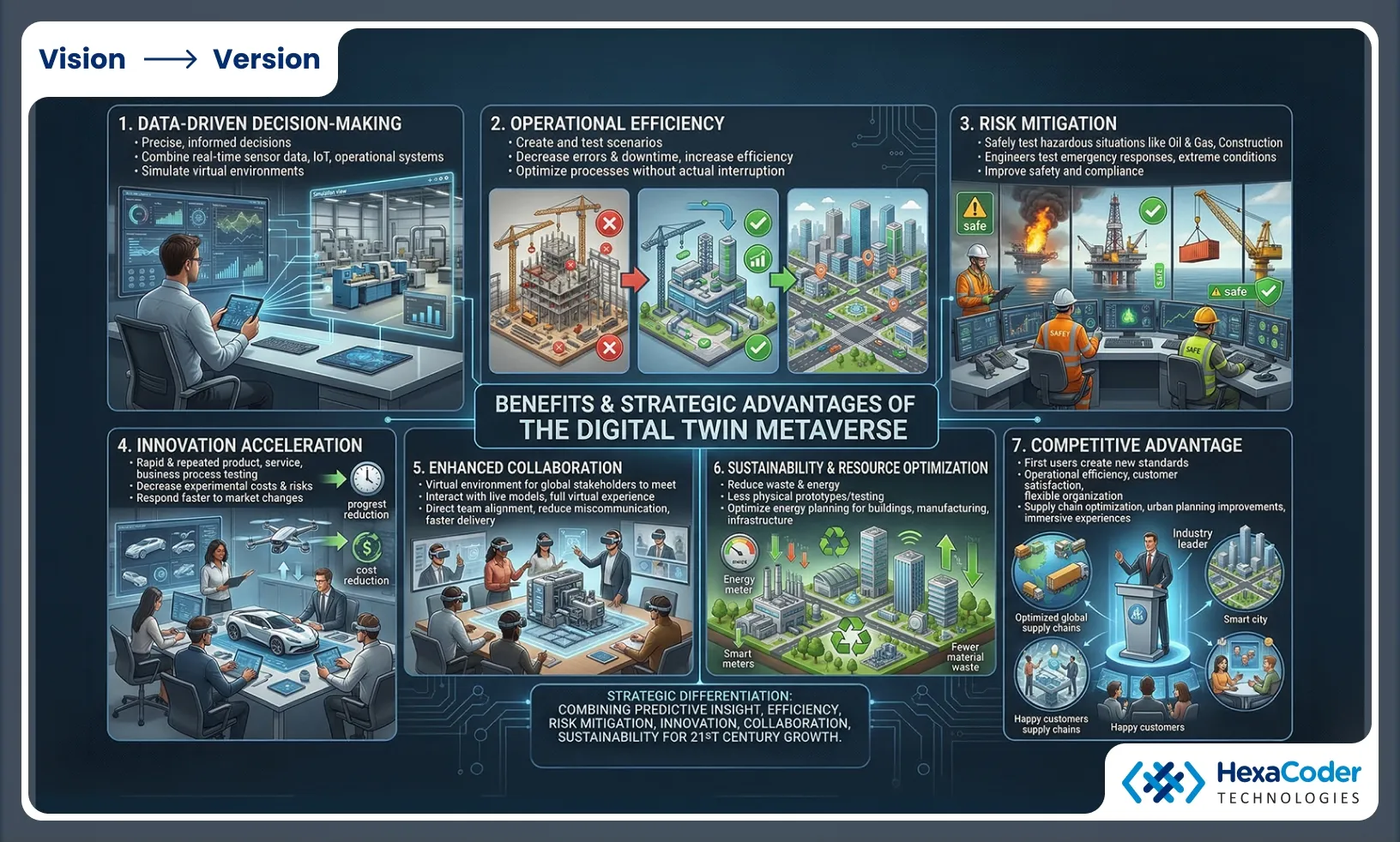
Data-Driven Decision-Making
The system enables organizations to develop precise and well-informed decisions through its capacity to combine real-time data from sensors with IoT devices and operational systems and its virtual environment simulation capabilities. The system uses simulation technology to create operational scenarios which it tests through virtual execution to decrease errors and downtime while increasing operational efficiency.
Operational Efficiency
Manufacturing construction and energy operations can be simulated through virtual testing which enables identification of operational bottlenecks and optimization of work processes without interrupting actual business activities. Urban planners and smart city projects use simulations to analyze traffic patterns and energy usage and public safety measures which helps them save time and reduce actual expenses.
Risk Mitigation
High-stakes or hazardous industries can safely test dangerous situations which include oil and gas operations and chemical production and large-scale construction projects. Engineers and safety personnel can test emergency responses and equipment performance under extreme conditions which leads to improved workplace safety and regulatory compliance.
Innovation Acceleration
The system offers a testing environment which enables users to conduct fast and repeated product testing together with service model testing and business process testing. The system decreases experimental costs and risks, which enables organizations to respond to market changes more quickly while obtaining a competitive advantage.
Enhanced Collaboration
The virtual environment enables stakeholders from various locations to meet and interact with live models through its complete interactive virtual experience. The virtual environment enables direct team collaboration which leads to better project alignment and less miscommunication while increasing project delivery speed.
Sustainability and Resource Optimization
The process achieves waste and energy reduction through its ability to decrease both physical prototype and testing requirements. The system assists organizations in achieving their environmental targets through improved energy efficiency planning for their building projects and manufacturing facilities and their infrastructure development activities.
Competitive Advantage
The first users create new standards which measure operational efficiency and customer satisfaction and innovative development and organizational flexibility. The digital twin metaverse enables organizations to achieve supply chain optimization and urban planning improvements while developing immersive customer experiences which help them become industry leaders.
Strategic Differentiation
The framework combines seven elements which are predictive insight, operational efficiency, risk mitigation, innovation, collaboration, and sustainability. The fast-changing environment of the 21st century now requires businesses to adopt this technology because it has become essential.
Challenges and Considerations of the Digital Twin Metaverse
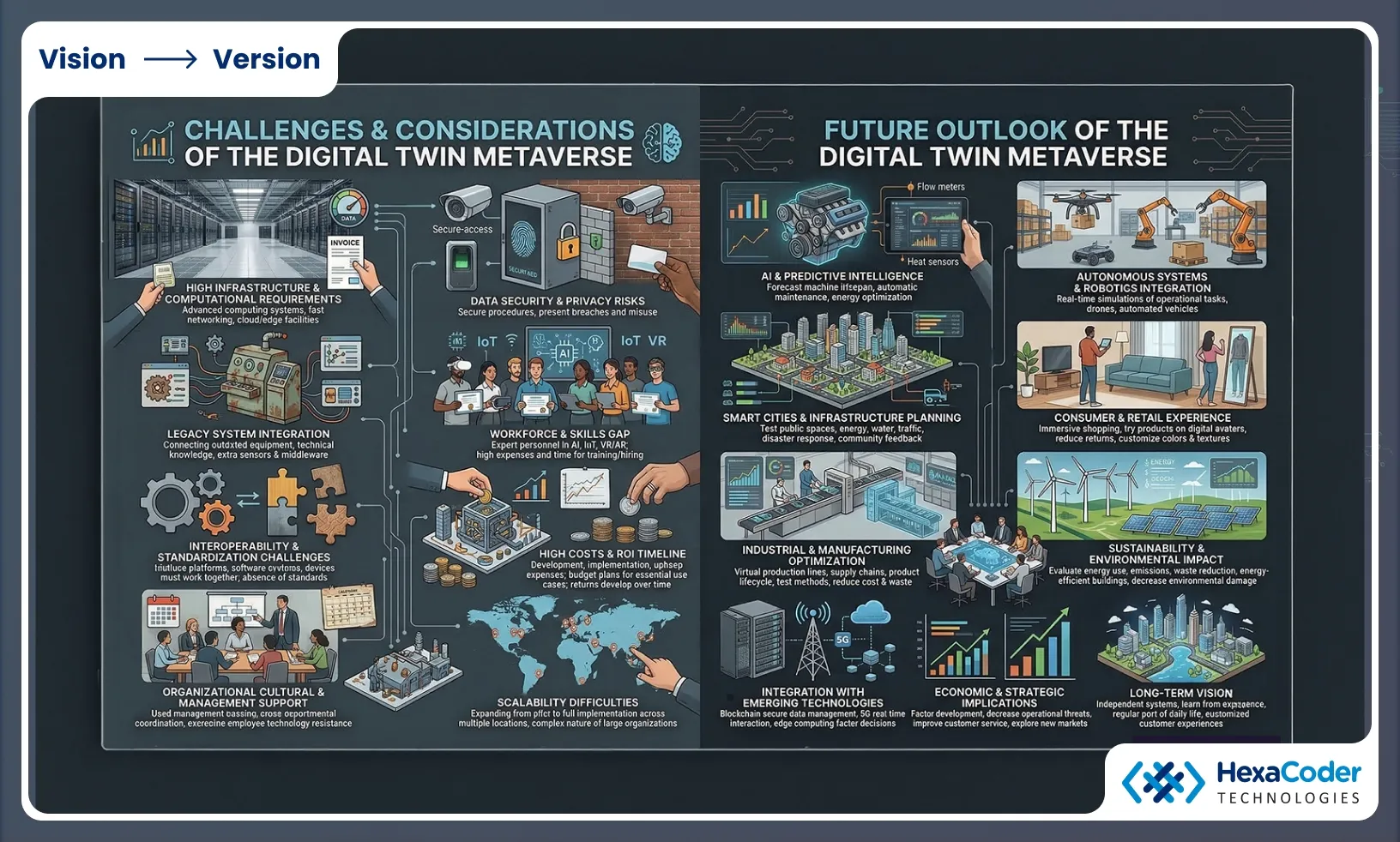
The digital twin metaverse provides organizations with transformative potential but requires them to address multiple obstacles before they can obtain its full advantages.
High Infrastructure and Computational Requirements
The High Infrastructure and Computational Requirements for real-time simulations of complex systems need advanced computing systems together with fast networking and cloud or edge computing facilities. Organizations need to make substantial upfront expenses to establish these operational capabilities.
Data Security and Privacy Concerns
Digital twins depend on extensive real-time data, which includes sensitive information about operations and customers and personal data. The organization needs to establish secure procedures for data transmission and data storage and data access to stop potential data breaches and data misuse.
Integration with Legacy Systems
Multiple industries continue to use outdated equipment and software systems. The implementation of digital twin metaverse technology requires technical knowledge to connect existing systems because the process demands extra sensors and middleware and custom interfaces.
Skills and Talent Gap
The organization needs employees who possess expertise in AI and IoT and data analytics and VR/AR and simulation technologies to achieve successful implementation. Organizations have two options to acquire needed personnel through staff development programs or through hiring processes, which both lead to high expenditures and extended time requirements.
Interoperability and Standardization
The interoperability and standardization challenges arise because multiple platforms and software systems and devices must work together without any problems. The absence of industry standards combined with system incompatibility creates obstacles that prevent organizations from implementing solutions and expanding their operations.
Cost and ROI Considerations
Digital twin metaverse systems require expensive expenses for their development work and their implementation work and their system upkeep work. Organizations need to create budget plans which allocate resources to essential use cases while they authenticate their funding requirements because return on investment (ROI) develops over time.
Organizational Change Management
To establish metaverse-based operations organizations need to change their organizational culture and secure management support and create cross-departmental coordination. The process of new technology implementation experiences delays because employees display technology resistance.
Scalability Challenges
The process of extending digital twin metaverse solutions from their initial pilot testing phase to full implementation across large organizations with multiple locations creates substantial difficulties because of their complex nature.
The digital twin metaverse provides organizations with complete advantages after organizations execute precise planning and make targeted investments and use gradual implementation methods to handle their existing challenges.
Future Outlook of the Digital Twin Metaverse
AI and Predictive Intelligence
AI will evolve to exceed its current capabilities which involve analyzing past data and responding to live situations by creating multiple future outcomes and providing recommendations for the best strategic approaches. For example, in manufacturing AI-powered twins use digital simulations to forecast machine component lifespans while creating automatic maintenance schedules and ordering required parts before operational interruptions happen. AI technology in smart cities can forecast emergency traffic pattern changes while it improves energy distribution and automatically updates public transit times to decrease traffic bottlenecks. The metaverse functions as an active system which enables decision makers to make choices before any problems arise.
Autonomous Systems and Robotics Integration
The digital twin metaverses will enable autonomous vehicles and drones and robotic systems to perform real-time simulations of their operational tasks. Construction projects can deploy autonomous cranes and machinery through virtual replicas which will enhance safety and operational effectiveness. Logistics companies can create virtual models of their complete supply chains which enable drones and automated vehicles to function together with their physical and digital counterparts while they identify operational bottlenecks and modify their delivery routes in real-time.
Smart Cities and Infrastructure Planning
Digital twin metaverses will enable cities to simulate large-scale infrastructure projects in full detail before implementation. Planners can test public spaces and energy grids and water systems and traffic networks to identify inefficiencies and risks. The simulation of emergency situations through natural disaster scenarios allows improvement of response procedures. Urban planners could even allow citizens to interact with virtual models of proposed developments which would help them gather community feedback before construction begins.
Consumer and Retail Experience Transformation
Retailers will use digital twin metaverses to create immersive shopping environments. Consumers can walk through virtual stores, try products on digital avatars, and interact with items before purchasing. Furniture retailers, for example, could allow shoppers to place a virtual sofa in their living room using AR, customizing colors and textures in real-time. Fashion brands could let customers try on clothes virtually, adjusting fit and style, reducing returns and increasing confidence in purchases.
Industrial and Manufacturing Optimization
Digital twin metaverses will create complete virtual representations of production lines and supply chains and product lifecycle processes in manufacturing. Factories can test new production methods and equipment layouts through simulation while maintaining their ongoing physical operations. Virtual monitoring of global supply chains enables organizations to predict shortages and modify their sourcing methods and streamline their logistics operations. The process will achieve three benefits which include cost reduction and waste reduction and improved operational resilience.
Sustainability and Environmental Impact
Digital twin metaverses will enable accomplishment of environmental targets. Companies can evaluate their energy consumption and emissions and waste reduction methods through virtual testing before implementing those methods in real-world scenarios. Architects can design energy-efficient buildings while production facilities can reduce their raw material consumption through virtual optimization of their production processes. The method decreases environmental damage while it boosts financial benefits.
Enhanced Collaboration and Workforce Development
The digital twin metaverse enables teams from different locations to work together in a common digital environment. The system enables engineers, architects, city planners, and managers to work together through real-time model access and simulation testing for their decision-making process. The creation of training programs involves building immersive training environments which enable employees to learn and practice complicated tasks in a secure setting. The method improves employee abilities while decreasing mistakes and speeding up the process of transferring information.
Integration with Emerging Technologies
The metaverse will increasingly develop through its integration with emerging technologies which include blockchain and 5G connectivity and edge computing. The system uses blockchain technology to provide secure data management which enables users to view all data operations. The system achieves real-time interaction through its 5G technology which decreases latency for users. Edge computing enables organizations to process data at its collection point which results in quicker decision-making and improved virtual reality experiences.
Economic and Strategic Implications
Organizations that adopt the digital twin metaverse solution will achieve better business results than their competitors. Companies that adopt the technology first will experience quicker development processes which will decrease their operational threats while improving their customer service outcomes. The virtual environment enables companies to explore new markets while conducting worldwide product testing and developing vital business strategies without needing to invest in extensive physical resources.
Long-Term Vision
The next ten years will see digital twin metaverses develop into independent systems which learn from their own experience and operate without human intervention. The metaverse will become a regular part of daily existence as cities and industries and consumers use digital replicas of actual things. The metaverse will serve as the primary platform which enables people to interact with technology and enables organizations to forecast infrastructure failure points and develop customized customer experiences.
Embracing the Digital Twin Metaverse for a Smarter Future
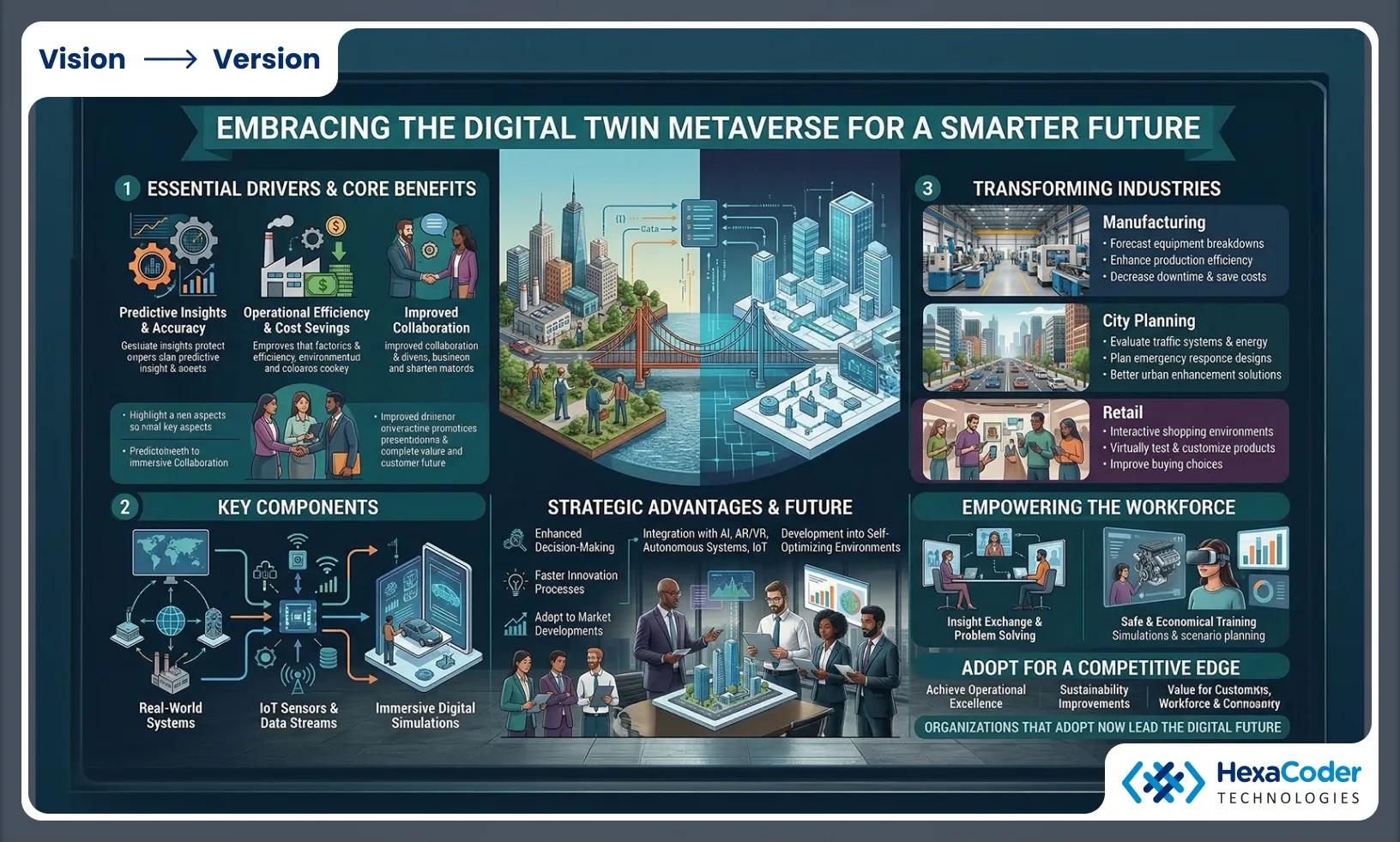
The digital twin metaverse has evolved from a theoretical concept into a real-world disruptive technology which now transforms various industries and urban environments and consumer behavior across the globe. The technology combines real-time operational data with immersive digital simulations to help organizations predict upcoming challenges and enhance their processes and strategic decision-making capabilities with exceptional accuracy. Organizations need predictive insights and operational efficiency and improved collaboration because these elements have become essential requirements for achieving success in an environment where speed and accuracy and flexibility control competitive success. The benefits of digital twin technology extend to multiple industries which include manufacturing and construction and energy and healthcare and retail operations.
Digital twins enable factories to forecast equipment breakdowns while they enhance production efficiency which results in decreased downtime and cost savings. Virtual city models allow city planners to evaluate traffic systems and energy requirements and emergency response designs which results in better environmental and urban enhancement solutions. Retailers are developing interactive shopping environments which enable customers to virtually test products and customize their selections before making buying choices. The digital twin metaverse improves all industries through better operational capabilities and decreased environmental harm and creation of new possibilities that were not possible before.
The digital twin metaverse provides organizations with strategic advantages which extend beyond their capacity to enhance operational processes. The system boosts decision-making efficiency while decreasing the time needed for innovation processes and enables organizations to adapt to market developments. Digital twins will develop into self-optimizing environments through the combination of artificial intelligence and augmented and virtual reality and autonomous systems and IoT technologies which will enable them to learn and adapt while producing highly accurate predictions. Organizations that embrace these capabilities today will improve their performance and sustainability while advancing their status as digital leaders in the modern world.
The metaverse provides organizations with a special platform that enables them to work together while transforming how their workforce operates. Geographic teams can work together in virtual spaces which enable them to achieve shared goals through insight exchange and fast problem resolution of challenging issues. The training process combined with simulation and scenario planning develops a safer and more economical and interactive training system which enables employees to handle real-world situations while decreasing risks and operational waste. The digital twin metaverse will transform societal interactions with technology as its future development progresses. The system will transform global supply chain operations and smart city infrastructure development and customized consumer experiences through its extensive effects. Organizations that adopt the system now achieve measurable benefits whereas those who wait to implement it will lose their competitive advantage in today fast-paced business environment.
The digital twin metaverse requires organizations to adopt it as their primary technological foundation for 21st century operations. Organizations that use all three of its predictive capabilities and immersive simulations and collaborative features will achieve operational excellence and sustainability improvements and create exceptional value for their customers and workforce and community stakeholders. The future will bring digital technologies that connect people through virtual environments, which will enable organizations using the digital twin metaverse to create tomorrow's world.

%2FBnnarAR.webp&w=3840&q=75)
