
Top Digital Twin Asset Management Companies
The present industrial environment presents extreme competition which makes equipment downtime expensive because it causes operational problems. Equipment failures and unplanned maintenance and operational inefficiencies result in companies losing millions of dollars each year while these issues damage their customer relationships and market position. Organizations have adopted digital twin technology which creates a real-time virtual duplicate of physical assets because it enables monitoring and simulation together with groundbreaking predictive insights. Digital twins have evolved from being futuristic technologies into actual operational instruments which completely change how different industries such as manufacturing and energy and transportation and infrastructure manage their assets.
The choice of a digital twin asset management company establishes a boundary which separates basic asset tracking from complete asset optimization which improves asset performance across all aspects. The leading providers use IoT connectivity together with AI analytics and predictive maintenance algorithms and cloud-based monitoring to produce actionable insights which help decrease operational expenses while increasing the lifespan of essential assets. The ability to predict problems before they happen transforms operations for remote wind turbines and power grid transformers and commercial vehicle fleets.
Current companies require digital twin platform providers who possess both advanced technology and an understanding of their particular industrial needs and integration processes and extensive asset management expertise. The solutions provide organizations with tools to make data-based decisions which help them manage their operations more effectively while achieving better safety results and productivity improvements and business growth.
The article investigates digital twin asset management companies which operate digital twin platforms with distinct functions through their use in various industries and their demonstrated operational success. Hexacoder Technologies which provides digital twin solutions through its AI-based scalable technology will serve as our starting point before we explore other digital twin solutions created by global technology companies such as Siemens and GE Digital and IBM and Dassault Systèmes. You will acquire complete knowledge about all available options which demonstrate how different companies assist their clients in maximizing the performance of their physical assets throughout our study.
1. Hexacoder Technologies
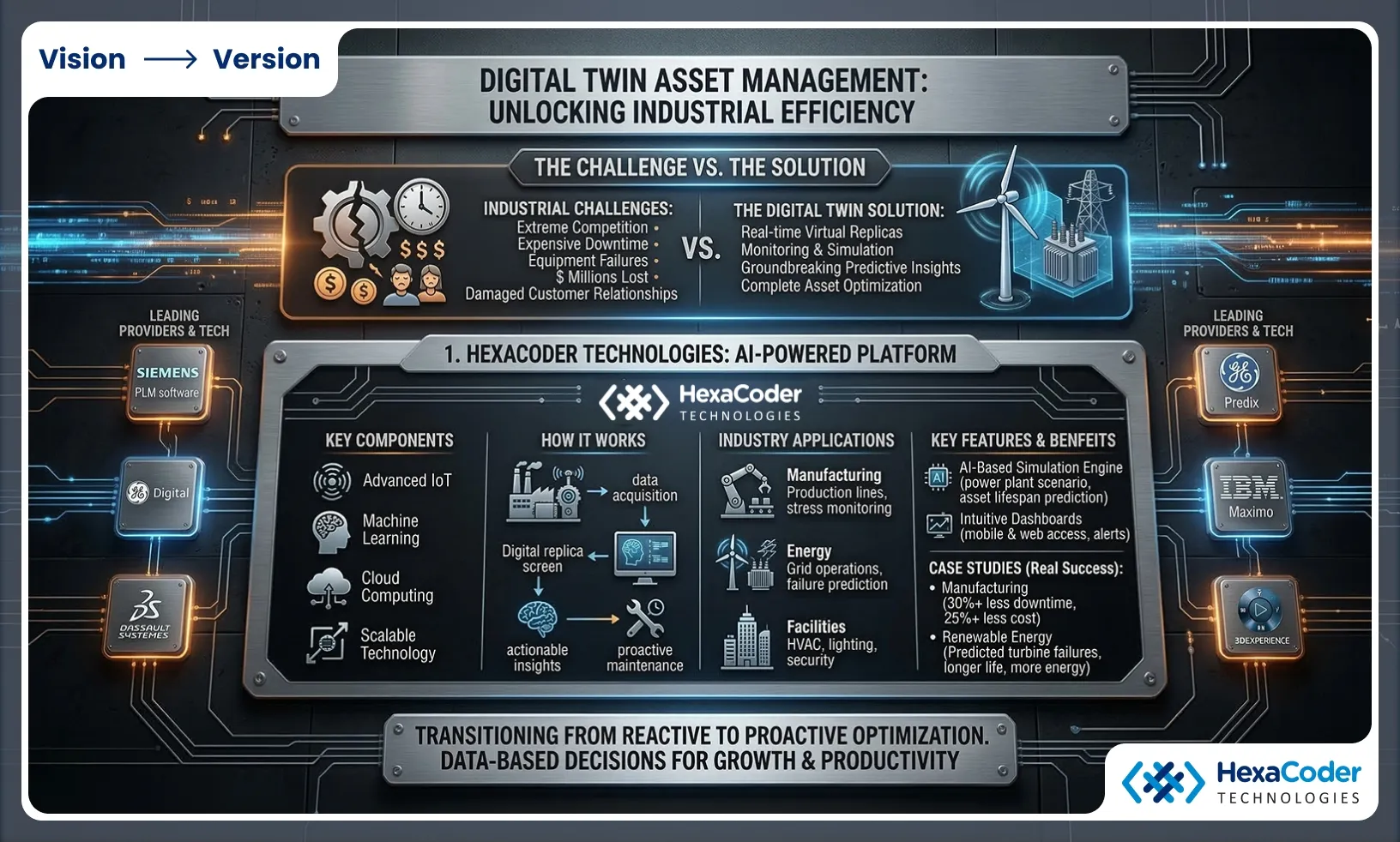
Hexacoder Technologies stands out as a frontrunner in digital twin asset management because it provides AI-powered solutions which can adapt to various industrial requirements. The platform enables users to create digital replicas of physical assets while its predictive capabilities and real-time monitoring system and automated intelligent system work to optimize asset performance. The company provides a complete asset management system through its use of advanced Internet of Things technology and machine learning systems and cloud computing analytics capabilities.
Hexacoder develops digital twins which enable users to create accurate virtual models of actual physical objects that include equipment and production facilities and energy systems and complete building control systems. The digital twin system uses operational data and sensor data to provide companies with real-time updates about their equipment performance. The system enables predictive maintenance because it identifies potential equipment failures before they happen which leads to significant decreases in operational downtime and repair expenses. A manufacturer using Hexacoder can track essential equipment through its monitoring system which detects changes in vibration patterns and temperature and operational stresses to create proactive maintenance procedures for their critical equipment systems.
Hexacoder also emphasizes industry-specific customization. The platform uses its simulation capabilities to help manufacturing businesses determine their best production line setup by testing multiple possibilities and finding operational constraints while showing how different working conditions will affect production results. Energy companies can use Hexacoder to track turbine and transformer performance and complete grid operations which leads to improved operational efficiency while decreasing unexpected equipment failures. The platform monitors HVAC systems and lighting controls and security devices in facilities management while combining maintenance timetables with operational data for more efficient building management.
The AI-based simulation engine of Hexacoder serves as its most impressive function. This system enables business enterprises to create multiple scenarios which they can use to predict their asset lifetimes and evaluate new business operation methods. The power plant uses its simulation system to test how different energy loads and maintenance activities affect equipment lifespan which enables optimal decision-making through precise data-driven methods instead of using experimental approaches.
Hexacoder also provides intuitive dashboards and analytics tools. Users can access a unified system to monitor asset status and operational performance metrics and receive alerts for upcoming maintenance needs. The platform enables users to access its features through both mobile devices and web browsers which allows users to receive essential information throughout their workday. The system enables different departments to work together more effectively through its ability to provide crucial information to all stakeholders in real time from teams which handle daily operations to those who manage strategic planning.
Hexacoder's effectiveness gets demonstrated through multiple case studies. A large manufacturing plant implemented platform to monitor its production line equipment. The facility achieved more than 30 percent reduction in unplanned downtime together with 25 percent decrease in maintenance costs while their overall production capacity increased. The renewable energy company used Hexacoder's digital twin platform to operate its wind turbine fleet which permitted them to forecast equipment failures that resulted in longer turbine lifetimes and better energy output.
Hexacoder Technologies functions as a complete asset management solution which goes beyond its role as a digital twin provider. Its solutions combine real-time monitoring with predictive analytics and scenario-based simulations and actionable insights to assist organizations in their efforts to achieve maximum operational efficiency while minimizing expenses and extending asset lifespan. Companies that implement Hexacoder's platform will transition from reactive maintenance practices to proactive optimization strategies which will help them maintain their competitive edge in industrial sector that increasingly relies on data.
2. Siemens Digital Industries Software
Siemens Digital Industries Software functions as a worldwide frontrunner in digital twin technology together with asset management tools which provide businesses complete control over their physical assets from monitoring through simulation until final asset optimization. The company assists its clients in moving from traditional maintenance methods toward advanced predictive and prescriptive maintenance solutions which will help them achieve their business targets through improved asset functions.
The Siemens platform uses IoT sensors with AI analytics and cloud infrastructure to develop complete digital models of assets which include production equipment and industrial robots and pipelines and major infrastructure components. Digital twins function as dynamic systems which utilize real-time data feeds from physical assets to support engineers and operators in performance evaluation and anomaly identification and instant decision-making.
Siemens provides its customers with a unique advantage through its predictive maintenance solution. The platform uses historical and current operational data to predict equipment breakdowns before they happen. The manufacturing plant uses its system to identify initial motor failures and belt system degradation which enables team to perform maintenance work before unplanned system outages become expensive. The predictive system enables businesses to extend equipment life while they schedule maintenance work more effectively and decrease their total expense of running operations.
Siemens gives priority to simulation methods and scenario testing methods. The platform enables businesses to create virtual models which simulate different operational situations. The system enables quicker decision-making processes while organizations can discover their best methods for enhancing performance. Energy companies can create models which demonstrate how different load conditions affect turbine performance and grid element behavior to achieve optimal energy generation while reducing equipment wear. The software delivers full analytics capabilities through its dashboards which present asset information alongside key performance indicators and performance data through an user-friendly interface. Operators can observe essential machinery from a distance while they track system performance in the present and create future operational predictions. The company provides mobile and web application interfaces which allow executives from different teams to access vital data at any moment from any location.
Siemens delivers digital twin solutions which meet the specific requirements of different industries. Automotive, aerospace, energy and manufacturing sectors receive tailored solutions from their digital twin offerings. The automotive platform enables monitoring of production lines through its assembly line tracking system and its robotic system observer and its quality control process watchdog. Aerospace companies use Siemens twins to manage aircraft maintenance schedules, track component wear, and simulate operational scenarios for safety and efficiency. Digital twins find their application in wind turbines, power grids, and oil and gas pipelines to maintain system dependability and achieve maximum operational efficiency in the energy sector.
The impact of Siemens is demonstrated through several case studies. The global automotive manufacturer adopted Siemens digital twins for its multiple production facilities which resulted in a 20% reduction in downtime and an increase of overall production capacity. The power utility used Siemens technology to track grid equipment which enabled them to predict maintenance needs and enhance their service reliability through better outage management.
Siemens Digital Industries Software delivers complete digital twin solutions which help businesses to control their assets better while forecasting their maintenance requirements and achieving performance results that span various sectors. Through its continuous data integration process and AI-powered data analysis and advanced simulation capabilities Siemens helps businesses gain a competitive edge in industrial markets while decreasing expenses and enhancing their productivity.
3. IBM Maximo
IBM Maximo is a globally recognized leader in enterprise asset management (EAM) and digital twin technology which provides organizations with complete solutions for tracking and maintaining their physical assets across all industry sectors. The platform uses IoT integration and AI analytics and cloud management to generate digital twin models of assets which help organizations make operational decisions and achieve operational excellence.
Maximo enables organizations to move from reactive maintenance to predictive and prescriptive asset management. Maximo uses real-time sensor data collection from equipment and pipelines and vehicles and manufacturing machinery to build a digital twin which shows the actual condition of each asset. The system allows operators and managers to track their operational efficiency while they identify problems and organize maintenance activities which help them avoid equipment breakdowns and reduce their downtime expenses.
The main advantage of Maximo lies in its ability to predict maintenance needs for equipment. The system uses artificial intelligence to analyze both past and current data for predicting when equipment will fail and determining the best time to perform maintenance. A utility company can use turbine vibration pattern analysis and temperature fluctuation monitoring to detect equipment faults before they disrupt power generation. Transportation operators use Maximo to predict vehicle component deterioration, which leads to improved safety and reliability of their fleet operations.
Maximo enables organizations to manage their entire asset lifecycle from the moment they purchase equipment until they dispose of it. The system shows users all information about assets which includes installation records and maintenance documentation and warranty details and compliance papers. The centralized system provides decision-makers with current and precise data which they need to enhance their operational performance and budget estimation and equipment maintenance duration.
The system provides users with access to IoT devices together with powerful analytical tools. Maximo uses sensors and edge devices and cloud computing to gather and analyze extensive data volumes. Organizations can create simulation scenarios for operational planning, test potential upgrades, or evaluate the impact of different maintenance strategies in a virtual environment. The simulations help reduce risks while decreasing the need for physical trials and they speed up the process of making choices.
The various industries which Maximo serves include energy, utilities, manufacturing, oil and gas, transportation, and facilities management. Energy companies use Maximo to monitor their pipelines and wind turbines and power grids to perform predictive maintenance. The manufacturing plants use tracking systems to monitor their equipment and production areas so they can achieve better operational performance while decreasing unexpected machine breakdowns. The transportation operators use tracking systems to monitor their vehicles and rail systems which helps them increase system reliability while meeting their operational requirements.
The IBM Maximo software offers organizations advanced reporting functions together with dashboard features which enable them to see their asset performance and key performance indicators and predictive insights in actual time. The customizable dashboards which exist in the system permit executives together with engineers and maintenance personnel to make quick decisions which lead to better operational results and lower organizational expenses. The system enables field teams to fetch essential asset information through their mobile devices which allows them to receive instant updates while operating from outside their designated work locations.
The case studies which focus on Maximo system show its positive effects through their research findings. The large utility company used Maximo to track their wind turbine operations which resulted in a 15 percent decrease of unexpected equipment failures together with better production results. A manufacturing enterprise used Maximo to perform predictive maintenance on their operational equipment which resulted in an 18 percent decline of equipment downtime together with lower maintenance expenses. The organization provides IBM Maximo as a complete solution which uses artificial intelligence to create digital twins together with asset management systems that help organizations achieve asset performance optimization and operational cost reduction and equipment lifespan extension.
The combination of predictive analytics with IoT integration and lifecycle management and industry-specific capabilities makes Maximo the top choice for enterprises which want to modernize their asset management systems and obtain practical insights for their decision-making process.
4. AVEVA
AVEVA, which serves as a worldwide industrial software market leader, offers digital twin solutions through its asset management and process optimization and operational efficiency software platforms. The software suite enables organizations from energy and manufacturing and utilities and marine sectors to track their assets through real-time monitoring and simulation and optimization functions. AVEVA enables companies to connect their physical operations with their digital insights through its IoT and advanced analytics and 3D visualization technology.
AVEVA uses its 3D engineering and visualization capabilities to enable teams to build precise digital twins of power plants and oil refineries and manufacturing lines. Engineers can explore virtual representations of equipment, pipelines, and infrastructure, which enables them to create precise plans and conduct predictive maintenance and risk assessments. Organizations can identify operational inefficiencies and test various operational scenarios and make informed decisions through digital asset behavior visualization, which enables them to gather data without interrupting real-world operations.
AVEVA's platforms also focus heavily on real-time monitoring and predictive analytics. The IoT-enabled sensors monitor equipment status and environmental conditions and system performance metrics through their data collection functions. The data creates digital twins, which support predictive maintenance and anomaly detection and operational performance improvement. A chemical plant can track its temperature and pressure and flow rates through AVEVA, which predicts equipment failures to reduce downtime, while a utility company tracks energy production and distribution to advance operational efficiency.
Another advantage of AVEVA is integration with asset lifecycle management (ALM). The platform enables companies to monitor their assets through all stages of design and decommissioning while documenting maintenance activities and performance developments and compliance achievements. The centralized system enables organizations to operate with complete visibility while maintaining regulatory requirements and protecting essential equipment. Data analysis enables managers and engineers to make decisions which help them use resources better while planning maintenance tasks more efficiently.
AVEVA provides solutions which can scale to meet the needs of large industrial facilities and networks consisting of multiple assets. The software provides interactive dashboards and reports which enable operators to see asset performance data and key performance indicators and predictive insights in one view. The system provides mobile and cloud access which enables teams to perform remote asset monitoring thus enabling organizations to operate with greater flexibility and faster response times.
AVEVA digital twins are used in various industries which include energy, oil and gas, chemicals, manufacturing, marine, and utilities. An offshore oil platform can use its virtual environment to test its production workflows while it controls equipment and predicts equipment failures before making any site changes. A manufacturing facility can use digital twins to achieve better production line efficiency and reduced energy use and enhanced safety through real-time operational data.
The case studies show that AVEVA creates positive results for its users because a chemical processing company achieved a 20 percent decrease in unscheduled operational interruptions after it adopted AVEVA predictive maintenance tools and a worldwide utility company enhanced its equipment performance while decreasing its operational expenses through its 3D visualization and analytics solutions.
AVEVA delivers powerful digital twin solutions which focus on specific industries to improve asset management and operational efficiency and safety performance within complicated industrial spaces. The combination of predictive analytics and 3D modeling and IoT integration and lifecycle management capabilities makes AVEVA the ideal choice for organizations which want to optimize their operations through digital twin technology.
5. General Electric (GE) Digital
General Electric's digital division GE Digital leads the development of industrial digital twin technology through its expertise in asset performance management and its predictive analytics solutions for essential infrastructure systems. GE Digital provides energy companies and aviation organizations and healthcare providers and manufacturing businesses with tools to track their assets through their entire lifespan which helps them achieve better productivity and operational consistency while decreasing equipment downtime.
The primary product of GE Digital called Predix delivers an industrial Internet of Things platform through its cloud system which establishes connections between physical assets and their digital twin counterparts. GE Digital develops a virtual asset monitoring system through its continuous data acquisition process which gathers information from various sensors and machines and operational systems. The digital twins enable engineers and operators to forecast equipment failures while scheduling maintenance activities and assessing performance during different operational scenarios which helps them decrease equipment downtime.
The predictive maintenance function of GE Digital stands out as its most important aspect. Digital twins enable proactive maintenance procedures by discovering initial signs of equipment wear and failures through historical data analysis combined with current data assessment. The wind farm operator utilizes GE's digital twin system to track turbine blade stress and vibration patterns which helps them avoid major equipment breakdowns while decreasing expensive operational interruptions.
The platform includes simulation capabilities which enable teams to evaluate operational changes through scenario modeling without affecting actual operations. Energy utilities can create virtual simulations to test how load changes and grid modifications and equipment upgrades will impact their operations before they implement those changes. This process decreases risk while it guarantees regulatory adherence and it boosts the quality of decision-making.
GE Digital uses AI and advanced analytics capabilities to create digital twin technologies which help businesses improve their predictive abilities. The machine learning models discover both patterns and anomalies which exist within extensive datasets to deliver practical operational efficiency solutions. Organizations can analyze efficiency metrics, energy consumption, and process bottlenecks to achieve sustainable performance improvements.
Engineers, operators, and stakeholders use 3D visualization tools to create immersive environments for examining asset condition. Digital twins enable users to inspect and assess performance from jet engines and industrial machinery to power plants and hospital equipment, which enhances collaboration and operational understanding.
Lifecycle management is another core strength. The platform developed by GE Digital monitors assets throughout their entire lifecycle starting from design and installation until they reach operational status and maintenance and final decommissioning. Historical and predictive data collection enables organizations to enhance their long-term planning activities and their regulatory compliance efforts and their risk management strategies.
GE Digital enables organizations to conduct remote operations while providing digital twin access to different teams who can monitor asset health and make decisions based on their findings. The functionality shows essential value for industrial operations which occur at large scales and for offshore installations and for projects that involve multiple countries.
The case studies show that GE Digital solutions enabled an airline to achieve a 20% reduction in unscheduled engine maintenance while a utility company found a 15% efficiency increase in turbine performance which resulted in financial benefits and higher operational availability.
GE Digital combines its industrial knowledge with its IoT capabilities and predictive analytics and simulation technologies to create complete digital twin systems. The company provides performance optimization and safety measures and lifecycle management solutions which make it the top choice for businesses which aim to improve their operational performance and asset dependability within demanding industrial settings.
Hexacoder Technology: Leading Digital Twin Revolution
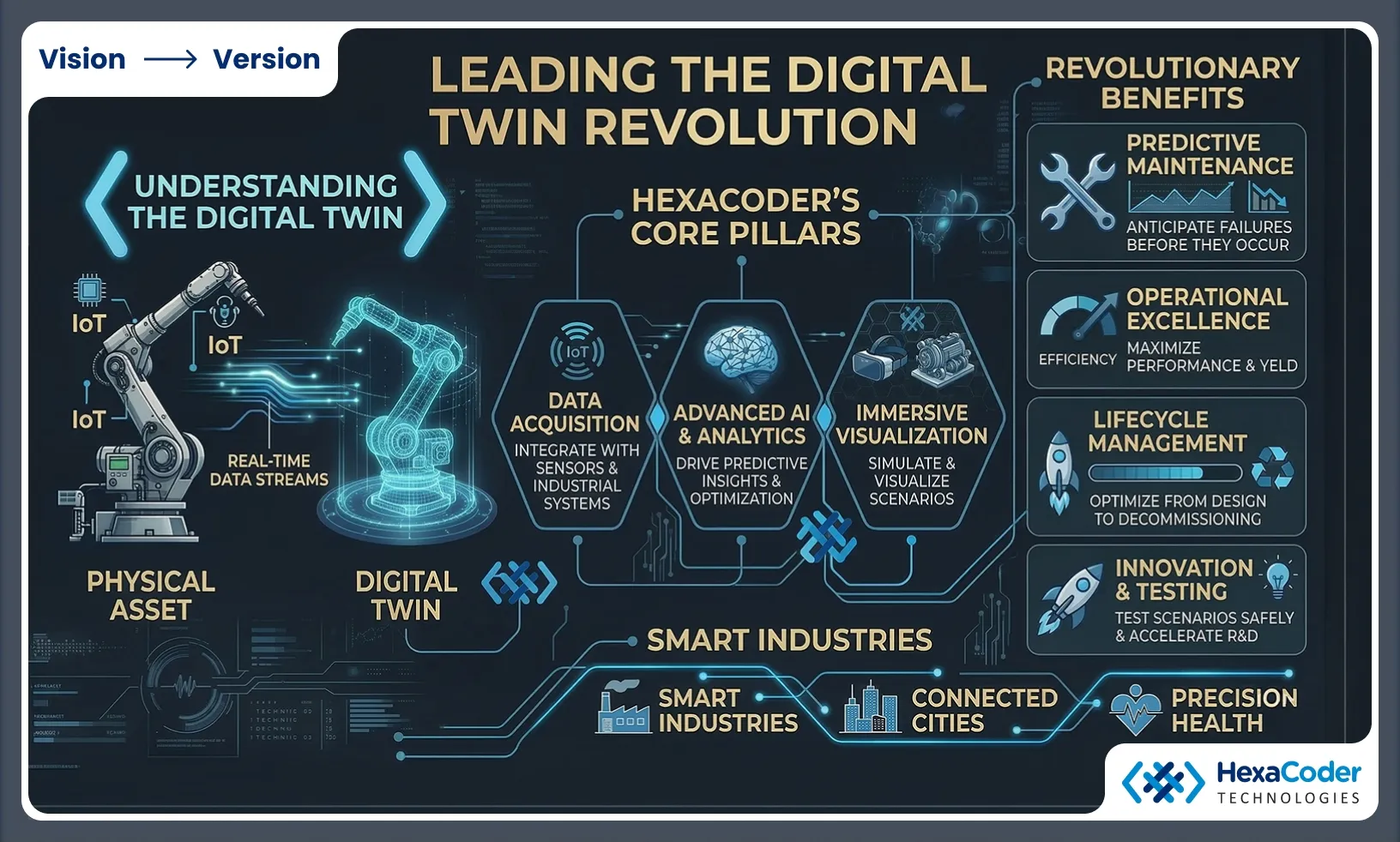
The company Hexacoder Technology has become a top provider of digital twin and asset management solutions which transform how companies track and preserve and enhance their assets. The platform Hexacoder provides an advanced system which combines high-resolution 3D visualization with real-time IoT information and AI-based predictive analytics into one unified platform. The system allows businesses to derive useful information from their assets which results in decreased operational interruptions and increased productivity and better operational choices.
The system provides the following primary functions:
Real-Time Digital Twin Modeling:
The system creates digital representations of every asset which include machinery and entire facilities and updates these models with current operational information.
Predictive Maintenance & Analytics:
The system uses AI algorithms to study both historical data and current data so that it can forecast upcoming equipment failures which will help organizations decrease expensive operational interruptions.
Integrated IoT Connectivity:
The Hexacoder system connects multiple sensors and devices and systems to create an integrated dashboard which shows different types of data.
Lifecycle Asset Management:
The system monitors assets throughout their entire life cycle from acquisition to operational use and finally to decommissioning which allows users to see both their performance metrics and their financial worth.
Remote Monitoring & Collaboration:
People can work together on system maintenance and upgrades while they access digital twin systems from different locations without needing to be physically present at the location.
The interface of Hexacoder combines user-friendly design elements with a scalable framework which enables its use across manufacturing operations as well as energy sectors and smart city development and infrastructure projects. The system provides operational flexibility through its ability to handle both small business operations and large organizational deployments while maintaining complete system performance.
The platform of Hexacoder contains simulation tools which enable companies to conduct virtual testing of operational changes through their existing workflows and system configurations before executing them in actual physical environments. The system provides multiple benefits which include cost savings and decreased operational risks and improved safety measures and guaranteed compliance with all industry regulations.
Hexacoder Technology provides organizations with a strategic asset which transforms data into actionable intelligence for operational management beyond standard management systems.
Conclusion
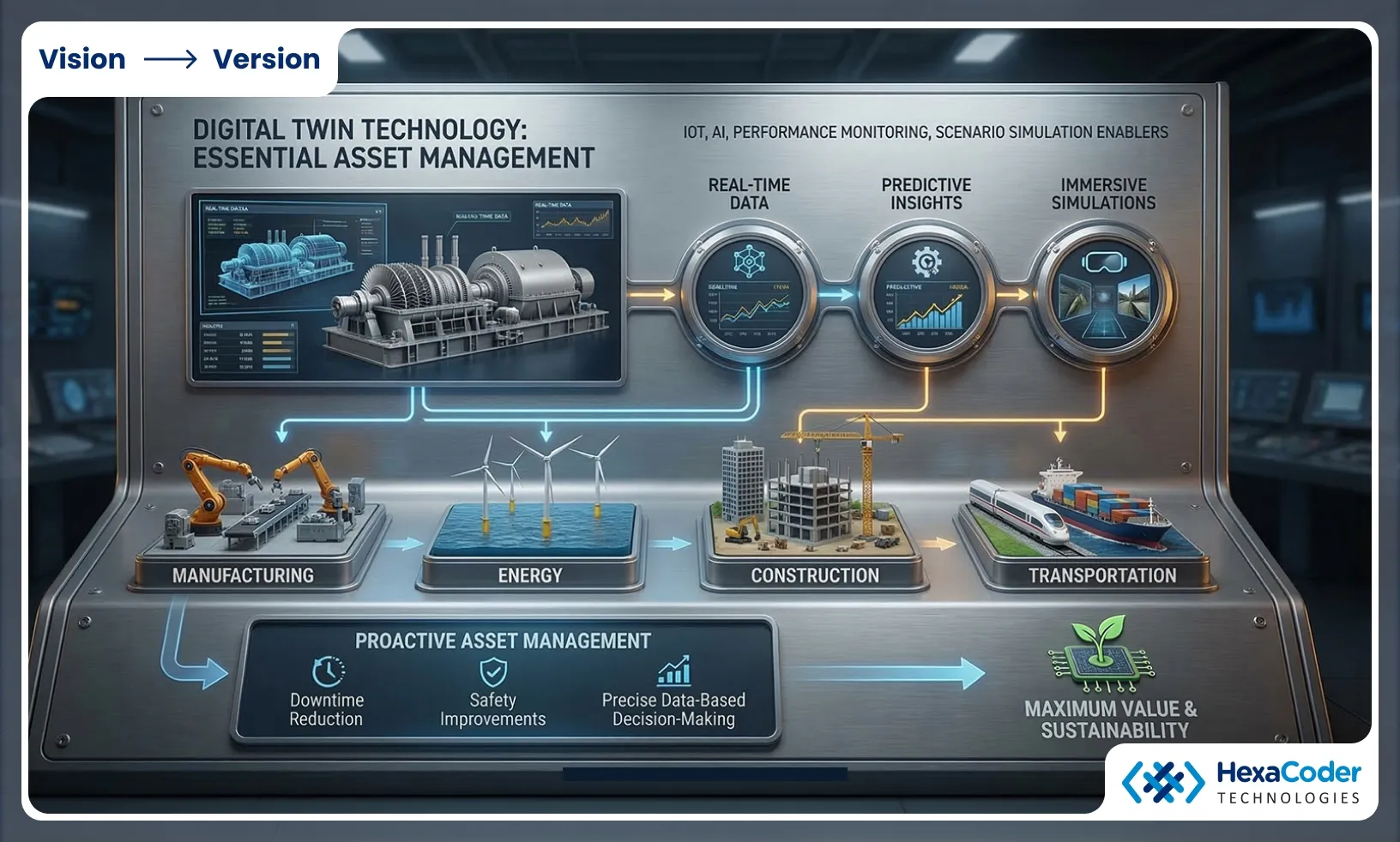
The adoption of digital twin technology has progressed to become an essential element of contemporary asset management systems which enable organizations to track and enhance and preserve their vital operational resources. Digital twins provide companies with three critical components which include real-time data and predictive insights and immersive simulations to enhance operational performance through downtime reduction and safety improvements and precise data-based decision-making.
Digital twin platforms let stakeholders from various industries which include manufacturing and energy and construction and transportation to view intricate systems and identify potential problems and develop solutions before actual problems occur. The combination of scenario simulation capabilities and performance monitoring and IoT and AI analytical tools enable organizations to achieve proactive asset management while generating maximum value and sustainability.
The companies leading this transformation provide tools, expertise, and innovation that enable businesses to manage assets smarter, safer, and more effectively than ever before. Through their investment in digital twin solutions organizations position themselves as leaders of a technological revolution which transforms future asset management practices.

%2FBnnarAR.webp&w=3840&q=75)