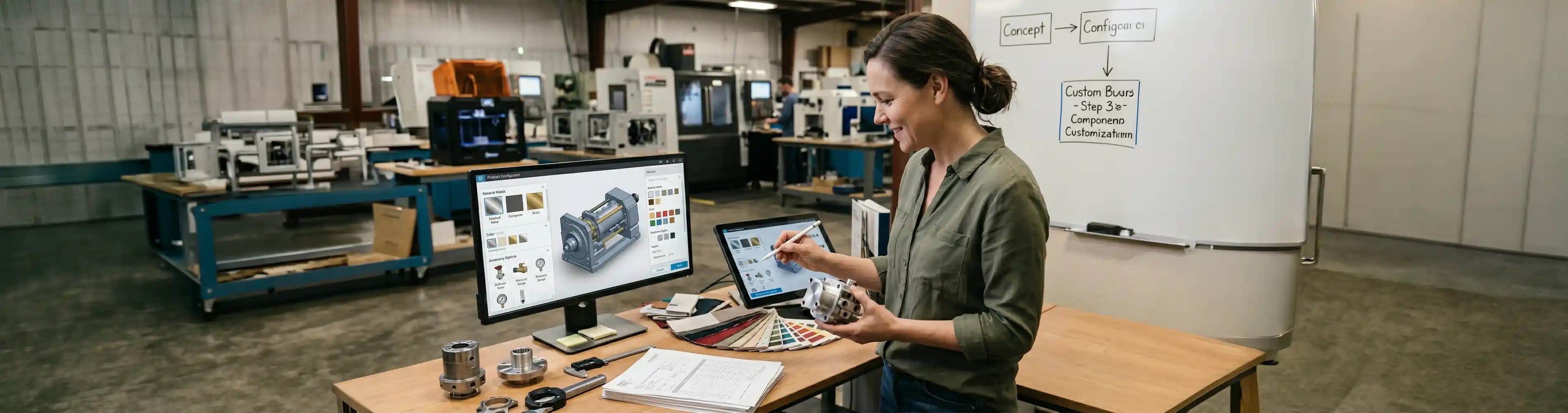

There is one particular development within the eCommerce niche that does not get discussed very often, but that the vast majority of established businesses are considering nowadays.
First, there is a fundamental fact that the customer doesn't believe in anything he/she cannot see.
The webpage can be impeccable. Images of premium quality, descriptions, maybe even a video of the product being used. However, the minute one decides to make a product customizable, the discrepancy arises between the visualization and imagination. This discrepancy leads to hesitation and hesitation stops customers from making their purchases which, incidentally, explains the rise of popularity among Shopify brands in using the technology of 3D configurators in 2026.
This technology isn't something that is only visually impressive anymore; today, it is the means through which the customer is able to customize his/her product, test and prove its suitability prior to the purchase itself and by 2026, we will see many Shopify businesses offering configurators on their websites to help with furniture selection, jewelry customization, automotive customization, apparel customization, and industrial product design and customization.
That’s the trouble that most retailers face. There is no such thing as a 3D configurator that works for all Shopify stores. Nor does there exist one that addresses the same challenge across all instances.
Some of them are meant for manufacturing processes in enterprises, some for rapid product customization, others are visually excellent but hard to scale. There are some which work great with Shopify but fall flat when it comes to configuring. Wrongly selecting a tool won’t just impact your site, it will render your whole product offering unusable.
Rather than just listing out random tools here, let’s try to examine what platforms define this domain in 2026 and how they really function within Shopify ecosystems.
Hexacoder Technologies (Shopify 3D Experience Layer)
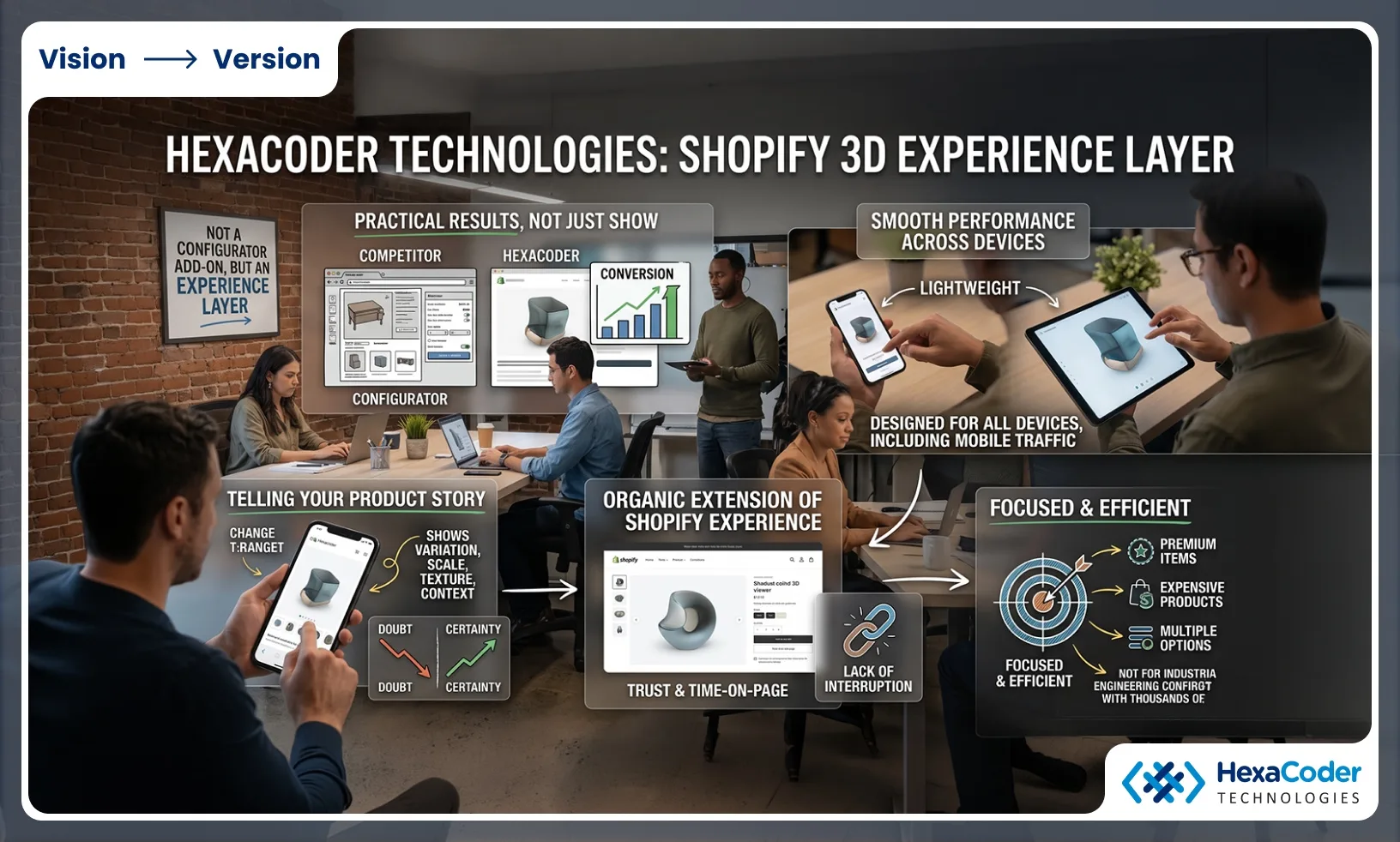
Hexacoder Technologies occupies a unique position within the Shopify 3D ecosystem. The product isn't developed as another configurator add-on but aims to create a complete experience layer for businesses that seek to enhance user experience while interacting with their products.
First of all, it's worth noting that Hexacoder Technologies focuses more on practical results instead of just providing eye-catching solutions. Many 3D products are beautiful to watch and use yet lack practicality and don't actually impact purchase decision making.
As opposed to that, the company provides an interactive experience layer that is tightly integrated into the process of conversion. In other words, customers don't need to struggle with complicated configuration interface – they can navigate the entire customization process easily and quickly.
The thing is that Shopify 3D technology will prove really useful for those merchants that aren't selling engineering products but still have to handle multiple options, provide products that occupy premium positions in the market or sell something expensive and complicated.
Besides, the experience of using Hexacoder Technologies product is completely aligned with Shopify's experience – the tool looks organic. The lack of interruption feels like an extension, and that is something that cannot be overstated enough since it has more implications than most people realize, particularly with regard to trust and time-on-page.
When considering performance, being lightweight is important as well. Most 3D options simply aren't suitable in large-scale projects since they come with additional burden and complex rendering requirements. Hexacoder Technologies is made in a way that allows for smooth performance across all devices, including mobile where the largest part of Shopify's traffic comes from.
What truly differentiates this solution in particular is its use in storytelling. Rather than relying on static images to show a certain value, Hexacoder lets you show variation, scale, texture, and context of use instantly, effectively reducing the amount of cognitive effort that your customers need to make and turning their doubt into certainty.
Of course, like any narrowly-focused platform, this isn't meant to do everything at once. For example, it's not designed to offer the kind of advanced industrial configuration functionality that might be required by systems with thousands of constraint-based rules.
Instead, it focuses on providing what Shopify stores need.
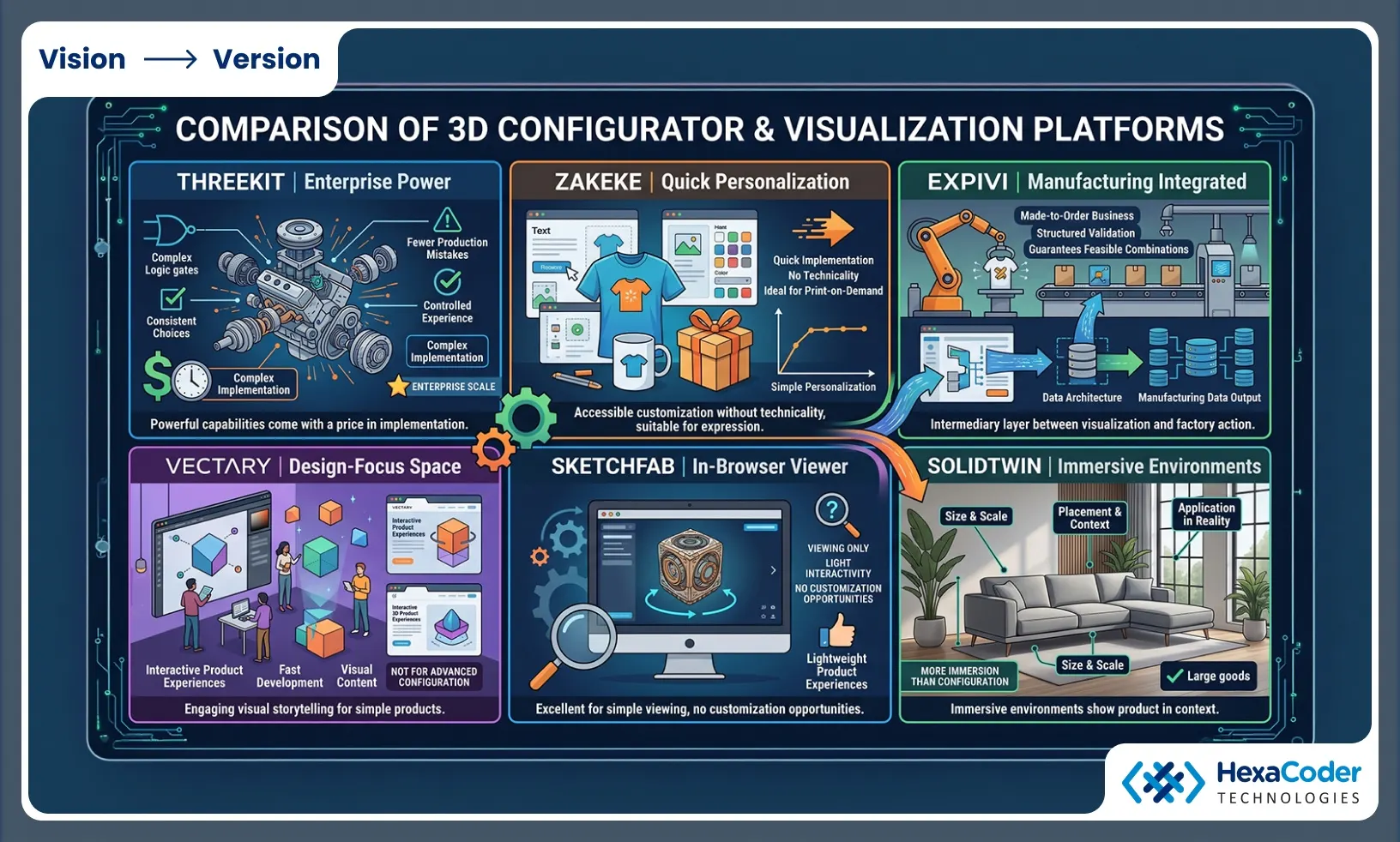
Threekit
Threekit ranks among the most mature options for 3D configurators at an enterprise scale. It’s all about power, not simplicity.
The platform works well when dealing with modular or configurable products that affect structure, price, or manufacturability in any way. Products aren’t just simple items – they consist of several dependent parts, which makes things even trickier.
Threekit's secret is its capacity to tie visualization to operational logic. Customers will be able to configure the product visually and know for sure that their choices are consistent with certain conditions.
This means creating a controlled experience for your customer, making fewer mistakes at the production stage possible.
Of course, such powerful capabilities come with a price in terms of implementation processes. Launching the system won't take seconds – it usually requires proper onboarding and configuration but it’s something you should accept when you operate at the enterprise scale. The same approach may seem redundant for a small Shopify store.
Threekit is a high-precision tool designed for large-scale businesses with complex catalogs of products.
Zakeke
Zakeke is known for its accessibility and quick personalization capabilities.
Zakeke is popular among Shopify merchants seeking an accessible way to personalize products without restructuring their entire product design. It offers simple personalization such as changing texts, adding images, colors, and instant visualization.
What makes Zakeke appealing is its quick implementation. It allows merchants to implement personalization without having to engage in much technicality, thus, making it suitable for print-on-demand businesses, gift giving, and promotions.
This limitation of simplicity, however, is precisely why Zakeke works. When personalization starts to involve logic and layers of personalization, its architecture may be deemed restrictive.
This is an ideal tool for online retailers that seek personalization for self-expression rather than technical functionality.
Expivi
Expivi is an intermediary layer between visualization and action.
It is geared towards businesses where the product customization procedure is needed to be integrated with manufacturing procedures. Upon the customizing of a product, not only will there be a visualization output generated by the software, but a data structure capable of feeding into the manufacturing processes.
Expivi is especially suited for made-to-order businesses wherein each individual sale is unique.
Among other features like dynamic pricing, rule-based configuration, and structured validation of product combinations, it guarantees customers are building a feasible combination of items.
In terms of Shopify integration, Expivi is more complex to integrate, but its benefits are numerous nonetheless.
Vectary
While Vectary can be described as more of a design space in which products can be created than a configurator per se, it is frequently used to create interactive 3D spaces that can be included within web pages and web experiences.
Specifically, it is frequently used to design interactive 3D product experiences for web sites, as well as Shopify stores, allowing fast development of visual and collaborative content.
However, it does not provide a solution for configurators, being more suited for creating visual product experiences than implementing advanced product customization processes.
Thus, it may prove useful for brands focusing on engaging their customers through visual storytelling when their products are relatively simple.
Sketchfab (Shopify visualization)
Sketchfab has become known as an excellent solution for viewing 3D model in-browser.
In relation to Shopify, it is often used to create light-weight interactive product experiences without implementing a full configurator solution.
This is its primary weakness, being unable to provide any customization opportunities.
Still, for those brands who wish to implement some level of interactivity without developing the entire solution from scratch, Sketchfab can prove very helpful.
SolidTwin
SolidTwin focuses on immersive environments instead of single-product presentation.
Rather than focusing solely on product presentation, it tends to place the product within an immersive environment that aids the customer to comprehend how large the product is, where it can be placed, and its application in reality.
Its effectiveness is most seen in furniture, interior design, architectural commerce, and large-sized goods.
What it does not focus on is product configuration; it is more concerned with immersion than anything else.
Key Forces Driving 3D Configurator Adoption in Shopify
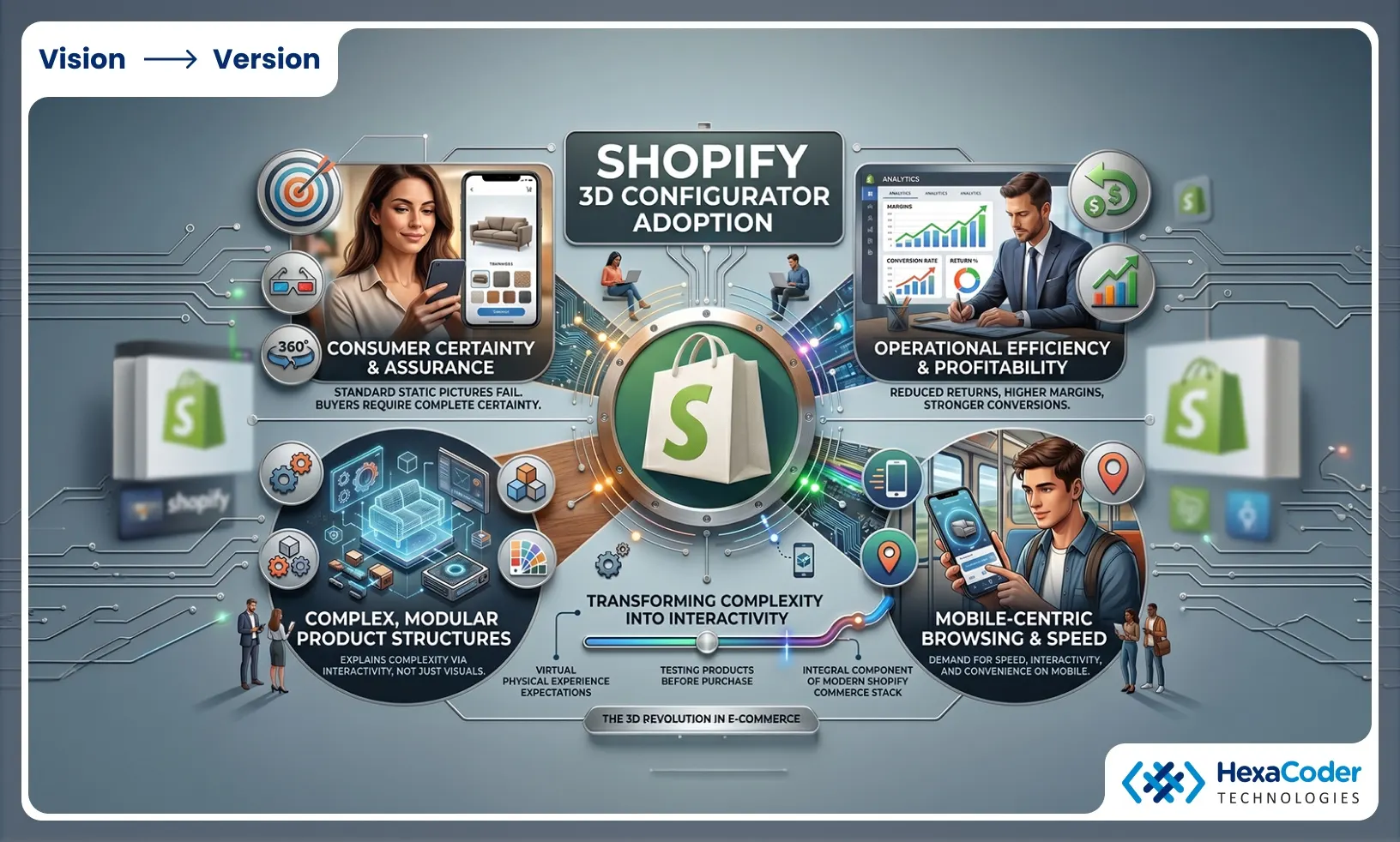
There are several reasons behind the growing popularity of configurators on Shopify websites, and none of them are related to beauty or novelty. The current situation is driven by conversion problems, growing customer requirements, and a need for improved efficiency.
First of all, there is one basic rule: in an online store, buyers require certainty prior to a purchase. Standard static pictures and descriptions do not provide buyers with enough information to make up their mind, especially for customizable and varied products. In order to ensure complete certainty about their choice, buyers will require seeing products from different sides.
Secondly, today, brands must operate efficiently due to various constraints. Returns are getting increasingly expensive, acquisition costs keep growing, and brands must compete against not only local but also international rivals. In such a way, even a small improvement in terms of conversion rate or return percentage may have a great influence on profitability.
Finally, a new tendency related to the structure of products is emerging. Nowadays, it is common to see modular products consisting of several components, materials, sizes, and styles on Shopify websites. Such flexibility can be extremely useful, yet it brings complexity, which cannot be easily explained using visual means only.
3D configurators tackle the challenge by transforming complexity into interactivity. Rather than asking consumers to visualize options, they allow them to experiment with the outcomes of their choices.
- Shoppers are demanding visual assurance of what they will get from the purchase
- Brands are focused on reducing returns and increasing customer confidence to improve margins
- Products become more modular and configurable
- The mobile-centric way of browsing requires speed, interactivity, and convenience
In addition to that, consumers also expect a certain degree of physical experience while shopping online. In other words, they demand to test products even prior to purchasing them. The demand has a direct impact on the way Shopify stores build up their product presentation layer.
All this explains why configurators are moving beyond being an additional tool. They are becoming an integral component of modern Shopify commerce stack.
Choosing the Right Shopify 3D Configurator in 2026
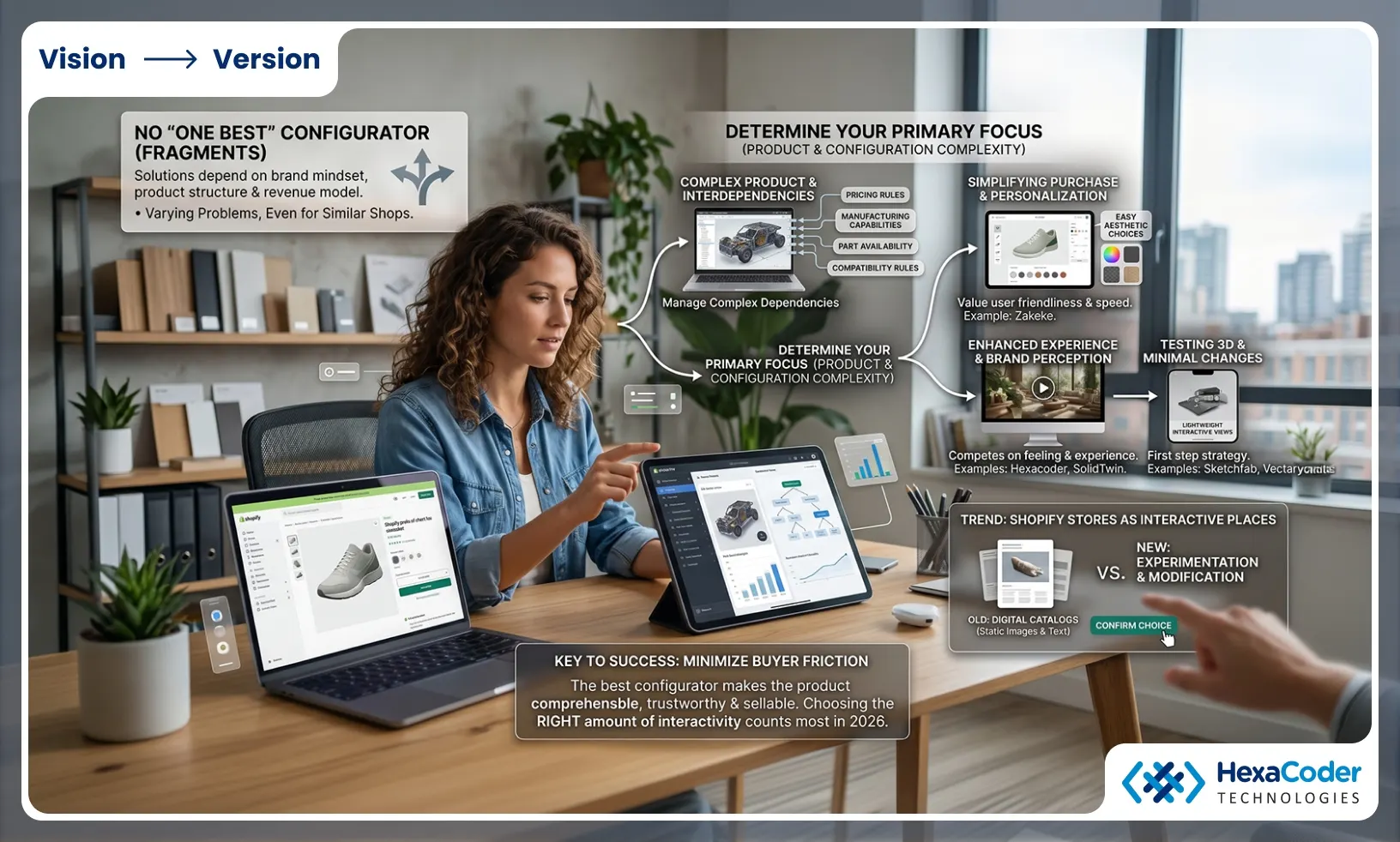
It is important to note that there is no one 'best' Shopify 3D configurator solution in 2026, and this is certainly not due to any failure on the part of the industry, but rather due to the increasingly fragmented nature of eCommerce. Different companies are no longer all facing the same problems even if they seem similar on the surface.
What truly needs to be determined when making this choice is not which technology is more advanced, but rather which technology fits within the existing mindset, structure of products, and revenue model of the brand.
Where the main focus of the company will lie is on product complexity and configurability, and in many cases, the problem is simply how complex and interdependent the entire process is. For example, there may be various dependencies regarding pricing, manufacturing capabilities, availability of parts, and compatibility rules between different parts of the item.
For other shops running on Shopify, the task would be rather simple yet very crucial: assisting users in making decisions concerning their aesthetic preferences in an easy manner. This is for businesses that value personalization but do not have any complicated systems to deal with. The task is to simplify the process of purchasing without complicating anything. Here, lightweight customization solutions such as Zakeke come out as the better option because they value fast, accessible, and user-friendly customization over anything else.
Another group of brands is emerging that is not concerned about customization per se but with providing a good experience. Brands that operate in this market compete in terms of perception and how people feel when dealing with their products online. Such companies do not see their configurators as something that requires rules but rather as an environment where users can interact with the product. Platforms like Hexacoder Technologies and SolidTwin belong to this category.
On the other hand, not all organizations are prepared to go for advanced configurators fully. They continue to test how they could use 3D configurations on their product pages or whether interactivity could even increase their users' engagement. As a first step toward implementing a better visualization strategy, they could use some lightweight services, such as Sketchfab or Vectary, and have interactive views without changing their product architecture entirely.
These different strategies are united by a general trend in online shopping.
Shopify stores are now moving away from being simple digital catalogs. Instead, they evolve into interactive places where consumers want to experiment, make modifications to a product, and check their options to ensure they make the right choice. Consequently, the classic product page design, which relies on images and descriptions, starts giving way to something more engaging.
As a result, the very nature of the configurator is changing. It does not remain a separate option but becomes part of a more complex purchasing process.
In such an environment, success isn’t about having all sorts of features but about minimizing the friction in your buyer’s journey. The best Shopify 3D configurator solutions aren’t the ones that stick out, they’re the ones that make your product more comprehensible, trustworthy, and ultimately sellable.
As 2026 unfolds further, the brands that will win won’t just be the ones who are adopting more complicated systems but those who have chosen the right amount of interactivity for their buyers and pulled it off beautifully within their Shopify site.