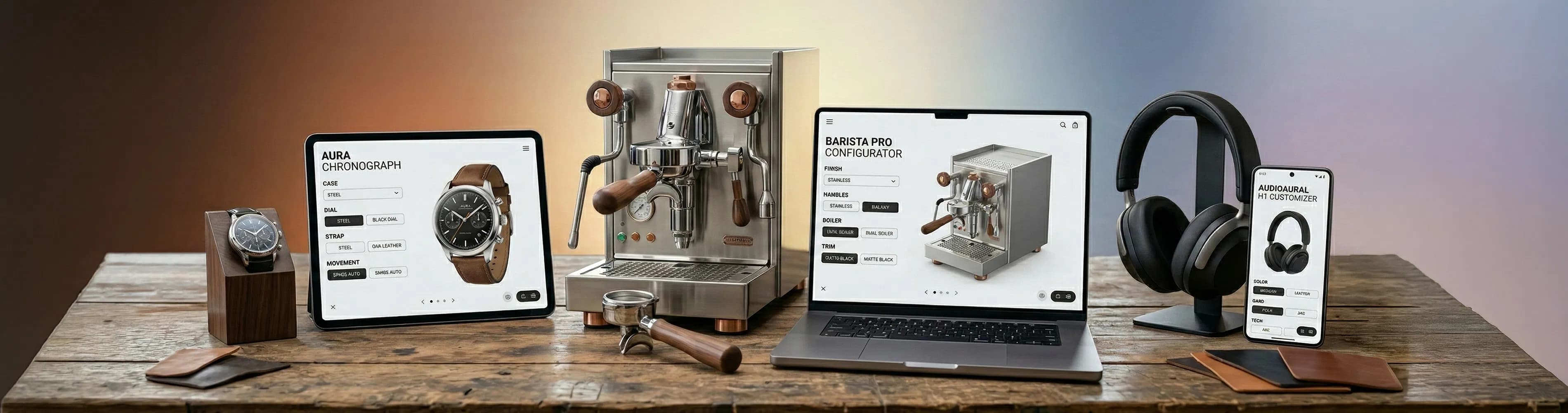
Configurator Meaning: The Ultimate Guide to Understanding Product Configurators in 2026

💡 Quick Summary: A configurator is an interactive software tool that lets users customize a product or system by selecting from options, seeing their choices visualized in real time, and generating an accurate quote or order. This guide covers everything — from the basic meaning to advanced technology, industries, ROI, and the future of configurators.
What Is a Configurator? The Core Definition
When people search for "configurator meaning," they are usually looking for a straightforward, reliable answer. Let us start with exactly that.
📖 Definition
A configurator is a software tool, system, or application that allows users whether customers, sales representatives, or internal teams to customize, configure, and personalize a product, service, or system according to their specific needs and preferences. The configurator presents options, applies business rules, validates combinations, and generates an output such as a price quote, a 3D visual, a bill of materials, or a production order. Our services include advanced configurator development. See our portfolio for examples.
The word "configurator" comes from the verb "configure," which originates from the Latin configurare, meaning to form or shape in a particular way. In the modern business and technology world, a configurator is the digital mechanism that makes customization scalable, accurate, and efficient.
A Simple Real-World Analogy
|
Think of a configurator like a digital workshop: 🛒 You walk in → You pick your options → You see the result → You get an instant price (Enter) → (Configure) → (Visualize) → (Quote/Order) |
🎥 Watch: Configurator in Action
See how a real product configurator works in this interactive demo
In its simplest form, imagine using a 3D Configurator for a Car on a manufacturer's website — choosing the exterior color, selecting the engine type, picking interior materials, and adding optional features — then watching the price update in real time and receiving an instant quote. That interactive experience is powered by a configurator.
At its most complex, a configurator can be an enterprise-grade software system managing thousands of interdependent product variables, pricing rules, manufacturing constraints, and regulatory requirements — all simultaneously and without error.
Who Uses Configurators?
| User Type | How They Use a Configurator |
|---|---|
| Consumers / End Customers | Self-service product customization on websites |
| B2B Buyers | Configure complex products with a sales rep |
| Sales Representatives | Generate accurate quotes quickly |
| Manufacturing Teams | Receive accurate, validated production specs |
| Product Managers | Define and manage product rules |
| Developers / IT Admins | Configure software systems and infrastructure |
Whether you are a business owner, a developer, a marketer, or simply a curious reader, understanding the configurator meaning is increasingly important in today's product-driven digital economy.
Types of Configurators Explained
There is no single type of configurator. Different business needs have given rise to different categories.
| Type | Best For | Visual? | Pricing? | Complexity |
|---|---|---|---|---|
| Product Configurator | Consumer e-commerce | Optional | Optional | Low–High |
| 3D Visual Configurator | High-value consumer goods | ✅ Yes | Optional | Medium–High |
| CPQ Configurator | B2B enterprise sales | Optional | ✅ Yes | High |
| AR Configurator | Furniture, home goods | ✅ Yes | Optional | Very High |
| Rule-Based Configurator | Moderate complexity products | Optional | Optional | Medium |
| Constraint-Based Configurator | Very complex products | Optional | Optional | Very High |
| Guided Selling Configurator | Unknown-needs buyers | Optional | Optional | Medium |
| Online / Web Configurator | E-commerce self-service | Optional | Optional | Low–High |
| Bundle Configurator | Kits, packages, bundles | Optional | ✅ Yes | Medium |
Product Configurator
The most common type, a product configurator allows customers or sales teams to customize a physical or digital product. Options typically include dimensions, colors, materials, features, and accessories.
3D Visual Configurator
A 3D visual configurator adds a photorealistic rendering or interactive 3D model to the configuration experience. As users make choices, they see the product update visually in real time. This dramatically increases engagement and purchase confidence.
CPQ Configurator (Configure, Price, Quote)
A CPQ configurator is specialized for B2B sales scenarios. It not only helps configure a product but also automatically calculates accurate pricing and generates formal customer quotations. CPQ systems are critical for companies with complex, custom pricing structures.
How Does a Product Configurator Work?
To understand the configurator meaning more deeply, it is essential to understand the mechanics of how a product configurator actually works under the hood.
The Configurator Workflow: Step by Step
| CONFIGURATOR WORKFLOW | |||
| STEP 1 | STEP 2 | STEP 3 | STEP 4 |
| User Opens Configurator |
Selects Options |
Rules Engine Validates |
Price Updates |
| 3D Model Updates |
User Confirms |
Output Generated |
DONE! |
Step 1: Defining the Product Model
Before any configurator can be built, the product and its configuration space must be modeled. This involves identifying:
- Attributes: The characteristics that can be varied (e.g., color, size, material)
- Options: The valid values for each attribute (e.g., red, blue, green for color)
- Dependencies: Relationships between attributes (e.g., if you choose leather, only beige and black are available)
- Constraints: Rules that define what is and is not a valid combination
Step 2: Building the Rules Engine
The rules engine is the heart of the configurator. It processes user selections and determines what options remain available, what options become unavailable, and what warnings or errors should be shown.
| RULES ENGINE EXAMPLE | |
| USER SELECTS: | "Carbon Fiber Body" on Mountain Bike |
| ↓ | RULES ENGINE CHECKS: |
| ✅ Compatible with: | Hydraulic Disc Brakes |
| ✅ Compatible with: | 29" Wheels |
| ❌ NOT compatible: | Entry-Level Fork (requires Suspension Fork) |
| ❌ NOT compatible: | Aluminum Handlebars (carbon fiber requires carbon/titanium) |
| ↓ | INTERFACE UPDATES: Shows only valid remaining options |
Why Businesses Need a Configurator
With the configurator meaning established, let us examine the concrete business reasons why companies invest in configurators.
| PROBLEM (Without Configurator) | SOLUTION (With it) |
| Slow, manual quoting | Instant automated quotes |
| High rate of order errors | Rules prevent mistakes |
| Customers can't visualize | 3D real-time preview |
| Sales reps bogged down | Customer self-service |
| Manufacturing miscommunication | Auto-generated BOM |
| Low average order value | Smart upselling prompts |
| Generic, commodity feel | Premium personalized UX |
1. Meeting Growing Demand for Personalization
A McKinsey report found that 71% of consumers expect companies to deliver personalized interactions — and 76% feel frustrated when they do not receive them.
2. Eliminating Quote and Order Errors
Manual quoting processes are notoriously error-prone. A salesperson might quote an incompatible combination of options, apply the wrong pricing tier, or miss a required component. These errors lead to costly rework, customer dissatisfaction, and lost trust.
📊 Industry Data: Companies report that manual configuration errors cost an average of $15,000–$50,000 per incident in rework, customer credits, and relationship damage.
3. Accelerating the Sales Cycle
In complex B2B sales, generating a quote can take days or even weeks when done manually. A CPQ configurator can compress this to minutes.
| TRADITIONAL QUOTE PROCESS | |
| Day 1: | Customer request → Day 2: Sales rep reviews → Day 3: Engineering |
| Day 4: | Pricing review → Day 5: Management approval → Day 6: Quote sent |
| TOTAL: 6+ days | |
| WITH CPQ CONFIGURATOR | |
| Customer configures | Rules validate → Price calculates → Quote generated |
| TOTAL: 15–30 MINUTES |
The Technology Stack Behind Configurators
Understanding the technology that powers configurators helps demystify how they work and what goes into building them.
The Full Configurator Technology Stack
| CONFIGURATOR TECH STACK | |||
| LAYER 1: PRESENTATION (Front End) | |||
| React.js | Vue.js | Angular | Vanilla JS/HTML |
| LAYER 2: 3D RENDERING | |||
| Three.js | Babylon.js | WebGL (Native API) | |
| LAYER 3: BUSINESS LOGIC (Rules Engine) | |||
| Node.js API | Python FastAPI | Java / .NET Spring Boot | |
| LAYER 4: DATA & STORAGE | |||
| PostgreSQL (Rules) | MongoDB (Configs) | Redis (Cache/Sessions) |
Key Features of a Great Product Configurator
Not all configurators are equal. The best configurators share a set of defining characteristics.
Must-Have Features
- ✅ Real-time 3D/visual preview
- ✅ Real-time pricing updates
- ✅ Valid combination enforcement (rules engine)
- ✅ Mobile-responsive design
- ✅ Save and resume configuration
- ✅ Share configuration link
- ✅ Fast loading (< 3 seconds initial load)
- ✅ Clear navigation and progress indication
- ✅ Backend system integration (ERP/CRM/e-commerce)
Nice-to-Have Features
- ⭐ AI-powered personalization recommendations
- ⭐ AR "Try Before You Buy" mode
- ⭐ Side-by-side configuration comparison
- ⭐ Social sharing of configurations
- ⭐ Wishlist / favorites
- ⭐ Analytics dashboard
- ⭐ Admin tools for managing options without code
- ⭐ A/B testing capability for options
- ⭐ Multi-language and multi-currency support
- ⭐ Accessibility (WCAG 2.1 compliant)
Building vs. Buying a Configurator
One of the most important strategic decisions for businesses considering a configurator is whether to build a custom solution or buy an off-the-shelf product.
| BUILD VS. BUY DECISION MATRIX | ||
| LOW COMPLEXITY | HIGH COMPLEXITY | |
| LOW BUDGET | BUY off-shelf SaaS solution |
BUY + Customize or Phase approach |
| HIGH BUDGET | BUY or BUILD (faster to market = buy) |
BUILD custom (best long-term differentiation) |
Arguments for Building a Custom Configurator
- Perfect fit for unique requirements — If your product or business logic is highly specialized, a custom-built configurator can be designed exactly to your needs.
- Competitive differentiation — A proprietary configurator with a unique user experience can be a genuine competitive advantage that competitors cannot easily replicate.
- Full control over the roadmap — You decide what features to build and when.
- Potential long-term cost advantage — For very large enterprises, the total cost of ownership of a custom solution may be lower than perpetual licensing fees.
Arguments for Buying an Off-the-Shelf Configurator
- Faster time to market — A pre-built solution can be configured and deployed in weeks rather than months.
- Lower upfront investment — SaaS configurator platforms eliminate large upfront development costs.
- Proven functionality — Established vendors like Threekit, Zakeke, and Cylindo have solved many hard problems.
- Vendor support and community — Ongoing updates, security patches, documentation, and a user community.
Future of Configurators: AI, AR, and Beyond
The configurator landscape is evolving rapidly. The future will be defined by several powerful technologies and trends.
| NOW (2026) | NEAR FUTURE (2027-2028) | FAR FUTURE (2029+) |
| • 3D Web Configurators | • AI Recommendation Engines | • Spatial Computing |
| • Basic AR (WebAR) | • NLP Configuration | • Full VR/AR Config |
| • CPQ Systems | • Real-time AR | • Generative 3D |
| • Mobile-First | • Photorealistic Rendering | • AI-Designed Products |
| • Headless APIs | • Voice Configuration | • Brain-Computer Config |
| • Basic AI Recommendations | • Emotion-sensing UX | • Fully AI-Generated Customization |
Artificial Intelligence in Configurators
AI is transforming configurators in multiple ways:
🎥 Watch: AI-Powered Configurators
Discover how artificial intelligence is revolutionizing product configuration
- Personalized Recommendations — AI analyzes a user's behavior, past purchases, and demographic data to suggest configurations they are likely to love.
- Natural Language Configuration — Instead of clicking through menus and options, future configurators may allow users to describe what they want in natural language — powered by large language models.
- Predictive Validation — AI identifies potentially problematic configurations before they reach production by learning from historical order and defect data.
- Dynamic Pricing Intelligence — AI-driven pricing engines optimize prices in real time based on demand, inventory levels, competitive pricing, and customer segments.
Augmented Reality and Extended Reality Configurators
AR configurators are moving from novelty to standard expectation. Apple's Vision Pro and other mixed reality headsets will open new dimensions for configuration experiences.
| AR CONFIGURATOR EVOLUTION | |
| 2020: | Basic AR - "Does this sofa fit in my room?" |
| 2023: | Enhanced AR - Photo-realistic rendering in room |
| 2025: | Real-time AR - Configure and see updates live |
| 2027: | Spatial Computing - Full room design in AR |
| 2030: | Haptic AR - "Feel" materials before buying |
Frequently Asked Questions About Configurators
What is the configurator meaning in simple terms?
A configurator is a tool that lets you customize something — usually a product or a system — by selecting from options and seeing what you build. Think of it like a digital workshop where you design exactly what you want. A great starting point to see this in action is Hexacoder's 3D Configurator for a Car.
What is a product configurator used for?
A product configurator is used to let customers or sales teams customize a product by selecting options like color, size, material, and features. It validates that the combination is buildable, calculates the price, and generates a quote or order.
What is the difference between a configurator and a CPQ tool?
A configurator focuses on the "C" (Configure) part — helping users select valid product options. A CPQ tool covers the full cycle: Configure + Price + Quote. CPQ tools, as offered by vendors like Salesforce CPQ, are more oriented toward B2B sales scenarios and include pricing engines and document generation.
How much does it cost to build a configurator?
| Type | Estimated Cost Range | Timeline |
|---|---|---|
| Basic variant configurator | $5,000 – $20,000 | 4–8 weeks |
| 3D consumer configurator | $30,000 – $100,000 | 3–6 months |
| Enterprise CPQ system | $100,000 – $500,000+ | 6–18 months |
| Full AR/VR configurator | $80,000 – $250,000 | 6–12 months |
Can a configurator work on mobile devices?
Yes, modern configurators are designed to work on mobile devices. Responsive design ensures the interface adapts to different screen sizes. 3D configurators may have reduced visual quality on lower-powered mobile devices, but performance optimization techniques can mitigate this.
What is a visual configurator?
A visual configurator is a configurator that emphasizes graphical representation of the product — either through 2D images that update dynamically, 360° product spins, or full 3D models that render in real time.
What industries use configurators the most?
Automotive, furniture, industrial machinery, IT hardware, fashion and apparel, construction products, jewelry, and consumer electronics are among the heaviest users of configurators.
A Brief History of Configurators
Understanding the configurator meaning also benefits from a historical perspective. Configurators did not appear overnight. They evolved over decades in response to growing market demands for customization.
Pre-Digital Era: Manual Configuration
Before computers, configuring a product was a manual process. A salesperson would consult a thick product catalog, manually check compatibility tables, and write up a custom quote — a process that was slow, error-prone, and labor-intensive. A single complex quote could take days or even weeks.
The 1980s: Expert Systems and the Birth of Digital Configurators
The first true digital configurators appeared in the 1980s. One of the earliest and most famous examples is XCON (later called XSEL), developed by Digital Equipment Corporation (DEC) in 1980. XCON was an expert system that automatically configured VAX computer systems based on customer requirements.
📊 Historical Impact of XCON:
- Saved DEC an estimated $25 million per year
- Handled over 80,000 orders per year by the mid-1980s
- Encoded over 17,500 configuration rules
- Reduced configuration error rate from ~30% to under 1%
XCON validated that computer-based configuration was not just possible — it was transformative.
The 1990s: ERP Integration and CPQ Emergence
Through the 1990s, configurators became integrated into Enterprise Resource Planning (ERP) systems. Companies like SAP and Oracle built configuration capabilities directly into their platforms. Simultaneously, the concept of Configure, Price, Quote (CPQ) software emerged — a more formalized, sales-focused approach to configuration that connected customer-facing selection with backend pricing and quoting.
The 2000s: The Web Configurator Revolution
The widespread adoption of the internet brought configurators directly to consumers for the first time. Automobile manufacturers like BMW and Ferrari launched online car configurators where customers could build their dream car from home. Nike introduced NIKEiD (now Nike By You), allowing customers to customize shoes online.
This era established configurators as a consumer-facing tool, not just a back-office system.
The 2010s: 3D, AR, and Mobile Configurators
The 2010s brought a visual revolution to configurators. Advances in WebGL, 3D rendering, and later augmented reality (AR) made it possible to show customers photorealistic, interactive 3D models of their configured products in real time. Mobile smartphones made configurators accessible anywhere.
Today and Beyond: AI-Powered, Headless, and Immersive Configurators
Today, configurators are becoming smarter through artificial intelligence and machine learning. Headless configurator architectures allow the configuration engine to be decoupled from the front end, making it possible to deploy the same logic across websites, mobile apps, kiosks, and AR devices simultaneously.
3D Configurator Meaning and Importance
The 3D configurator meaning deserves special attention because it represents one of the most significant innovations in the configurator space.
A 3D configurator is a product configuration tool that displays a three-dimensional, interactive, and often photorealistic visualization of the product as the user makes configuration choices. Instead of seeing static photographs or flat color swatches, the user sees their exact configuration come to life visually.
The Impact of 3D: By the Numbers
| 📊 3D CONFIGURATOR STATS | |||
| +94% | -40% | +66% | +30% |
| Conversion Rate Lift | Return Rate Drop | Purchase Confidence | Avg Order Value Lift |
| (vs static photos) | (vs standard photos) | (reported by buyers) | (vs standard catalog) | |||
| Source: Shopify Research, Threekit Industry Report |
CPQ Configurator: What Does It Mean?
CPQ stands for Configure, Price, Quote, and CPQ software is one of the most important enterprise applications in the B2B world.
The CPQ Process Explained
| CPQ WORKFLOW | |||
| C = CONFIGURE | P = PRICE | Q = QUOTE | |
| • Select product options | • Apply base prices | • Generate formal PDF | |
| • Validate rules | • Add option prices | • Send to customer | |
| • Check inventory | • Apply discounts | • Track approval | |
| • Ensure compatibility | • Add taxes | ||
| • Calculate margin |
Who Uses CPQ Configurators?
CPQ configurators are primarily used by:
- Sales representatives in B2B companies
- Sales engineers who need to configure technically complex products
- Channel partners and distributors
- E-commerce platforms handling custom or complex orders
CPQ Business Impact Statistics
📊 CPQ Performance Data (Source: Salesforce)
| Metric | Without CPQ | With CPQ | Improvement |
|---|---|---|---|
| Quote Generation Time | 3–7 days | 1–4 hours | ~90% faster |
| Pricing Errors | ~40% of quotes | ~2% of quotes | ~95% fewer errors |
| Quote-to-Close Rate | Industry average | +49% above average | Significant lift |
| Average Deal Size | Baseline | +38% | Larger deals |
| Sales Rep Satisfaction | Low (manual work) | High (automated) | Measurable boost |
CPQ vs. Standard Product Configurator: Key Differences
| Feature | Standard Configurator | CPQ Configurator |
|---|---|---|
| Primary User | End consumer | B2B sales rep or buyer |
| Pricing Logic | Simple / optional | Complex, multi-tier |
| Output | Visual / price display | Formal quote document |
| CRM Integration | Rarely | Always (Salesforce, Dynamics) |
| Discount Workflow | No | Yes (approval chains) |
| Multi-currency | Rarely | Standard feature |
| Contract Pricing | No | Yes |
| Complexity | Low–Medium | High–Very High |
Visual Configurator vs. Rule-Based Configurator
Two of the most commonly compared configurator types are visual configurators and rule-based configurators.
| RULE-BASED CONFIGURATOR | VISUAL CONFIGURATOR |
| Logic-first approach | Visual-first approach |
| If-then rules drive experience | 3D/2D model drives experience |
| Great for technical products | Great for aesthetic products |
| Easier to audit and explain | More engaging for end-users |
| Lower development cost | Higher development cost |
| Can become hard to maintain at scale | Requires quality 3D assets |
| Examples: | Examples: |
| • Industrial machinery config | • Car color/trim configurator |
| • Software license selector | • Furniture material picker |
| • Server hardware builder | • Jewelry designer |
| • HVAC system configurator | • Apparel customizer |
Rule-Based Configurators: Deep Dive
A rule-based configurator encodes the logic of valid configurations as explicit if-then rules. For example:
| EXAMPLE RULES (Mountain Bike Configurator) | |
| IF frame_material = "Carbon Fiber" | THEN fork_type MUST BE IN ["Full Suspension", "Hardtail Carbon"] AND price_modifier += 450 |
| IF wheel_size = "29 inch" | THEN frame_size CANNOT BE "XS" AND suspension_travel MUST BE IN ["100mm", "120mm", "140mm"] |
| IF brake_type = "Hydraulic Disc" | THEN wheel_type MUST HAVE "Disc Rotor Compatible" |
**Advantages of Rule-Based:**
- ✅ Transparent and auditable logic
- ✅ Easy to understand for non-technical product managers
- ✅ Well-suited to products with moderate complexity
- ✅ Lower initial cost to implement
**Disadvantages of Rule-Based:**
- ❌ Can become unwieldy with thousands of rules
- ❌ Difficult to maintain when product lines change frequently
- ❌ May miss edge cases if rules are incomplete
Visual Configurators: Deep Dive
A visual configurator places the emphasis on the graphical representation of the product. The user sees a beautiful, accurate 3D model while the rules engine quietly ensures they cannot select invalid combinations.
**Advantages of Visual:**
- ✅ Highly engaging and intuitive for customers
- ✅ Reduces misunderstandings about what a configured product looks like
- ✅ Drives higher conversion rates
- ✅ Especially powerful for visually differentiated products
- ✅ Reduces returns because customers know exactly what they ordered
**Disadvantages of Visual:**
- ❌ More expensive and complex to build and maintain
- ❌ Requires high-quality 3D assets
- ❌ Can be performance-intensive on older devices
The Modern Hybrid Approach
Most sophisticated configurators today combine both approaches. The user sees a beautiful, accurate 3D model while the rules engine quietly ensures they cannot select invalid combinations.
Industries That Use Configurators
Configurators have found applications across virtually every industry. Here's a comprehensive look at which sectors are leading the adoption:
🚗 Automotive & Vehicles
The automotive industry pioneered consumer-facing configurators. Today, virtually every car manufacturer offers an online configurator allowing customers to select colors, interiors, engines, wheels, and optional features.
- Car Configurators: Exterior colors, interior materials, performance packages
- Motorcycle Configurators: Custom paint, exhaust systems, performance upgrades
- Truck & Commercial Vehicle Configurators: Cargo capacity, engine specs, fleet options
- Electric Vehicle Configurators: Battery range, charging options, software features
🛋️ Furniture & Home Goods
Furniture was one of the first industries to embrace 3D configurators for visual customization. The ability to see exactly how a piece will look and fit has transformed online furniture sales.
🎥 Watch: Furniture Configurator Demo
See how furniture configurators help customers design their perfect pieces
- Sofa Configurators: Fabric selection, size configurations, modular arrangements
- Kitchen Cabinet Configurators: Layout design, materials, hardware, accessories
- Office Furniture Configurators: Desk configurations, storage options, ergonomics
- Bedroom Furniture Configurators: Bed sizes, materials, matching pieces
💍 Jewelry & Watches
High-value, personalized items like jewelry are perfect for configurators. Customers can create unique pieces while seeing exactly what they're buying.
- Engagement Ring Configurators: Stone selection, metal type, setting style
- Wedding Band Configurators: Engraving, metal combinations, diamond settings
- Watch Configurators: Dial colors, strap materials, case finishes
- Custom Jewelry Designers: Complete piece creation from scratch
👗 Fashion & Apparel
The fashion industry uses configurators for both mass customization and bespoke design, from casual wear to high-end fashion.
🎥 Watch: Fashion Configurator Experience
Discover how fashion brands use configurators for custom clothing
- Custom Sneaker Configurators: Colors, materials, personalization
- Jeans Configurators: Fit, wash, distressing, embroidery
- Suit Configurators: Fabric selection, measurements, styling options
- Accessories Configurators: Bags, belts, custom prints
💻 Technology & Electronics
From consumer gadgets to enterprise hardware, technology companies use configurators to manage complex product variations and technical specifications.
- PC Build Configurators: Components, performance levels, peripherals
- Gaming Setup Configurators: Complete systems with optimized components
- Smartphone Configurators: Storage, colors, accessories
- Audio Equipment Configurators: Sound systems, room acoustics, finishes
🏭 Industrial & Manufacturing
B2B industrial companies rely heavily on configurators to manage complex technical specifications and ensure manufacturing feasibility.
- Machinery Configurators: Technical specifications, capabilities, options
- Industrial Equipment Configurators: Size, power, safety features
- Manufacturing Line Configurators: Production capacity, automation levels
- HVAC System Configurators: Capacity, efficiency, control systems
🏢 Construction & Building Materials
Construction and building material companies use configurators to help architects, builders, and customers specify exactly what they need.
- Window Configurators: Sizes, materials, energy efficiency ratings
- Door Configurators: Styles, materials, hardware, security features
- Deck Configurators: Layout, materials, railing options
- Building System Configurators: Complete structure design
🎸 Sports & Recreation
Sports equipment companies use configurators to let athletes and enthusiasts customize gear to their exact preferences and performance needs.
🎥 Watch: Car Configurator Experience
Explore how cycling enthusiasts customize their dream bikes
- Bike Configurators: Frame materials, component groups, geometry
- Golf Club Configurators: Shaft flex, club head design, customization
- Ski/Snowboard Configurators: Graphics, flex patterns, binding systems
- Custom Guitar Configurators: Woods, electronics, finishes
📦 Packaging & Print
Packaging companies and print services use configurators to help customers design custom packaging and printed materials.
- Box Configurators: Dimensions, materials, printing options
- Label Configurators: Sizes, materials, barcode integration
- Custom Print Configurators: Business cards, brochures, marketing materials
Conclusion
The configurator meaning spans a wide and fascinating territory — from technical rules engines and 3D rendering pipelines to the psychology of customer personalization and the strategic imperatives of modern manufacturing.
Whether you encountered the word in the context of car shopping, enterprise software sales, or web development, the core concept is always the same:
A configurator is the intelligent bridge between human preferences and structured, deliverable outcomes.
Configurators represent one of the most important convergence points between user experience design, business logic, and technology. They are simultaneously a customer-facing tool, a sales enablement system, a manufacturing interface, and an analytics engine. Done well, a configurator can transform a business — reducing errors, accelerating sales, delighting customers, and creating competitive differentiation that is hard to replicate.
The future of configurators is bright — powered by AI, enriched by augmented reality, and expanded by increasingly flexible manufacturing. Businesses that invest in excellent configurator experiences today are building a strategic capability that will compound in value for years to come.
We hope this comprehensive guide to the configurator meaning has been valuable. If you have questions, want to explore what a configurator could do for your business, or are ready to start a project, visit Hexacoder.com.
References and Further Reading
Industry Research & Reports
| Resource | Topic | Link |
|---|---|---|
| McKinsey & Company | Personalization Value | Read → |
| Salesforce | What Is CPQ? | Read → |
| Gartner | CPQ Software Guide | Removed |
| Gartner | Composable Commerce | Read → |
| Shopify | 3D and AR Commerce | Read → |
| BigCommerce | Product Customization | Removed |
3D Configurator Platforms
| Vendor | Specialty | Link |
|---|---|---|
| Hexacoder | Real Product Feel | hexacoder.com |
| Threekit | Enterprise 3D/AR | threekit.com |
| Zakeke | E-commerce customization | zakeke.com |
| Cylindo | Furniture industry | cylindo.com |
Accessibility & Standards
| Standard | Link |
|---|---|
| WCAG 2.1 Guidelines | w3.org/TR/WCAG21 |
| Americans with Disabilities Act | ada.gov |
| European Accessibility Act | ec.europa.eu |
Historical Context
Use the buttons above to share this article on various social platforms or copy the direct link.

Book a demo to learn how you can enhance your buying experience with AI
Start growing your business with us
Related posts



© Copyright 2026 Hexacoder Technologies. All rights reserved.