
Introduction
Historically, the selling of sophisticated roofing and façade systems has been done by spec sheets, phone calls and manual estimating.
A contractor or architect will specify the building's needs. The estimator tests specifications. Someone does the pricing manually, sometimes on dozens of separate line items. Days later, a quote comes in, sometimes needing a second round of corrections before it’s even right.
That model is proving more and more difficult to maintain.
Roofing and Facade systems are more configurable now, not less. Now, panel type, structural grade, insulation value, finish and dimensional variation all interact in ways that are really hard to track manually, especially on a large commercial project with dozens of distinct panel or roofing zones.
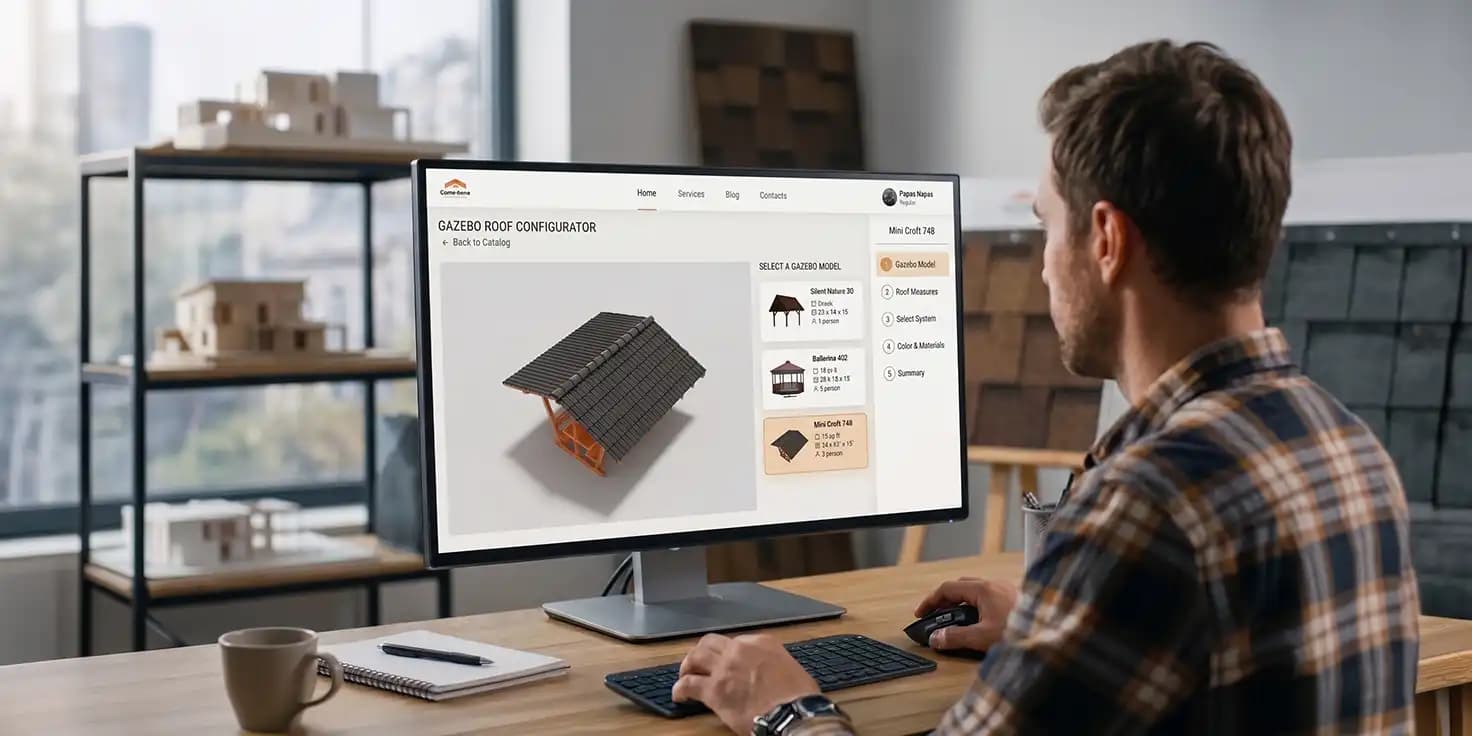
This is directly addressed by Configure Price Quote ( CPQ ) Software . Instead of manual review of each configuration, a connected system automatically validates, prices and quotes a roofing or façade build, often coupled with a 3d product configurator so buyers can see exactly what they are ordering.
But the opportunity for CEOs and business leaders goes even further. The right CPQ platform can help reduce estimating overhead, shorten sales cycles, avoid costly configuration errors and create a scalable way to sell increasingly complex Building Materials.
But not all CPQ solutions are created equal.
A simple quoting tool could price it. A contemporary solution must go much further.
8 Capabilities You Should Expect From Real CPQ Software for Roofing and Facade Manufacturers
1. Instant Quotes & Real Time Configuration
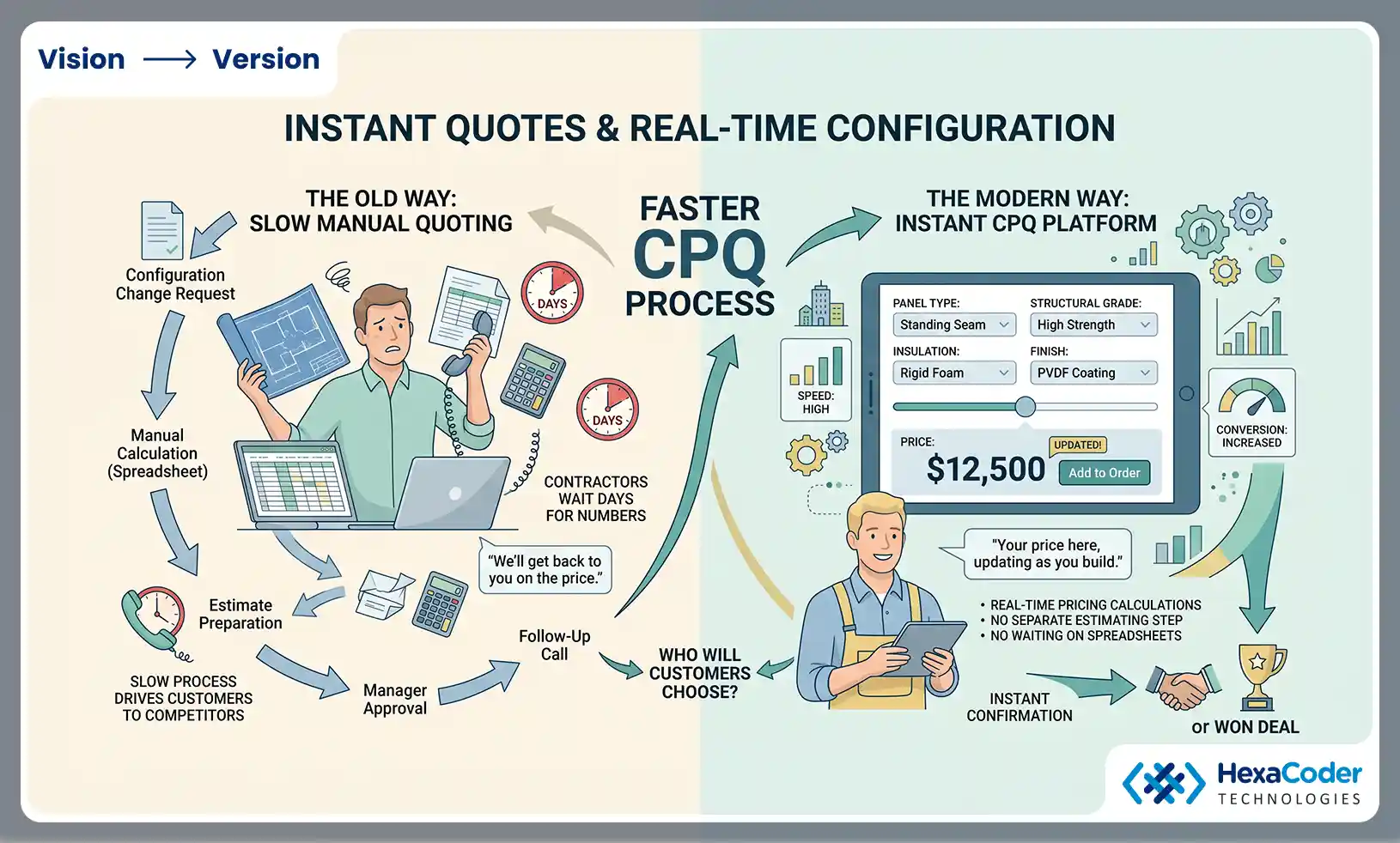
The first requirement is basic: buyers and sales teams need a price when a configuration changes.
Manual quoting slows down the process when speed is of the essence. A contractor rarely waits a few days for a number when comparing roofing quoting for manufacturers before going to a competitor.
As the panel type, structural grade, insulation and finish change, a modern CPQ platform instantly calculates the pricing. No separate estimating step, no waiting on a spreadsheet, no follow-up call just to confirm a number.
This shifts the sales conversation from: We’ll get back to you on the price.
To: Your price here, updating as you build.
That change alone often determines which manufacturer a contractor or architect first turns to.
2. Roofing & Facade Configuration According to Rules
Roofing and façade systems are not typically simple, single-variant products.
Panel dimensions, structural grade, insulation value, fastening systems, and finish all work together and not every combination is actually constructible or code compliant.
A good CPQ engine should be able to enforce rules to determine which combinations are valid.
For example,
- The size of the panel varies with structural grade and wind load requirements.
- Climate zones and building code can limit insulation options.
- Leaving some panel systems can cause loss of some finishes.
- Automatically removes incompatible fastening/panel combinations.
- Limitation of curtain wall and facade components according to structural bay layout.
When evaluating a platform, roofing manufacturers, roofing system companies, and facade manufacturers should not just look at the interface, but also verify that the underlying rules engine really represents engineering reality.
This is an important layer of protection for the manufacturer. Buyers get flexibility and the business gets the accuracy of structural, thermal and code compliance.
3. Rules-Driven Dynamic Pricing
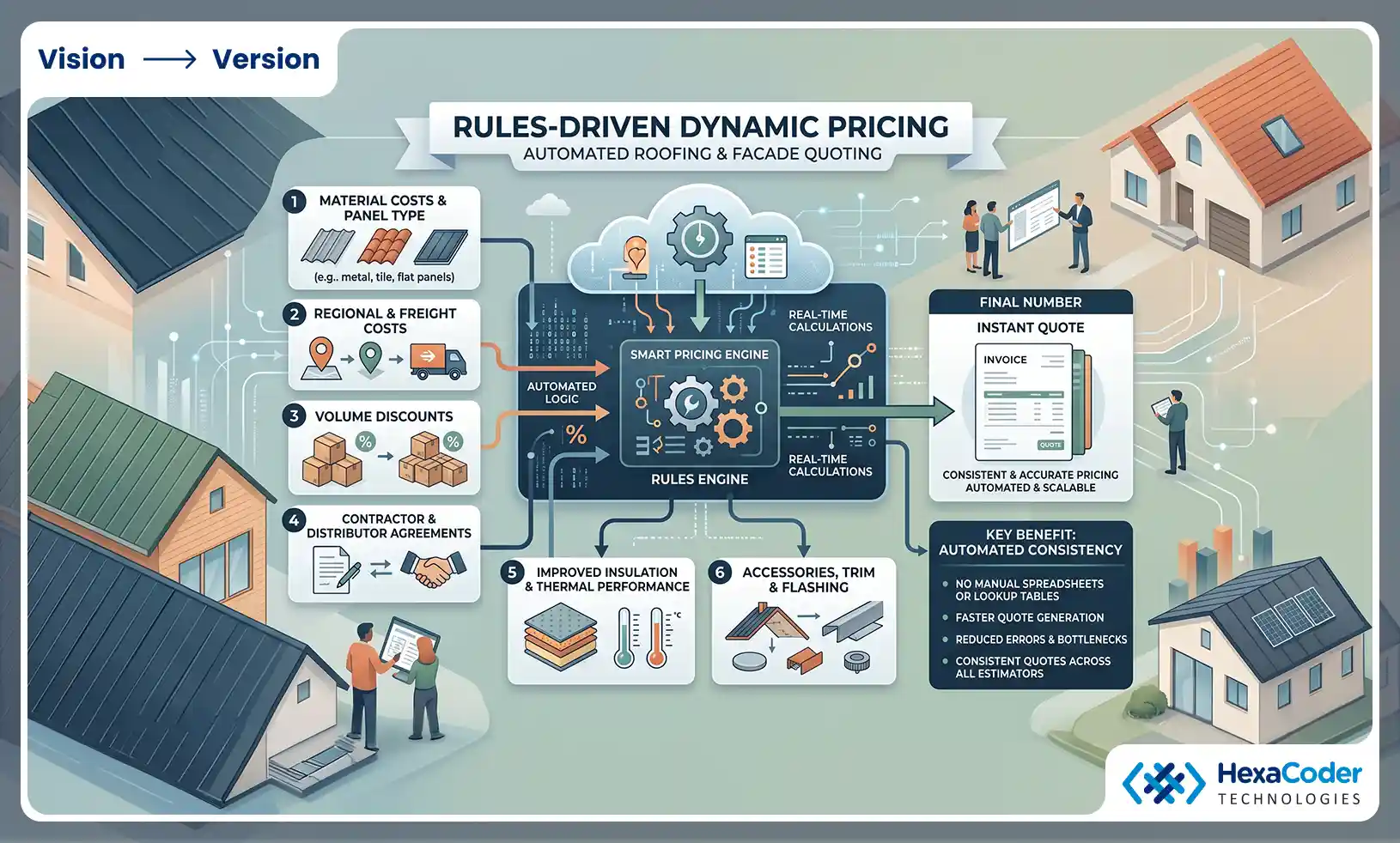
The complexity of pricing is one of the biggest reasons that roofing and facade quoting has remained a manual process for so long.
Material costs, type of panel, regional variation, volume discounts and contractor-specific agreements are all factors that affect the final number. A modern CPQ platform should be able to calculate all of this automatically without needing to use a separate spreadsheet or manual lookup table.
Same principle applies across:
- Cost of base panels and materials
- Improved insulation and thermal performance
- Changes in Regional or Freight Costs
- Contractor & distributor discount levels
- Accessories, trim and flashing
This makes pricing an automated, consistent part of every quote, regardless of the estimator, rather than a manual bottleneck.”
4. Integration with Roofing Visualization & 3D Product Configurator
Quoting Software is much more convincing when it is combined with visual configuration.
Static spec sheets show how a roofing or facade system appears on paper. A connected 3d product configurator enables buyers to view it.
Buyers should be able to change panel type, color, texture and finish whilst seeing an accurate model update in real-time, with the quote updating at the same time. Genuine Roofing visualization allows architects and contractors to see how a system will look in a real world application on an entire building facade, not just a single sample panel.
This connects two things that are typically handled separately, visualization and pricing, into one seamless experience.
The aim is not to make the quoting tool look cool.
The aim is to eliminate the guesswork that buyers have had to put up with in the past when specifying a system for a building that does not yet exist.
5. Accuracy of Quantity and Material Estimation
Visualization grabs attention. Accuracy of operation gets adoption.
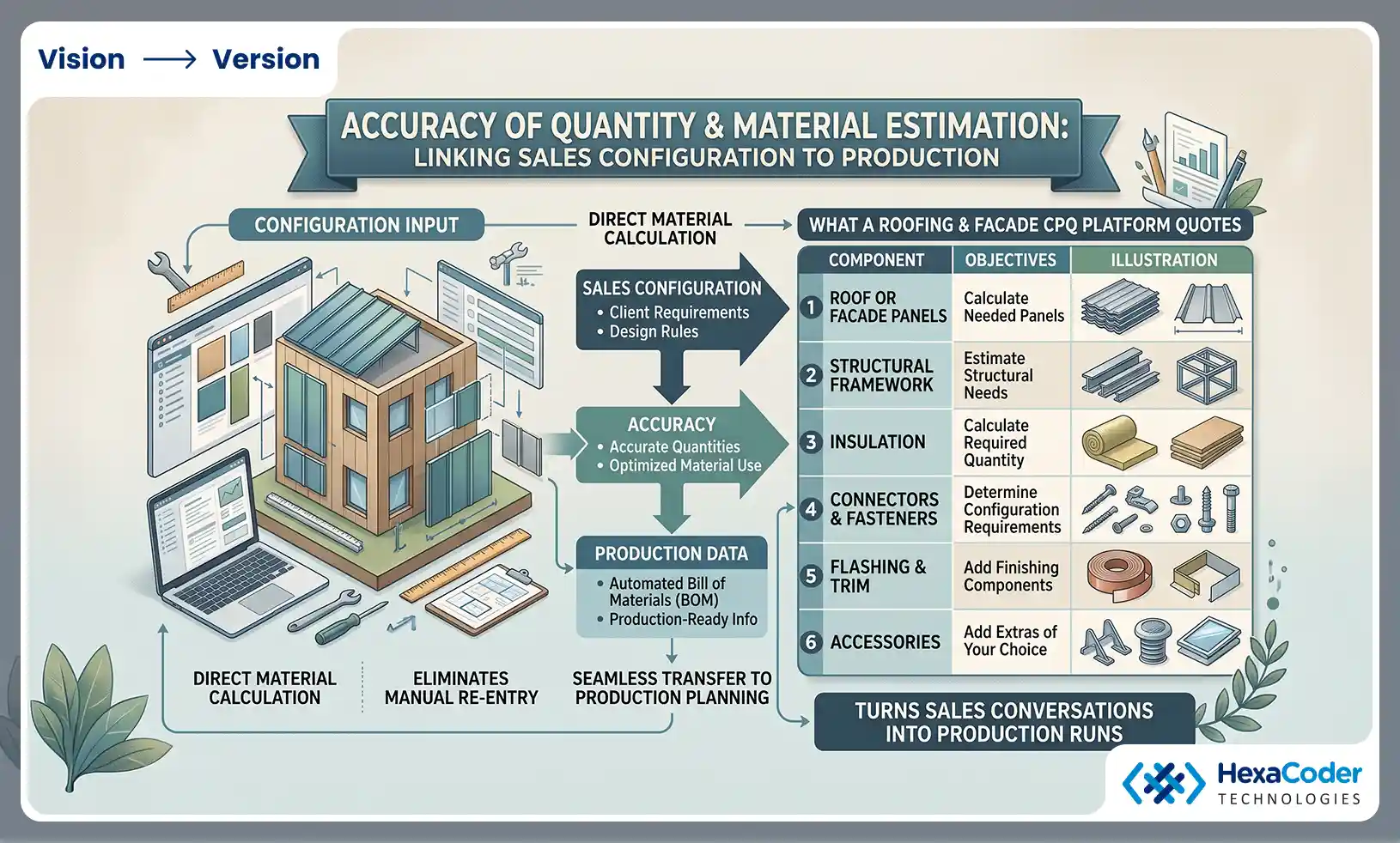
One of the most valuable capabilities for a roofing or facade manufacturer is the ability to translate a configured system into usable production information.
A modern CPQ solution should calculate material quantities directly from the configuration wherever the underlying product rules and building dimensions permit.
What does a Roofing & Facade CPQ Platform quote?
| Component | OBJECTIVES |
|---|---|
| Roof or façade panels | Calculate needed panels |
| Structural framework | Estimate structural needs |
| Insulating | Calculate the required quantity |
| Connectors & Fasteners | Determine configuration requirements |
| Flashing and trim | Add finishing components |
| Accessories | Add extras of your choice |
That turns a sales conversation into a production run.
This link between quoting and estimating is especially useful for manufacturers where a configuration needs to move from sales into production planning without the need for manual re-entry.
6. Selling With No Mistakes
A sophisticated CPQ platform shouldn’t just generate a price. It should guide the quote builder to a valid, sellable, code compliant configuration.
This is one of the largest differentiators between a standard quoting tool and a true CPQ Software.
Imagine a sales rep choosing a particular panel system. The system should immediately restrict the available structural grades, insulation and finishes to only those that are compatible.
Similarly, the platform can automatically surface the thermal and structural components that are typically required if a buyer selects a climate zone or building use case.
This means guided selling, not open-ended guessing.
The system enforces accuracy behind the scenes, for every rep, on every quote, instead of depending on the memory of a senior estimator for every unusual configuration.
This is especially important for scaling sales teams that operate in different regions with different code requirements. New hires can generate accurate, compliant quotes from day one rather than waiting months for product and code training.
7. Web-based, multi-device access
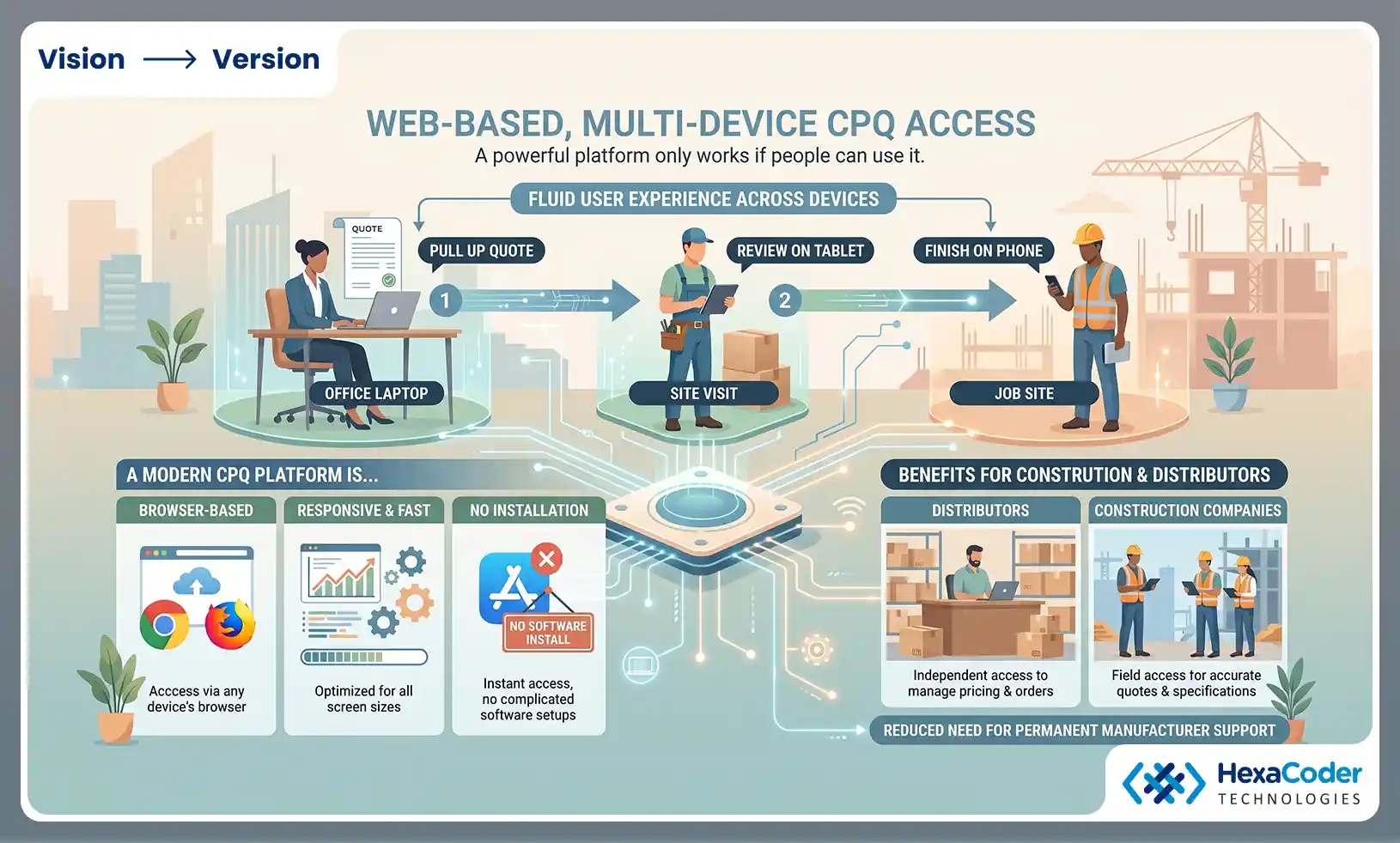
A powerful CPQ platform only works if the people who need it are able to use it.
Buyers, contractors and field sales teams are on the move, constantly switching devices. Someone could pull up a quote on the office laptop, review it on a tablet on a site visit and finish it on a phone from a job site.
So the experience has to work in all places.
A modern CPQ platform should ideally be browser-based, responsive and fast, without complicated software installation on every device that touches it.
Especially distributors and construction companies should be assessed regarding their capability to independently access and use the platform without permanent support from the manufacturer.
8. Sales and Production Ecosystem Integration
The last feature may well be the most important to a CEO.
CPQ Software should not be another siloed digital tool.
It has to plug into the existing business ecosystem.
Today’s CPQ platforms can potentially connect the sales experience to the systems used by production, estimating, CRM, ERP and enterprise operations.
Integrations could support depending on business needs:
- Product & Pricing Data
- Customer and lead data
- Order and Production Transfer
- Material and inventory availability
What Can Link Roofing & Facade CPQ?
| Integration | Support |
|---|---|
| ERP | Production and inventory information |
| CRM | Lead and customer flows |
| Systems estimate | Material and cost estimates |
| Production Schedule | Handoff Procedure |
| Information Analytics | Performance insight |
This integrated-first approach is especially critical for roofing and façade manufacturers. A CPQ platform must serve the commercial and operational ecosystem, not be a disconnected front-end application that invisibly reproduces the fragmentation it was meant to address.
What to Look for in CPQ for Roofing & Facade Manufacturers
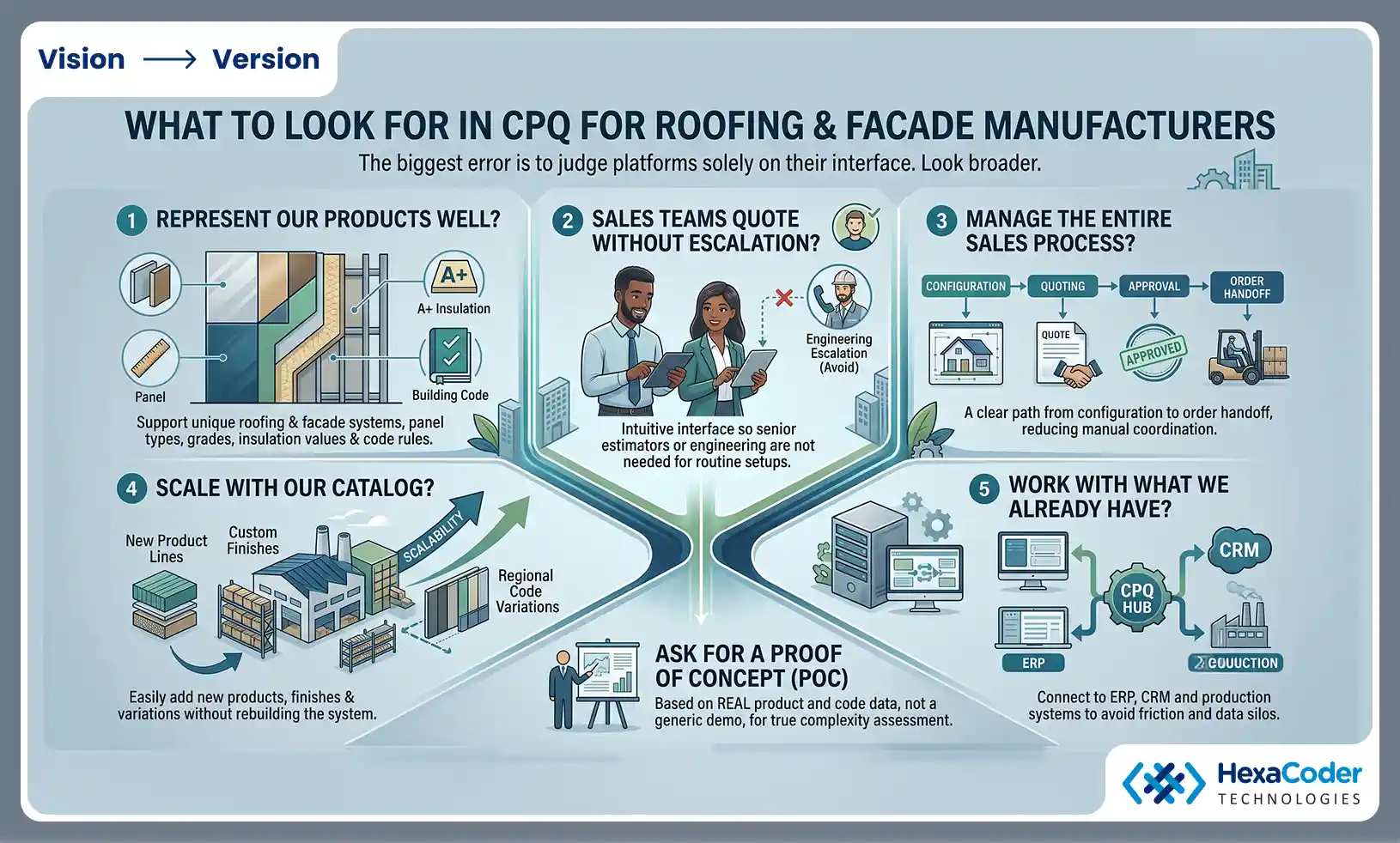
The biggest error is to judge CPQ platforms mostly on the brilliance of their interface.
A clean quote screen is useful but insufficient.
Decision makers should look at the platform on five broader questions:
- Can it represent our products well? The system must support the unique nature of the manufacturer’s roofing and façade systems such as panel types, structural grades, insulation values and code rules.
- Can sales teams and contractors quote without escalation? The interface should be intuitive enough that you don’t need to refer back to your senior estimators for routine setups. If you still have to call engineering for every third quote, the platform hasn’t fixed the underlying problem.
- Can it manage the entire sales process? Rather than stopping at the quote and leaving everything else to manual coordination, the platform requires a clear path from configuration all the way through quoting, approval and order handoff.
- Will it scale with our catalog? Manufacturers regularly add products, finishes and regional code variations. The platform must be able to scale with that complexity, not have to be rebuilt every time the catalog grows.
- Can it work with what we already have? CPQ for facade manufacturer platforms that are not connected to ERP, CRM and production systems creates the same friction as the manual process it was meant to replace.
One good step in the evaluation process is to ask for a proof of concept based on the real product and code data of the manufacturer and not a generic demo catalog. This says a lot more about what a platform will actually do when deployed on real complexity.
Why It Matters For CEOs And Decision Makers
For CEOs considering this type of investment, the case is more often made on the basis of specific measurable outcomes rather than on a general feeling that quoting should be modern.
Revenue translates directly into shorter sales cycles. A quote that used to take days now takes minutes. Buyers respond to speed, especially on large commercial projects with tight bidding timelines.
Margin defends less mistakes. Every badly set up order – scrapped panels, a rejected quote, expensive rework after installation has started – eats directly into the profitability that builds up over a year of project volume.
Sales capacity grows without a corresponding increase in headcount as reps and distributors can produce accurate quotes themselves instead of sending every non-standard quote back to a small pool of senior estimators.
And cleaner data leads to better planning because each quote generated on a connected CPQ platform is a snapshot of real demand, not a collection of anecdotal sales reports from individual reps and regions.
There’s another benefit, less obvious but real. Buyer trust. A manufacturer that provides a quick, accurate, code compliant quote to a contractor or architect will be viewed differently than one that takes multiple days to provide a number that may still need revision.
The Strategic Opportunity Beyond Configure, Price, Quote (CPQ)
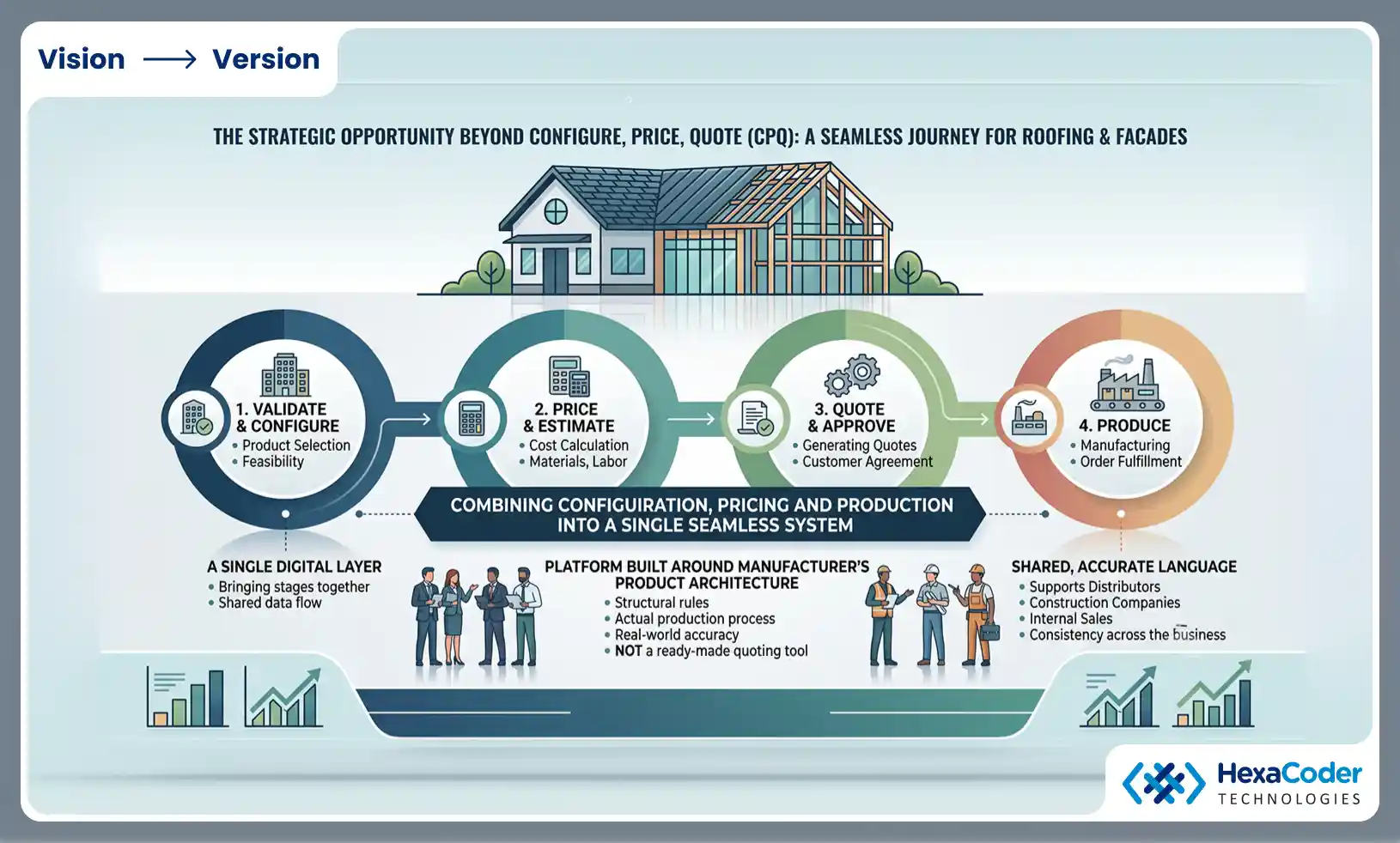
The future of sales technology for roofing and facades is more than simply getting quotes faster.
It’s about combining configuration, pricing and production into a single seamless system.
That means for roofing and facade manufacturers, the next generation of sales tools should support the whole journey:
Validate → Configure → Price → Estimate → Quote → Approve → Produce
And CPQ software for complex roofing and facade configurations can be the digital layer that brings all those stages together.
The business case becomes really strong if the platform is built around the manufacturer’s actual product architecture, structural rules and production process, rather than being offered as a ready-made quoting tool.
The same technology can also support distributors, construction companies, and internal sales teams, creating a shared, accurate language around pricing and product configuration across the entire business.
Conclusion
Manufacturing of roofing and facades is speeding up, getting more accurate and more connected to the sales process.
Buyers want to be able to trust a quote at the moment, not days later.
Sales teams and distributors want tools that let them quote with confidence, without having to ask every configuration question.
Manufacturers want a scalable way to sell more complex Building Materials across roofing and façade product lines, without hiring proportionally more estimators for every new region or code requirement.
And CEOs want technology investments that provide measurable business results, not just a prettier quoting screen.
With real-time configuration, rule-based validation, dynamic pricing and real production integration, CPQ Software can meet all these needs and turn quoting from a manual bottleneck into a real competitive advantage for roofing and facade manufacturers.