

Introduction
Every furniture maker has a set of rules that determine what can really be built.
Some are written. A fabric book shows what grades are suitable for what frames. There is a production manual for maximum seat spans without support. Most aren't written down at all. They are assisted by people who have been on the floor for years and who know without being told why a given pattern can't be used for a tight back, why a certain base can't take a specific frame length.
That knowledge works until it becomes the limiting factor.
As a dealer network grows, or as seasoned estimators retire, or as a business begins to sell configurable product online, the informal system stops scaling. Orders come in that look good on paper and die on the cutting table.
Visual CPQ addresses this by shifting those rules from memory into software. But the value depends on how well the rules are captured and modeled, not on how good the configurator looks.
This guide describes what 3D furniture product configurator rules are, the types they fall into, how a configurator applies them, and how the same rule set can generate buildable output and not just block invalid choices.
The Real Meaning of a Product Rule
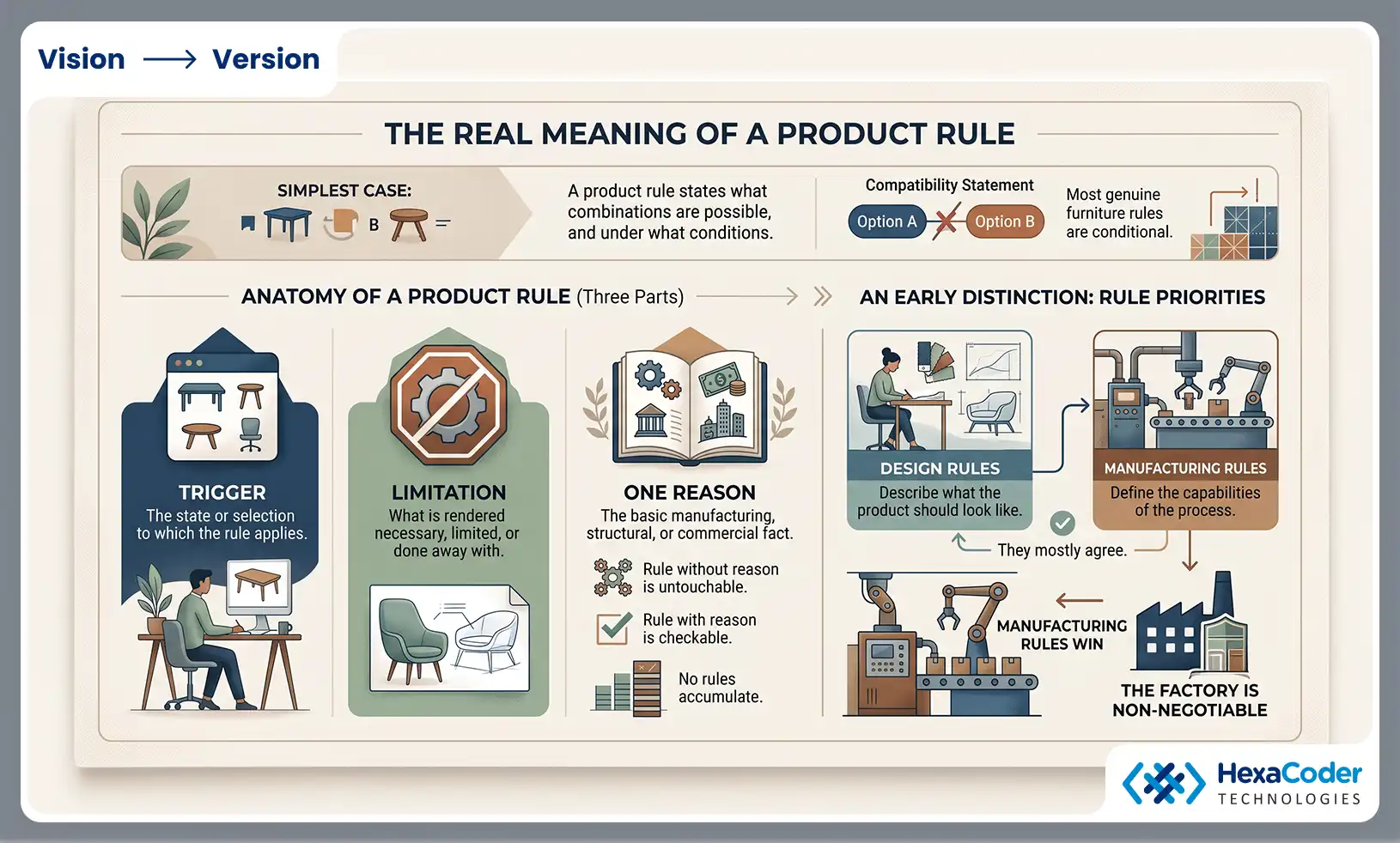
A product rule states what combinations are possible, and under what conditions.
The simplest case is a compatibility statement: option A cannot be chosen with option B. Most genuine rules about furniture are more conditional than this.
To think about it in a useful way, each rule has three parts:
Trigger. The state or selection to which the rule applies.
A limitation. What is rendered necessary, limited, or done away with.
One reason. The basic manufacturing, structural or commercial fact.
The third part is bigger than teams normally think. A rule that is written without reason becomes untouchable. Two years later, we still don’t know if the restriction was a structural limit, a supplier that no longer exists, or the preference of a product manager who has since moved on. Rules are checkable with reasons. No, rules accumulate.
But there is also an early distinction to be made. Design rules describe what the product should look like. The manufacturing rules define the capabilities of the process. They mostly agree. If they don’t, the rule of manufacturing wins. The factory is non-negotiable.
Where Furniture Rules The Day Now
Before a manufacturer can model rules, it must find them.
In most furniture businesses, they are spread over at least five places.
Some of them are included in the price list, generally as footnotes and asterisks. Repeat. The fabric book has more, often in small print about railroads. Engineering drawings were written with dimensional limits that never went anywhere else. Customer service has rules; rules are just a list of problems in the past. And the biggest chunk goes to the production floor; habits and corrections that were never called rules in the first place.
The real problem is distribution. Not that the rules are secret, but that no one person or document has them all.
It’s a familiar symptom: a quote that sails through all the checks the sales team can do, and then comes back from production with a question. The rule was there. Just wasn’t anywhere accessible to the salesperson.
The Four Families of Furniture Product Rules
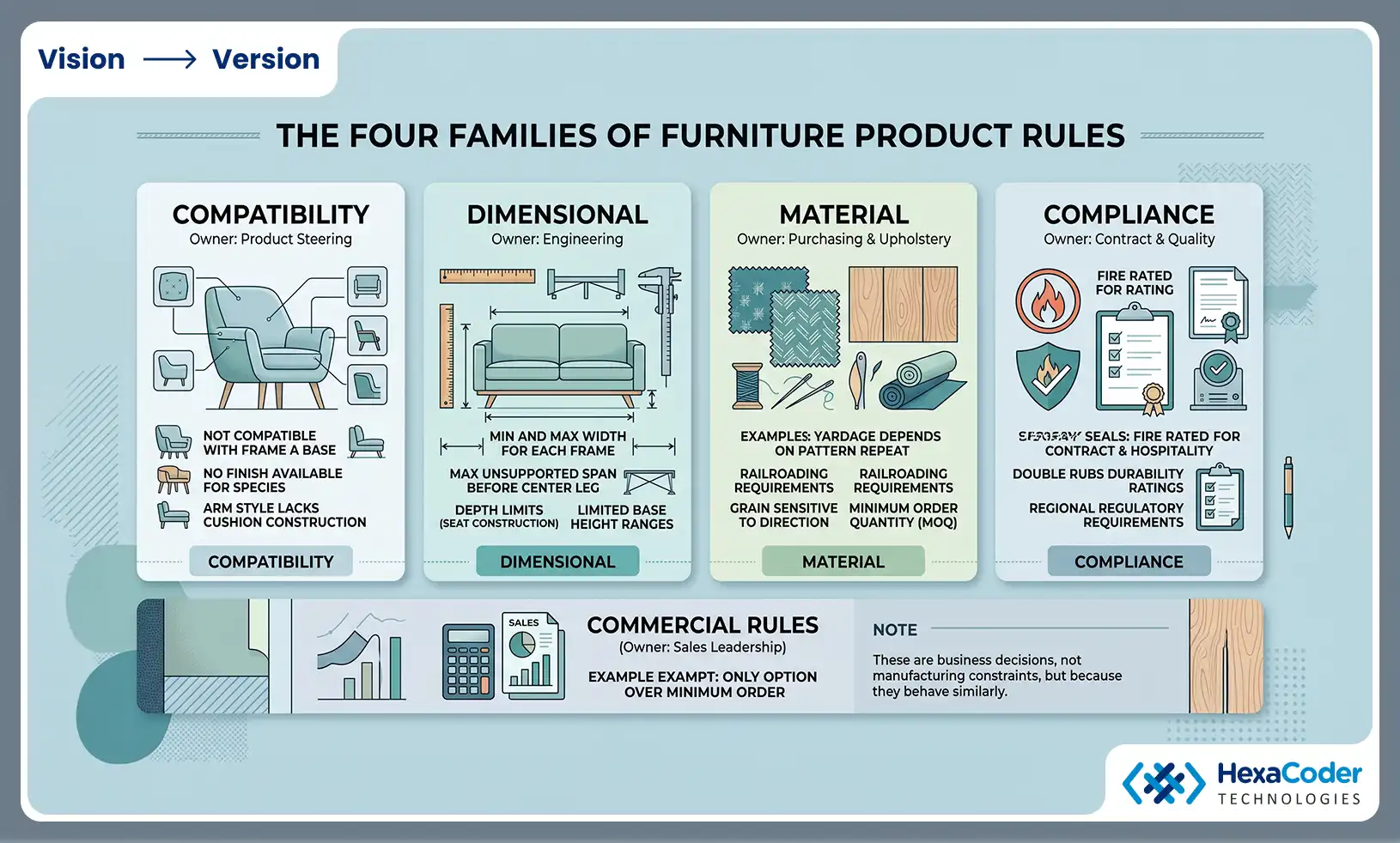
There are four main families of rules about furniture. This allows for a much quicker capture process since each family is owned by a different part of the business.
Compatibility rules specify which options are compatible. Not compatible with a certain frame. A base is No finish is available for this species. In particular, an arm style does not have a cushion construction.
Size and proportion are subject to dimensional rules. Min and max width for each frame. Max unsupported span ahead of a center leg. Depth limits are related to seat construction. Limited base height ranges.
The selected materials need to be ruled off material. Yardage depends on pattern repeat. Railroading requires. Grain sensitive to direction. A minimum order quantity applies to selected finishes.
The market needs what the compliance rules require. Fire rated for contract and hospitality specification Double rubs durability ratings. Regional regulatory requirements that apply to some locations but not other locations.
| Rule family | Typical owner | Typical example |
|---|---|---|
| Compatibility | Product steering | No frame length base rating |
| Dimensional | Engineering | Maximum span before center support |
| Material | Purchase & upholstery | Repeat raises yards needed |
| Compliance | Contract & Quality | Fire rating of hospitality |
| Commercial | Sales Leadership | Only Option over Minimum Order |
The fifth row is interesting. Commercial rules are not manufacturing constraints, but they behave the same way inside a configurator and mixing them into the same rule set without labeling them is a common source of confusion later.
How a Rules Based Configurator Uses Them
A rules-based configurator does not only verify the final configuration. It imposes constraints as choices are made, and does so continuously.
The practical difference is between two behaviors.
In a validate at the end model, the user builds a complete configuration and then gets an error. The buyer has made a choice and now they're told to unmake that choice, often without being told what choice created the conflict.
In a constraint propagation model, each choice immediately narrows what remains. You pick a frame and this filters the list to remove bases that are not compatible before the buyer ever sees them. Selecting a fabric with a large repeat will automatically affect the yardage calculation.
The second approach is what most people are asking when they ask how furniture configurators handle product rules. Options aren't tossed. They’re never given.
This has a design consequence that product teams should decide deliberately: whether unavailable options disappear completely or remain visible but disabled with an explanation. Hiding gives a cleaner interface. Disabling with a reason teaches the user how the product works, reducing repeat questions from dealers. Usually, dealer-facing tools have wins visible and explained.
Order dependence also requires attention. The system should be able to accommodate the constraint of the buyer selecting fabric first and frame second and vice versa. A one sequence only configurator is not modeling a product but a form.
The Line Between Valid and Manufacturability
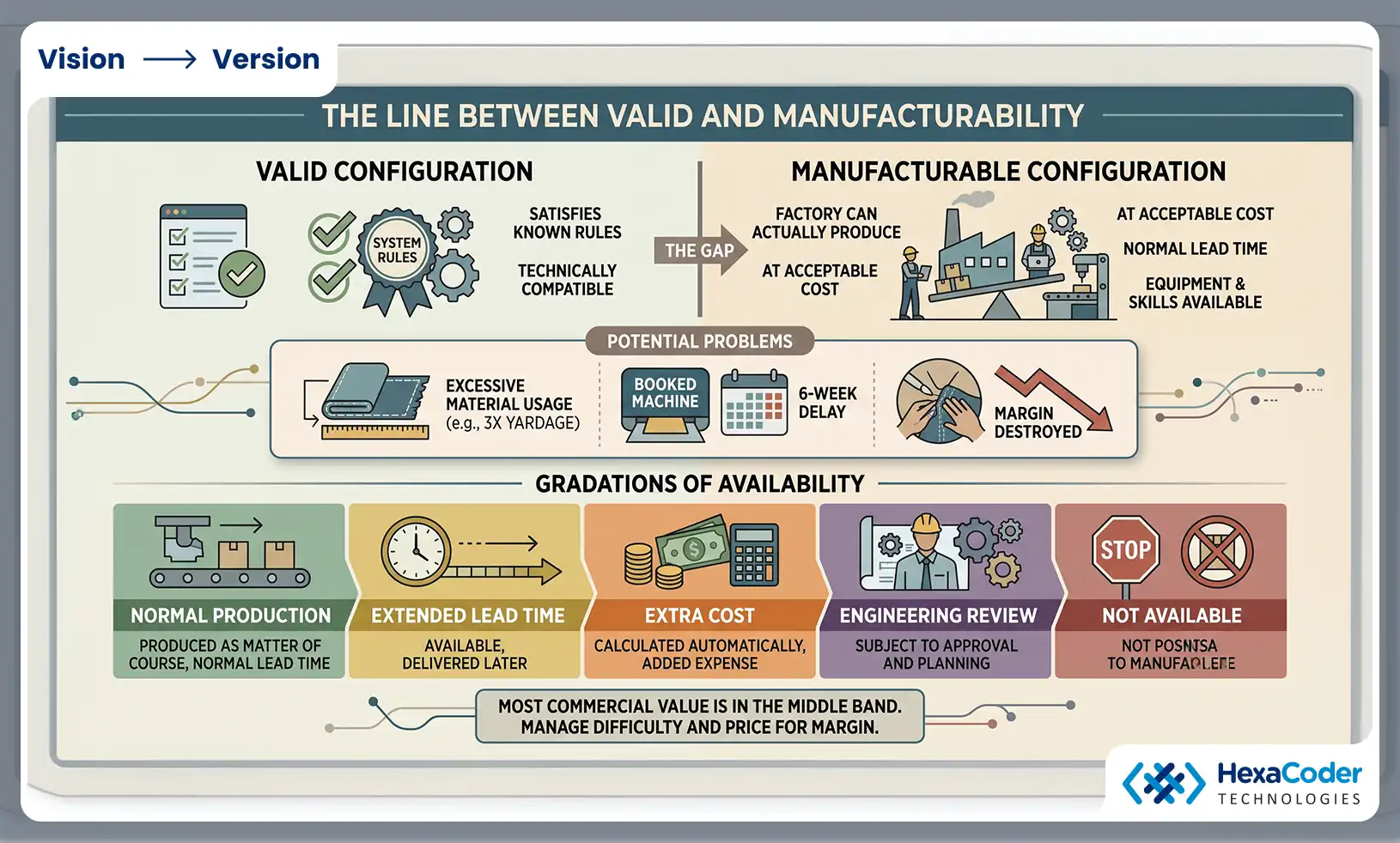
This is the most important difference, and the one most often missed.
A valid configuration is one that satisfies all the rules the system knows. The factory can actually produce a manufacturable configuration, at acceptable cost, within normal lead time, with the equipment and skills currently available.
These are not the same test.
But a configuration can be perfectly valid and still be a problem. It might be a fabric that is technically compatible but it takes three times the normal yardage. It might be something we can only do on a machine that’s booked for six weeks.” It might be buildable but require a level of hand finishing that quietly destroys the margin on the order.
A furniture configurator with manufacturing constraints has to consider this. And that means the rule set needs to be more than allowed or not allowed. Useful systems have gradations:
- Normal, produced as a matter of course on normal lead time
- Available with extended lead time
- Available at extra cost, calculated automatically
- Available subject to engineering review and approval.
- Not Available
Most of the commercial value is in that middle band. Manufacturers do not lose margin on the orders they decline but on the orders they accept without knowing what they cost. Instead of just allowing or blocking, having a configurator that can price and flag difficulty makes those exceptions a visible, managed part of the business.
Converting Rules to Production Output
A well-modeled rule set does more than prevent bad configurations. It provides the factory with the information it needs.”
That’s the difference between a manufacturable configuration and a permitted one. The rules already describe how components relate. So the same logic can calculate what a configuration consumes.
| Output | Source Of |
|---|---|
| Bill of materials | Component and compatibility rules |
| Fabric yardage | Material rules including repeat and railyard |
| Cut List | Frame Geometry and Dimensional Rules |
| Hardware schedule | Base, fixing and load rules |
| Labor estimating | Construction method and complexity rules |
| Lead time | Rules for availability and capacity |
When this works, the quote and the work order are no longer two documents that someone reconciles. They become one definition with two outputs.
This is also the best argument for bringing engineering in early instead of treating configuration as a sales project. A rule set designed only to stop bad quotes will stop bad quotes. That will be done by a rule set to describe how the product is made and a byproduct of that will be the manufacturing data.
Where Rule Modeling Gets It Wrong
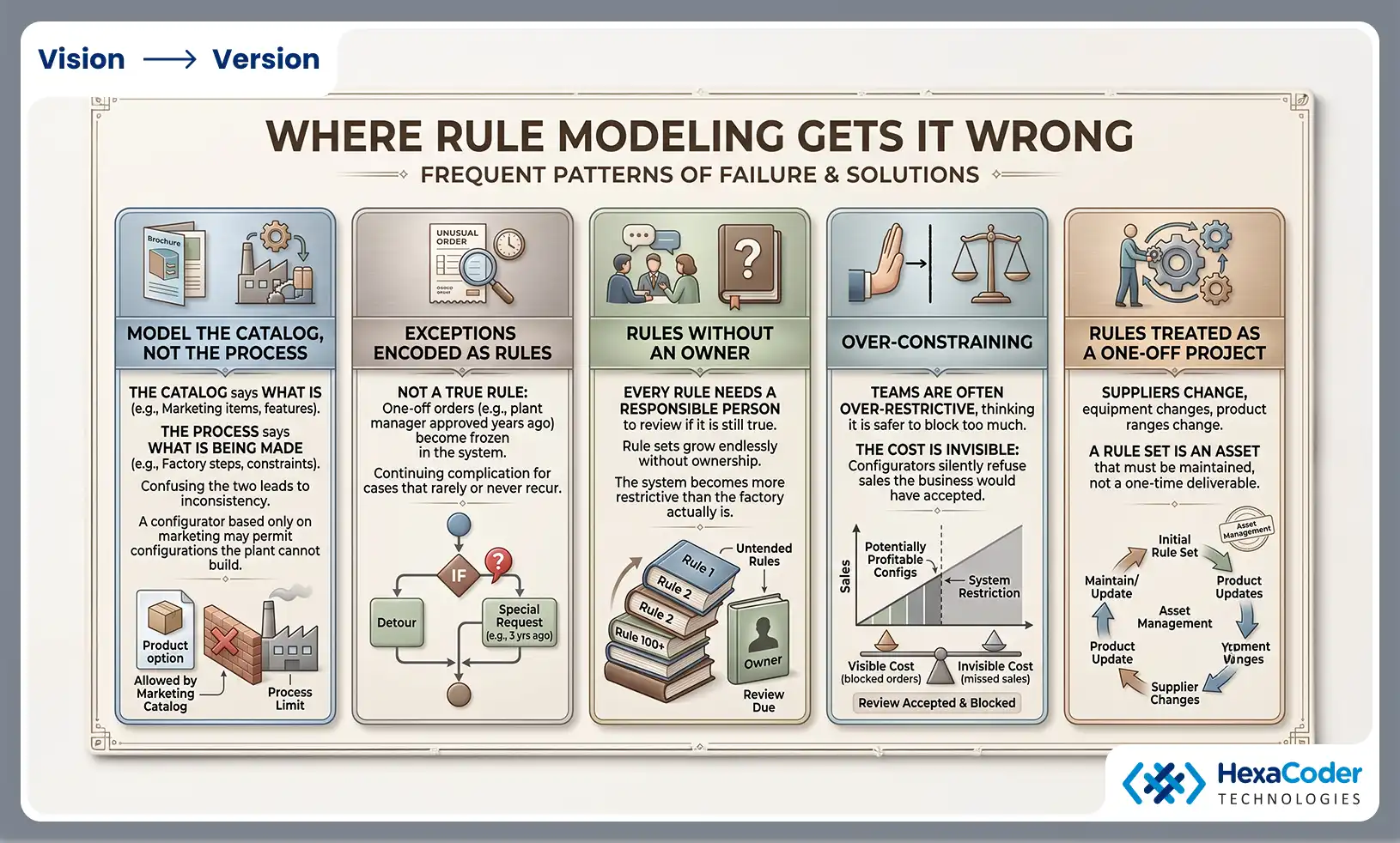
Some patterns of failures are frequent enough to deserve a name.
Model the catalog, not the process. The catalog says what is sold. The process says what is being made. A configurator based on marketing material will be internally consistent, but still permit configurations that the floor can not build.
Exceptions Encoded as Rules This is not a rule, it is a one-off order approved by a plant manager three years ago. It's a continuing complication in exchange for a case that may never occur again, the thinking goes.
Rules without an owner. Someone has to be responsible for every rule to see if it is still true. Rule sets only grow without ownership. The system ends up being more and more restrictive than the factory actually is.
Over-constraining. Teams tend to be over-restrictive, because it is safer to block too much than too little. The cost is invisible, the configurator sales that the business would have accepted, silently refused. Review of accepted configurations is as important as periodic review of blocked ones.
Rules treated as a one-off project. Suppliers change, equipment changes, ranges change. A rule set is an asset that is maintained, not a deliverable that ships one time.
Understanding the rules of the factory floor
Rule capture is an engineering exercise more than it is a software exercise. An open-ended workshop does not work as well as a practical sequence.
Start with one product family, preferably the most configurable one, not the simplest. Complexity found early is cheaper than complexity found at launch.
From failures backward. Pull the last 12 months of orders that were queried, corrected, remade or returned. Each is a rule that existed but was not enforced anywhere. This is usually the quickest way to get real constraints, and it produces rules which are already cost-justified.
Interview people from multiple functions – not just one. Ask engineering what will fail structurally. Ask upholstery what can’t be applied. Ask purchasing what has min. quantities or long lead times. Inquire of customer service regarding customer complaints. Seldom overlap as much as one expects, the four answers.
Every rule should have a reason recorded. Without it, nothing can be reviewed later on.
Then test against actual history. Run past orders versus the model rule set. Orders successfully built should go through. Orders that caused issues should be trapped. The factory has actually made configurations that the rules block. That means over-constraint. Each needs a decision, not silent restriction.
What Product, Engineering & Sales Leaders Should Look For
You need all three views. Different functions test the same platform differently.
Can it tell us our real limitations? Conditional binary rules are what product managers should be testing. Most platforms handle basic compatibility. Fewer deal with a rule where the yardage depends on repetition, which depends on the frame, which depends on the dimension chosen.
Can you maintain rules without development work? If you require a vendor ticket to add a fabric book or a new base option, the rule set will be behind the catalog in a year.
Does it produce manufacturing output? Engineering should check that the configuration produces a usable bill of materials and cut list, not just a validated price.”
Is this apparent to the user? Sales leaders should test what a dealer sees when an option is not available. Silence gives rise to phone calls. A sale is redirected by a particular reason.
Can it be tested against the past? The single most useful validation is the ability to run orders through the rule set before going live, and this is rarely offered unless you ask for it.
A proof of concept with one real complex product family, with the rules from the manufacturer itself, shows a lot more than a broad demo on an easy catalog.
Why It Matters to Decision Makers
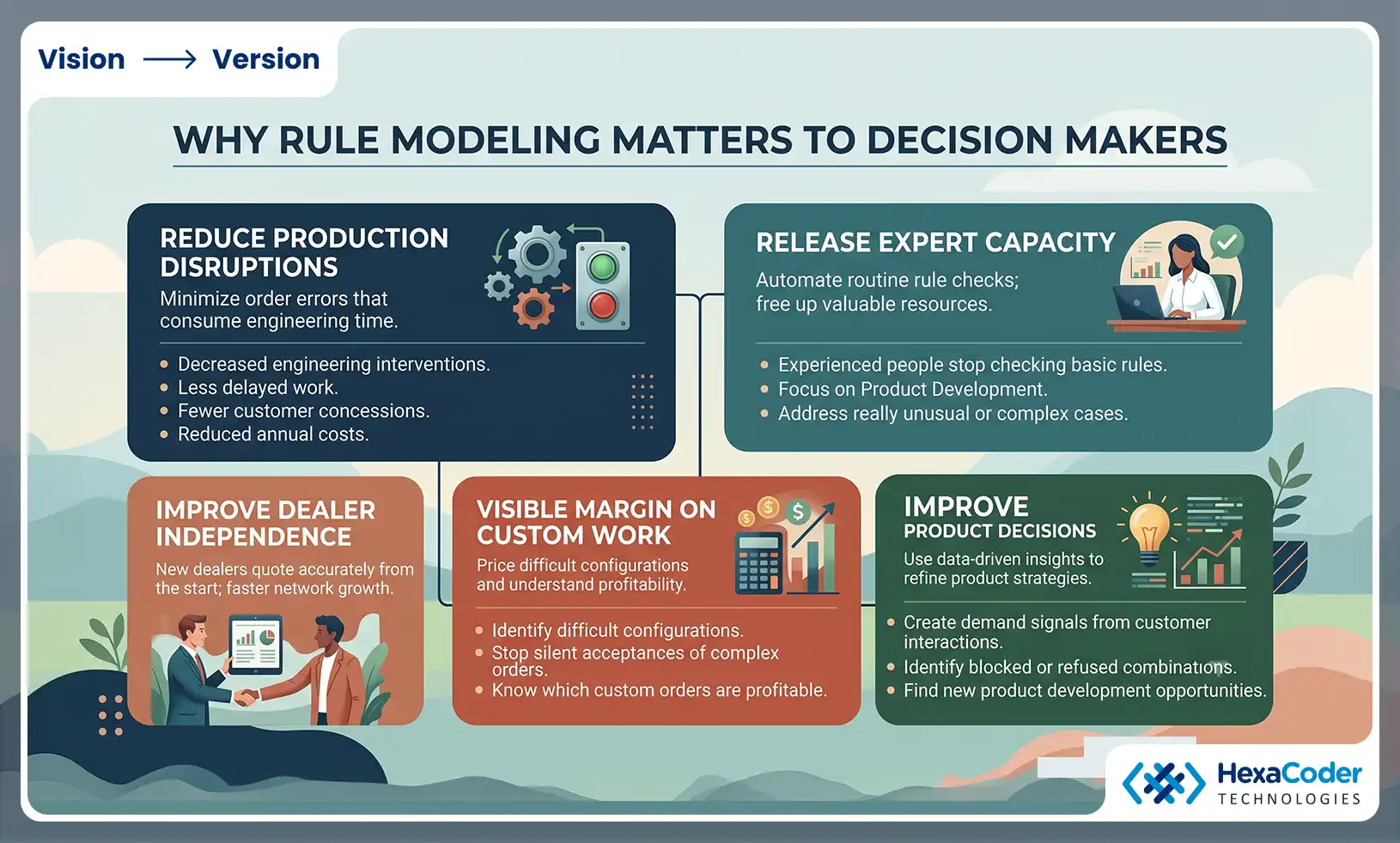
The business case for rule modeling is not as obvious as for a configurator, but it is where the real returns kick in.
Production disruption is down. Orders that end at the factory consume engineering time, delay other work and often result in a concession to the customer. They are all small. The annual total is seldom.
Capacity estimate is released. When the system enforces the rules, experienced people stop spending their days checking whether configurations are possible and start spending them on product development and on the really unusual cases.
Dealer independence is improved. What makes network growth practical rather than theoretical is that new dealers can quote accurately from their first week, not after months of product training.
Margin is visible on custom work. When difficult configurations are priced and flagged, not silently accepted, the business finally knows which custom orders are profitable.
And product decisions improve. A demand signal is a set of rules that captures what the customers asked for and what was blocked. Repeatedly refused combinations are a rule worth revisiting, or a product to be developed.
The Strategic Opportunity Outside of Rules
The long-term value is not in enforcement. It has one correct model for what the business can produce.
Once that model is created it is useful to more than just the configurator. Quoting, production planning, catalog development, dealer training and, ultimately, any future channel are supported because the definition of the product doesn’t exist in individual memory anymore.
For furniture makers, the order is straightforward:
Capture → Model → Validate → Configure → Estimate → Generate
The configurator is the visual tier. The asset is the rule set underneath. It’s the part that keeps its value even if the front end is replaced.
The business case is strongest when the rule set is developed around the way the manufacturer actually makes furniture rather than adapted from a generic template built around a different process.
Conclusion
A configurator with wrong rules is a great way to create unbuildable orders.
The rendering is not what makes furniture visual CPQ powerful. It is the unglamorous exercise of finding the constraints that live today on the production floor, in the fabric book, in the memory of experienced people, and expressing them precisely enough that software can consistently apply them.
Do it well and the configurator stops being a sales tool that engineering has to check. Each configuration that a customer builds is one that the factory can produce, correctly priced, and with the bill of materials already generated.
That is the real test of a rules based configurator. Not if it looks good to a buyer, but whether the floor believes what comes out of it.