
Top Augmented Reality Use Cases for Manufacturing and Industrial Design
Would you want to save 60 percent on the cost of physical prototyping? Cut down the amount of time needed to train employees for manufacturing jobs by half? Or identify issues in design long before a piece even hits the production line?
This is no longer the case of wishful thinking. This is precisely what is going on in today's manufacturing plants. The global market value of industrial augmented reality reached $80.37 billion in 2024 and is expected to soar all the way up to $631 billion by 2030. This is not a trend; it's an entire paradigm shift when it comes to designing and producing goods.
And the companies that are undergoing this change do it not because of trends but due to their quest for operational excellence. Augmented reality has emerged into the very infrastructure necessary for that to happen. If you're working on cars, planes, or heavy machinery, you don't have to worry if AR will come to your industry. It is there right now, changing product design, manufacturing training, equipment maintenance, and quality control as you read.
1. 3D Rendering and Product Design Visualization
Now let us begin by considering the design process itself. That is where we can clearly see one of the strongest influences of AR technology.
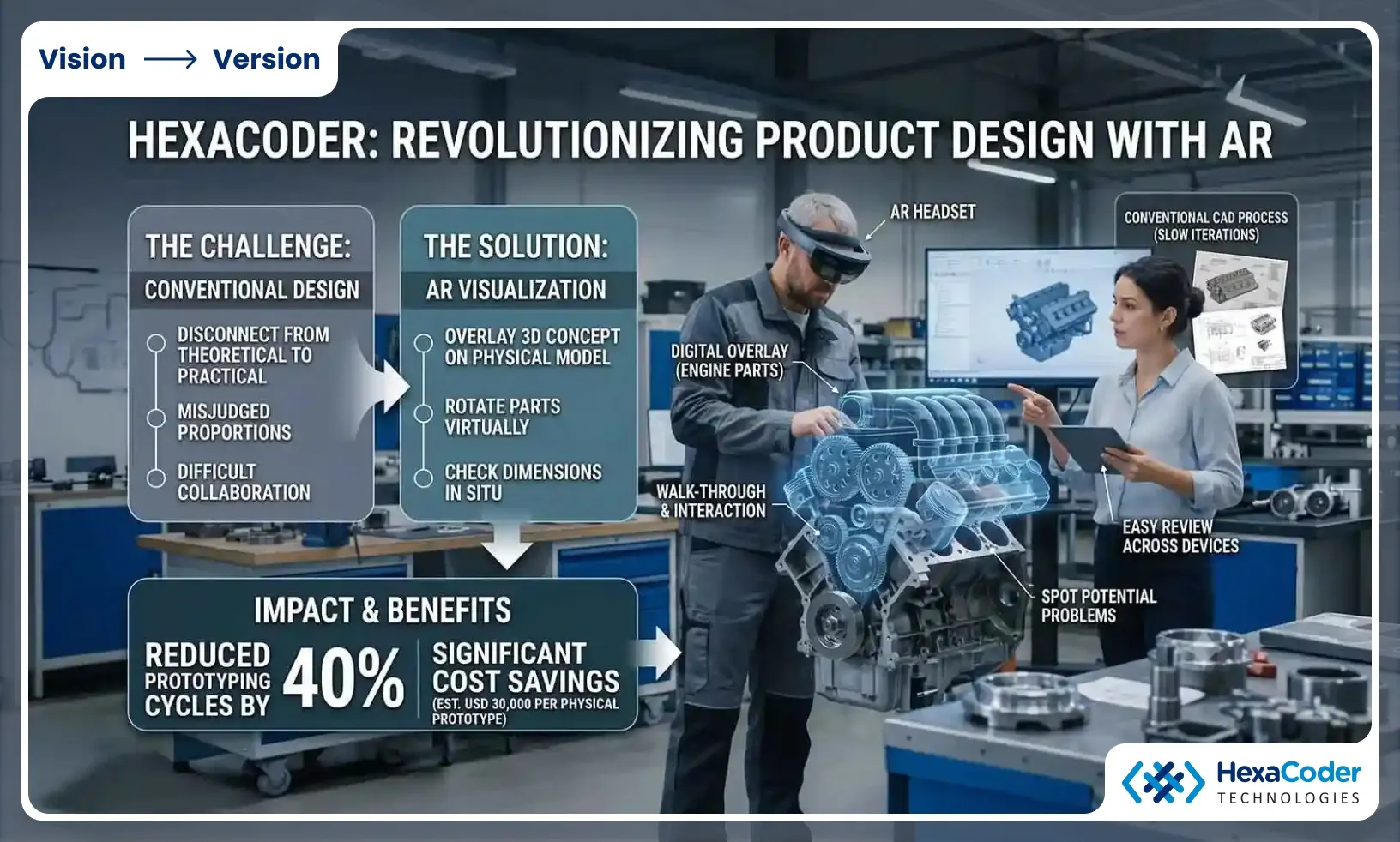
Conventionally, in manufacturing industry, designers prepare product concept using CAD software. Then they are reviewed in a series of iterations where project participants analyze various 2D and perhaps 3D renderings. It is inevitable that there is always a disconnect between theoretical designs and practical solutions. Designers may fail to grasp all spatial relations. They may misjudge proportions. And collaborators will inevitably have troubles giving their critique about the object being visualized in mind.
But things are completely different in case of AR. Using it, designers can overlay their 3D concept onto the physical model and prototype and see how their product would fit into the picture from the very beginning. Let us consider the complicated assembly such as an engine block for automobile. In this case, using AR technologies, engineers could walk through a physical mock-up environment while seeing digital parts of an engine positioned just in place where they really will be located. It allows them to check all dimensions and even rotate parts virtually and spot any potential problems immediately.
This has huge monetary implications. Presently, organizations are estimated to be spending as much as USD 30,000 per physical prototype. The typical product design cycle requires the creation of many different prototypes before the final version gets approved. In case of AR visualization, organizations will now have the advantage of virtualizing prototypes before actually creating them. In one such case study, a manufacturer reduced prototyping cycles by an impressive 40% just by incorporating AR visualization technology.
Such is the level of integration of AR visualization with design offered by Hexacoder's rendering services. Through the use of AR visualization technology, it becomes possible to turn CAD models into interactive 3D visualizations that can easily be viewed in AR environments. This makes it easy to interact with the design and understand the look and feel of the product even before going into manufacturing. These visualizations are easily accessible across devices.
2. Assembly Instructions and Real-Time Guidance
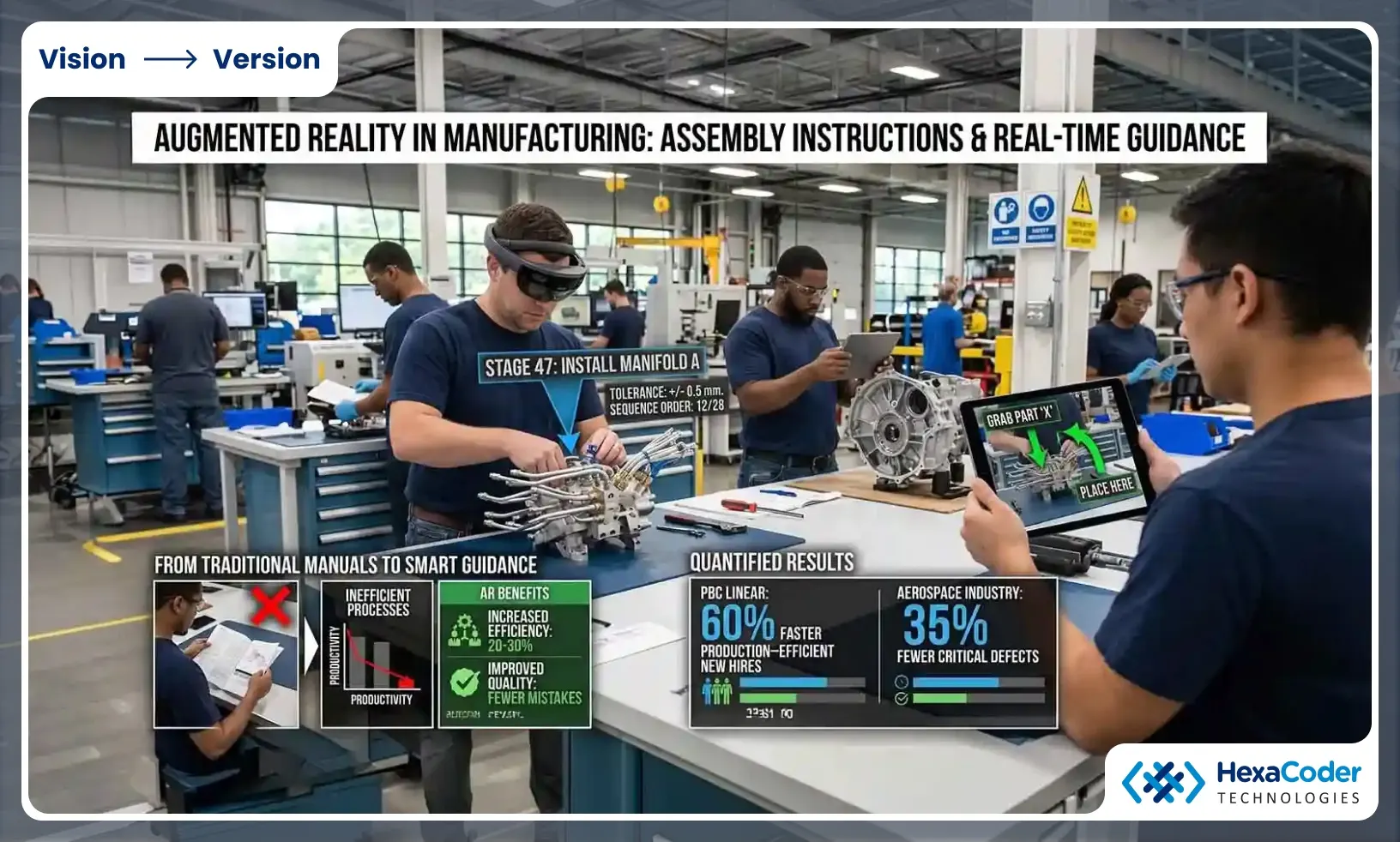
However, areas where AR technology can make the biggest impact almost right away are the factory floors. Assembly is complicated business. There might be hundreds of assembly stages required for one particular product, all of which involve different tolerance, sequence order, and quality. Traditionally, workers have been using printed instruction manuals, PDF files stored on their tablets, or supervisor guidance for assembly operations. However, that's quite an inefficient approach, especially in case of high employee turnover rates.
By using AR-powered assembly technology, employees wear AR goggles or use a tablet aimed at the area of operation. Instruction manual appears literally on top of the hardware the employee needs to assemble. For example, stage 47 of the assembly process shows what particular part of hardware should be grabbed and placed, and in which particular way by indicating it precisely with arrows. In case of any deviation from instructions – if an employee grabs a wrong part or places it with wrong tolerances, AR assembly technology notifies him or her instantly.
The difference is quantified in both quality and speed. PBC Linear has introduced AR training for assembly workers through Manifest and found out that the new hires became production-efficient 60 percent faster than traditional training techniques took. Fewer mistakes were made. The workers did not need to memorize the instructions. They only had to follow the instructions displayed on their vision screens. Companies that manufacture products in aerospace, automobiles, and heavy machinery industries are finding that they can increase efficiency by 20-30 percent by using AR as opposed to paper-based instructions.
This becomes increasingly important when there are complex processes involved. Small mistakes lead to big problems. One such company in the aerospace industry is finding that its AR-enabled assembly process is resulting in 35 percent fewer critical defects.
3. Quality Control and Defect Detection
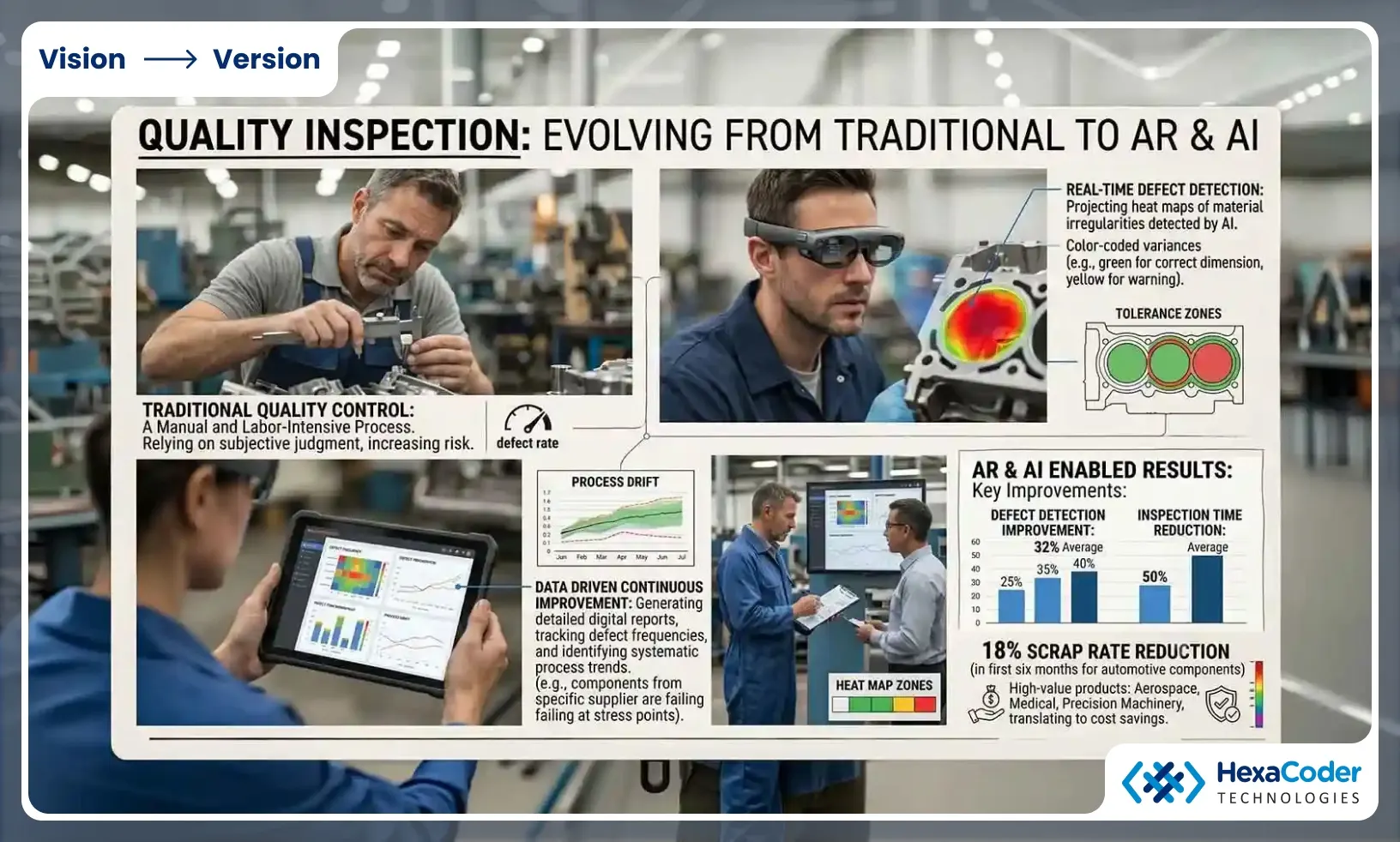
Quality inspection is when the marriage of AR technology with AI becomes truly revolutionary.
Traditional quality control processes require inspectors to manually verify physical parts according to specs. It involves using various measurement devices, templates, and benchmarks. It is labor-intensive and highly subjective process where each inspector finds his own flaws, with standards shifting along the way. Moreover, if an inspector overlooks some defects in his work – a stress fracture, dimensional tolerance problem, or a surface flaw – the flawed product is put in motion, moving into its final destination.
Using augmented reality for quality control, an inspector can visualize digital specs of the product superimposed on top of physical one. Inspectors aim their camera at the part in question, and the AR program shows what should look like according to design specs. The program automatically highlights all deviations from standards. Various colors are used to point out dimensions that exceed specs. Heat maps show areas of surfaces which have irregularities detected by AI.
The data is equally important as the inspection itself. Every scan creates a record. AR systems generate detailed reports showing defect types, locations, frequencies, and trends. Quality teams can identify systematic issues – maybe components from a particular supplier consistently fail at a specific stress point, or perhaps a manufacturing process drift is creating increasing dimensional variation. This intelligence drives continuous improvement rather than just catching bad parts at the end of the line.
Companies implementing AR-based quality control report 25-40 percent improvements in defect detection and 50 percent reductions in inspection time. One automotive manufacturer using AR for dimensional quality control reduced scrap rates by 18 percent in the first six months of implementation. For high-value products – aerospace components, medical equipment, precision machinery – those improvements translate to enormous cost savings and liability reduction.
4. Maintenance and Remote Assistance
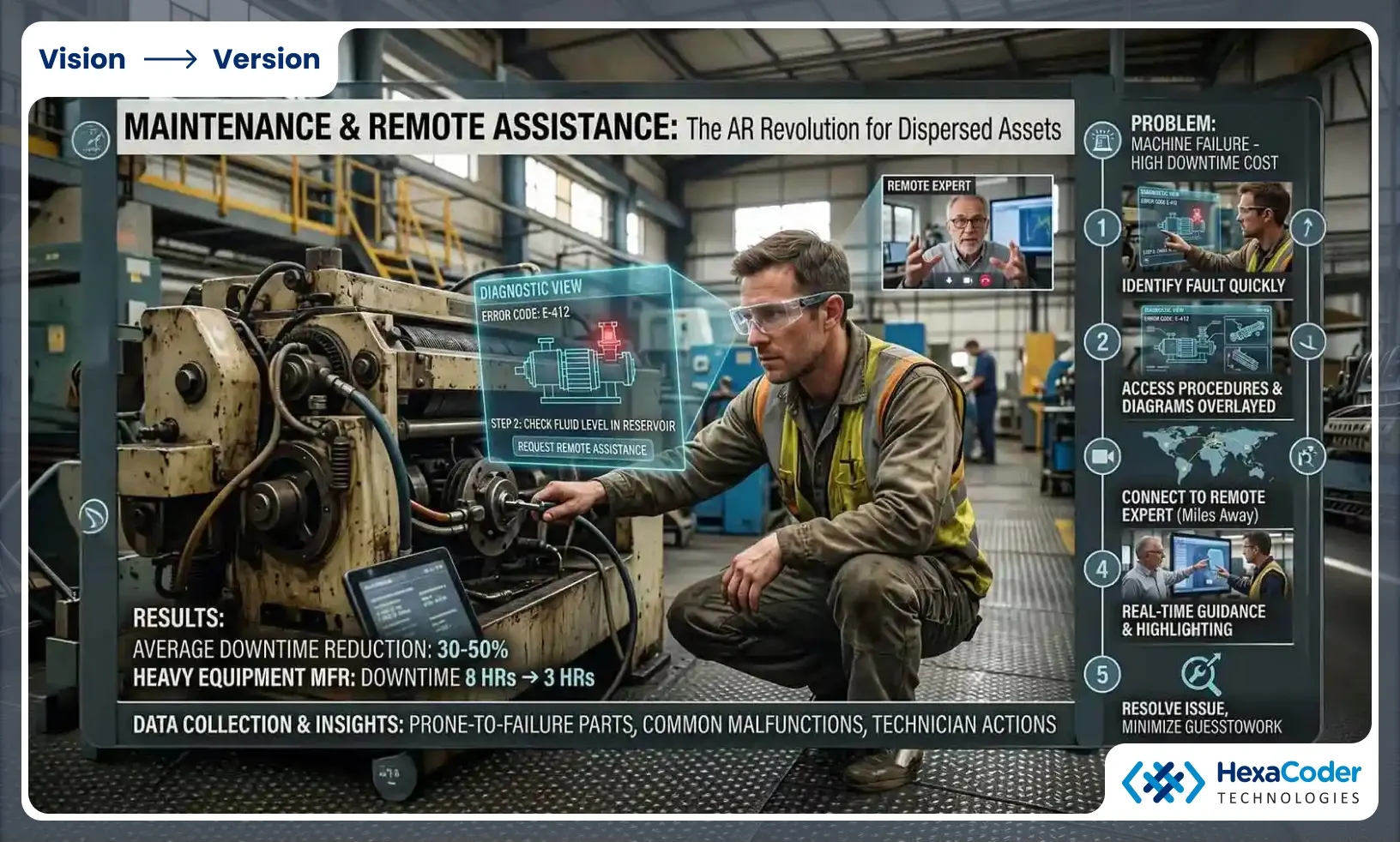
Machinery fails. If critical manufacturing machinery breaks down, it is costly and requires immediate action. Engineers should be able to identify the fault and correct it within a short period of time, without having to involve on-site experts who would take many hours to arrive.
AR maintenance solutions allow one to do that very quickly. A maintenance engineer examining machinery wears AR glasses that display procedures, diagrams of parts, and decision trees right on top of the machine. If he or she requires any help, an expert from thousands of miles away will connect to the technician's live AR stream and be able to see exactly the same picture as the engineer does. He or she will be able to highlight the problematic areas and point out where to look next.
This is truly revolutionary for businesses with dispersed assets or specialized equipment that necessitates expert-level troubleshooting. Factories with aged equipment, maintenance shops in aerospace, energy producing factories share similar results. The average downtime comes down by 30-50% since the technician gets instant help rather than having to guess or wait for the experts to come. A company manufacturing heavy equipment says it was able to reduce downtime during maintenance processes from 8 to 3 hours simply using AR guided maintenance solutions.
But more importantly, augmented reality maintenance solutions collect valuable data. Every time there is an asset break down, a record is made which tells you what part is prone to failure, what kind of malfunction happens first, and how does the technician act with the new found information.
5. Worker Training and Knowledge Transfer
In manufacturing, one of the main issues that exist in this industry but not in others is the knowledge concentration. The expertise is accumulated in experienced personnel who have been working for decades and know everything there is to know regarding the process of working. However, these people are retiring, taking all the knowledge with them. New workers have to adapt to the work process, losing productivity in the process.
This issue is solved via AR training system by making expert knowledge accessible through visual representation in 3D. Experts will be able to demonstrate proper actions in AR, showing what exactly needs to be done and avoiding certain errors. This process is recorded and transformed into training material. For example, new worker is at an assembly desk and he can see the virtual expert demonstrating the actions step-by-step.
The results are quantifiable. Companies employing AR training claim a decrease of 60% in training times of their new recruits. The real benefit comes in terms of greater consistency when it comes to quality and compliance to processes. This way, when all your new employees receive instruction according to optimized processes rather than depending on who happens to have time and experience enough to mentor them, quality will become more consistent.
This is especially relevant in view of the aging manufacturing labor force. As the workforce gets older, you're always bringing in new recruits to replace them. With AR training, you no longer depend upon few skilled technicians to mentor these newcomers. In one case, it has been reported that not only did AR training decrease training times, but also raised first year retention rates of employees by 18%.
6. Distributed Team Collaboration and Design Review
The manufacturing process no longer takes place in just one place. Engineers can be scattered throughout the globe. Video conferences are utilized for design review discussions. It is cumbersome. Team members find it difficult to interpret spatial relationships from a flat surface. Criticisms tend to be vague because people do not have the ability to point to the problem. The process takes long since each team member may be working on a slightly different mental picture of the product.
Through AR-based collaboration, all these inconveniences could be eliminated. Engineers in Germany and the manufacturing team in Singapore could be viewing the very same three-dimensional model in the very same spatial orientation at once. When one person points to a particular part of the model, the annotation becomes visible to everybody immediately. An engineer in Australia could then turn around the model in order to look at an interesting part. Any change made by any engineer becomes available to others almost instantly.
It even allows for distributed manufacturing. There may be a company that has design centers located in different areas, manufacturing centers located in another set of places, and quality control centers located in still different areas. Instead of asking individuals to travel for reviewing designs or moving the manufacturing process from one phase to another, the teams will meet in the virtual reality environments. The applications of Microsoft’s HoloLens technology in aerospace and automotive industries are designed for that exact purpose.
The Numbers Behind AR in Manufacturing
The adoption curve is actually speeding up because the economic sense is evident.
The AR for manufacturing market size was evaluated to be USD 8 billion in 2025 while growing to USD 35 billion by 2033, which implies a CAGR of 25%. But the above figures are underestimated since they refer to hardware and software revenues only. The true value lies in operational efficiency: saving on prototyping and development costs, cutting time to market, decreasing training expenditures, enhancing quality, reducing downtime, etc.
The financial sense of applying AR in manufacturing is evident. Assume you can cut employee training time by half within a factory with a thousand of production personnel – that is tens of million dollars annually saved in labor costs alone. Assume your product defects rate will be cut by 20% while maintaining gross margins of 15% – this directly increases your profit. Assume you decrease equipment downtime by fivefold from 8 to 3 hours while having hourly costs of USD 500,000 – and ROI follows immediately.
It is clear to major players in the industry. For example, Microsoft, PTC, and Google are now placing major stakes on AR manufacturing. As reported in 2024, Microsoft collaborated with a number of industrial firms on incorporating HoloLens into their design, training, and maintenance processes. Magic Leap received $500 million in funds for development of AR technologies targeted at enterprise and industrial use cases. This is not some speculation; rather, it is a response to actual demand for the technology.
Making AR Implementation Work: Beyond the Technology
The technology is very much real. The challenge for businesses today is not about building this capacity but implementing it.
There are three key pieces in the puzzle here. First, precise 3D computer representations of your products and facilities. Here's where the need for 3D renderings becomes absolutely critical. Not only do your CAD models have to be turned into actual manufacturing 3D visuals in order to function in AR, but also they must do it fast, accurate and across all possible devices. Secondly, you'll need some kind of software that would combine 3D renderings of your products and facilities with your manufacturing workflow systems such as design, quality management, maintenance or training. Finally, change management and training. Your workforce has to know how to use AR technology to achieve practical business outcomes, not how to put a headset on.
Successful implementation of AR as a manufacturing tool does not happen by accident. The companies applying AR technologies correctly look for certain pain points in their manufacturing processes – long training cycles, defects, high equipment downtimes, etc. They tackle them using AR technology, measure results and improve.
What's Coming Next in Manufacturing AR
The future is obvious. The hardware will become even better – the lightweight glasses, increased battery life, better display resolution. The software will evolve as well with AI performing predictive maintenance, automated quality control, and process optimization in real time. With 5G and cloud infrastructure advances, AR experience will become seamless globally.
The trend itself is much more subtle. AR will not exist anymore as an independent solution and will be integrated into your manufacturing process. Your CAD will automatically provide you with the ability to review 3D models in augmented reality mode. Quality management systems will be able to overlay product specification details in AR when inspecting products. Your training software will use AR guidance for teaching new tasks as the standard solution, and the same thing goes for troubleshooting solutions.
Ready to Transform Your Manufacturing Operations?
Technology is proven. Return on investment is evident. Companies spearheading innovations in manufacturing are already implementing AR for enhancing design efficiency, accelerating training, minimizing defect rates, and shortening maintenance timeframes. It is not about the inevitability of such changes but rather about how fast you can introduce AR into your business processes.
In our company Hexacoder, we spend years transforming difficult-to-analyze CAD models into ready-for-use 3D visualization models that become an integral part of the process described above. Our experience in creating high-quality visualization provides you with the opportunity to deploy AR successfully by transforming technical blueprints into digital content.
However, 3D rendering is just the beginning. The true potential of using visualization for your manufacturing needs appears only when you create an infrastructure where visualization is deeply integrated with other manufacturing components. Such an approach is implemented within the framework of SolidTwin, which combines 3D visualization capabilities with the process of making operational decisions and solving emerging challenges.
In case when you are prepared to make a leap from planning to implementation to actually use AR to streamline production, fast-track innovation, minimize errors, and speed up the training process the infrastructure is already there. Hexacoder takes care of your 3D visualizations, SolidTwin manages operational integrations. The result is a solid basis for real manufacturing revolution.
The future of manufacturing is not only about producing better items faster. In fact, it is all about manufacturing smarter, by leveraging the potential of technology to cut the time, avoid mistakes, and provide your people with unprecedented expertise. AR enables you to do all of this. What remains to be seen, however, is whether your business is going to pioneer this revolution or fall behind the competition.
For related visualization use cases, compare these AR examples with our car configurator guide and our automotive 3D configurator breakdown.