
Introduction
The digital age has brought about a complete revolution in e-commerce which has changed the way people shop with different brands. People now consider online shopping as an essential retail activity because of its ability to offer products through convenient and accessible online platforms which provide almost unlimited product choices. E-commerce continues to expand yet businesses face a major challenge because customers cannot examine products directly before making their buying decisions. People usually experience hesitation and doubts about their purchasing decision which results in them abandoning their shopping cart.
The issue becomes more severe within fashion and furniture and electronics and automotive and customized product sectors. A shopper cannot easily discern the quality of a fabric, the fit of a shoe, or the exact finish of a piece of furniture from a static image or a pre-recorded video. The existing traditional methods cannot recreate the physical store experience which allows customers to touch products and feel their materials. Central to online retailing companies online marketplaces experience increased product returns while customers display decreased satisfaction and tend to shop less.
Brands increasingly utilize 3D configurators to solve their business problems. Customers can use these interactive digital tools to discover products while they change the products according to their preferences. The 3D configurators enable customers to experience a shopping path that exceeds what they find in physical stores because the system creates a shopping path that includes interactive elements and three-dimensional displays. 3D configurators provide visualization capabilities while they function as strategic tools which deliver data insights to decrease operational costs and promote environmental sustainability and customer brand loyalty. Our e-commerce solutions integrate seamlessly. See our portfolio for examples.
Why E-Commerce Needs 3D Configurators
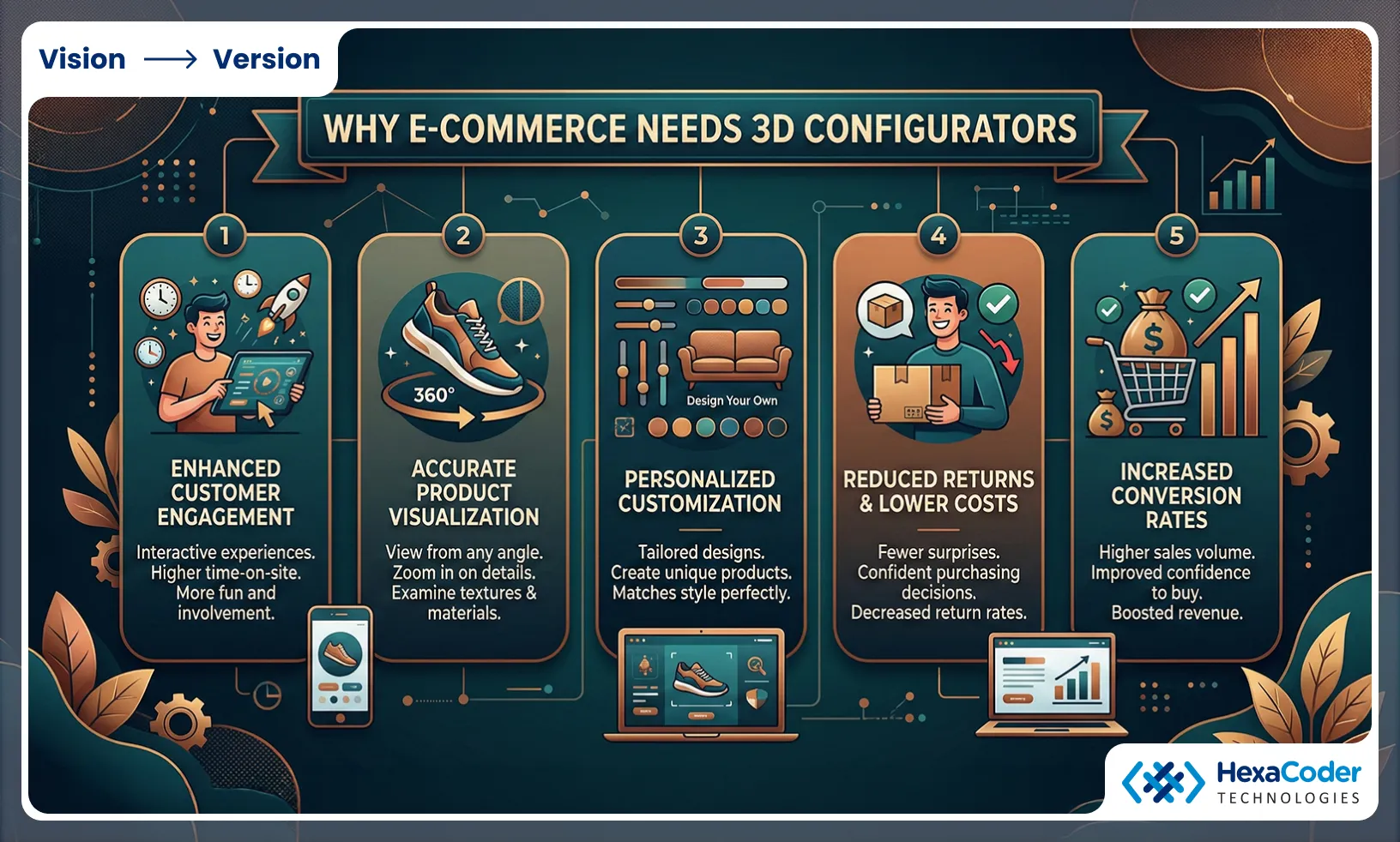
E-commerce depends on visual storytelling, yet conventional images and videos cannot effectively showcase today's sophisticated products. Users can examine products from all angles through interactive 3D configurators, which enable users to rotate and zoom and manipulate products in three dimensions. Customers can explore variations in colors and materials and patterns and textures and finishes all in real time. The interactivity enables customers to build confidence while decreasing their product uncertainties and granting them ownership rights to the product before they complete their purchase.
Take furniture brands, for example. A sofa or dining set can be displayed in multiple fabrics, colors, and configurations. Shoppers can place the virtual product in a digital representation of their home, visualize it under different lighting conditions, and even explore how it interacts with other items in the room. Fashion retailers permit customers to use virtual try-ons for clothing and accessories because this feature shows how garments fit various body types and how colors match their personal style. The augmented reality (AR) system lets users view products in their real-life surroundings which increases consumer trust while decreasing their buying process doubts.
3D configurators deliver two advantages because they improve customer experience and provide organizations with valuable data analysis capabilities. The system records and analyzes all user activities which include changing colors and swapping materials and adjusting angles. Brands gain insights into popular configurations, preferred colors, and feature combinations, which informs product development, inventory planning, and targeted marketing campaigns. A footwear brand discovers that a specific color combination attracts more audience engagement, which influences both its production plans and marketing tactics.
The company gains two advantages through operational efficiency together with sustainability. Virtual prototyping helps brands create and improve their products through digital testing which eliminates most of their need for physical prototypes. The process removes materials from the product development process while it shortens product development duration which leads to sustainable manufacturing results. The fashion label develops its new collection through digital design which enables virtual testing of different fabric and color options until they reach their final decisions without needing to create any physical samples.
3D configurators provide businesses with a unified customer experience that works seamlessly across multiple online platforms which include e-commerce sites, mobile applications, social media marketing and in-store kiosks. The combination of these tools with AR or virtual reality (VR) technology enables shoppers to see how products look in their personal space or on their body which results in better product customization and higher sales conversions. The need for brands to create immersive shopping experiences has become essential because it enables them to differentiate themselves from their competitors.
Benefits of 3D Configurators in E-Commerce
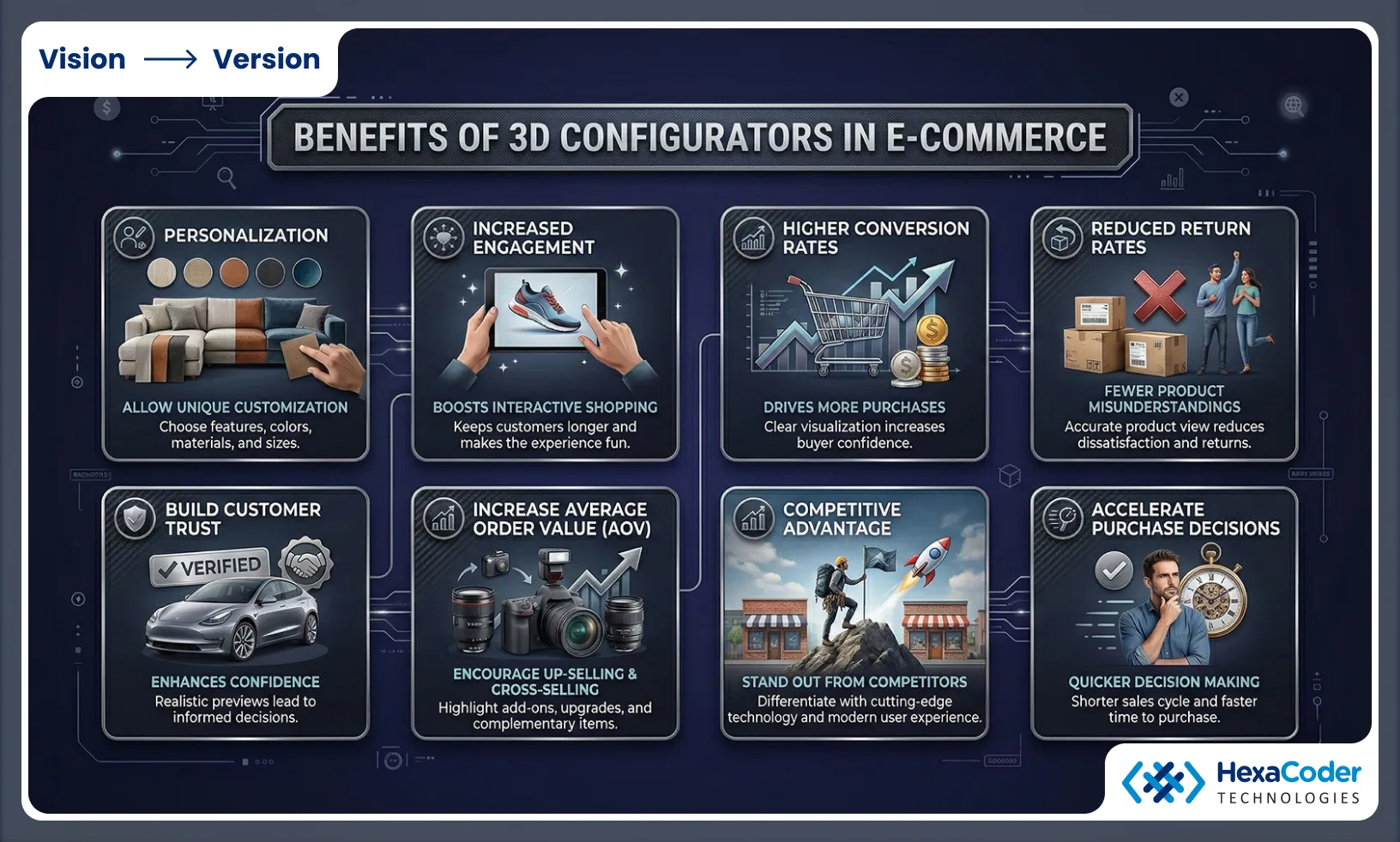
The effective implementation of 3D configurators delivers measurable advantages to businesses which they benefit. The method produces two outcomes which improve customer interactions with their products.
- Increased Conversion Rates: The interactive nature of product exploration allows users to spend more time on websites because it draws their attention. customers who can personalize and see their products will spend more time engaging with them which will result in higher conversion rates.
- Reduced Return Rates: The 3D configurators give customers accurate product presentations together with their personal design choices which helps to decrease buyerism. The customer will experience a better understanding of their purchase which will minimize doubt while decreasing return possibilities.
- Faster Product Development: Companies use virtual prototyping to create and test different product designs through digital testing. Digital testing leads to faster product development because it decreases physical sample requirements while reducing development time and production expenses.
- Sustainability Benefits: Digital product testing eliminates the need for physical samples which results in decreased material waste. Brands can improve their environmental impact through sustainable practices by decreasing the number of required prototypes.
- Data-Driven Insights: User tracking data enables brands to understand customer behavior through their interactions with products. Brands use this information to identify market patterns which help them forecast demand and manage their inventory while making marketing choices.
- Omnichannel Experience: The 3D configurators provide e-commerce platforms through their mobile applications and in-store kiosks with a complete digital and physical channel experience. The system provides customers with three methods for product interaction which include virtual try-ons and immersive showrooms and AR visualizations.
Enhancing Customer Engagement Through 3D Configurators
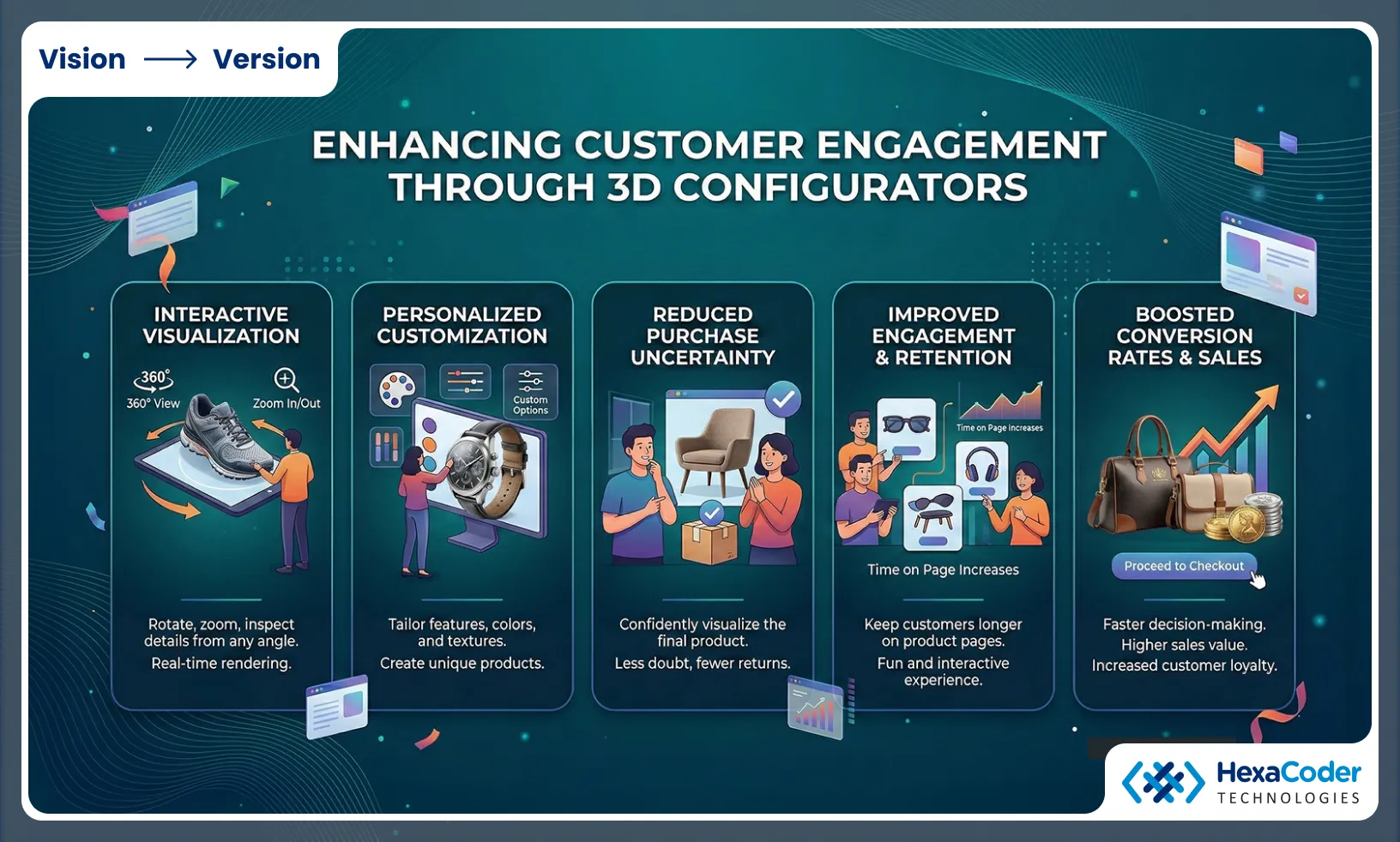
The main benefit of using 3D configurators on e-commerce websites enables businesses to enhance their customer interaction levels. Online customers use their engagement to connect with products which they will eventually buy. Traditional product images or videos are static; they offer a limited view of a product and fail to involve the customer in an interactive journey. The 3D configurators create an environment where users can actively explore products through their own personal product development experience. Customers who use product rotation and zoom functions to examine all product details across different angles will experience buying power because they can handle the product. The product interaction creates a bond between the customer and the product which extends to the entire brand.
The sneaker customer who wants to customize their shoe can choose from different color options and material textures and lace patterns that they want to apply and logo designs that they want to see on their shoe. Users can try different options because every selection shows up immediately, which lets them proceed without restrictions. The ability to make decisions gives shoppers the power to choose their purchases, which leads them to spend more time with products while they shop, and it increases the chances that they will complete their purchases.
Configurators enable brands to develop complete storytelling experiences which extend beyond their standard product display functions. The furniture retailer displays a complete living room setup which allows customers to design their own space through their choice of furniture items. Customers can create a virtual space which shows their preferred style and current home environment by selecting different combinations of sofas and rugs and tables and lighting. Brands use configurators through e-commerce websites and social media platforms and AR-enabled applications to increase customer interaction beyond their basic product display functions. Shoppers can discover their preferred setups through interactive experiments which allow them to create virtual displays that cannot be matched by standard photographs.
The 3D configurators increase user engagement rates which result in customers sharing their content with others. Users who design a product according to their preferences will tend to save their work and share it with others while they continue to refine their design. Social media integration enables customers to showcase their creations, generating organic promotion and peer validation. The active user involvement increases engagement metrics while improving brand visibility across different platforms.
The information collected through user interactions holds equal significance for analysis purposes. The tracking system records every user customization selection, color selection, and viewing angle choice which enables brands to study customer engagement patterns. This data helps companies understand customer preferences and current market trends which they use to develop marketing plans and product strategies and demand forecasting. Brands use customer experience data to locate areas which create challenges during user interaction, especially with interface components that cause confusion or annoyance to users, which helps them enhance their configurator system.
The engagement metrics that 3D configurators generate directly impact both conversion rates and product return rates. Shoppers who can see how a product will look and fit their body dimensions can make better purchase choices. Customers who have this confidence will experience fewer purchase-related regrets which results in operational efficiency gains and better customer satisfaction.
3D configurators serve as more than visual tools because they function as strategic assets which help businesses enhance customer interaction while establishing credibility that leads to increased sales. The platforms transform regular customers into active participants who create customized shopping experiences that meet contemporary e-commerce requirements. Brands that use this technology to sell their products create customer experiences which both astonish and motivate people to make purchases.
Top 10 3D Configurators for E-Commerce Product Customization
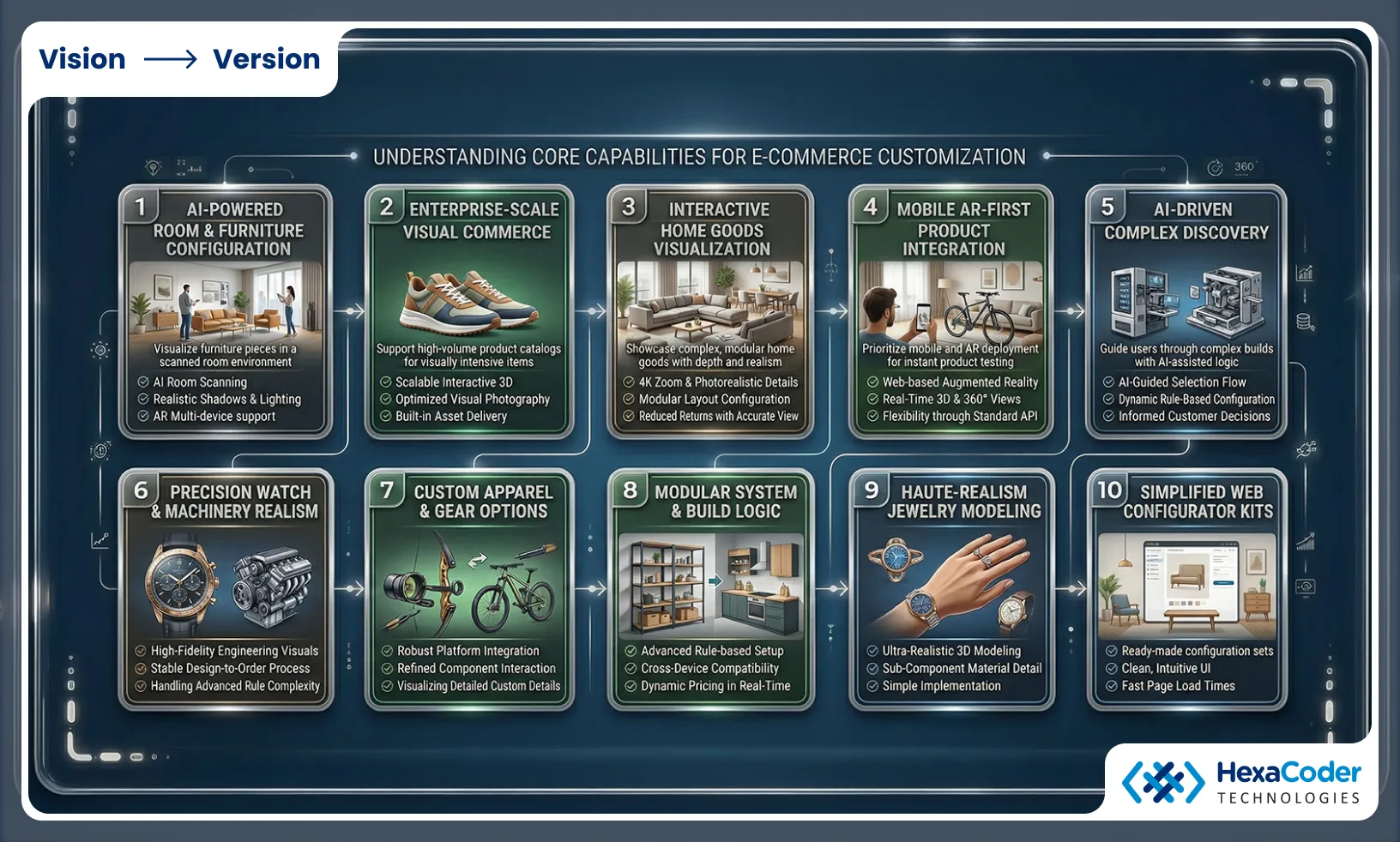
To help brands choose the right platform, here are the top 10 3D configurators currently shaping e-commerce:
- Hexacoder Technologies
Hexacoder provides businesses with 3D configurator solutions which can be expanded to meet any requirement. The system enables brands to present their products which include apparel and accessories and furniture items through its advanced visual features. Customers have the ability to explore products through live interactions which allow them to modify items by selecting different colors and materials and patterns and finishes. Hexacoder enables virtual try-ons through augmented reality while providing system independence and e-commerce functionality for smooth purchasing processes. The realistic visualizations which drive customer interaction make Hexacoder the preferred option for digital-first businesses according to brands who use the platform. - Threekit
Threekit delivers 3D and AR product configurators through its cloud-based system to handle complex product lines. The platform enables users to create multiple product configurations while monitoring their performance data through different e-commerce systems. Customers can visualize products in their own spaces using AR while brands gain insights into popular configurations and customer behavior. - Zakeke
Zakeke combines 3D visualization with AR capabilities. Customers have the ability to change product appearances through their selection of colors and textures and patterns and their creation of personalized text or logos. Retailers can use its plug-and-play integration with Shopify and WooCommerce and Magento to quickly implement configurators which boost user interaction and sales. - iDesigner
iDesigner enables users to create interactive product customizations through the 3D model library of CGTrader. The application enables users to visualize products through augmented reality in authentic environmental conditions. Brands gain from the dual benefit of higher customer interaction and data acquisition which assists them in developing their design and marketing methods. - Sketchfab
Sketchfab delivers 3D interactive visualization services across various sectors which include e-commerce. Users have the ability to view products from different angles while zooming in to examine specific details. Its virtual reality and augmented reality features enable users to experience digital content through their dev environments. - Iconasys 360 Product Viewer
The company develops 360-degree product configurators which let customers interact with products through rotation and zoom functions. The solution provides easy implementation for brands who want to offer interactive features without requiring complex technical setup. - Salsify 3D Configurator
The Salsify platform combines product information management with three-dimensional product visualization. Brands can track interactions, optimize their inventory and create customized product experiences. The system enables digital shopping through its configurators while delivering insights that can be used to take further actions. - SketchUp with Augment
The combination of SketchUp and Augment enables users to create 3D designs which they can then explore through interactive digital spaces. Customers can modify furniture and interior design elements through AR technology which allows them to see products in their actual surroundings. - 3DVIA Composer by Dassault Systèmes
Technical products require the application of 3DVIA Composer software. The platform provides users with interactive visualization features which enable them to customize parts and test assembly processes through augmented reality for electronic devices and machinery and complex systems. - Avametric
The company Avametric develops virtual fitting rooms and realistic rendering and AR try-ons for fashion and apparel design. Brands can provide interactive customization experiences for customers through their devices.
Implementation Tips for E-Commerce Brands
The following best practices will help brands achieve optimal outcomes through 3D configurators. Businesses need to establish 3D configurators which function properly across their web sites and mobile applications and social media platforms and physical stores. The user experience of automatized systems and their brand identity will benefit from omnichannel systems which create consistent user experiences. Businesses should develop augmented reality and virtual reality systems to create immersive interactive experiences which let users see products within their personal surroundings.
The company should monitor customer interactions to identify their product display preferences and the items they frequently select. The company should use this information to make inventory and marketing and design decisions for future products. Products need to achieve realistic material and texture and lighting rendering to establish customer trust while discourage purchase decisions. Businesses should use customer feedback and usage data to continuously improve their configurators through an ongoing testing process.
Transform Your E-Commerce Experience with Hexacoder
Hexacoder enables businesses to create advanced online shopping environments through its technology. The strategic requirement for e-commerce brands to use 3D configurators now exists as their essential business requirement. Hexacoder provides businesses with scalable and flexible and immersive solutions which enhance customer engagement while decreasing product returns and delivering business intelligence. Hexacoder 3D configurator allows brands to create shopping experiences which provide customers with personalized and interactive and authentic shopping experiences that match or exceed what they experience in physical stores.
Hexacoder offers a solution which will transform how your customers experience your products. The process starts with visualization which creates user engagement that leads to user confidence that results in product sales.