
Introduction
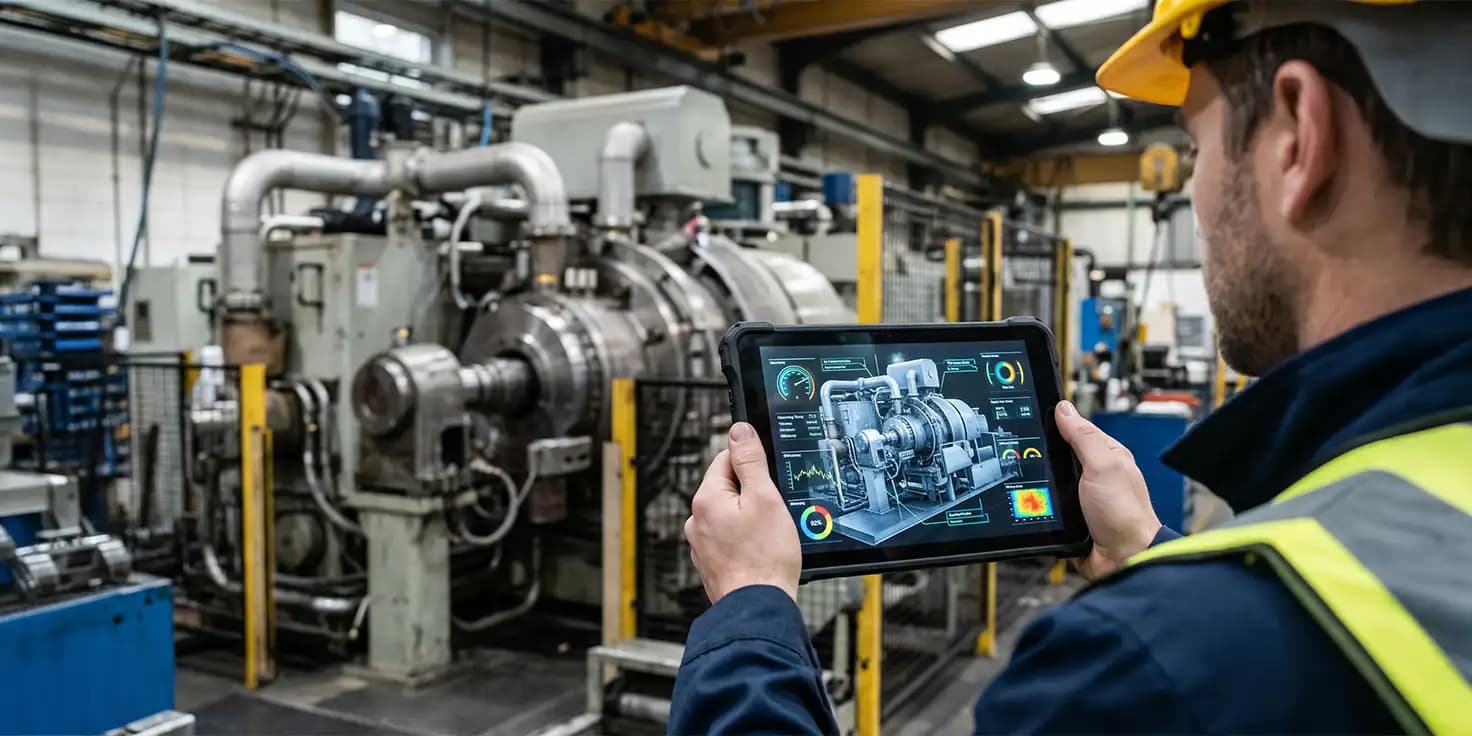
Imagine managing a factory where each machine produces valuable data, but that data is stored in many systems. Production data is kept in one location, maintenance records in another, and equipment performance is frequently examined by hand.
Combining that data may make it simpler to comprehend what's going on around the plant floor.
Digital twin technology can help with it.
It's not always easy to connect digital models to actual equipment, though.
Older machinery causes problems for some manufacturers. Others have an abundance of information but no trustworthy means of connecting it. Costs, security, upkeep, and quantifiable returns are still concerns even after implementation.
Manufacturers can avoid needless costs and create digital twin systems that serve real production needs by anticipating these issues.
What is a digital twin solution in manufacturing?
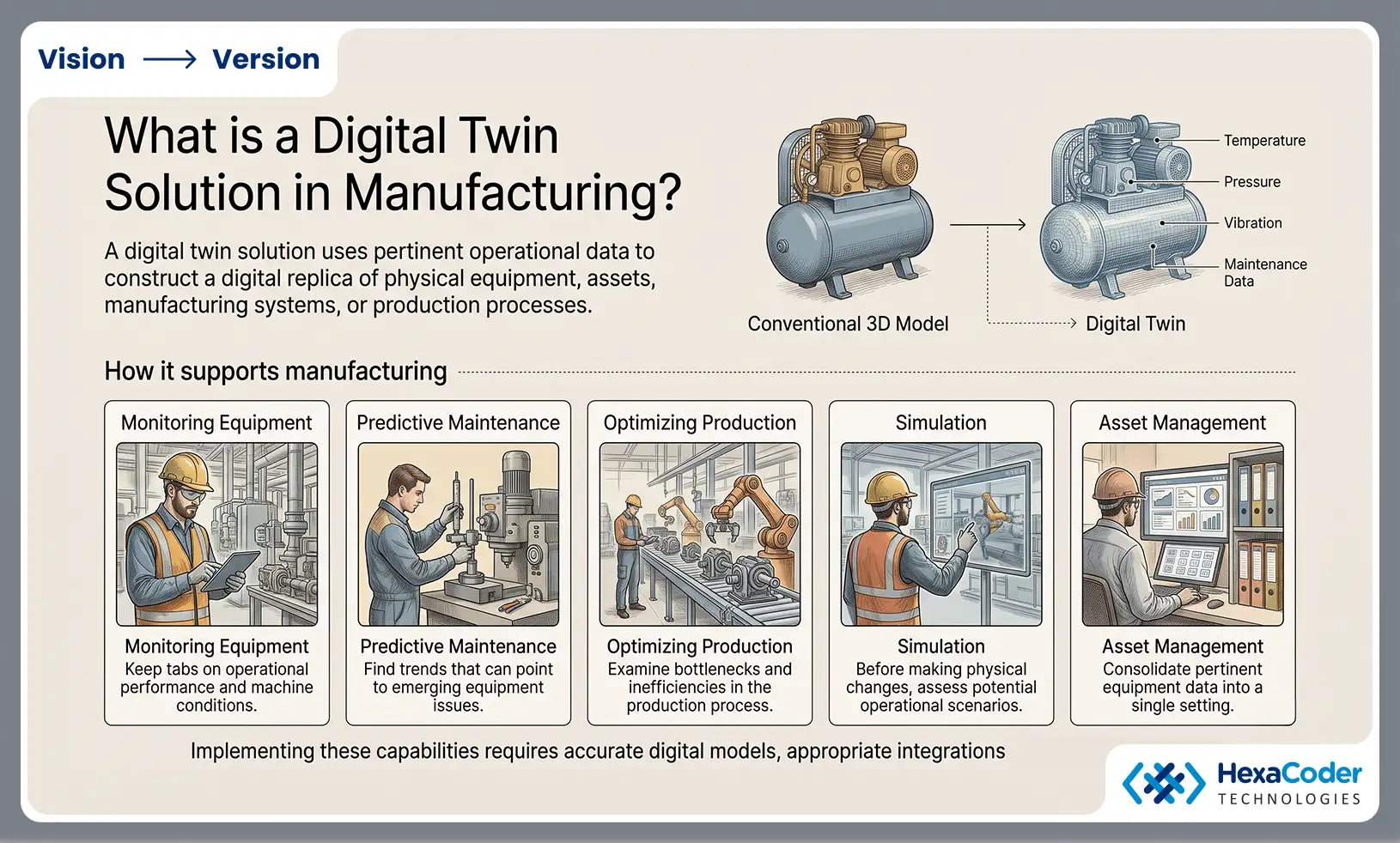
A digital twin solution uses pertinent operational data to construct a digital replica of a physical equipment, asset, manufacturing system, or production process.
A digital twin, in contrast to a conventional 3D model, can accept data from linked devices and other systems to represent performance and physical conditions.
Think of an industrial compressor.
Its structure can be seen in a traditional 3D model. To assist engineers in comprehending the behaviour of equipment, a digital twin can include temperature, pressure, vibration, and maintenance data.
The following are supported by digital twin in manufacturing, depending on the application:
- Monitoring equipment: Keep tabs on operational performance and machine conditions.
- Predictive maintenance: Find trends that can point to emerging equipment issues.
- Examine bottlenecks and inefficiencies in the production process.
- Simulation: Before making physical changes, assess potential operational scenarios.
- Asset management: Consolidate pertinent equipment data into a single setting.
Accurate digital models, appropriate integrations, and trustworthy data are necessary for these capabilities.
What are the main challenges of implementing digital twin solutions in manufacturing?
The eight categories of legacy integration, data quality, prices, model accuracy, cybersecurity, scalability, technical competence, and return on investment are the main digital twin implementation challenges in manufacturing.
Manufacturers can plan more practical solutions when they comprehend each problem.
1. Integrating digital twins with legacy manufacturing systems
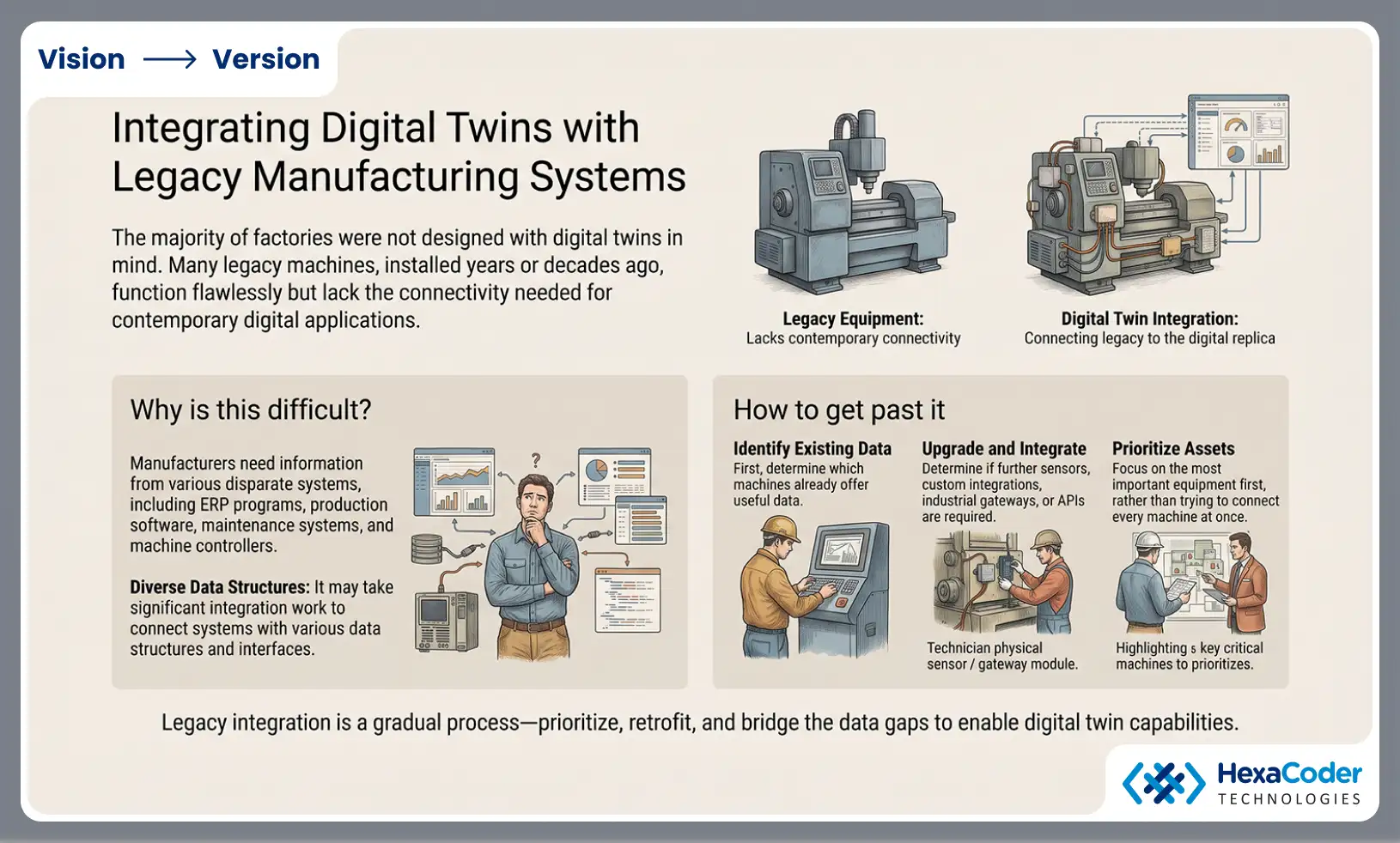
The majority of factories were not designed with digital twins in mind.
Many machinery that were installed years or decades ago are still in use. These devices might function flawlessly, but they don't have the connectivity needed for contemporary digital applications.
While some employ proprietary communication methods, others are unable to supply the operating data required by a digital twin.
Why is this difficult?
Information from ERP programs, production software, maintenance systems, and machine controllers may be required by manufacturers. It may take a lot of integration work to connect systems with various data structures and interfaces.
How to get past it
- Determine which machines now offer useful data first.
- Determine if further sensors, custom integrations, industrial gateways, or APIs are required.
- Prioritise the most important equipment above attaching every machine right now.
2. Obtaining reliable data from the production floor
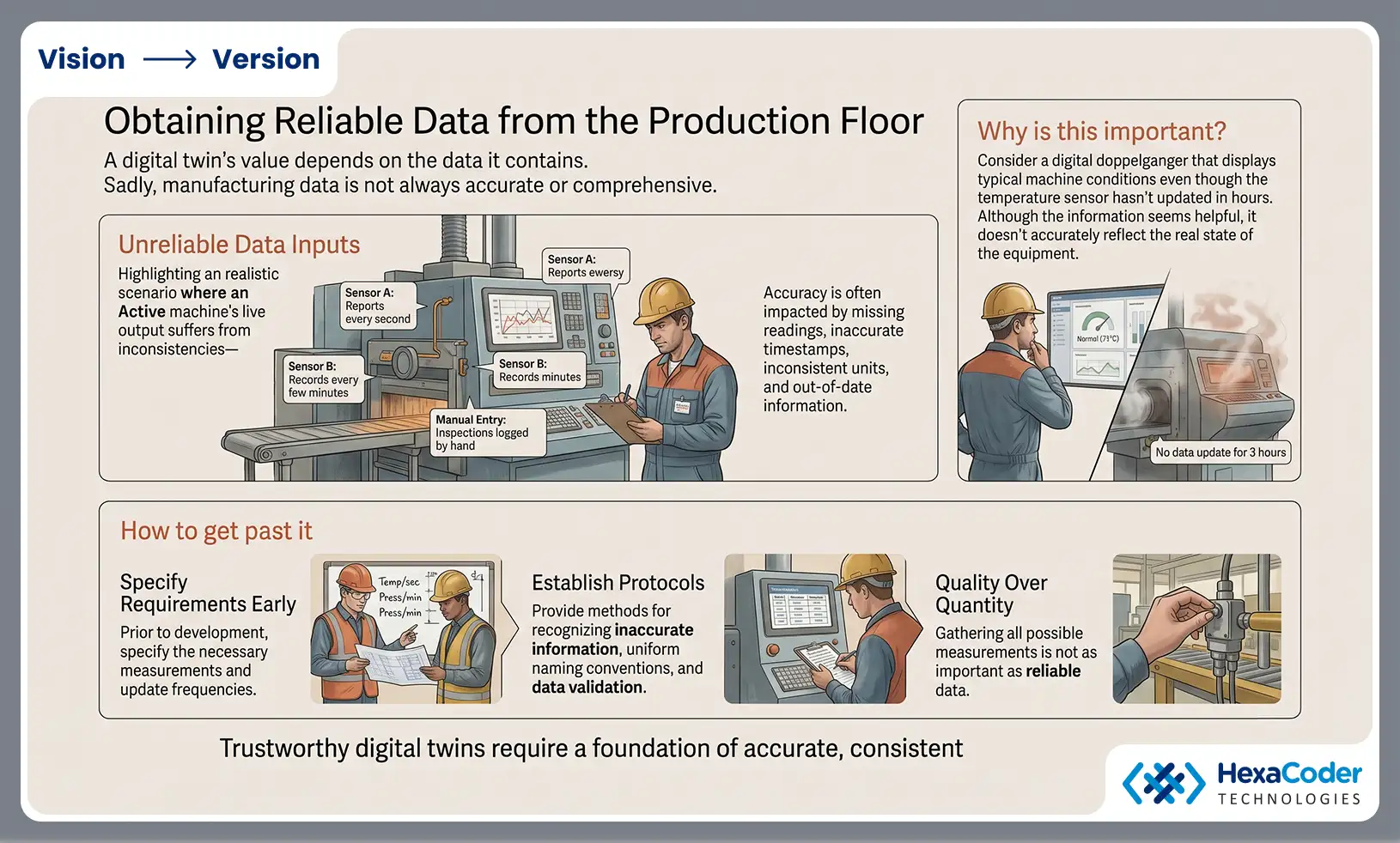
A digital twin's value depends on the data it contains.
Sadly, manufacturing data isn't always accurate or comprehensive.
While one system may record data every several minutes, another may report temperature every second. Inspection findings can still be manually entered by maintenance personnel.
Accuracy can be impacted by missing readings, inaccurate timestamps, inconsistent units, and out-of-date information.
Why is this important?
Consider a digital doppelganger that displays typical machine conditions even though the temperature sensor hasn't changed in a few hours.
Although the information seems helpful, it doesn't accurately reflect the state of the equipment.
How to get past it
- Prior to development, specify the necessary measurements and update frequencies.
- Provide methods for recognising inaccurate information, uniform naming conventions, and data validation.
- Gathering all possible measurements is not as important as reliable data.
3. Understanding the true costs of digital twin implementation
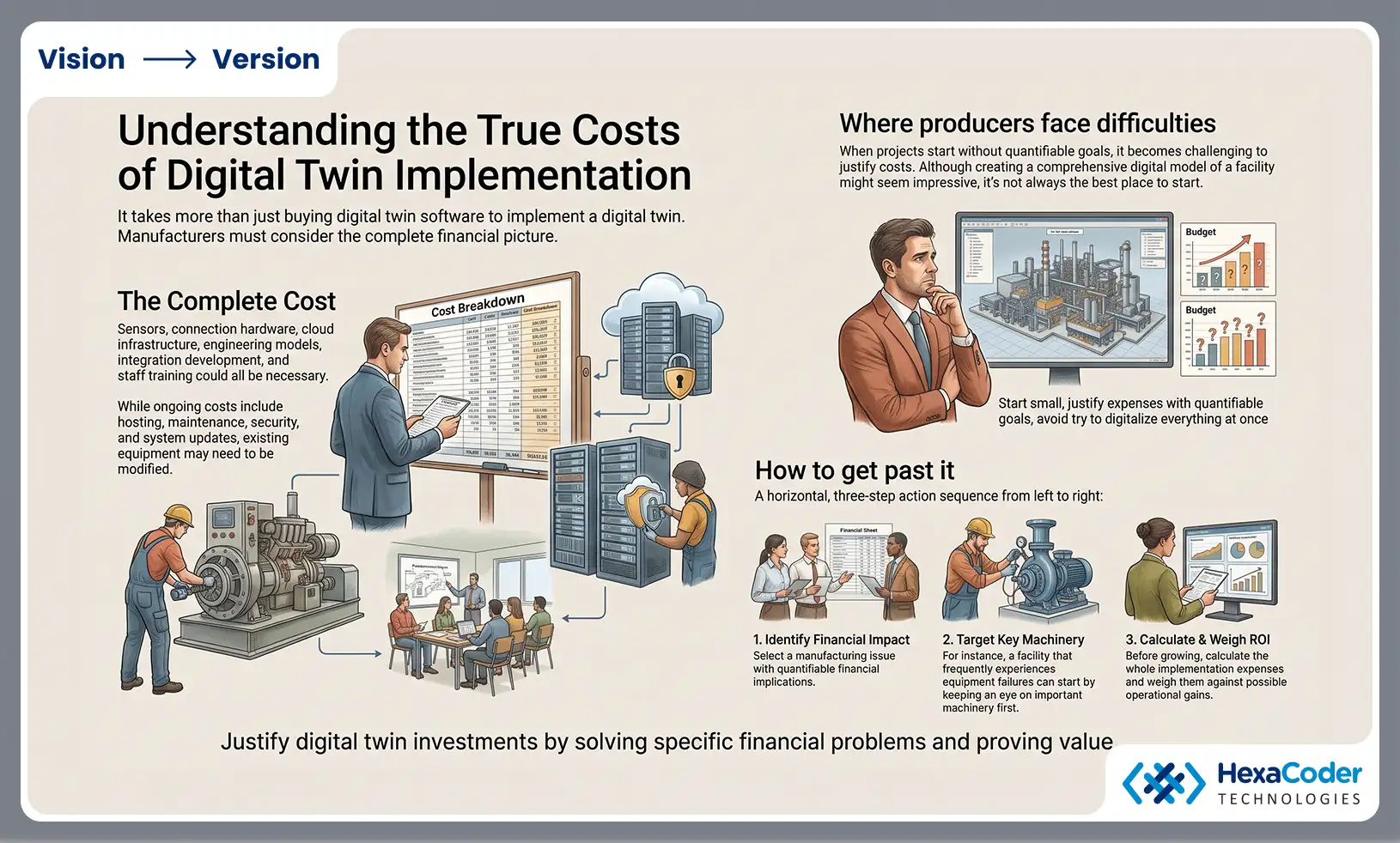
It takes more than just buying digital twin software to implement a digital twin.
Sensors, connection hardware, cloud infrastructure, engineering models, integration development, and staff training could all be necessary for manufacturers.
While ongoing costs include hosting, maintenance, security, and system updates, existing equipment may need to be modified.
Where producers face difficulties
When projects start without quantifiable goals, it becomes challenging to justify costs.
Although creating a comprehensive digital model of a facility might seem impressive, it's not always the best place to start.
How to get past it
Select a manufacturing issue with quantifiable financial implications.
For instance, a facility that frequently experiences equipment failures can start by keeping an eye on important machinery.
Before growing, calculate the whole implementation expenses and weigh them against possible operational gains.
4. Maintaining digital twin accuracy as equipment changes
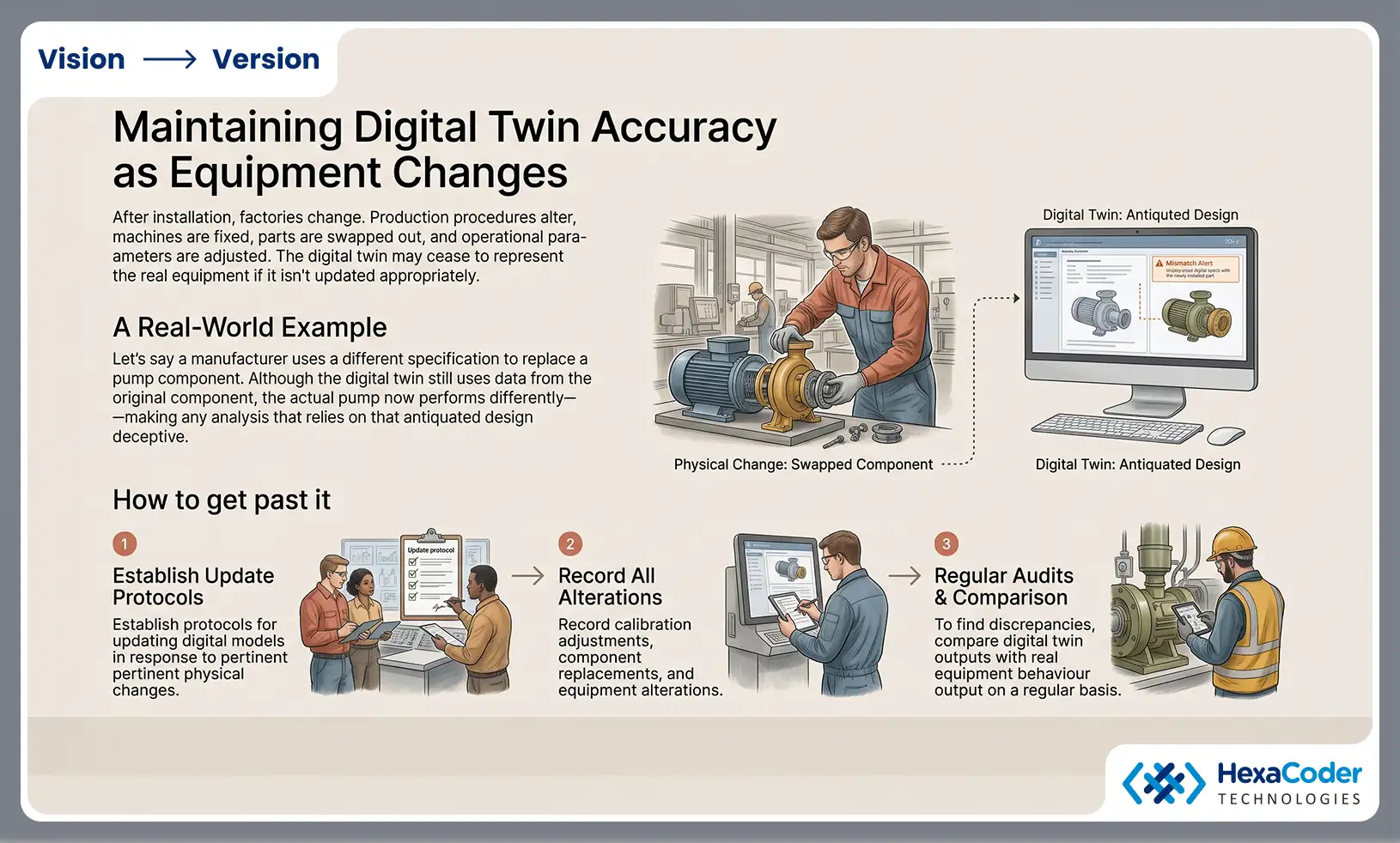
After installation, factories change.
Production procedures alter, machines are fixed, parts are swapped out, and operational parameters are adjusted.
The digital twin may cease to represent the real equipment if it isn't updated appropriately.
A real-world example
Let's say a manufacturer uses a different specification to replace a pump component.
Although the digital twin of the pump still uses data from the original component, the actual pump now performs differently.
Any analysis that relies on that antiquated design may be deceptive.
How to get past it
- Establish protocols for updating digital models in response to pertinent physical changes.
- Record calibration adjustments, component replacements, and equipment alterations.
- To find discrepancies, compare digital twin outputs with real equipment behaviour on a regular basis.
5. Protecting manufacturing data and connected equipment
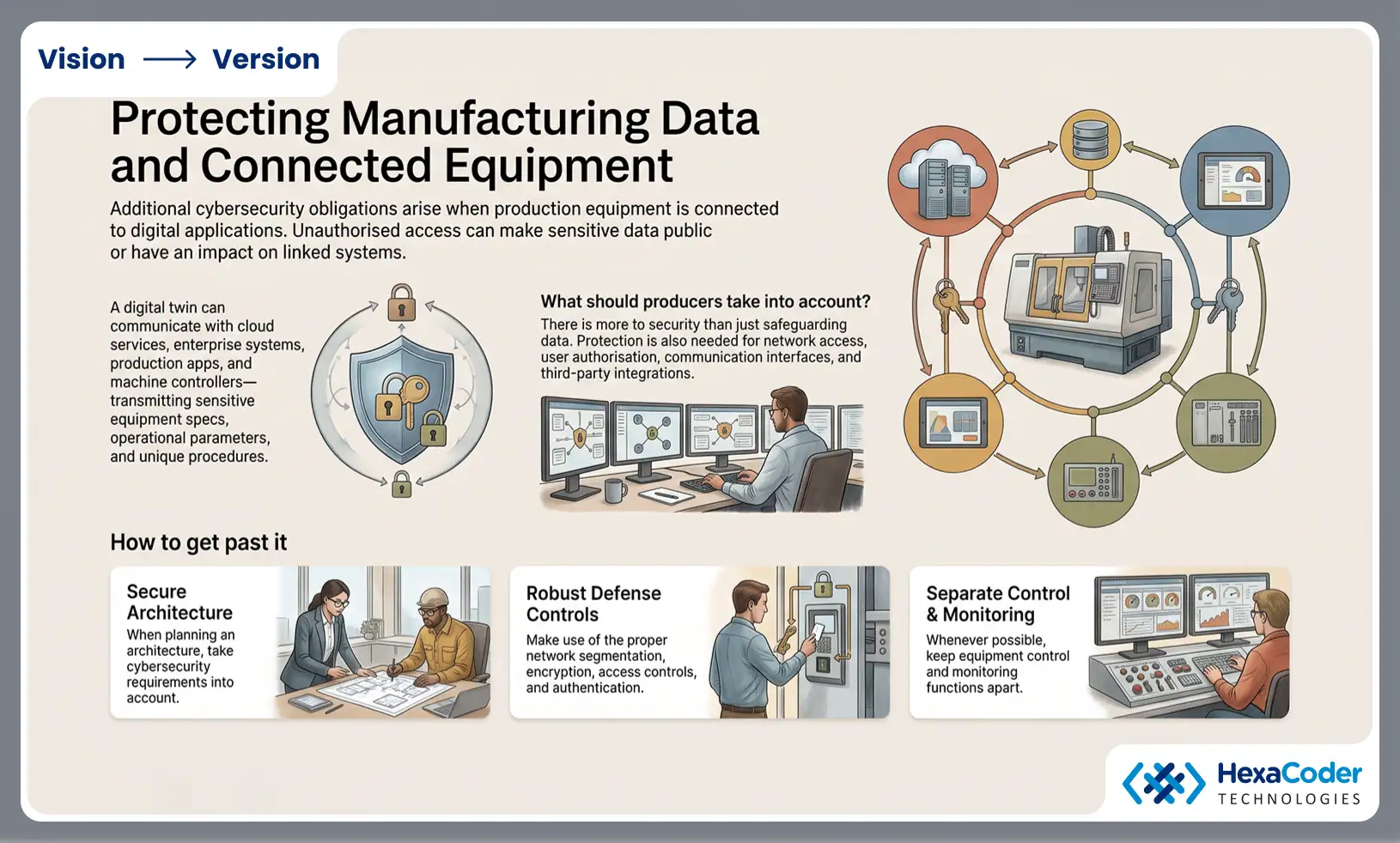
Additional cybersecurity obligations arise when production equipment is connected to digital applications.
A digital twin can communicate with cloud services, enterprise systems, production apps, and machine controllers.
Sensitive equipment specs, operational parameters, and unique procedures are examples of manufacturing data.
Unauthorised access may make this data public or have an impact on linked systems.
What should producers take into account?
There is more to security than just safeguarding data.
Protection is also needed for network access, user authorisation, communication interfaces, and third-party integrations.
How to get past it
- When planning an architecture, take cybersecurity requirements into account.
- Make use of the proper network segmentation, encryption, access controls, and authentication.
- Whenever possible, keep equipment control and monitoring functions apart.
6. Scaling digital twins from one machine to an entire factory
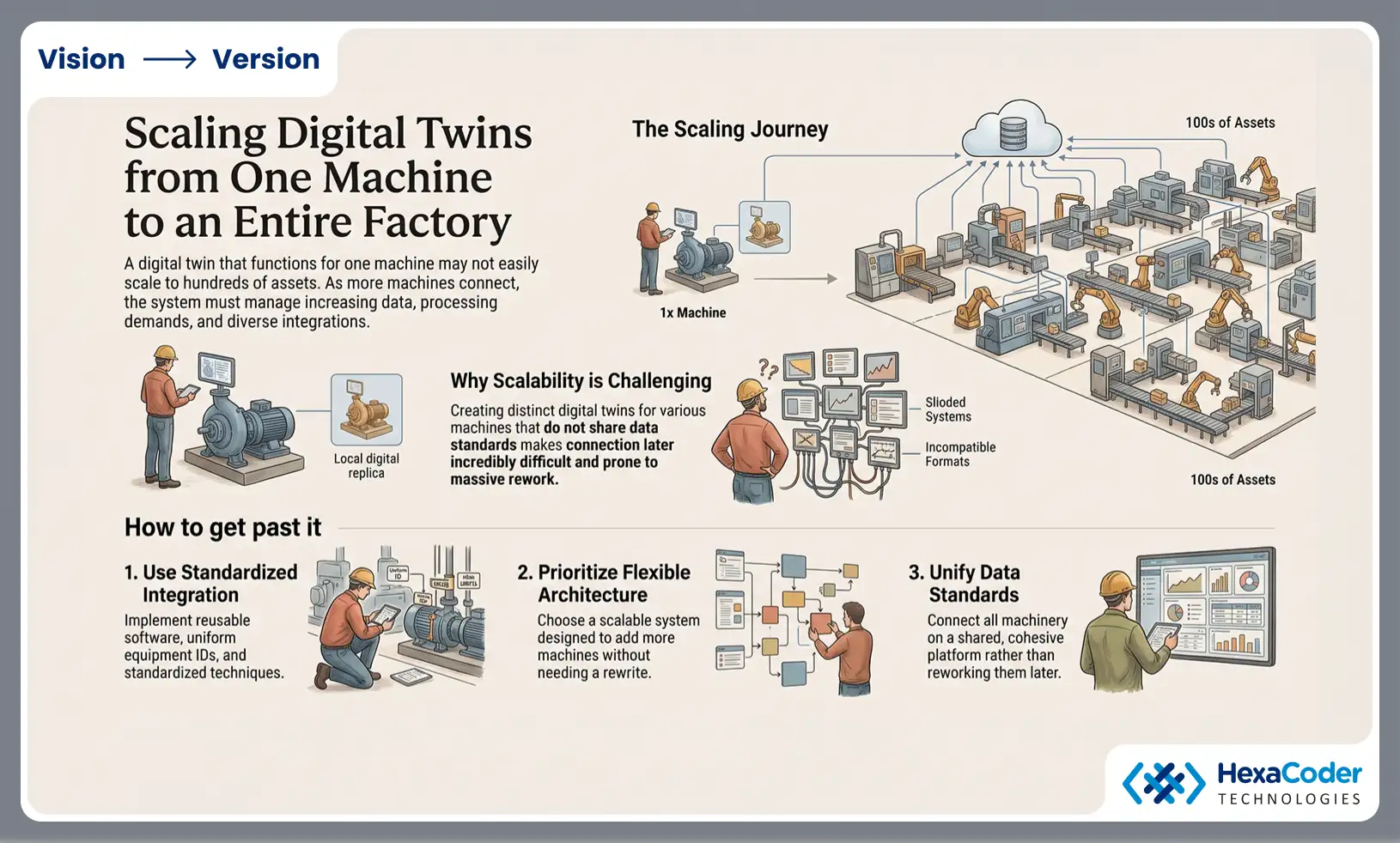
It is not always the case that a digital twin that functions for one machine will also function for hundreds of assets.
Different operating techniques, data formats, and protocols may be used by various pieces of equipment.
The system must manage increasing data, processing demands, and integrations as more machines connect.
Why does scalability become challenging?
Imagine creating distinct digital twins for multiple computers that don't share data standards.
Each might function separately, but it might take a lot of rework to connect them later.
How to get past it
- Make use of standardised integration techniques, reusable software components, and uniform equipment IDs.
- Select an architecture that allows you to add more machines without having to rewrite the entire system.
7. Finding the right technical expertise for digital twin implementation
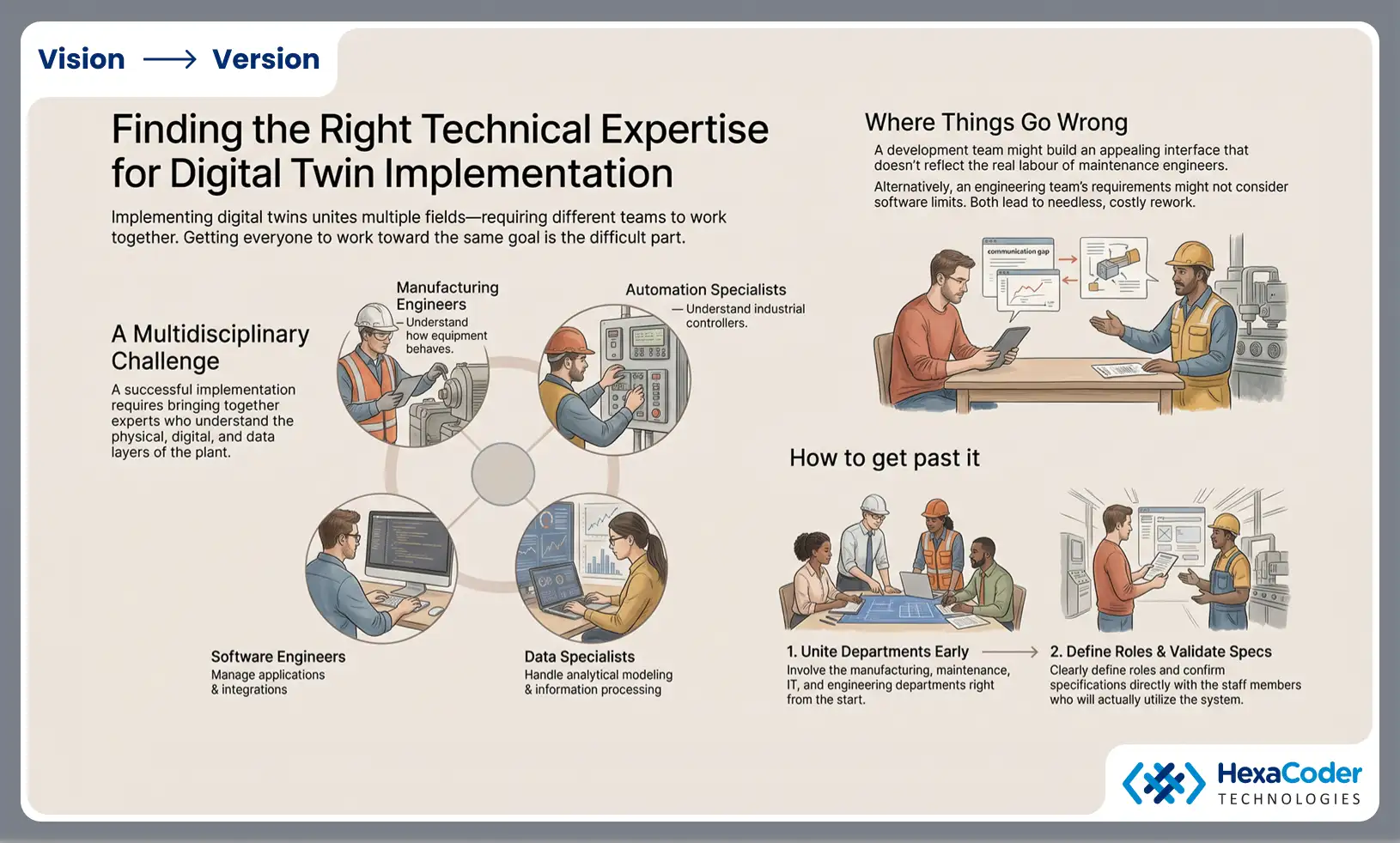
Implementing digital twins unites multiple fields.
Manufacturing engineers are aware of how equipment behaves. Industrial controllers are understood by automation specialists. Applications and integrations are managed by software engineers.
Analytical modelling and information processing are handled by data specialists.
Getting everyone to work toward the same goal is the difficult part.
Where things go wrong
An appealing interface designed by a development team may not reflect the real labour of maintenance engineers.
Software limits may not be taken into account when an engineering team defines requirements.
Both circumstances may result in needless rework.
How to get past it
- Involve the manufacturing, maintenance, IT, and engineering departments right away.
- Clearly define roles and confirm specifications with staff members who will utilise the system.
8. Proving the return on digital twin investment
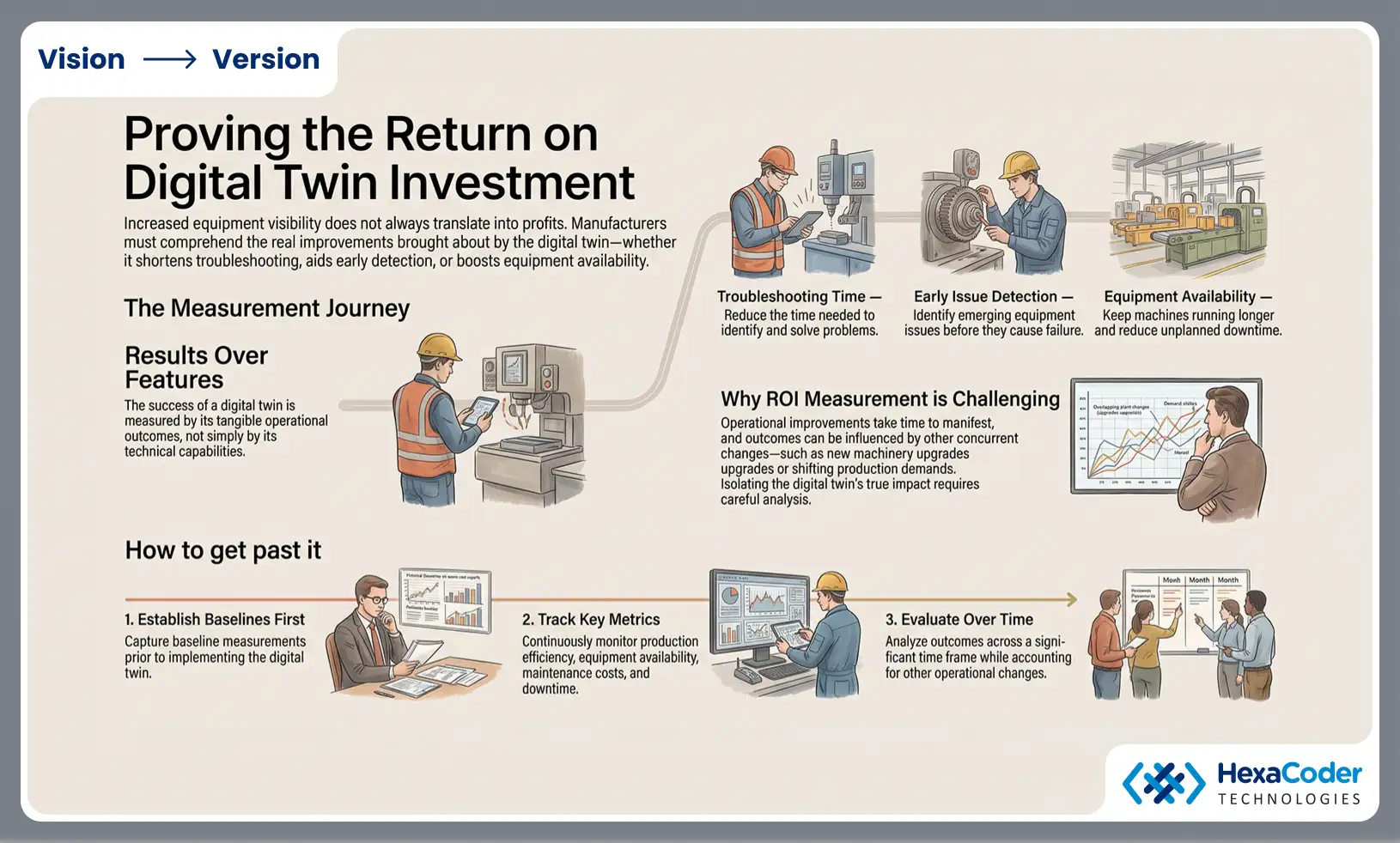
Increased equipment visibility does not always translate into profits.
Manufacturers must comprehend the real improvements brought about by the digital twin.
Does it shorten the time needed for troubleshooting? Aid in the early detection of issues by maintenance teams? Boost the availability of equipment?
More important than the quantity of features accessible are these results.
Why ROI measurement is challenging
It can take some time for operational improvements to manifest.
Performance may also be impacted by other modifications, such as improved machinery or lower production demands.
How to get past it
- Prior to implementation, establish baseline measurements.
- Monitor production efficiency, equipment availability, maintenance costs, and downtime.
- Examine outcomes across a significant time frame while taking other operational modifications into account.
What makes digital twin predictive maintenance challenging to implement?
Manufacturers can look into equipment behaviour that might point to emerging issues with the use of digital twin predictive maintenance.
Nevertheless, gathering sensor data does not guarantee accurate failure prediction.
Appropriate historical data and knowledge of typical and unusual equipment behaviour are prerequisites for predictive models.
Four challenges are frequently faced by manufacturers:
- Limited failure history: Some devices don't fail very often, thus there aren't enough examples to create accurate forecasts.
- Changing operating conditions: Temperatures, production loads, and maintenance tasks can all affect how equipment behaves.
- Inaccurate alerts: Models may overlook emerging issues or confuse typical changes for possible breakdowns.
- Maintenance coordination: Without prompt investigation and action, even correct warnings are of little use.
When important operating data is available, manufacturers should start with crucial equipment.
Regular validation of predictive models against real-world machine behaviour is also necessary.
Better information is intended to assist maintenance crews, not to take the place of engineering judgement.
What are the digital twin implementation requirements for manufacturing companies?
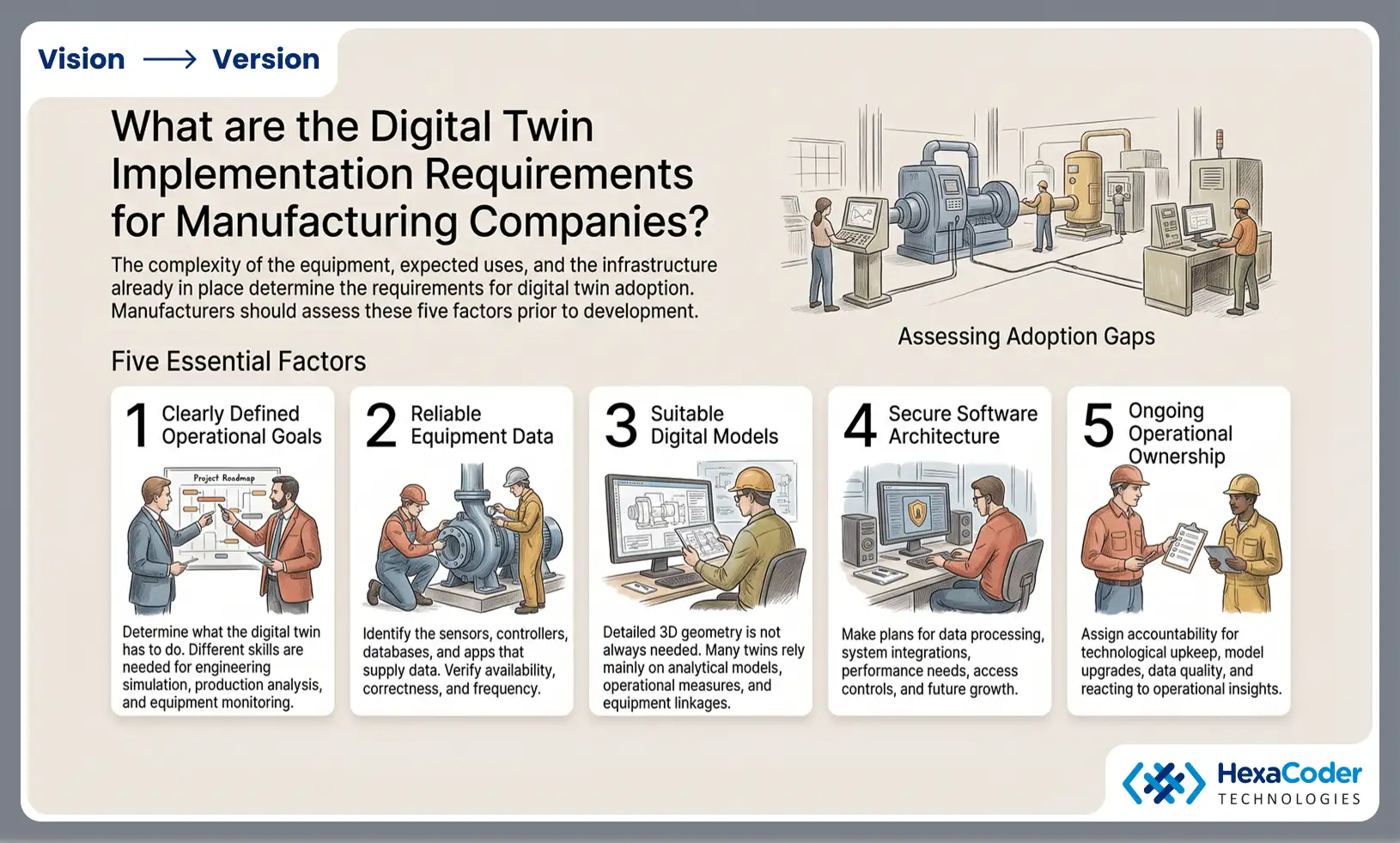
The complexity of the equipment, the expected uses, and the infrastructure already in place determine the requirements for digital twin adoption for industrial organisations.
Manufacturers should assess these five factors prior to development.
1. Clearly defined operational goals
Determine what the digital twin has to do.
Different skills are needed for engineering simulation, production analysis, and equipment monitoring.
2. Reliable equipment data
Identify the sensors, controllers, databases, and applications that supply the required data.
Verify the availability, correctness, and frequency of updates of the data.
3. Suitable digital models
Detailed 3D geometry is not necessary for every application.
Analytical models, operational measures, and equipment linkages are the main sources of reliance for some digital twins.
4. Secure software architecture
Make plans for data processing, system integrations, performance needs, access controls, and future growth.
5. Ongoing operational ownership
Assign accountability for technological upkeep, model upgrades, data quality, and reacting to operational insights.
Before significant development starts, these requirements aid in identifying implementation gaps.
How manufacturers can successfully implement digital twin technology
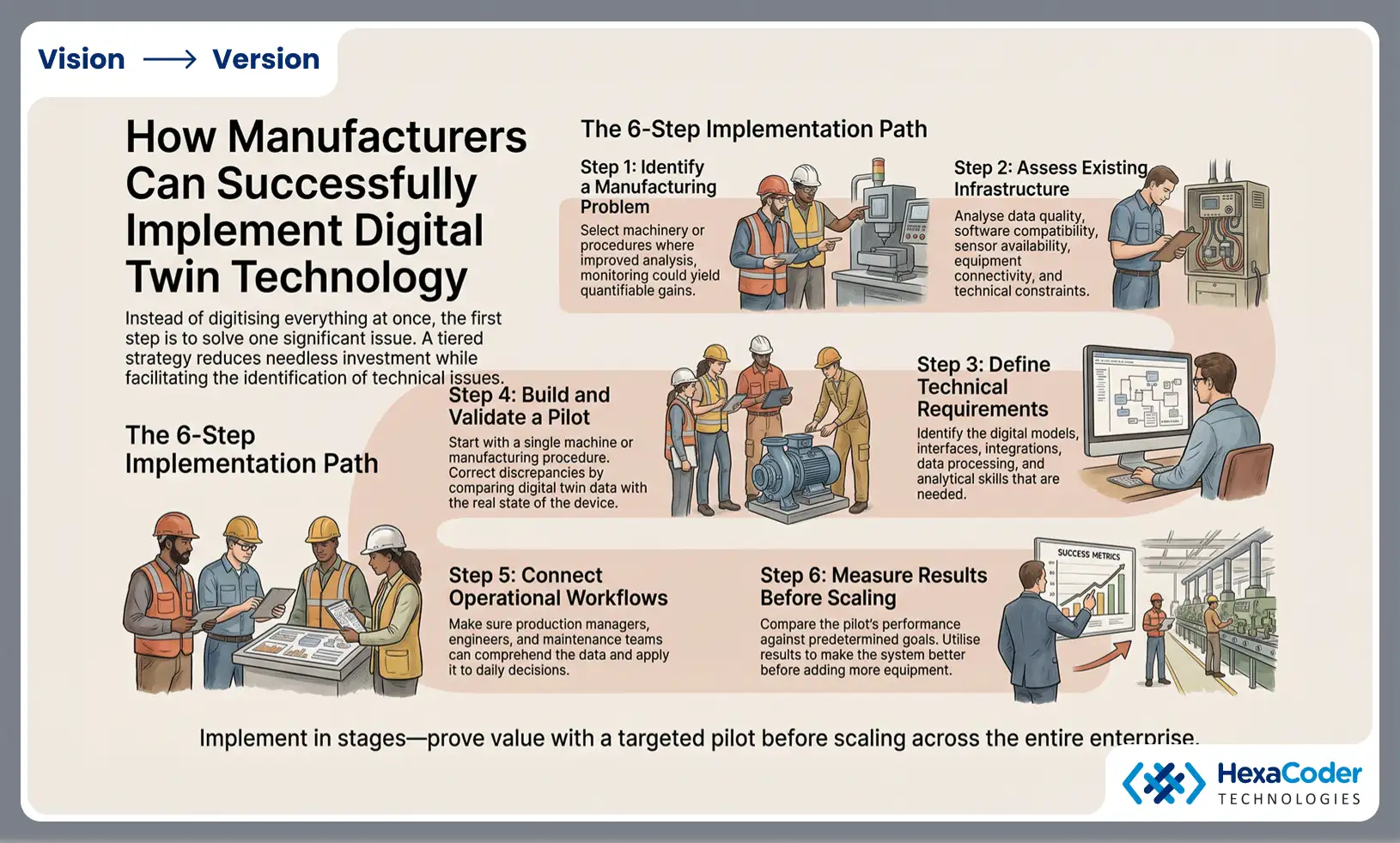
Instead of digitising everything at once, the first step in understanding how manufacturers can successfully implement digital twin technology is to solve one significant issue.
There are six steps in a practical implementation procedure.
Step 1: Identify a manufacturing problem
Select machinery or procedures where improved analysis, simulation, or monitoring could yield quantifiable gains.
Step 2: Assess existing infrastructure
Analyse data quality, software compatibility, sensor availability, equipment connectivity, and technical constraints.
Step 3: Define technical requirements
Identify the digital models, interfaces, integrations, data processing, and analytical skills that are needed.
Step 4: Build and validate a pilot
Start with a single machine or manufacturing procedure.
Correct discrepancies by comparing data from the digital twin with the real state of the device.
Step 5: Connect operational workflows
Make sure production managers, engineers, and maintenance teams can comprehend the data and apply it to daily decisions.
Step 6: Measure results before scaling
Compare the pilot's performance against predetermined goals.
Utilise the results to make the system better and decide whether to add more equipment.
This tiered strategy reduces needless investment while facilitating the identification of technical issues.
Digital twin implementation best practices for smart factories
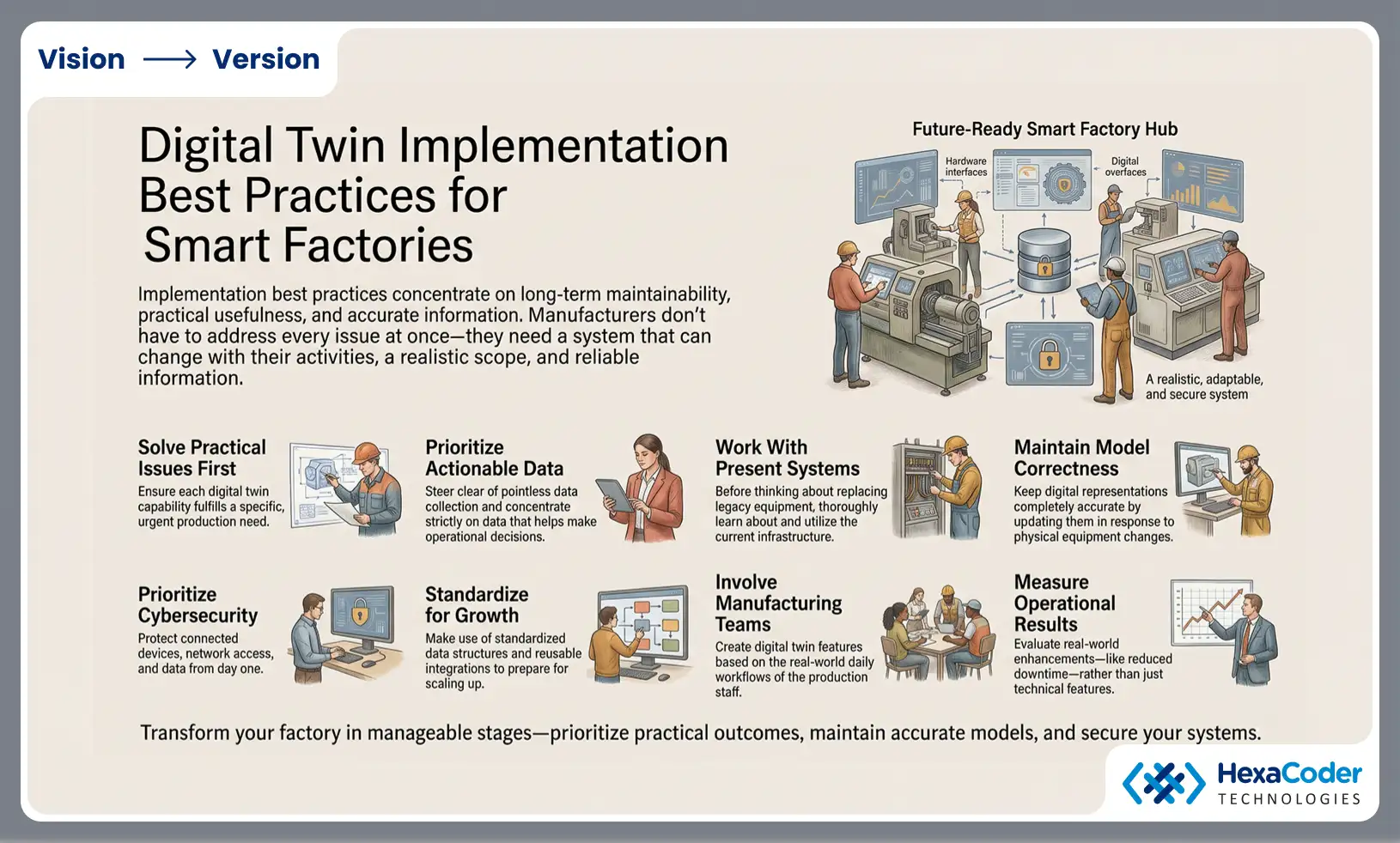
The digital twin implementation best practices for smart factories concentrate on long-term maintainability, practical usefulness, and accurate information.
- First, solve a practical issue: Each capacity should fulfilll a specific production need.
- Steer clear of pointless data collection and concentrate on data that helps make operational decisions.
- Work with present systems: Before thinking about replacing equipment, learn about the current infrastructure.
- Maintain model correctness by updating digital representations in response to changes in physical equipment.
- Make cybersecurity a top priority and safeguard linked systems during implementation.
- Make use of standardised data structures and reusable integrations to get ready for growth.
- Involve manufacturing teams: Create features based on real production processes.
- Measure operational results: Instead of depending solely on technological characteristics, consider enhancements.
Before beginning, manufacturers don't have to address every issue related to digital transformation.
They require a system that can change with their activities, a realistic scope, and reliable information.
Conclusion
Manufacturers can gain a better understanding of equipment behaviour, increase operational visibility, and make more informed decisions by implementing a digital twin solution.
However, cautious preparation is necessary due to cybersecurity, unreliable data, implementation costs, legacy system integration, and technical knowledge.
Implementation can be made easier by beginning with a specific manufacturing challenge, confirming the solution, and assessing outcomes.
At HexaCoder, we create unique digital twin solutions based on intricate physical assets, technical specifications, and current business processes.
Are you organising a digital twin project? Speak with HexaCoder about creating a solution that meets your operating, infrastructure, and equipment requirements.
Frequently asked questions
1. What is the most difficult aspect of implementing a digital twin?
One of the most difficult tasks is generally integrating disparate software systems and current production equipment while preserving dependable data quality. A digital twin cannot reliably represent physical operations without precise data.
2. What is the cost of putting in place a digital twin?
Infrastructure, software development, model complexity, equipment connectivity, and integrations all affect costs. Additionally, manufacturers should take into consideration system updates, hosting, security, and continuous maintenance.
3. Can older manufacturing equipment be used with digital twin technology?
Indeed. Sometimes middleware, industrial gateways, extra sensors, or unique integrations allow older equipment to connect. Available interfaces, equipment capabilities, and necessary data all affect feasibility.
4. How much time does it take to implement a digital twin?
Project scale, data accessibility, equipment complexity, and integration needs all affect timelines. Compared to a facility-wide digital twin, a single-machine monitoring program often involves less development work.
5. How can manufacturers lower the risks associated with implementing digital twins?
By establishing specific goals, assessing infrastructure, verifying data quality, beginning with a targeted pilot, incorporating operational teams, and growing based on quantifiable outcomes, manufacturers may lower risks.