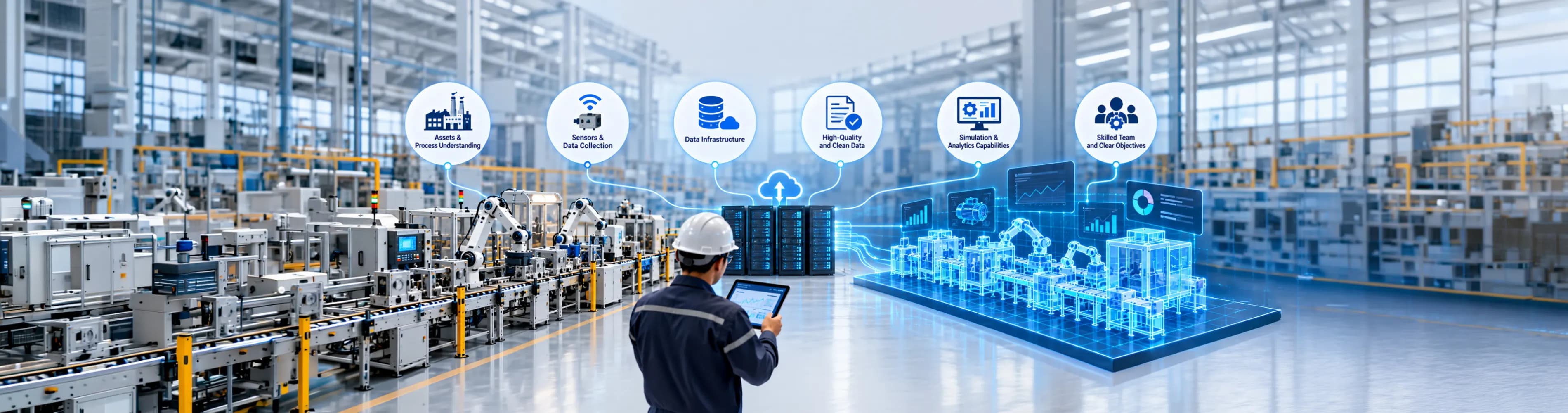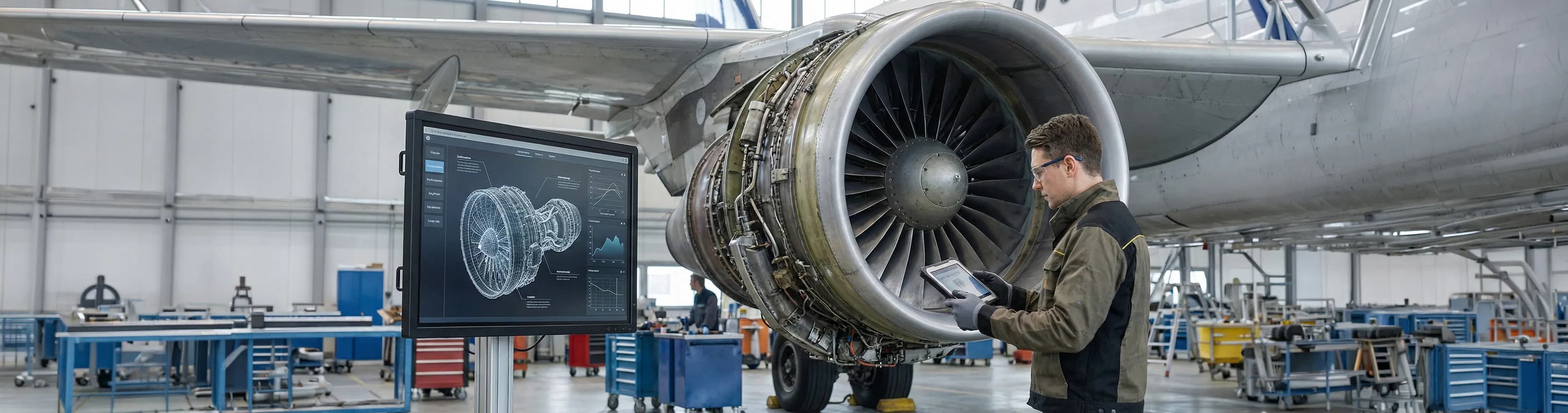

The use of digital twin technology is no longer limited to aerospace laboratories and advanced manufacturing facilities. By 2026, digital twins will have become a commonplace layer of operations used by companies across all major industries for the operation of their assets, planning of urban development, and even internal processes within businesses. Digital twin market revenue worldwide in 2026 is forecasted to reach $49.47 billion and grow to $328.51 billion in 2033, with a compound annual growth rate of 31.1%. Such rapid growth doesn't come from thin air and occurs due to specific industry success cases. The analysis of the sectors where the use of digital twins brings the greatest value reveals much about the future development of this technology.
This article discusses the top industries utilizing digital twins in 2026 and the methods of application.
Why 2026 Is a Turning Point for Digital Twin Technology
Before we get into specific industries, however, there is some context around why this year stands out. The development of digital twins goes hand in hand with the development from static models to reasoning entities. With the help of generative AI, twins can now create 3D content by themselves and answer difficult queries in natural language. Finally, agentic AI extends this capability, helping twins to not only notify about an issue but diagnose a problem on its own and perform repair without any assistance from people.
The point here is that this changes the entire paradigm of usage. Sure, a digital twin which notifies users when a machine overheats works great. But what will make users want to implement this technology even more is a twin which can predict overheating three days ahead of time, simulate fifty possible preventive measures, and tell you how to save money on this. As compared to reflecting real-time status, an autonomous digital twin runs thousands of simulations in parallel all the time.
Manufacturing: The Originator and Also the Biggest Beneficiary
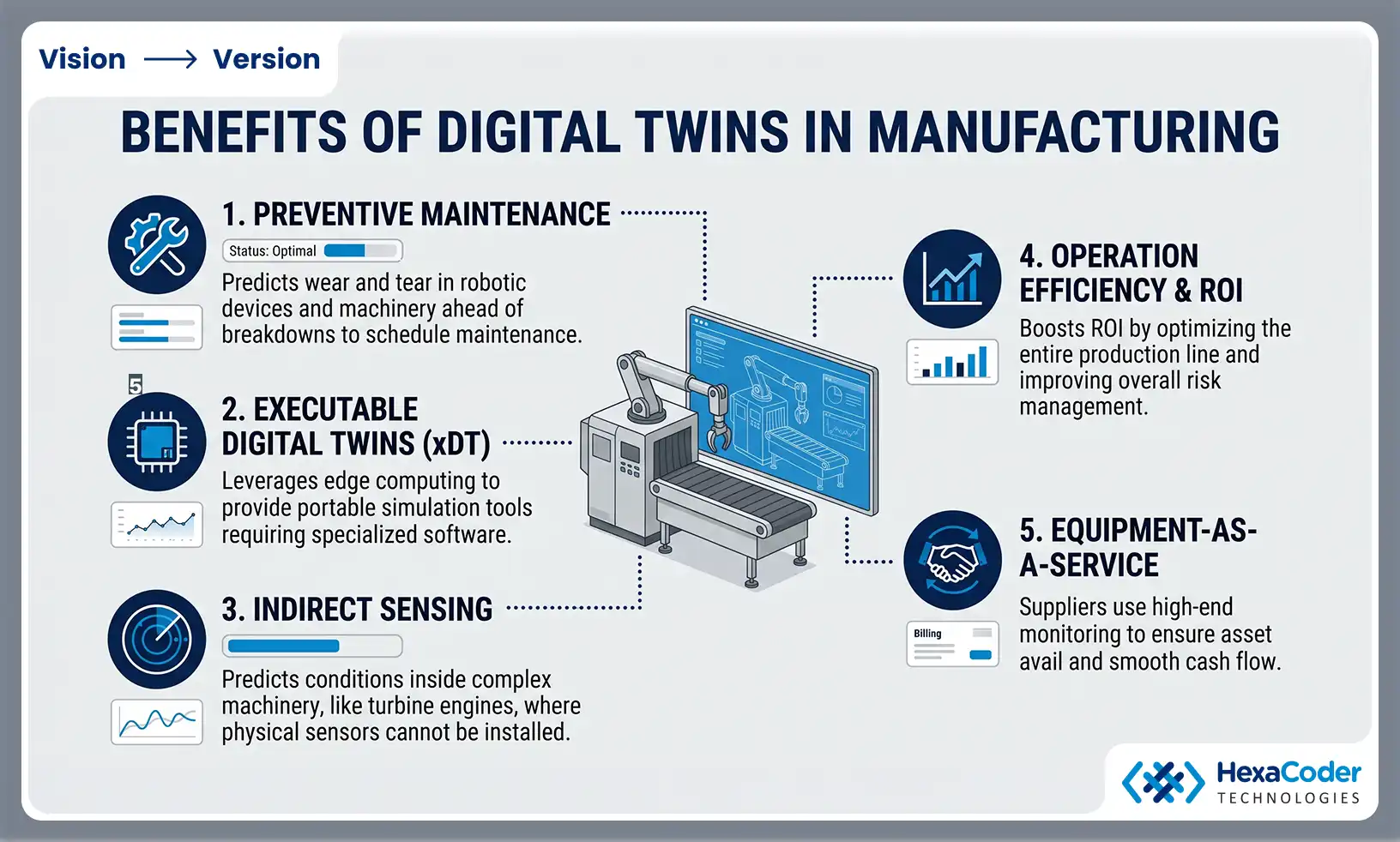
The manufacturing industry continues to be the main beneficiary of digital twins technology and with reason. Manufacturing, oil and gas, automotive, and healthcare industries continue being some of the top adopters of the technology owing to the return on investment in operation efficiency and risk management. The factories leverage digital twins in modeling the entire production line in an attempt to pick up wear and tear in the robotic devices ahead of any breakdowns hence scheduling maintenance ahead of time.
What has been different about 2026 is the advanced monitoring technology. Executable Digital Twins or xDTs are now emerging as portable simulation tools which do not need special software to operate within the factory setup. This technology leverages already installed sensors together with hardware but then overlays a twin on top to enhance the performance of the machinery, thanks to the edge computers which are now giving each machine computing power and connectivity to the central data lake. Manufacturers are also leveraging the twins in areas where there are no physical sensors such as inside the turbine engine, making predictions on conditions from the available data. Change is not limited to just the service offerings. With equipment-as-a-service becoming more common, suppliers are using digital twins to provide high-end monitoring that assures the availability of assets, thereby ensuring smooth cash flow for both parties.
Energy and Utilities: Dealing with a Complicated Grid
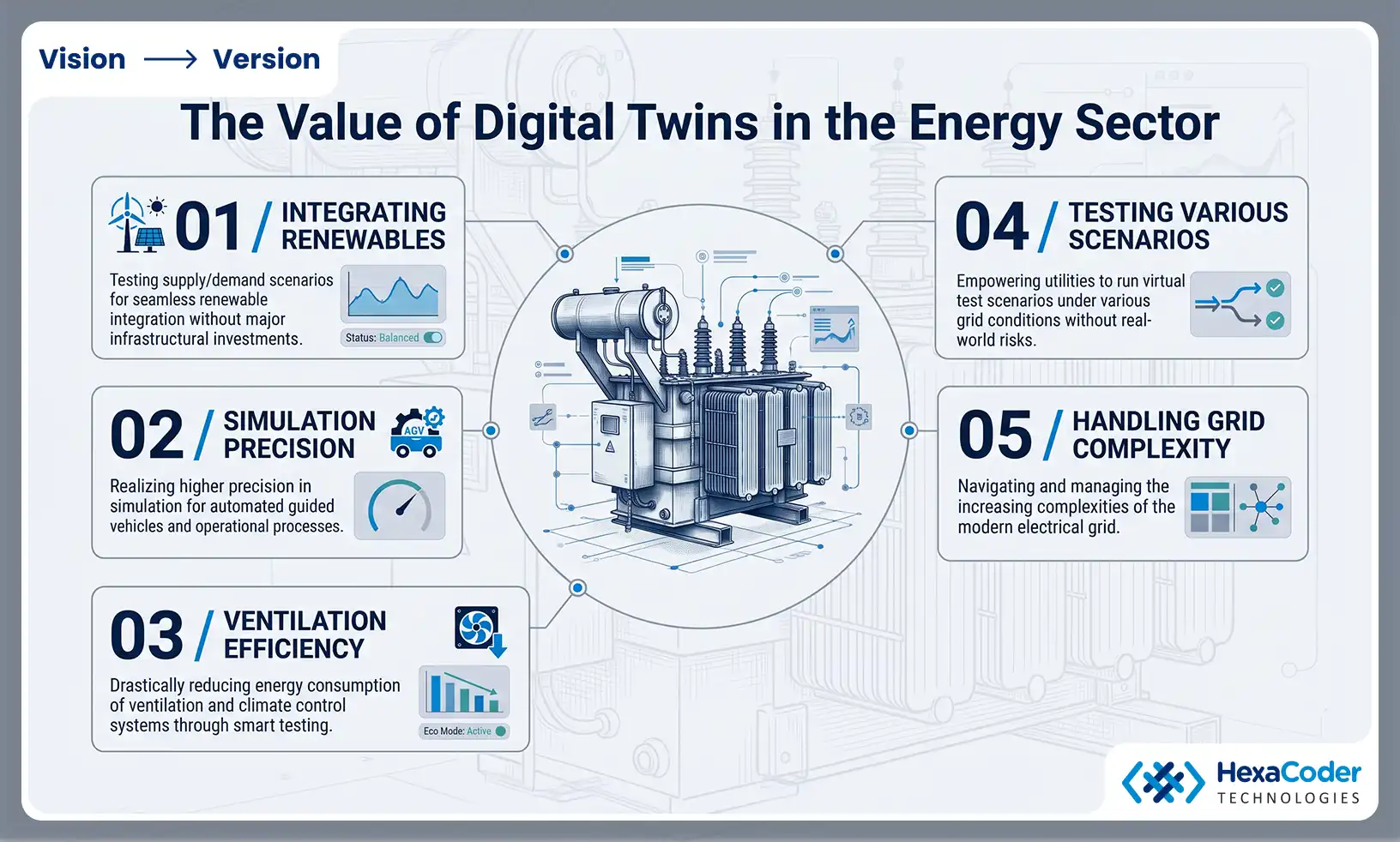
While the energy sector is known for quietly adopting many new technologies, it has now emerged as a rapidly growing market for digital twins, owing to the growing complications of the grid itself. The market for electrical digital twins is expected to touch $285.46 billion by 2033, recording a CAGR of 36.3%, starting from 2026, due to the complexities involved in integrating renewables with the grid.
Actual applications have already proven successful. Siemens and Schneider Electric utilized digital twins in energy processes to achieve higher simulation precision for automated guided vehicles by 10%, while also reducing the energy consumption of the ventilation system by 70%. In line with the growing adoption of renewable energy resources, twins provide utilities with an opportunity to test various supply/demand situations without making significant infrastructural investments.
Oil and Gas: Safety and Asset Lifespan Optimization
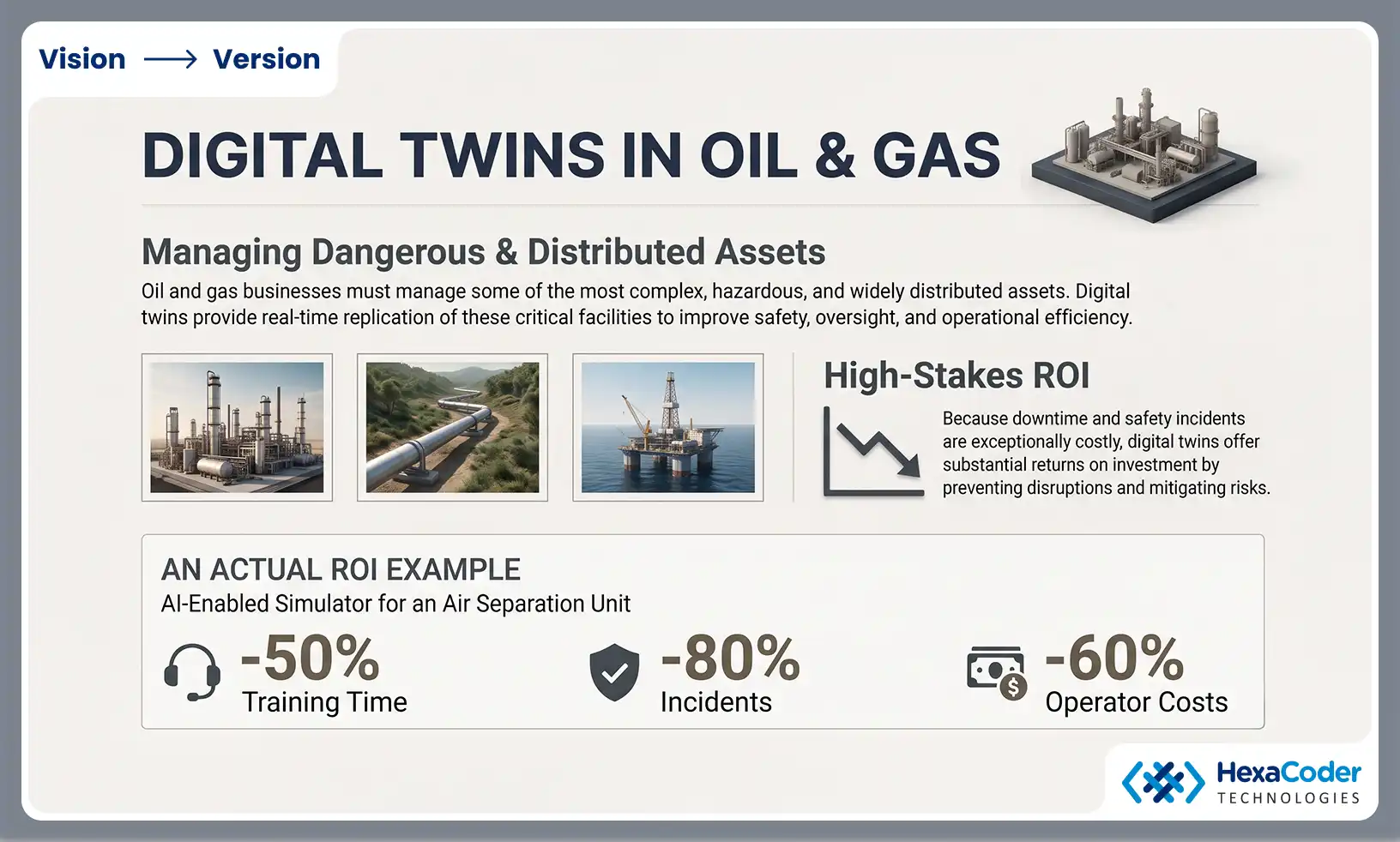
Oil and gas businesses have to deal with some of the most dangerous and distributed assets in the industry. Therefore, digital twins become particularly beneficial for oil and gas businesses. Digital twins of the oil and gas sector enable real-time replication of such facilities as oil refineries, pipelines, and drilling platforms. In this industry, the ROI is usually quite spectacular due to the expensive nature of downtime and safety issues. An actual ROI example outside the typical oilfield environment would be an AI-enabled simulator for an Air Separation Unit that has managed to reduce training time by 50%, cut incidents by 80% and reduce costs for each operator by 60%.
Healthcare Industry: A Slow Yet Certain Move towards Digital Twins
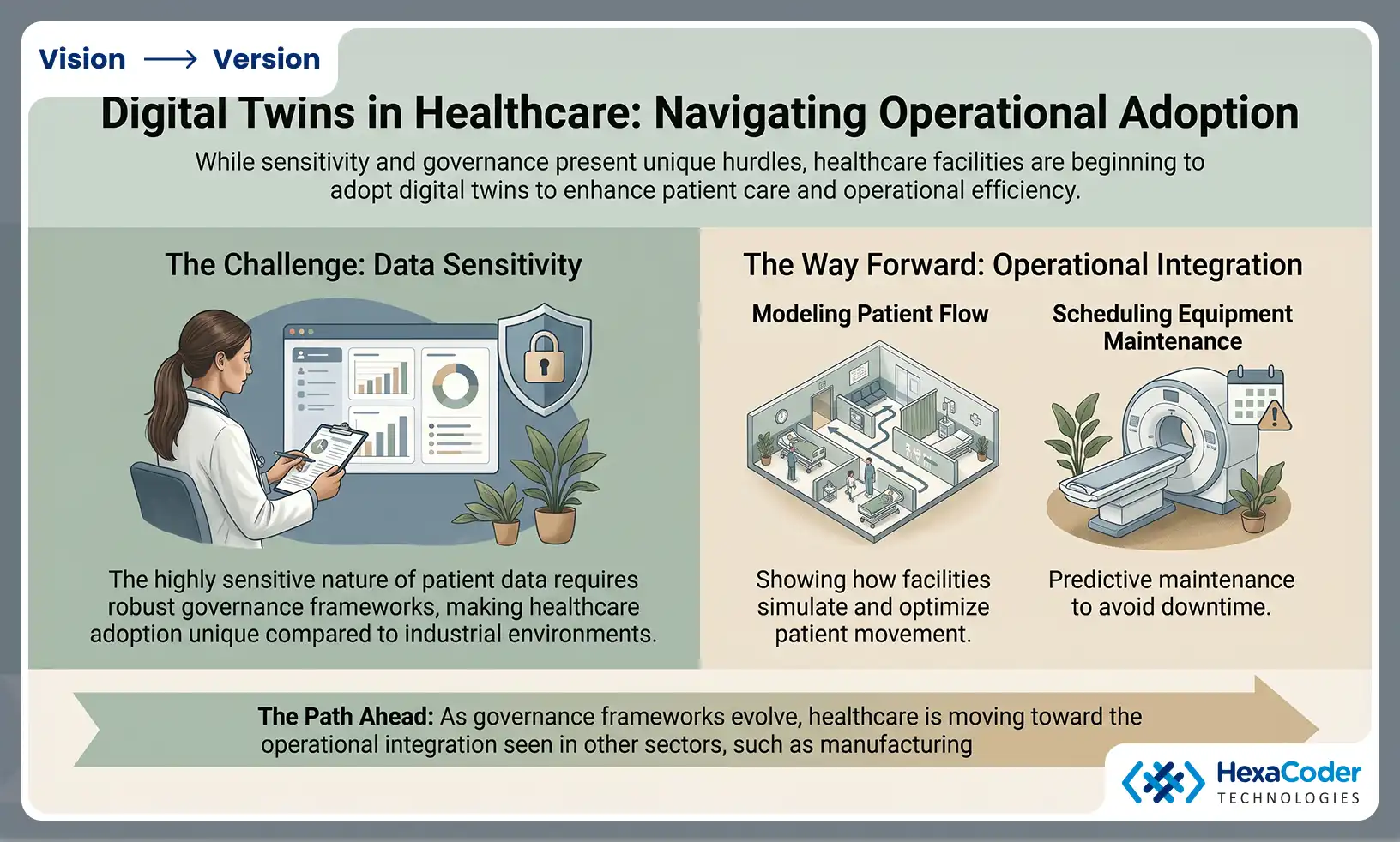
The adoption of digital twin technology in the healthcare industry does not show the same adoption trends compared to industrial environments due to the highly sensitive nature of the information being processed. More and more companies adopt digital twins across all industries including manufacturing, healthcare, smart cities, and aerospace and defense, but there is a certain problem faced by healthcare organizations.Nonetheless, the way forward is apparent as hospitals and health care facilities are now experimenting with digital twins to model patient flows in facilities to even scheduling maintenance for expensive diagnostic equipment. As the governance frameworks evolve further, health care will be following the same trajectory towards operational integration seen in manufacturing.
Telecommunication: Developing the 6G Infrastructure
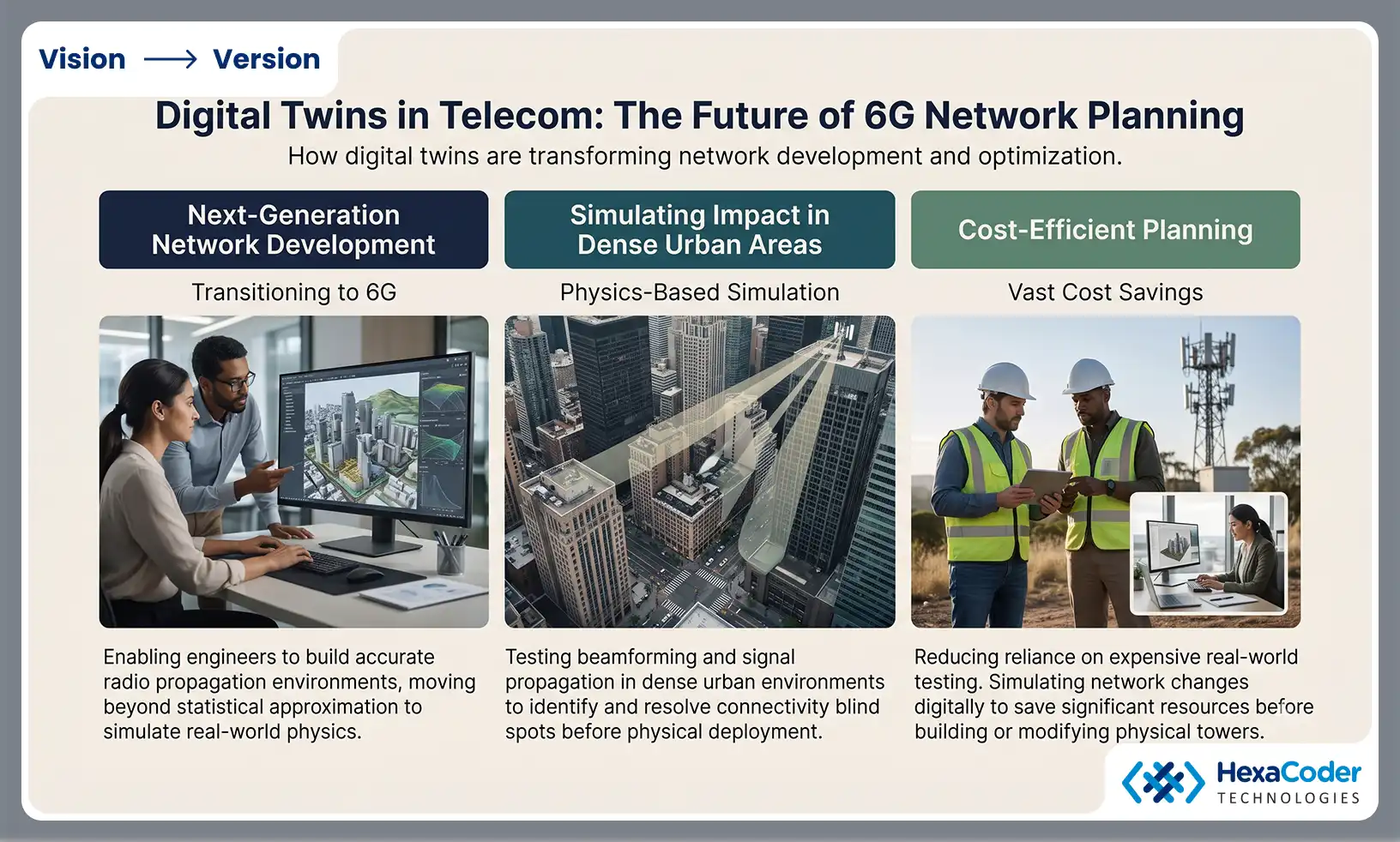
The telecommunication industry has proved to be an unexpected leader in the adoption of digital twins in 2026. This is due to the shift to the next generation of networks. The telecommunication industry is currently using digital twins to hasten the development of 6G networks by adopting the Nokia RAN Digital Twin that has been developed by the company on top of the NVIDIA Aerial Omniverse Digital Twin platform. This has enabled the engineers to develop accurate radio propagation environments rather than the use of statistical approximation.There is huge potential value here in terms of network planning. It is possible to simulate the impact of beamforming in dense urban environments to avoid connectivity blind spots even before building or modifying any towers at all. The financial benefits of doing so when considering how costly real-world tests are, will save telecom operators vast sums.
Smart Cities and Urban Infrastructure
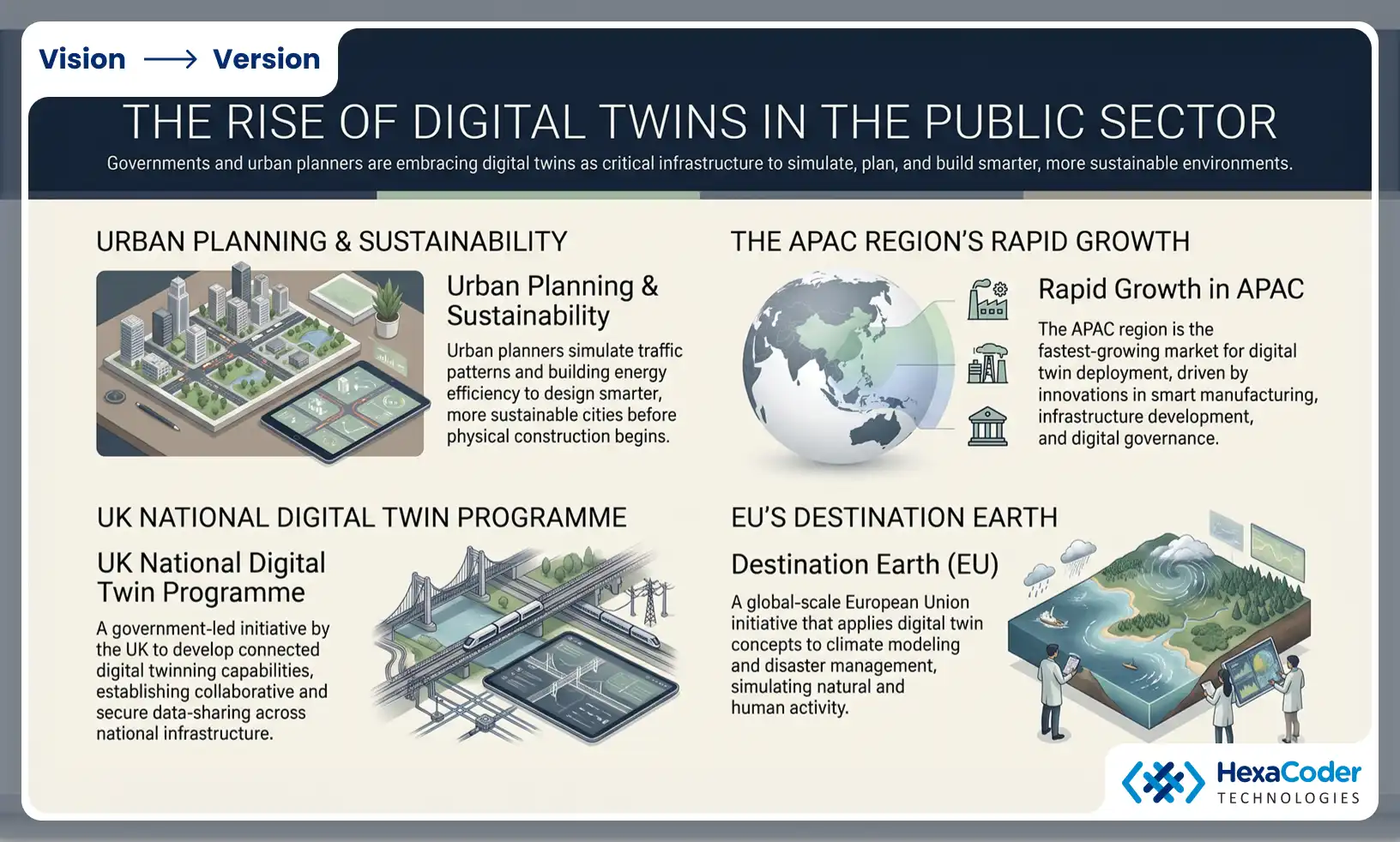
Governments and public sector entities are increasingly viewing digital twins as infrastructure rather than just cool technology. Urban planners are using digital twins in their efforts to build smarter, more sustainable cities, simulating aspects like traffic flow and energy efficiency in buildings before any physical construction occurs.
The APAC region has become the fastest growing region in terms of digital twin deployment, thanks to innovations in smart manufacturing, infrastructure development and government digitalization.The National Digital Twin programme by the UK Government is presented as an example of government-led initiatives to develop digital twinning capabilities within the country, whereas other global-scale initiatives like the Destination Earth by the EU take twin concepts further, applying them to climate modeling and disaster management planning.
Constructions and Real Estate
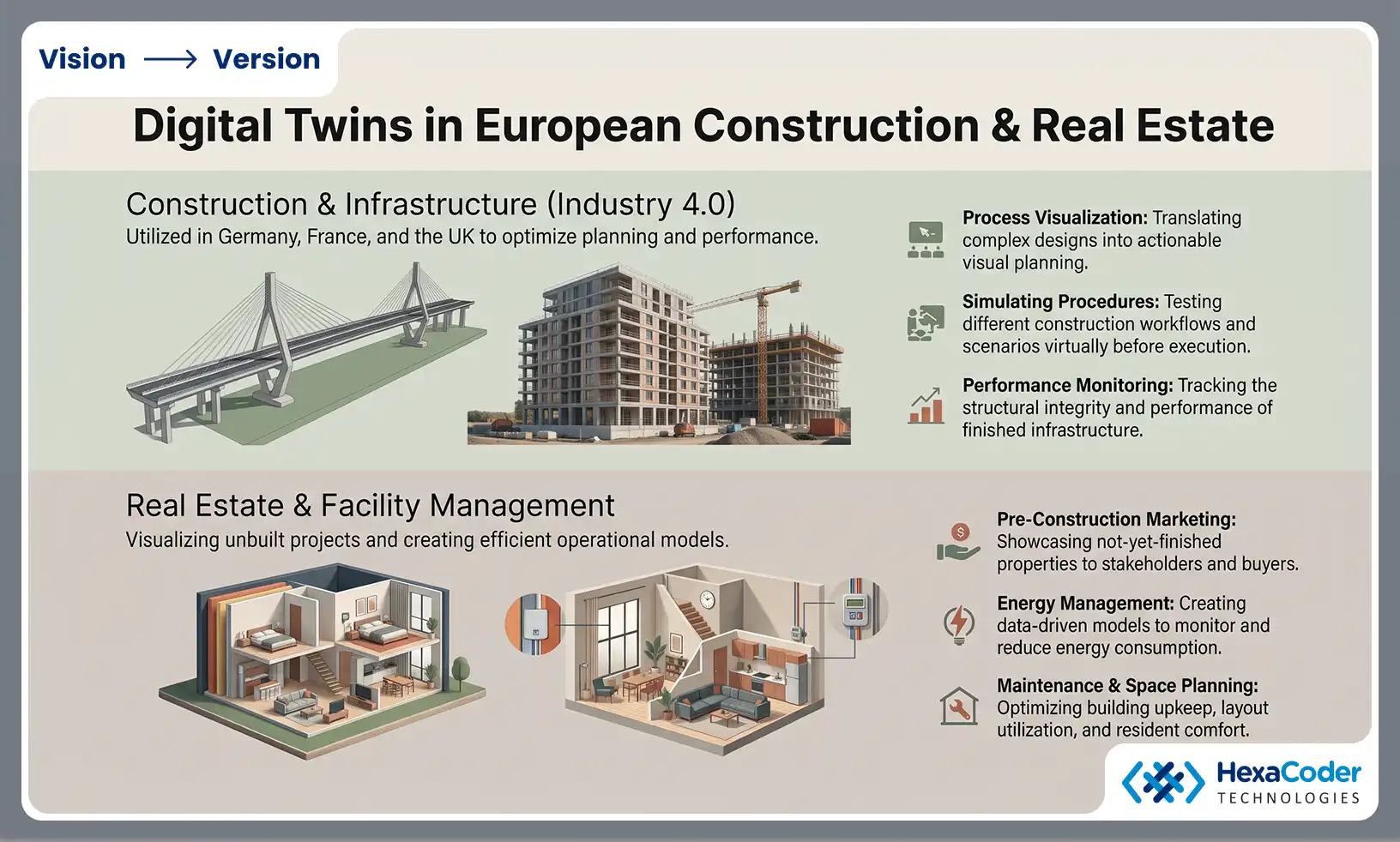
Digital twins are being used increasingly earlier in the lifecycle of construction and facility development projects. In European countries, digital twins are utilized for construction and infrastructure projects to visualize the process, simulate different procedures involved, and monitor performance of structures, especially in Germany, France, and the UK in connection with Industry 4.0.
As far as the real estate industry is concerned, visualization and marketing of properties via the use of 3D digital twins allow presenting not-yet-finished constructions in advance, as well as creating a management model for energy usage, maintenance, and planning of available space after it has been occupied by the residents.
Automotive: From Design Floor to Live Fleet Management
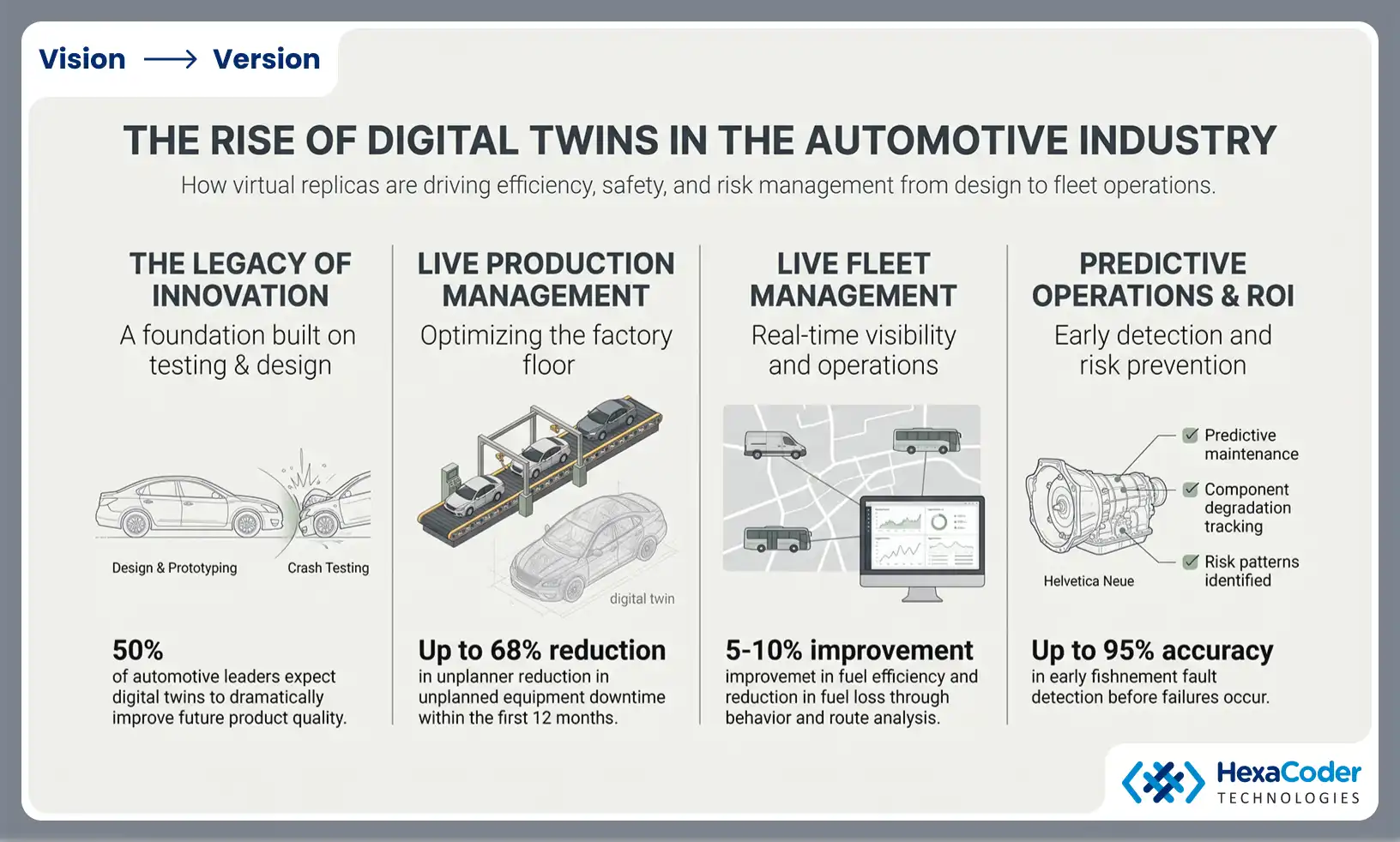
The automotive industry was one of the first industries to implement digital twins in their design process and crash testing, and this legacy continues with live fleet and production management. The automotive industry remains one of the leading industries adopting digital twin technology, thanks to the measurable return on investment from increased efficiency and risk management, with twins being increasingly used for monitoring the performance of fleets of vehicles.
Driving Forces for the Adoption in all these Industries
There are some driving factors common to all these sectors and they also justify why the year 2026 becomes an important milestone rather than continuation of previous years’ trends.
Investment in AI infrastructure. Around 75 percent of large businesses have invested in digital twin technology to deploy AI solutions throughout their business processes, which indicates that the digital twin technology is now being used as AI infrastructure and not just as a simulation technology.
Self-healing systems reducing costs. There is a growing ability in the digital twin technology that it can recognize if there is any inconsistency in its own data or the data given by the physical sensors; in such cases, the missing information is filled up using past trends and predictions.
Decrease in barrier to entry through twin-as-a-service solutions. By 2026, digital twins are likely to become the ultimate solution for resilience, enabling industries to model any changes in global logistics or extreme weather conditions before they occur. More and more often, this technology will be provided as an on-demand solution, making it accessible to medium-sized organizations unable to afford its customization and deployment in-house.
The Gap Between Pilot and Production
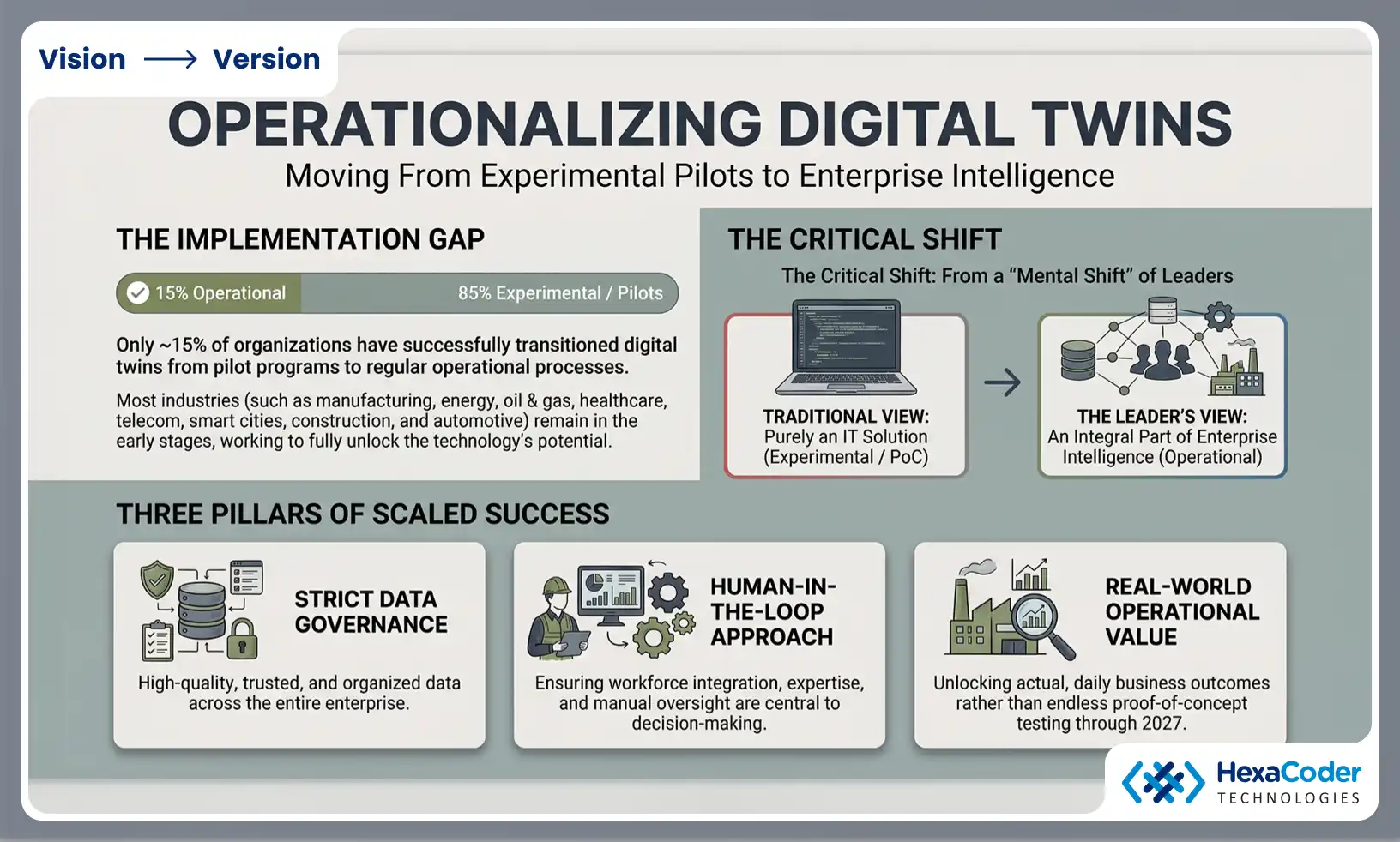
Even with the progress made, there is much more work left for most organizations to make digital twins operational, rather than merely experimental. Just around 15% of organizations are actually implementing digital twins from pilot programs to regular operational processes, which means that these industries mentioned are relatively early to fully unlock all the potential benefits.
All the leaders in digital twin implementation share one thing – they stopped regarding digital twins as purely IT solutions and started treating them as an integral part of enterprise intelligence that requires strict data governance and human-in-the-loop approach. This shift in mentality is what will distinguish businesses that are reaping the real benefits of their digital twins from those who are running proof-of-concept pilots up until 2027 in manufacturing, energy, oil and gas, healthcare, telecom, smart cities, construction, and automotive industries.
Where Digital Twin Technology Goes From Here
Digital twins in 2026 are no longer a gamble on what is coming next. They have already reached a tipping point where all CIOs and IT executives need to make an active, strategic choice regarding implementation, and the sectors highlighted above demonstrate that the technology works when applied within the correct data foundations. Manufacturing and oil & gas still lead in terms of ROI, energy and telecom scale quickly to handle infrastructure complexity, and healthcare, smart cities, and construction are catching up as regulations improve.
What makes successful implementation of the technology different from unsuccessful one is not the amount of budget, but the proper execution of a project. Implementing a working digital twin, which actually reflects reality and helps to make the decision that will be trusted by the leadership, requires much more than purchasing a platform license. The organization needs a partner that knows everything about the entire stack of technologies necessary for implementation.
This is precisely how Hexacoder Technologies has made its name known. Hexacoder operates specifically in the area that most businesses have problems filling, creating digital twins from static 3D models that connect with real-time operational data as opposed to remaining standalone visuals. No matter whether the application area is for predictive maintenance models on the manufacturing floor, immersive property configurators for a real estate portfolio, or a digital thread for the construction to operations of an infrastructure project, the philosophy of Hexacoder Technologies follows the same line as the one that is driving adoption in all industries discussed in this article: digital twins must make decisions, not merely dashboards.
This becomes increasingly true in 2026 compared to even last year when the majority of large companies have started investing in digital twins to expand on other AI-related projects. In this case, companies that view digital twin as their infrastructure and not an individual IT project tend to succeed in terms of performance. The same approach is taken by Hexacoder in the development of PropTech and the industrial configurator.
For those teams which are trying to figure out whether they should invest in digital twins right away, all the information given in this article is enough to convince them of doing so. Firstly, the market is still developing rapidly; secondly, the ROI is proven for a variety of sectors; thirdly, the companies that are late will always lose out to those that made a decision earlier.
In whichever industry you are looking at for the application of this technology, the real question in 2026 is not about whether digital twins should have a place in your organization, but how soon you can get from a pilot project to full deployment before your competition does it.
Are you ready to learn more about what a digital twin might be able to do for your organization? Contact Hexacoder Technologies to discuss how a custom-built 3D digital twin solution might fit your requirements.