
Introduction
The breakdown of a machine rarely occurs at a convenient time. When a motor fails, the assembly line can stop, customer orders can be delayed, and maintenance teams have to search for replacement parts while production is halted.
Most plants use either reactive maintenance when equipment is repaired after it breaks or preventive maintenance in which machines are maintained at regular intervals independent of their real state.
There are limitations to both approaches. The first responds too late, while the second may schedule maintenance in advance.
Manufacturers can manage equipment health using digital twins. The maintenance team is able to detect unusual behavior, identify potential faults, and plan repairs based on the condition of equipment by connecting physical machinery with continuously updated digital models.
In a manufacturing facility, how does digital twin technology facilitate predictive maintenance, and how is it implemented?
How digital twins make predictive maintenance more effective
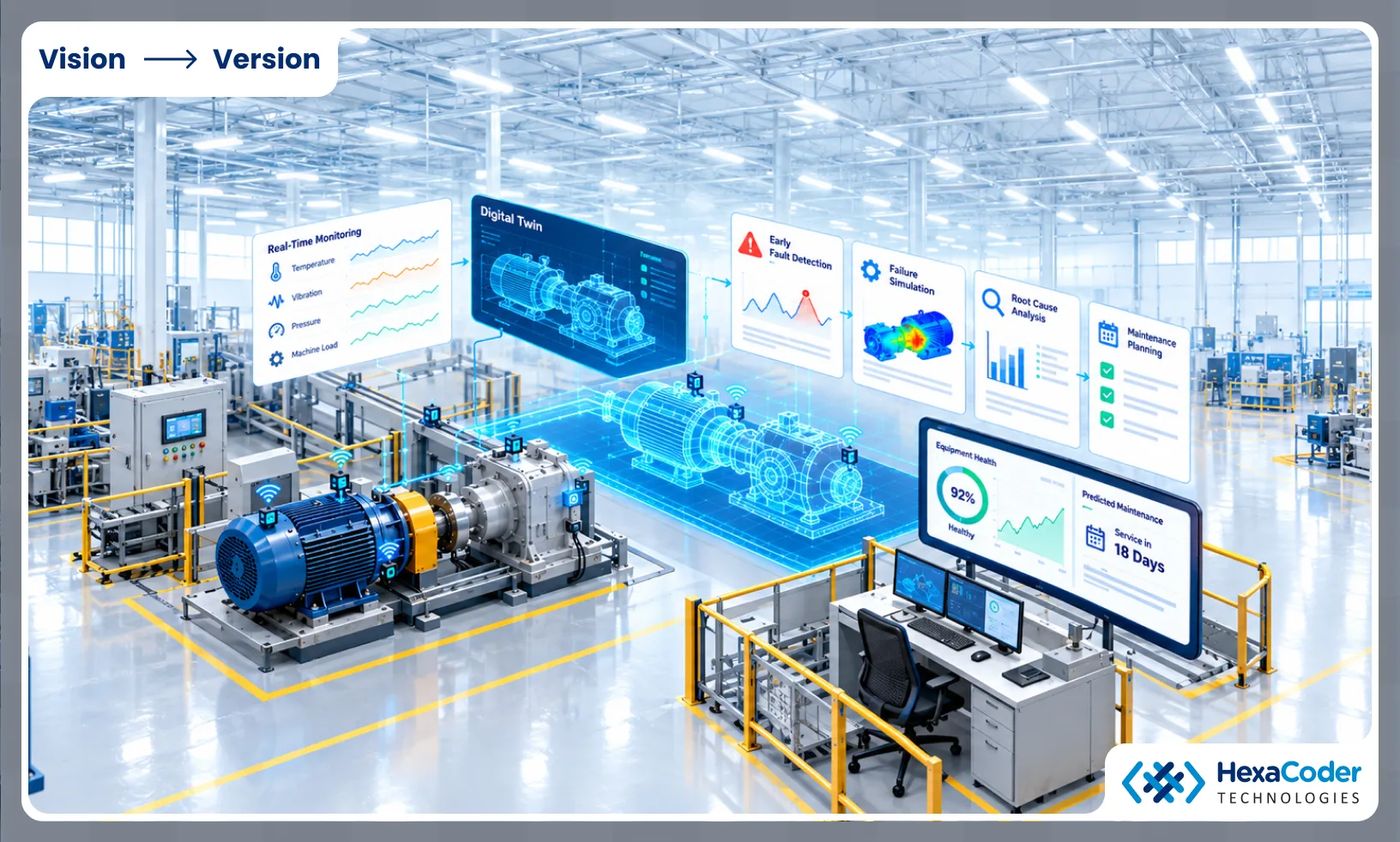
By using digital twins, manufacturers can move beyond reacting to equipment failures to understanding why those failures occur. Through the combination of machine data and analytical models, they can provide insights that are not possible with traditional maintenance schedules.
-
Real-time monitoring
Manufacturing equipment has sensors that measure temperature, vibration, pressure, and machine load.
By updating the digital twin, maintenance teams can observe changes in equipment behavior without having to manually inspect each machine.
It may be necessary to investigate a mechanical problem such as wear, misalignment, or other factors causing motor vibration.
-
Early fault detection
Analyzing historical patterns and expected operating conditions helps predict future equipment behavior.
In the event of unusual changes, the system can alert maintenance teams before a failure of equipment occurs.
There is no guarantee that an alert means a machine is about to fail. There has been a change and something needs to be addressed.
-
Failure simulation
With physics-based models, engineers can simulate equipment behavior under different operating conditions using a digital twin.
An engineer might investigate the effect of increased loads or operating temperatures on a machine component, for example.
By conducting these simulations, teams can assess potential risks without exposing physical equipment to harmful conditions.
-
Root cause analysis
In case something does go wrong, the twin allows engineers to investigate the root cause of the problem by looking into its digital history rather than speculating about it.
Teams can identify what changed prior to a failure by analyzing historical sensor readings and operating records. It may still be necessary to perform additional inspections or tests to determine the cause.
-
Maintenance planning
Maintainers can determine when to replace components based on equipment condition and predicted deterioration, rather than merely relying on a calendar.
The maintenance activities can be coordinated with the production schedule, technician availability, and inventory of replacement parts as a result.
Why traditional maintenance methods fall short
Digital twins can be understood by looking at how manufacturers traditionally maintain equipment. However, neither of the two approaches accurately reflects every machine's actual condition.
Reactive maintenance
When equipment fails, reactive maintenance begins. In cases where a breakdown affects vital production machinery, this approach can be cost-prohibitive for cheap, noncritical components.
Reactive maintenance involves unscheduled downtime, hasty fixes, and delays in manufacturing that cause ripples throughout the entire chain of production.
Multiple workstations could be interrupted while technicians diagnose and repair a broken conveyor motor, for example.
Preventive maintenance
At predetermined intervals, preventive maintenance includes inspections, repairs, and replacements. Despite offering a structured approach to managing machinery, it often doesn't take conditions into account.
Two machines of the same type operating in the same plant will suffer from wear-and-tear differently because of the difference in ambient temperature, the way in which they are operated and the quality of material.
This could result in one machine receiving maintenance before it is necessary, while another developing a problem between scheduled inspections.
Predictive maintenance
The goal of predictive maintenance is to predict when intervention is necessary based on equipment condition, historical behavior, and analytical models.
The use of digital twins can enhance this approach by connecting operational data with simulations and predictions, giving maintenance teams a better understanding of equipment performance.
The use of predictive maintenance does not eliminate the need for scheduled maintenance. It may still be necessary to conduct safety inspections, comply with regulatory requirements, and maintain equipment according to manufacturer recommendations.
What is a digital twin in predictive maintenance?
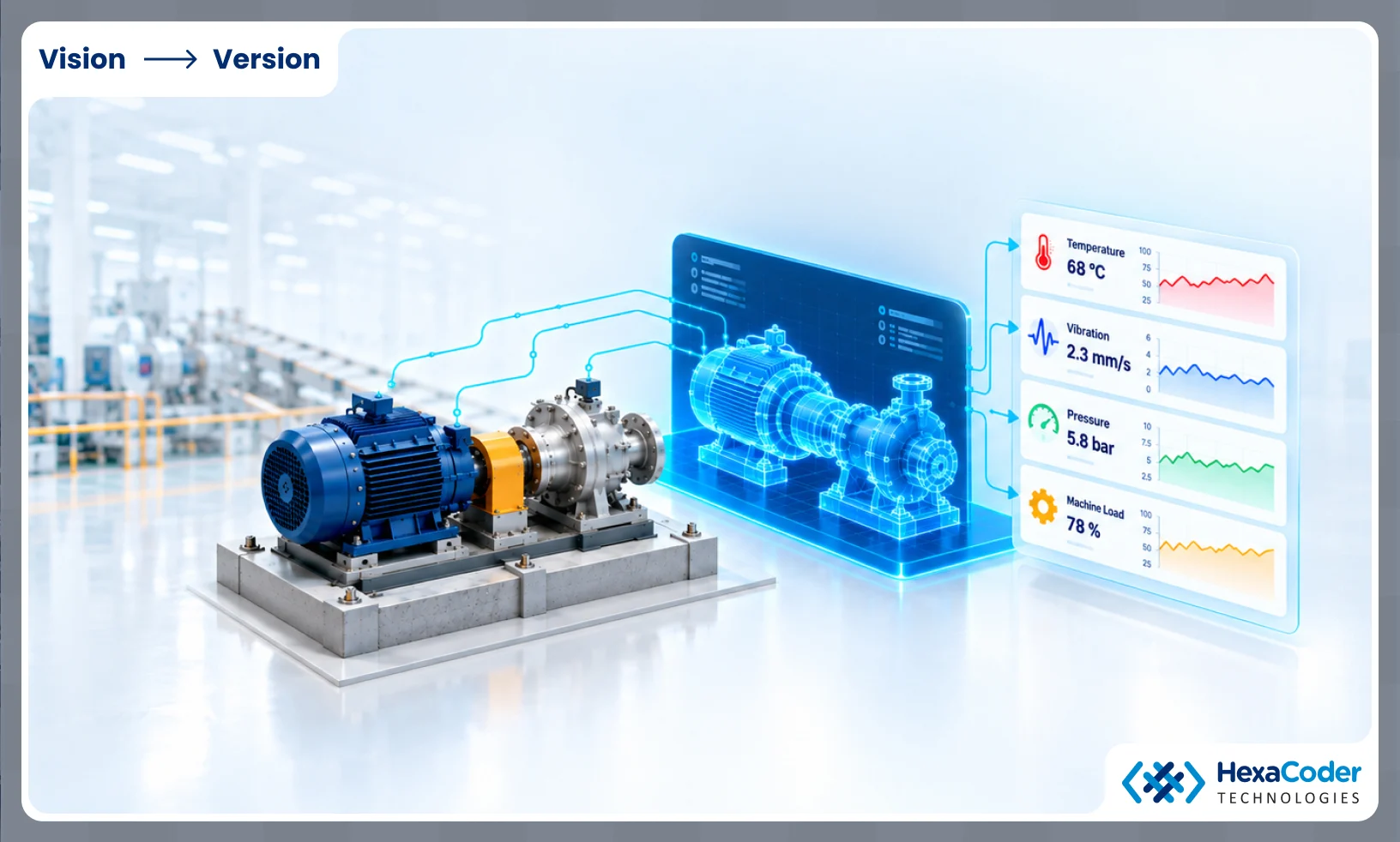
Digital twin is a virtual model of a physical entity like a factory machine or equipment, assembly line or even an entire factory itself.
Digital twins are digital representations of physical equipment used in predictive maintenance. In addition to monitoring conditions and analyzing behavior, it supports predictions about future performance through operational data and models.
Digital twins connected to physical counterparts share information, not static 3D models. This connection may be updated continuously or periodically, depending on the application.
Digital twins are useful when they combine three elements:
1.Data about the physical equipment and its operation
2.Modeling the behavior of equipment digitally
3.The process of converting data into useful maintenance insights
A realistic 3D interface is not necessary for every digital twin. Often, predictive maintenance relies more on the accuracy and quality of its equipment model than on its visual appearance.
How digital twin predictive maintenance works
A digital twin must do more than collect readings from machinery. Those readings need to be processed, interpreted, and connected to maintenance decisions. Here is how the process typically works.
Step 1: Collect equipment data
Data from machines' performance and operating conditions is provided by IoT sensors, industrial controllers, and existing monitoring systems.
Step 2: Update the digital model
Using the collected data, the model is updated to reflect relevant changes in equipment condition after being cleaned, organized, and analyzed.
Step 3: Analyse the machine's behavior
Methods such as statistical analysis, machine learning, or physical-based models can be used to evaluate operating patterns and identify unusual behavior.
Step 4: Estimate potential failures
A system can estimate fault likelihood and deterioration trends, as well as remaining useful life, if sufficient data and validated models are available.
Step 5: Plan for maintenance
The maintenance team reviews the findings, verifies concerns, and schedules inspections or repairs according to operational needs.
For instance, a compressor showing rising vibrations and temperatures may trigger an alert. By inspecting the evidence, assessing the risk, and deciding whether to repair the machine rather than shutting it down immediately, engineers can prevent the machine from being damaged.
Where manufacturers can use digital twins for predictive maintenance
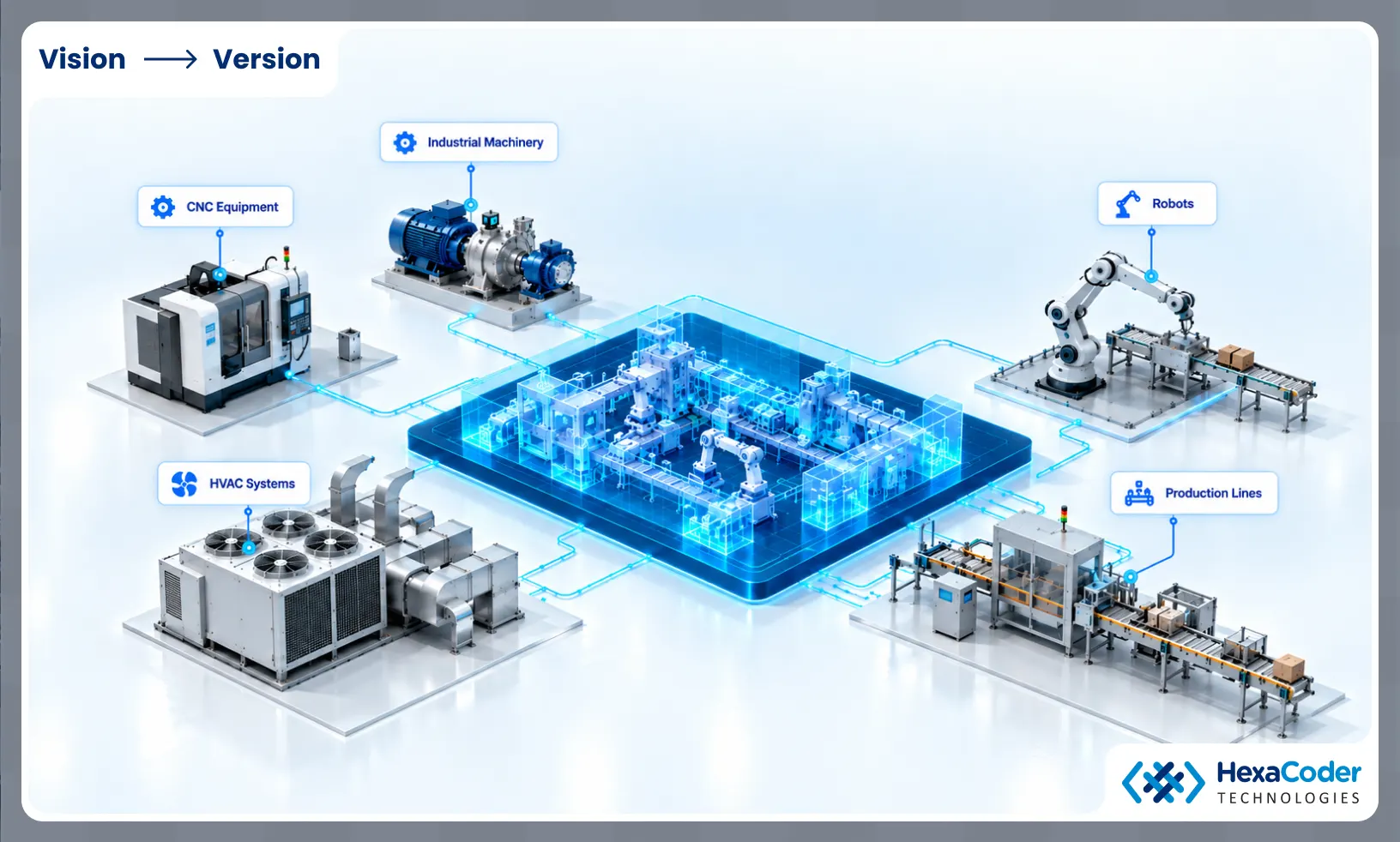
The concept of a digital twin is very easy to agree with in theory. However, its importance is really felt when it is put into practice using actual equipment that runs the entire plant.
Industrial machinery
Friction, vibration, temperature, and operational loads often affect motors, pumps, compressors, and turbines.
Monitoring these conditions and detecting mechanical faults can be made easier with digital twins.
CNC machines
The accuracy of CNC equipment depends on the spindle's performance, the cutting tool's condition, and the positioning of the tool.
By using a digital twin, engineers can investigate abnormal spindle loads, tool wear, or changes in machine behavior that may affect the reliability or quality of their equipment.
Industrial robots
Mechanical assemblies, joints, and motors are put to the test by repetitive movements carried out by manufacturing robots.
In order to identify potential maintenance needs earlier, it is helpful to monitor operating cycles, movement deviations, and equipment loads.
HVAC systems
A compressor, chiller, boiler, or another facility system supports manufacturing conditions even if they are not directly involved in production.
A digital twin can be used by facility teams to monitor their performance and investigate operational inefficiencies.
Conveyor systems
The motors, belts, drives, and all other equipment connected to a conveyor and packaging line must move in sync with one another.
Keeping track of speed, torque, and load variations can provide insight into belt wear, resistance, or jam development.
What are the benefits of digital twins for predictive maintenance?
The value of digital twin predictive maintenance comes from its ability to improve maintenance decisions in terms of timing and quality. A team's ability to use the predictions effectively will determine its financial impact.
Less unexpected downtime
In the event that maintenance teams are able to identify developing problems earlier, they will have a better chance of addressing them before equipment breaks down unexpectedly.
Production schedules can be protected and disruptions caused by emergency repairs can be reduced.
Lower maintenance costs
Preventing expensive failures can be achieved by making condition-based decisions.
There are however costs associated with sensors, software development, data infrastructure, and maintenance of the model which must be taken into account when evaluating these savings.
Better equipment reliability
Engineers gain a deeper understanding of how equipment performs under various loads and environments by tracking operating conditions over time.
As a result of this information, maintenance decisions can be made more consistently, and equipment reliability can be improved.
Improved production planning
By predicting potential problems in advance, teams are able to schedule maintenance during planned shutdowns or low-demand periods.
As well as assessing the need for replacement equipment, spare parts, and schedule adjustments, production managers can look for improvements.
Safer maintenance decisions
By using digital analysis, certain diagnostic tests on operating machinery could be reduced and safety risks could be identified before they become serious.
Inspections performed by qualified maintenance personnel, approved safety procedures, or physical inspections cannot be replaced by it.
From individual machines to entire production lines
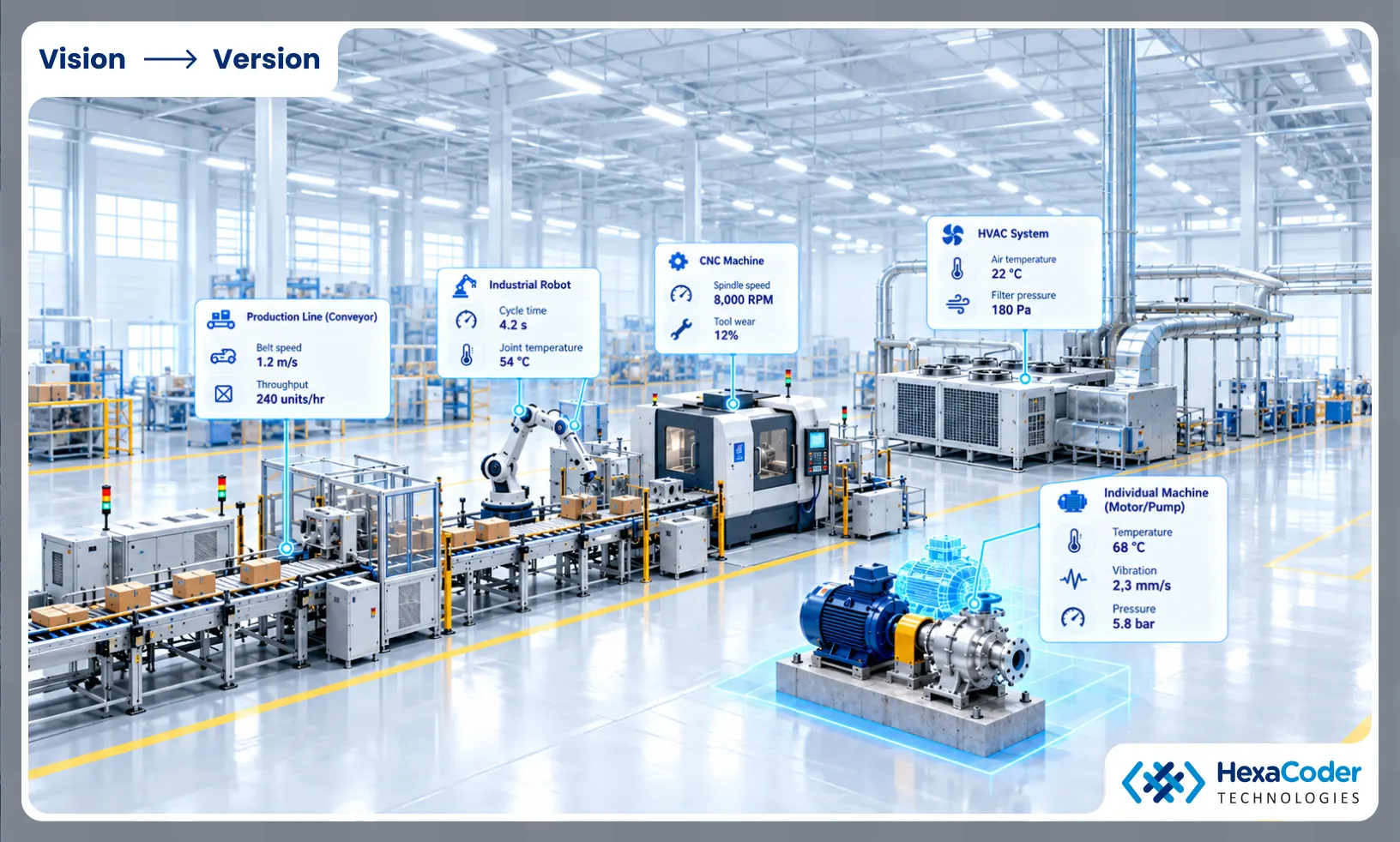
Manufacturing equipment rarely operates independently, so monitoring one machine can provide valuable information. It is possible for one part of a production line to be affected by a problem affecting several processes that are connected.
Leading edge manufacturers are not content with modeling individual components. They are creating digital twins of whole production lines, sometimes even of whole facilities in order to understand the way in which equipment interacts under actual operating conditions.
Suppose there is a production line that has three assembly stations connected by one conveyor. Even if the equipment at each station works properly, all three may have to stop if the conveyor fails.
These dependencies can be understood and evaluated through the use of a production-line digital twin.
This broad approach supports:
Equipment visibility: Understand how connected machines influence one another.
Scenario planning: Evaluate how maintenance delays or equipment failures may affect production.
Coordinated maintenance: Identify opportunities to service related equipment during planned interruptions.
Operational insights: Bring relevant machine data into a connected view of production performance.
The modeling of equipment relationships and the behavior of a process at the line level is more challenging than monitoring the behavior of a single machine.
How AI is changing digital twin predictive maintenance
A digital twin provides a model of equipment behavior, while artificial intelligence analyzes complex data patterns. The combination of these techniques can enhance maintenance teams' ability to identify and investigate potential equipment problems.
Pattern recognition
Using machine learning models, it is possible to identify combinations of signals that indicate a developing fault by analyzing historical failures and normal operating behavior.
When these models analyze individual sensor readings, they can recognize patterns that are hard to detect otherwise.
Failure predictions
The use of artificial intelligence (AI) can help estimate equipment deterioration when there is sufficient historical data and validated models available.
There is no guarantee that predictions will be accurate. It is possible that accuracy can be affected by operating changes, incomplete data, and previously unknown failure types.
Maintenance recommendations
Using artificial intelligence, equipment alerts can be summarized, potential risks explained, and maintenance actions suggested.
Maintenance engineers might be alerted that a motor is vibrating abnormally, temperature has changed, and a bearing needs to be inspected during the next planned production break.
Technical findings may be easier to understand with the help of generative artificial intelligence, but their explanations should remain based on equipment data and vetted by engineers.
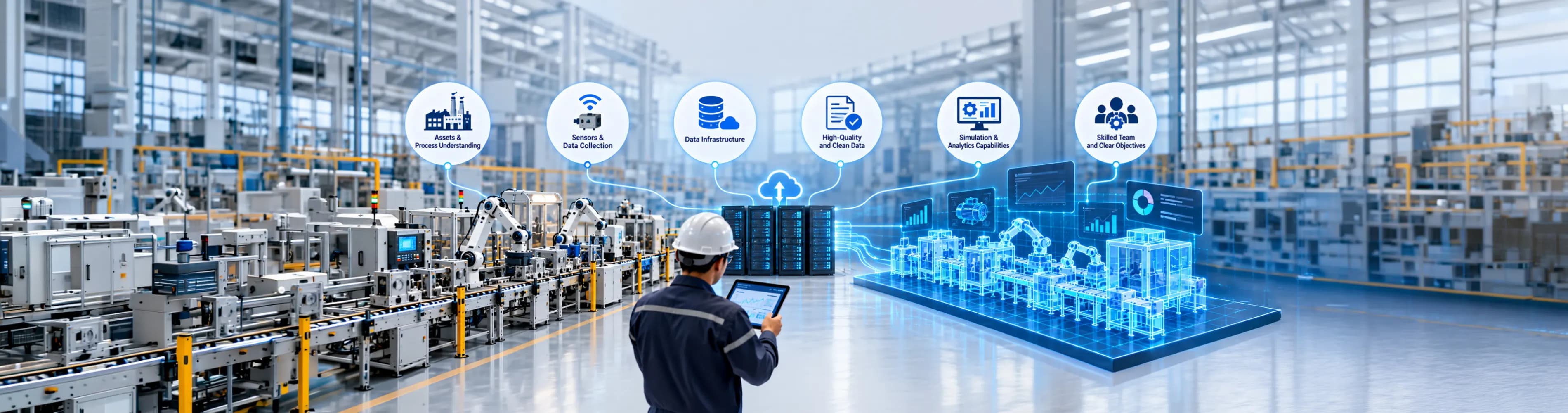
What manufacturers need before implementing digital twins
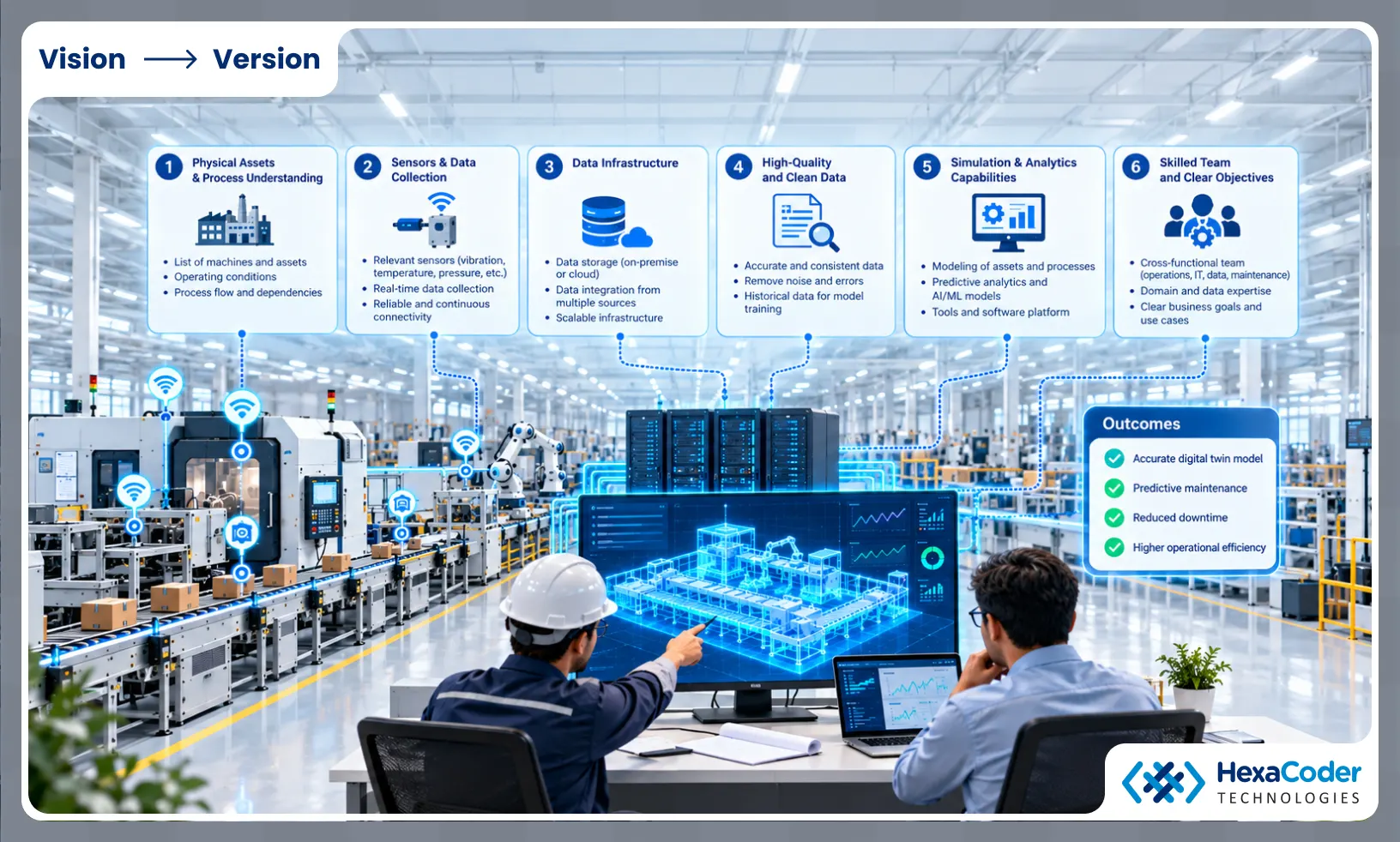
Digital twins certainly offer a lot of value, but it is only achievable with the proper underlying architecture in place.
Before investing in digital twin development, manufacturers should evaluate the following requirements.
Reliable sensor data
A monitoring system for equipment begins with sensors and data sources that are appropriate for the type of failure being investigated.
It is possible for faulty sensors, missing readings, or inconsistent data to weaken the model's reliability and cause misleading alerts.
Connected systems
A digital twin may require information to be exchanged with manufacturing execution systems (MES), enterprise resource planning systems (ERPs), and computerized maintenance management systems (CMMSs).
The integrations enable maintenance tasks, spare-part requests, and operational decisions to be made based on analytical findings.
Validated models
It is important to verify a digital twin's predictions against observed equipment behavior before relying on them to make crucial maintenance decisions.
Additionally, models should be evaluated periodically as equipment ages, operating conditions change, or new data become available.
Data security
Cybersecurity and access-control requirements are introduced by connecting operational technology and software platforms.
In addition to protecting equipment data and managing system permissions, manufacturers should account for the security risks associated with connected industrial infrastructure.
Measurable objectives
Start by identifying equipment where unexpected failures have a significant impact on production, safety, or finances.
A pilot program should start from a baseline of equipment availability, downtime, maintenance costs, and repair times.
If the technology produces reliable insights and sufficient operational value, it may be worth implementing on a larger scale.
Conclusion
In manufacturing, digital twins are transforming how equipment is monitored, faults are investigated, and maintenance plans are prepared. By connecting operational data with predictive models, they can improve production reliability and support earlier interventions. To succeed, they must have accurate information, validated technology, and maintenance teams that are capable of turning predictions into reality.
Frequently asked questions
What is a digital twin in predictive maintenance?
A digital twin models physical equipment using operational data to support monitoring and failure prediction.
How do digital twins improve predictive maintenance?
They combine equipment data with predictive models to identify faults and support maintenance planning.
Can digital twins prevent equipment failures?
They can identify potential problems early, but cannot guarantee that every failure will be prevented.
What equipment can use digital twin technology?
Digital twins can support motors, compressors, CNC machines, industrial robots, conveyors, and other manufacturing equipment.
Do digital twins require IoT sensors?
They require relevant equipment data, which may come from IoT sensors or existing control systems.