
The eyewear industry is undergoing fundamental changes to its business operations. People now prefer to shop for eyewear online because digital shopping has become more popular and customers demand easier ways to shop. The process of selling eyewear through digital channels proves to be extremely challenging because of its intricate nature. The final choice depends on multiple factors which include fit comfort, appearance, accuracy and personal style preferences.
The complex nature of eyewear products leads to difficulties for many eyewear brands because it results in low online sales rates and high product returns together with consumer uncertainty. As competition increases and customer expectations rise, eyewear configurators are becoming a critical driver of online sales performance rather than an optional enhancement.
The Challenge of Selling Eyewear Online
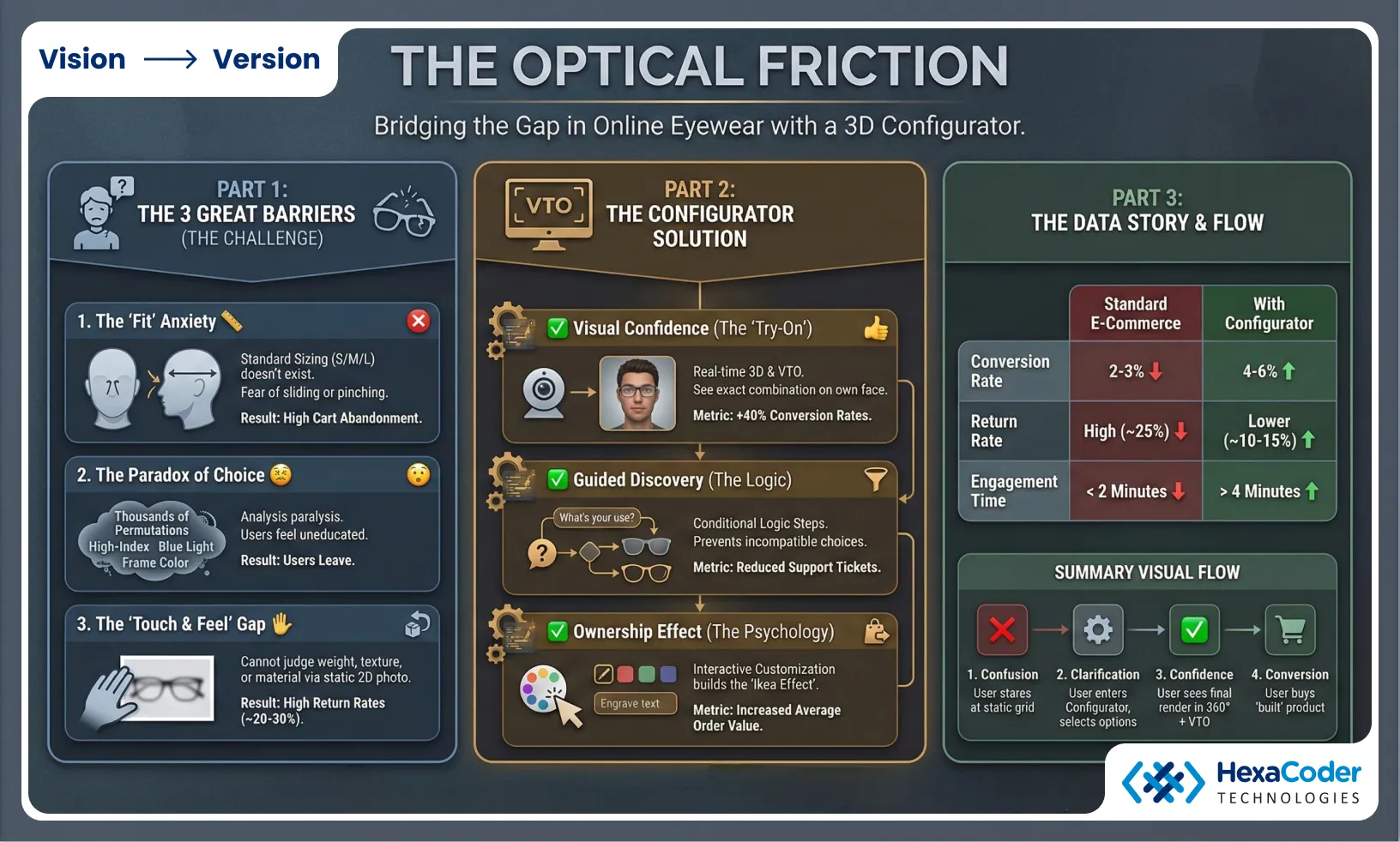
Customers use frame width and bridge fit and temple length and lens thickness and material to make their decision about which product to purchase. The slightest frame width change or bridge fit adjustment or temple length modification or lens thickness difference or material selection will lead to different wearing experiences. Customers use mirrors and opticians and trial sessions to evaluate these factors in physical stores.
The most common question online shoppers struggle to answer is simple but critical: how will these glasses actually look and feel on me?Customers need clear answers to their questions because they will either make their decision or stop comparing products or they will cancel their purchase. The eyewear brands experience decreased conversion rates because their customers hesitate to make purchases at their stores.
Directly following customer support transactions, retailers face increased danger because customers lack complete confidence in their products. Customers immediately become dissatisfied when the delivered product fails to meet their expectations. Prescription eyewear returns create high costs because customized lenses become unusable and cannot be resold. The business experiences dual impacts because financial losses and operational challenges create barriers that damage customer trust.
The absence of effective methods for online eyewear visualization and validation and personalization prevents digital sales from achieving stability. Customers use eyewear configurators to solve their product doubts which they can resolve through the system that provides clear guidance to support their buying choices.
What Makes Eyewear Configurators Different
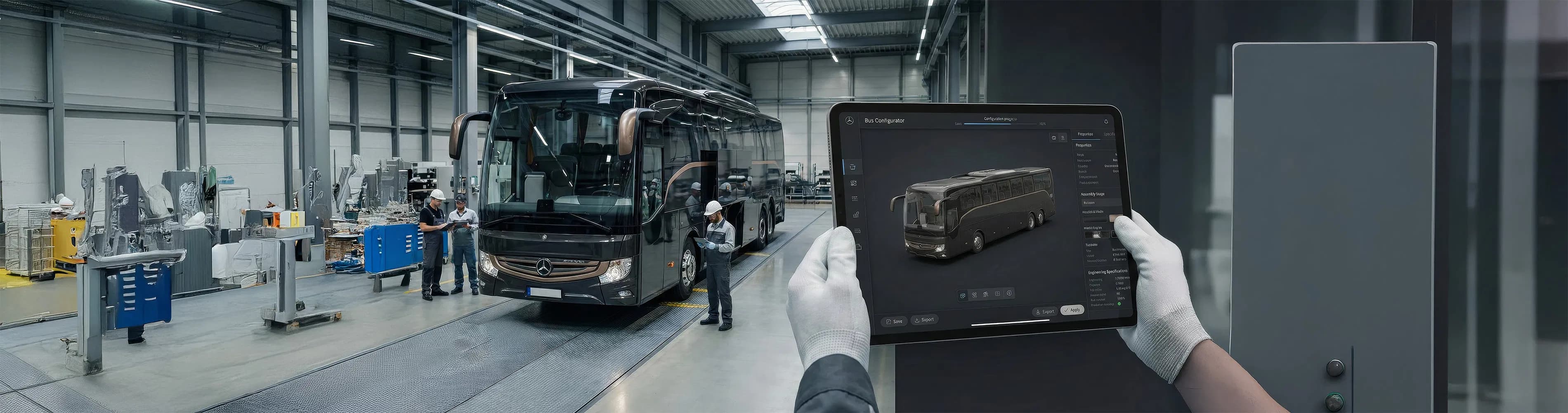
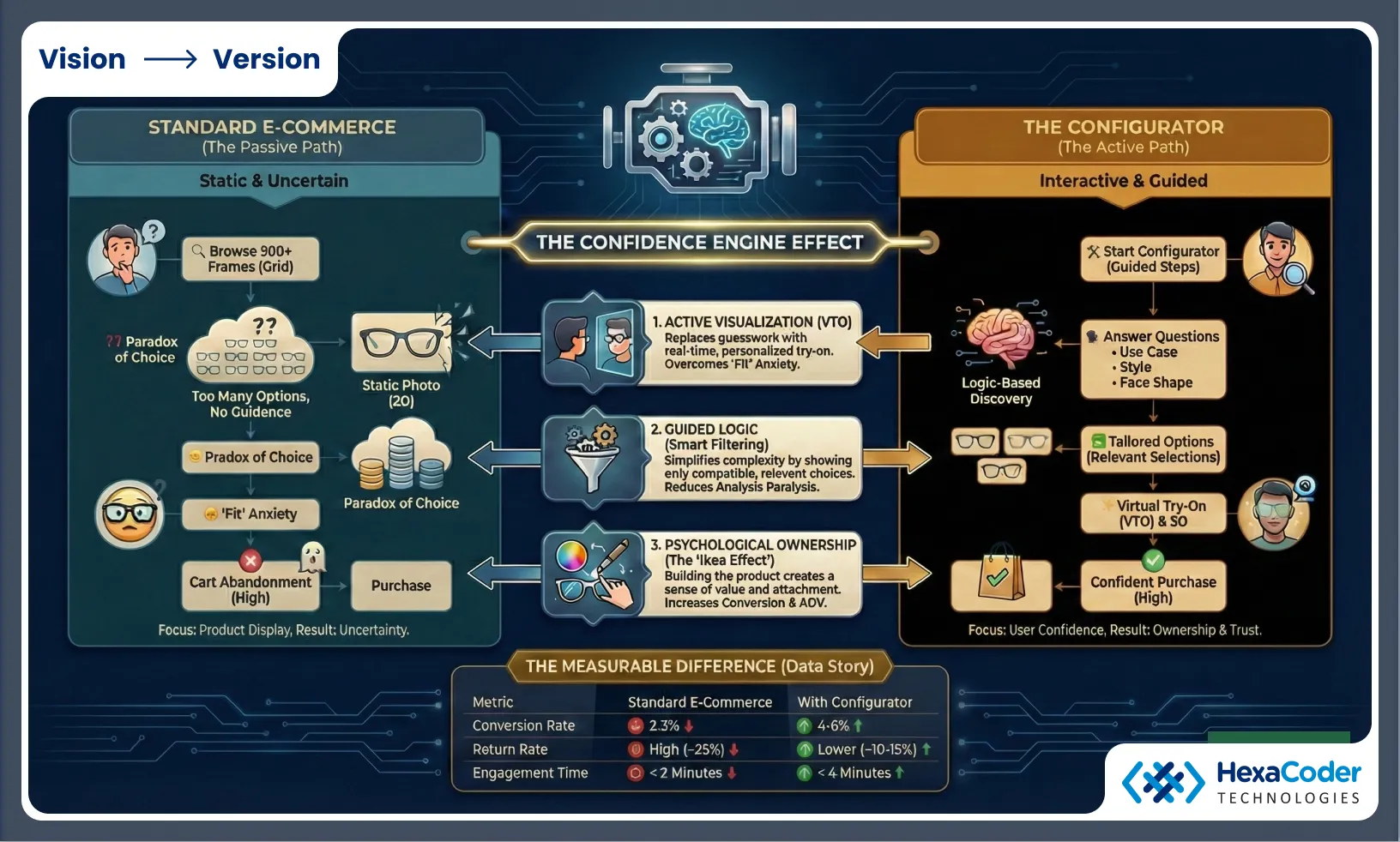
Eyewear configurators offer more advanced capabilities than simple product visualization and virtual try-on systems. The system serves as an interactive system which intelligently replicates the decision-making process that occurs during an in-store consultation in a digital format. The combination of 3D product models and real-time customization plus logic-based validation allows users to experience active exploration through static browsing.
The system shows customers the final product through realistic representations while allowing them to rotate frames and zoom into details and change colors and finishes and pick lens options. The visuals demonstrate dynamic response to user inputs which enables customers to see how their selections impact the complete appearance and construction of the eyewear.
The operational logic behind the interface represents the key element that distinguishes configurators from each other. The system generates configurations which adhere to the established rules for manufacturing and prescription requirements and legal compliance. The system prevents customers from creating combinations which violate technical requirements and compliance standards. The system automatically enforces all rules regarding frame and lens compatibility and prescription limits and material restrictions and pricing requirements.
The rule-based system guarantees that customers see during configuration exactly which products the company can create and deliver to them. The marketing visuals match the actual manufacturing operations without any discrepancies. All departments including sales and engineering and production use the same approved configuration information.
The combination of visualization with engineering logic and manufacturing restrictions enables eyewear configurators to remove all buying process uncertainty. The system functions especially well for online try-before-buy experiences because it needs both precise information and customer trust.
Building Confidence Through Visual Accuracy
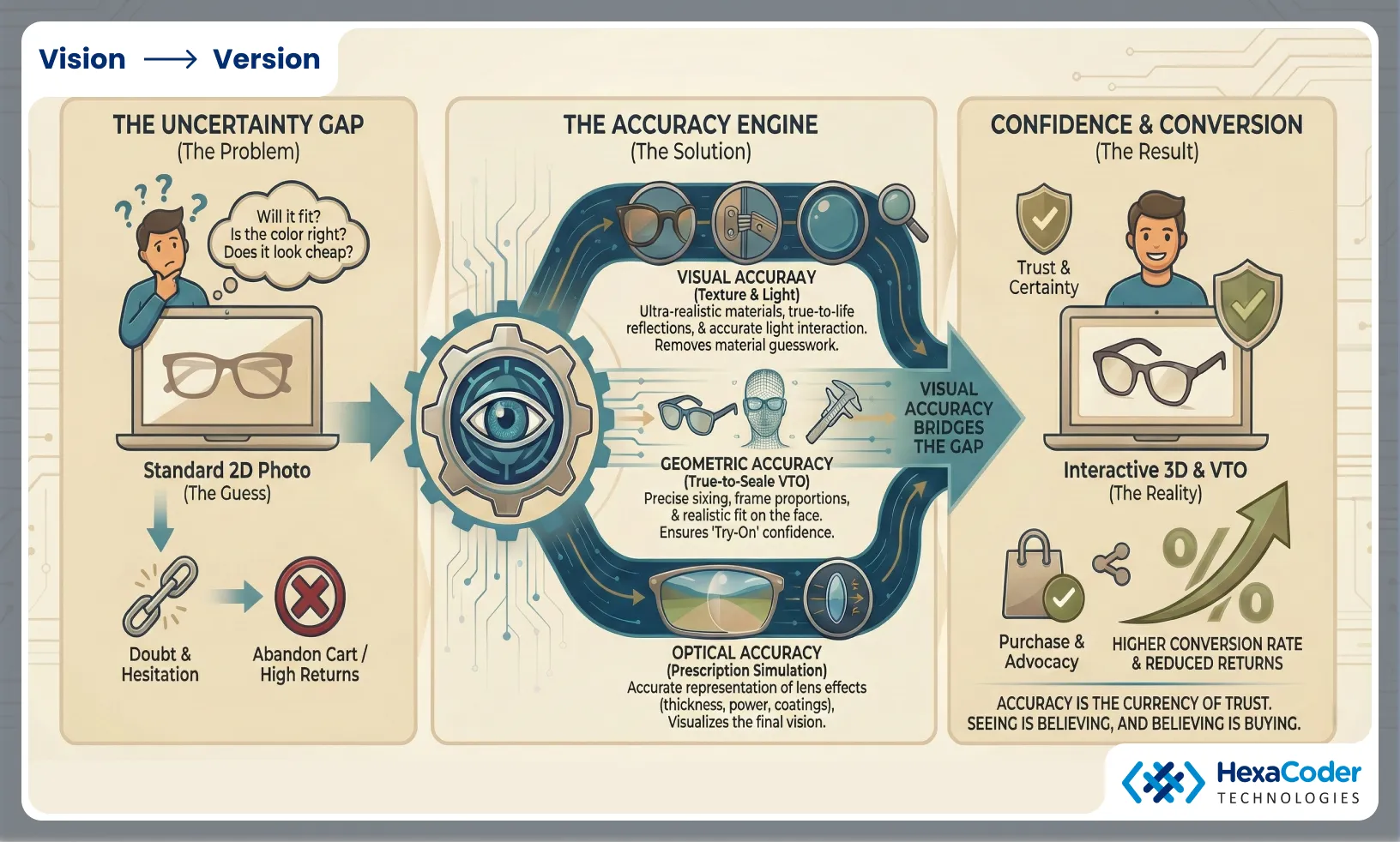
The process of online eyewear sales relies on customer confidence because this single aspect determines whether customers will make purchases. Customers are far more likely to complete a purchase when they clearly understand how a product will look, fit, and perform in real life. Visual accuracy plays a central role in building this confidence.
Eyewear configurators use true-to-scale 3D models that reflect actual product dimensions rather than idealized or stylized imagery. Customers can see how wide a frame is, how it sits on the face, and how proportions change based on design choices. The product creates this level of realism which ensures buyers will have the correct expectations from the beginning of their purchasing process.
Advanced configurators often integrate facial mapping and augmented reality, allowing customers to view frames on their own face using a camera or uploaded image. The addition of personal context results in better realism which enhances emotional connection with the material. Customers understand how their product will look and fit because they now experience it in real life.
The combination of lens visualization with existing systems produces improved results. Customers need clear information about high prescription lenses to avoid surprises because they will receive thicker or heavier lenses at delivery. The configurators create lens thickness and edge profile simulations through their use of prescription information together with frame design and lens material. The system creates trust through its open information access because it prevents users from facing unexpected outcomes. Through visual proof, eyewear configurators eliminate all uncertainty and fear which customers experience. Customers who receive complete product information experience greater confidence which results in higher conversion rates and better customer satisfaction before they receive their items.
Reducing Returns Through First-Time-Right Decisions
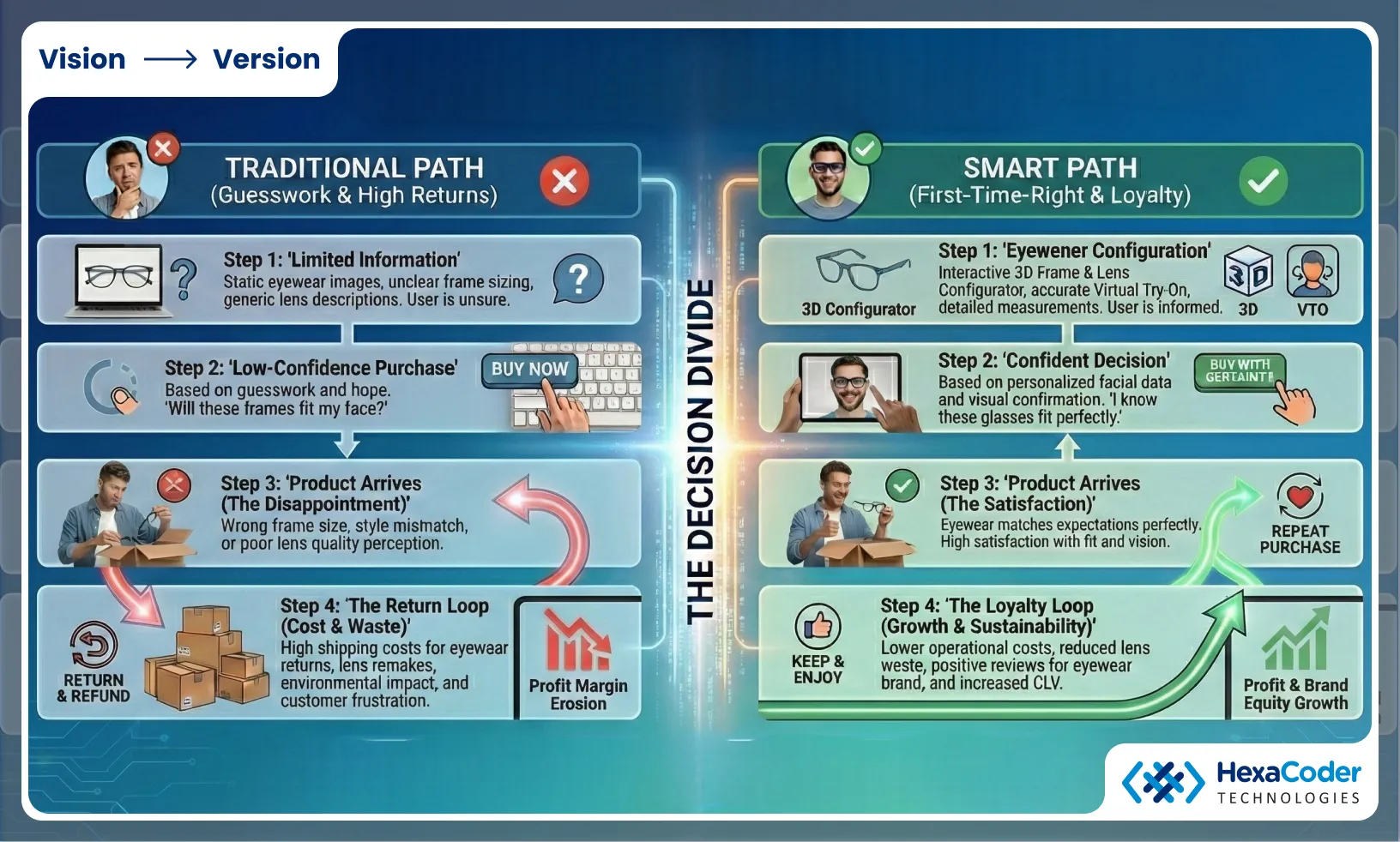
Returns represent a major financial expense for companies that operate eyewear e-commerce platforms. Customers return their eyewear products because they do not match their expectations about how the product will fit or feel or look or how the lenses will function. The problems become more expensive to resolve because they require special procedures that need to take place after the product reaches the customer.
Eyewear configurators reduce return rates by ensuring customers fully understand what they are ordering before purchase. The product configuration process allows customers to see and validate all product components which include frame size and color and finish and lens type and coatings and prescription compatibility. Customers are not guessing; they are approving a clearly defined outcome.
The system uses built-in rules to stop customers from creating invalid or unsuitable product combinations. Prescription users are directed toward options which match their prescription and usage requirements and frame selection. This reduces the risk of errors that would otherwise surface only after manufacturing or delivery.
Because configurators act as a single source of truth all stakeholders work from the same approved configuration. The production process replicates exactly what the customer confirms and pays for. The system alignment process leads to better first-time correct delivery rates and fewer post-delivery conflicts.
The organization experiences fewer product returns and lower rework expenses and less customer service work and higher customer satisfaction that lasts over time. For eyewear brands, configurators shift the focus from fixing problems after purchase to preventing them before they occur.
Personalization Without Manufacturing Complexity
People today want brands to provide customized experiences. Sales teams and manufacturing processes will face operational challenges when businesses try to deliver customized products to their customers at scale. Eyewear configurators enable brands to provide customers with customized product options which their customers can choose from established limits. The system allows customers to explore all potential options, but the backend rule engines restrict access to only valid configuration choices. The system automatically updates pricing based on customer product selections, which eliminates the need for manual calculation processes that can lead to mistakes.
This approach enables eyewear manufacturers to expand their product offerings without increasing operational risk. Businesses establish personalized experiences as an efficient and controlled method to deliver scalable services to their customers.
Bridging Online and In-Store Experiences
The function of eyewear configurators serves as an essential component for omnichannel retailing through their ability to create unified customer experiences that connect online and physical store operations. Customers increasingly move between online research and in-store consultations before making a purchase. The absence of continuous service leads to an experience which lacks seamlessness and creates difficulties for users. The process of eyewear configuration starts through online configurators which enable customers to save their chosen items and finish their order at a physical store with an optician. The same configuration data can be accessed across touchpoints which ensures consistency and reduces the need for multiple entries of information. Brands which operate through both online and offline channels use configurators to create a cohesive customer experience that builds brand trust and makes the purchasing process easier for shoppers.
Digital systems work as tools for handling prescription management which contains intricate elements. Prescription eyewear establishes limitations which standard e-commerce websites cannot manage successfully. Different prescriptions require different lens indices, thickness tolerances, and frame compatibilities. The need to comply with both safety and regulatory standards creates additional challenges for the process.
Advanced eyewear configurators manage these dependencies automatically. Customers receive assistance which helps them make prescription-compatible selections without needing to understand technical details. Visual feedback helps them understand trade-offs between aesthetics, weight, and cost.
This system enables manufacturers to reduce their need for manual inspections and post-order adjustments which results in confident digital growth of prescription eyewear sales.
Data Insights from Configuration Behavior
Every time customers use the eyewear configurator their behavior data is recorded as useful information. Brands can study which frames customers select most frequently and which points customers stop their configuration process and which product choices make them leave.
Manufacturers and retailers use these insights to improve their product designs and their pricing methods and their inventory management processes. The data collected from configurators develops into a crucial resource for making decisions about product development and market positioning.
Brands obtain insights into customer behavior and shopping preferences through their sales performance which enables them to understand customer behavior before customers finalize their purchases.
Enhancing Brand Perception and Trust
The digital experience quality establishes customer perceptions of an eyewear brand. A professional business shows technical skills through its precise configurator system which operates without faults.
Customers link product quality to reliable products when they see realistic images and can use simple customization features. The process establishes brand trust before customers receive their products.
In a competitive market where many eyewear brands offer similar designs experience quality becomes the main factor that distinguishes companies from their competitors.
Why Eyewear Configurators Are Becoming Essential
The limitations of static product pages become more obvious when online eyewear sales continue their upward trend. Customers expect experiences that match the complexity of the product they are buying.
Eyewear configurators fulfill this requirement through their interactive system which enables users to see products authenticate their identity and create customized solutions. The system helps businesses to decrease doubts which leads to better productivity and deeper customer connections.
The essential system for brands which want to expand their online sales while maintaining product quality and customer trust needs to be built through product configurators. The system functions as a fundamental business asset.
HexaCoders' Approach to Eyewear Configurators
HexaCoders treats eyewear configurators as operational systems because they serve functions beyond digital sales capabilities. The team builds configurators which show the actual design process and manufacturing methods and pricing strategies and distribution pathways of eyewear products. HexaCoders builds all configurators to function precisely with existing business systems by creating visually appealing interfaces which provide frontend access.
The core principle of this method is precision. HexaCoders creates configurators through the development of detailed 3D product models which accurately represent actual frame dimensions and materials. The models use rule-based configuration logic which determines valid options based on prescription limits and lens compatibility and frame specifications and coating choices and regulatory standards. The system guides customers through the process of creating valid and manufacturable designs starting from their initial contact with the system.
The system requires system integration as its second essential requirement. HexaCoders develops eyewear configurators that establish direct links to ERP systems and order management systems and pricing engines and production systems. The system transfers structured data to downstream workflows after a customer completes their configuration without requiring any manual data entry. The system reduces errors while it decreases order processing times and it maintains product consistency between online sales and factory production.
HexaCoders uses operational actualities to create configurator designs which enable eyewear brands to expand their online sales while maintaining product quality and operational efficiency and customer confidence.
Conclusion
The online eyewear market achieves success when customers possess confidence about their purchase and access complete information while maintaining decision-making authority. The process of selecting eyewear products demands precise measurement methods which must be personalized for each customer while establishing trust with the user. Customers make a dual choice because they select a specific design which they will use as their everyday vision aid. The absence of clear information creates a situation where people will experience difficulties making decisions.
Eyewear configurators solve the problem by providing customers with a precise experience which eliminates the need for uncertainty during their product selection process. The system enables customers to visualize their complete order through real-time customization which works with existing visual elements while applying predefined rules to confirm their selections. The system establishes trust before product delivery through its complete operation display.