

Introduction
Every furniture business faces the same problem: customers want more options, but adding options makes quoting slower, pricing less consistent, and orders easier to miscalculate in ways that are not apparent until they have already cost you time or margin. Specs are usually checked by hand by sales, estimates are double-checked by estimators, and quotes are often outdated before the customer has even finished reading them. A visual CPQ solves this problem by bringing configuration, pricing, and quoting together into one system. Buyers can watch the product as it changes in real time while rules dictate what's possible.
Here's the problem.
Furniture businesses do not have a quoting problem; they have a visibility problem. Nobody can see where time, accuracy, or margin is being lost until it appears in a production meeting.
Top 8 benefits of visual CPQ for furniture manufacturers
Here, we will discuss how visual CPQ (Configure, Price, Quote) can benefit furniture manufacturers and turn challenges into opportunities in the meantime.
Faster quote turnaround
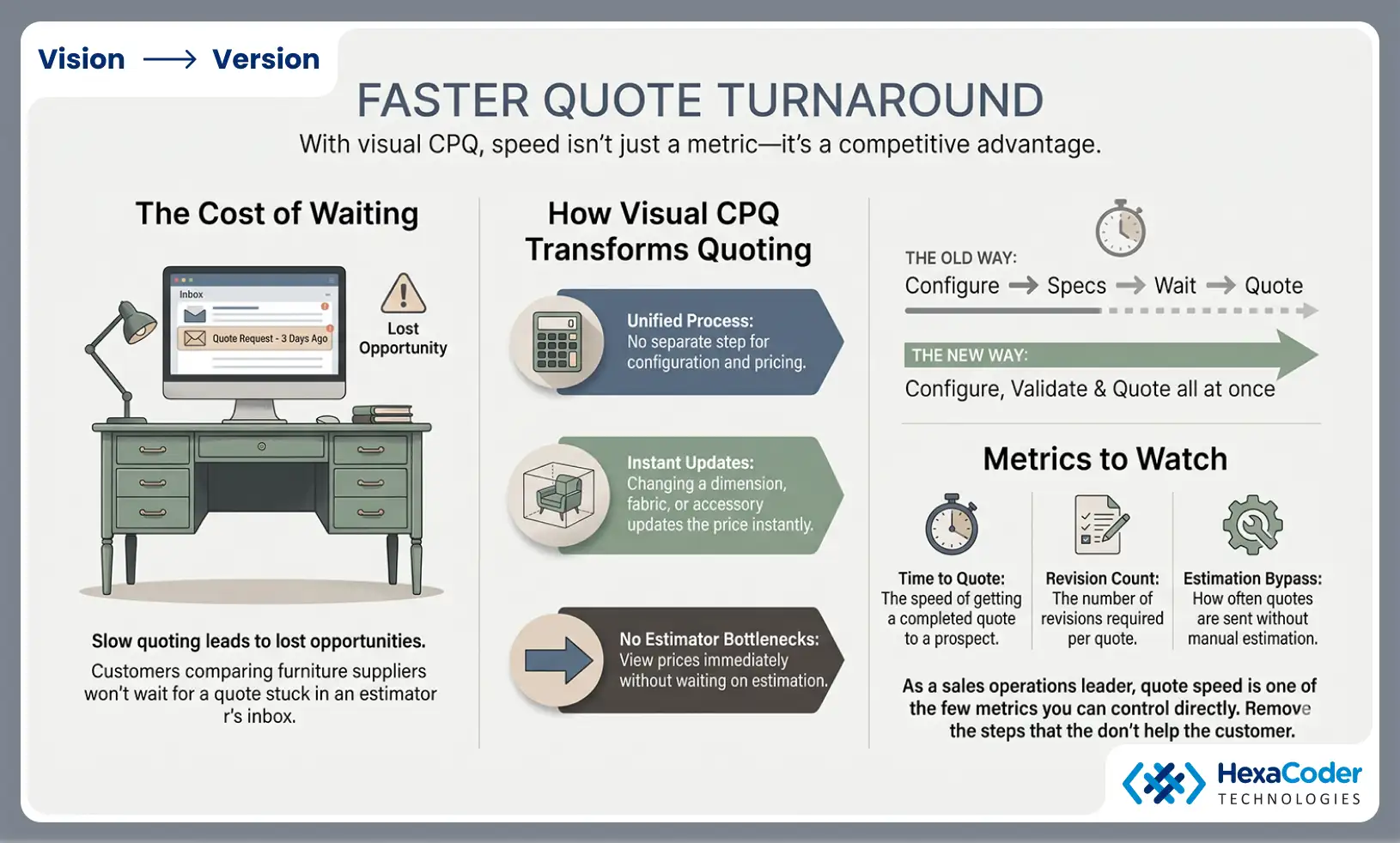
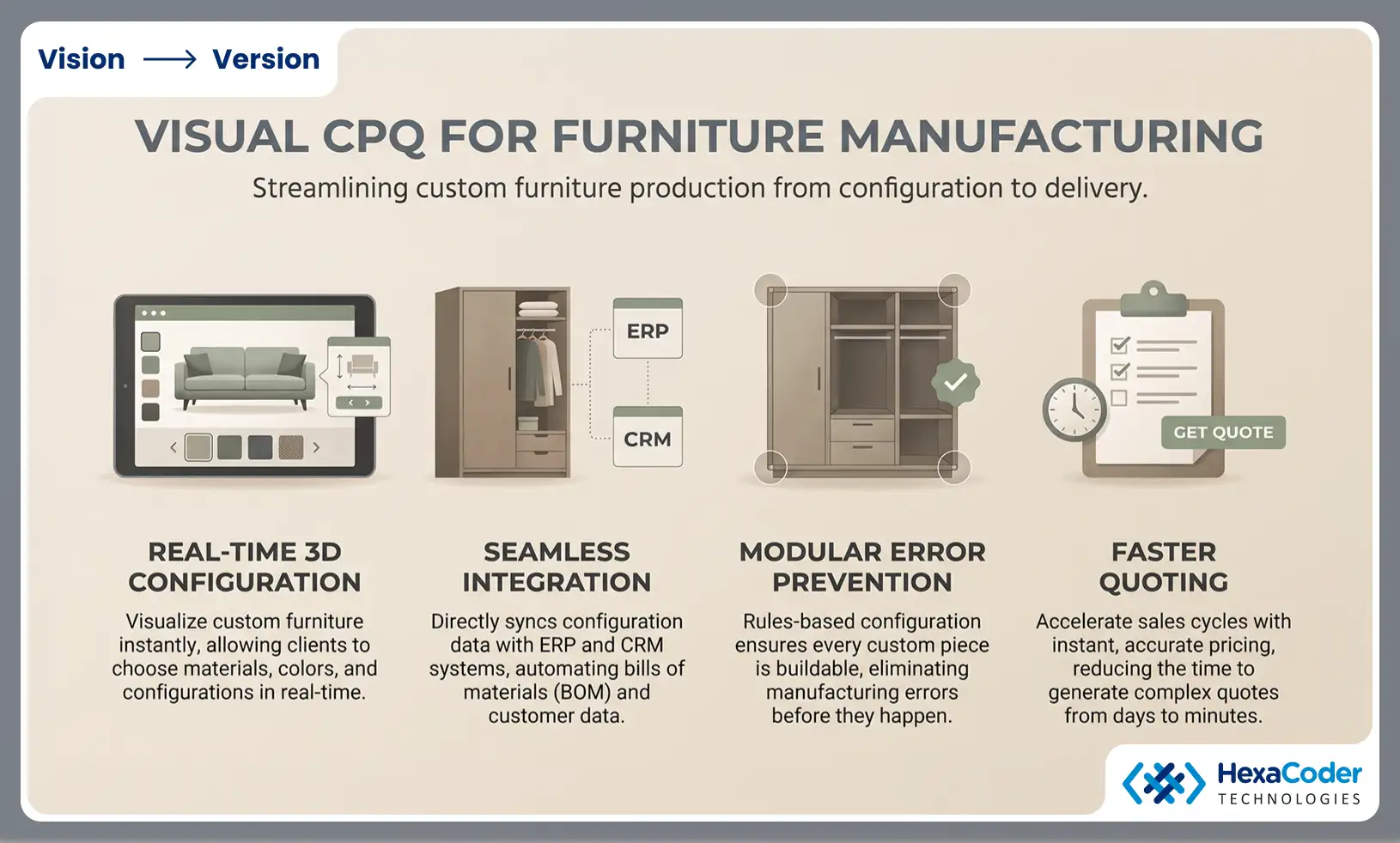
Slow quoting leads to lost opportunities, not just annoyance. You know how much of a loss it is when a quote sits in an estimator's inbox for three days. Customers don't have to wait around when they compare furniture suppliers.
Here's what you get with visual CPQ:
- There's no separate step for configuration and pricing.
- When you change a dimension, fabric, or accessory, the price updates instantly.
- There's no point in waiting on an estimator just to see a number.
Thus, the old configuration, specs, wait, quote process becomes configure, validate, quote all at once.
Here's what to track:
- Time it takes to get a quote
- Amount of revisions per quote
- How often do quotes go out without an estimator?
It's not just about speed, it's about removing steps that don't help the customer - which is exactly what furniture quoting automation is supposed to do.
As a sales operations leader, this is the metric you should watch most closely, since quote speed is one of the few you can control directly.
An increase in configuration and order accuracy
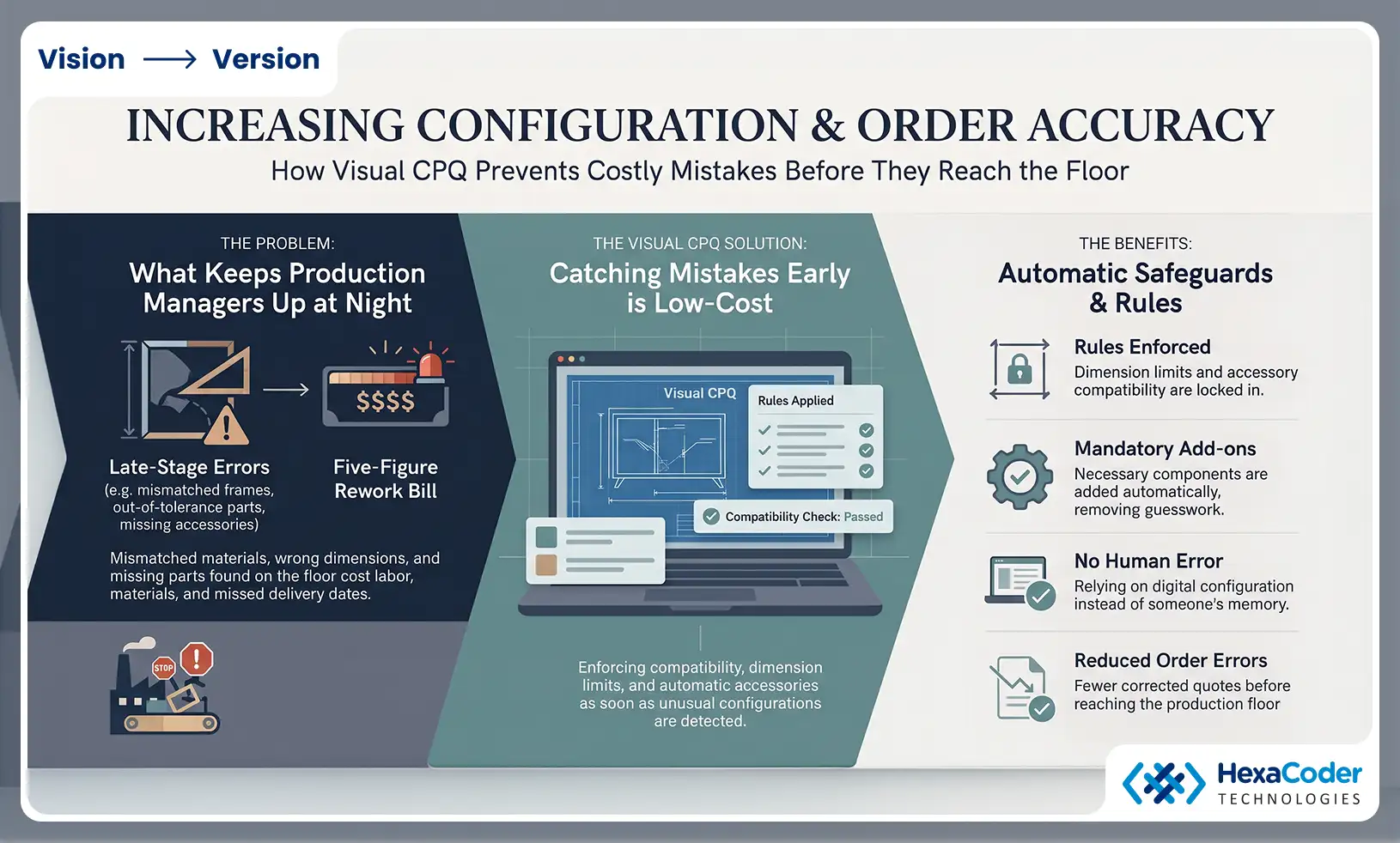
If you ask any production manager what keeps them up at night, "wrong specs that make it all the way to the floor" is usually at the top of the list. The cost of catching mistakes early is very low and the cost of catching them late is very high. For example, a mismatched frame and fabric, an out of tolerance dimension, and an accessory that needs a part nobody ordered.
During the build process, a single configuration error - i.e., a frame and mechanism combination that was overlooked can result in a five-figure rework bill once all material, labor, and a missed delivery date are added up. Those are not hypothetical numbers; they show up in a single production meeting and are remembered long after the quote that triggered them is forgotten.
Visual CPQ prevents incompatible combinations from being created in the first place. As soon as the system detects anything unusual, it flags it and enforces dimension limits, creates compatible accessories, and adds mandatory components automatically.
One of the easier benefits to prove is to reduce order errors before they reach production. Keep track of the number of quotes that needed to be corrected after implementation because of order errors. There is simply less room for error when configuration rules are stored inside the quoting tool instead of in someone's memory.
Better margin control and consistent pricing
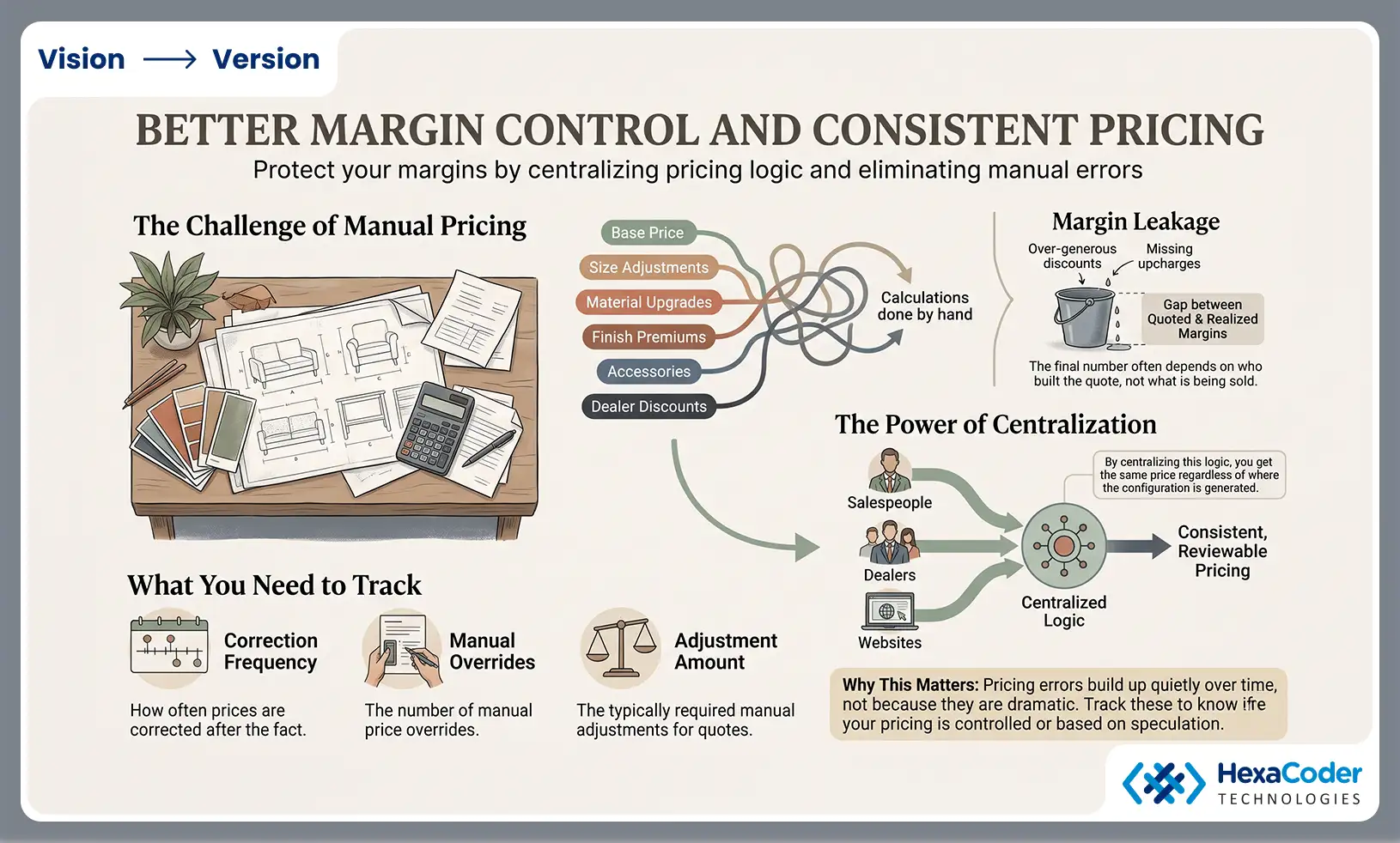
Furniture pricing involves many moving parts, such as base price, size adjustments, material upgrades, finish premiums, accessories, and dealer discounts. Calculations must be done by hand, and sometimes the final number is more dependent on who built the quote than what is actually being sold.
This is also where margin leakage occurs.
The discount was applied too generously. Some quotes were missing an upcharge at the end. Both are flagged at the same time.
No one can fully explain why they appear months later as a gap between quoted and realized margins.
By centralizing this logic, you can give the same price to salespeople, dealers, or your website regardless of where the configuration is generated. The best way to protect margins is to have consistent pricing, not because every quote gets cheaper, but because prices can be reviewed and adjusted rather than something you have to rely on.
What you need to track:
- The frequency with which prices are corrected after the fact
- The number of manual price overrides
- The amount of manual adjustment that is typically required for quotes
This allows you to determine whether pricing is controlled or based on speculation.
Most executives pay most attention to this metric because pricing errors build up quietly over time, not because they are dramatic.
Increasing sales capacity without hiring
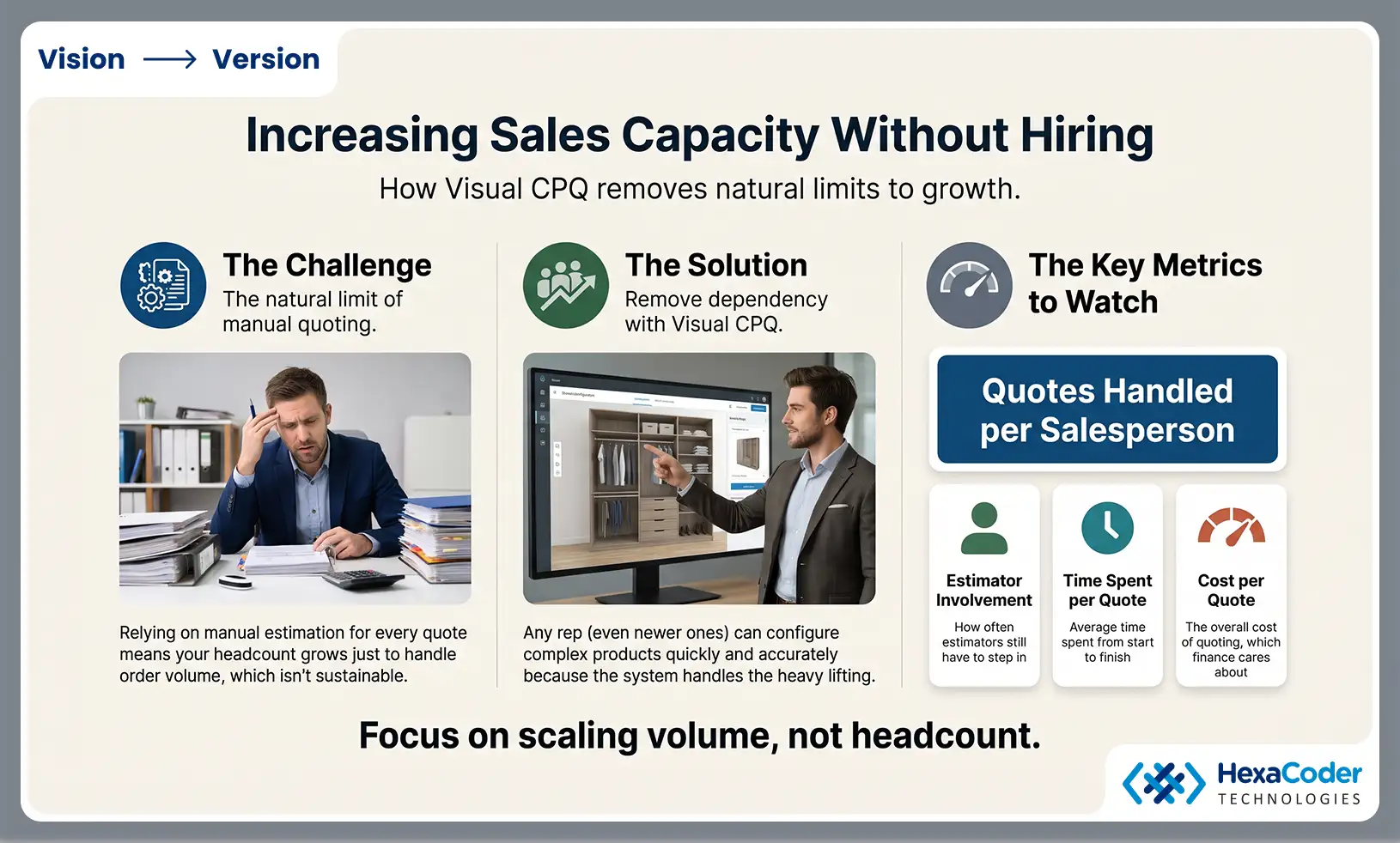
When every quote needs an experienced rep or estimator working through specs and pricing manually, there's a natural limit to how many quotes a team can produce. When a business grows, its headcount grows as well - more orders require more people to do the same manual labor, which isn't sustainable.
With Visual CPQ, that dependency is removed. When your platform allows it, reps can configure both standard and complex products using guided rules, rather than routing every calculation through another person. With the system, even newer and less experienced sales representatives can put together accurate and complete quotes, because the system handles the heavy lifting.
The most important number is quotes handled per salesperson.
Watch these too:
- How often do estimators still have to step in
- Average time spent on a quote
- Cost per quote overall - what finance cares about
When you track these, the discussion shifts from "how do we clear the backlog" to "how much more volume could this team handle right now" - which is a much better question, and one that doesn't require yet another round of hiring.
Better conversions and more buyer confidence
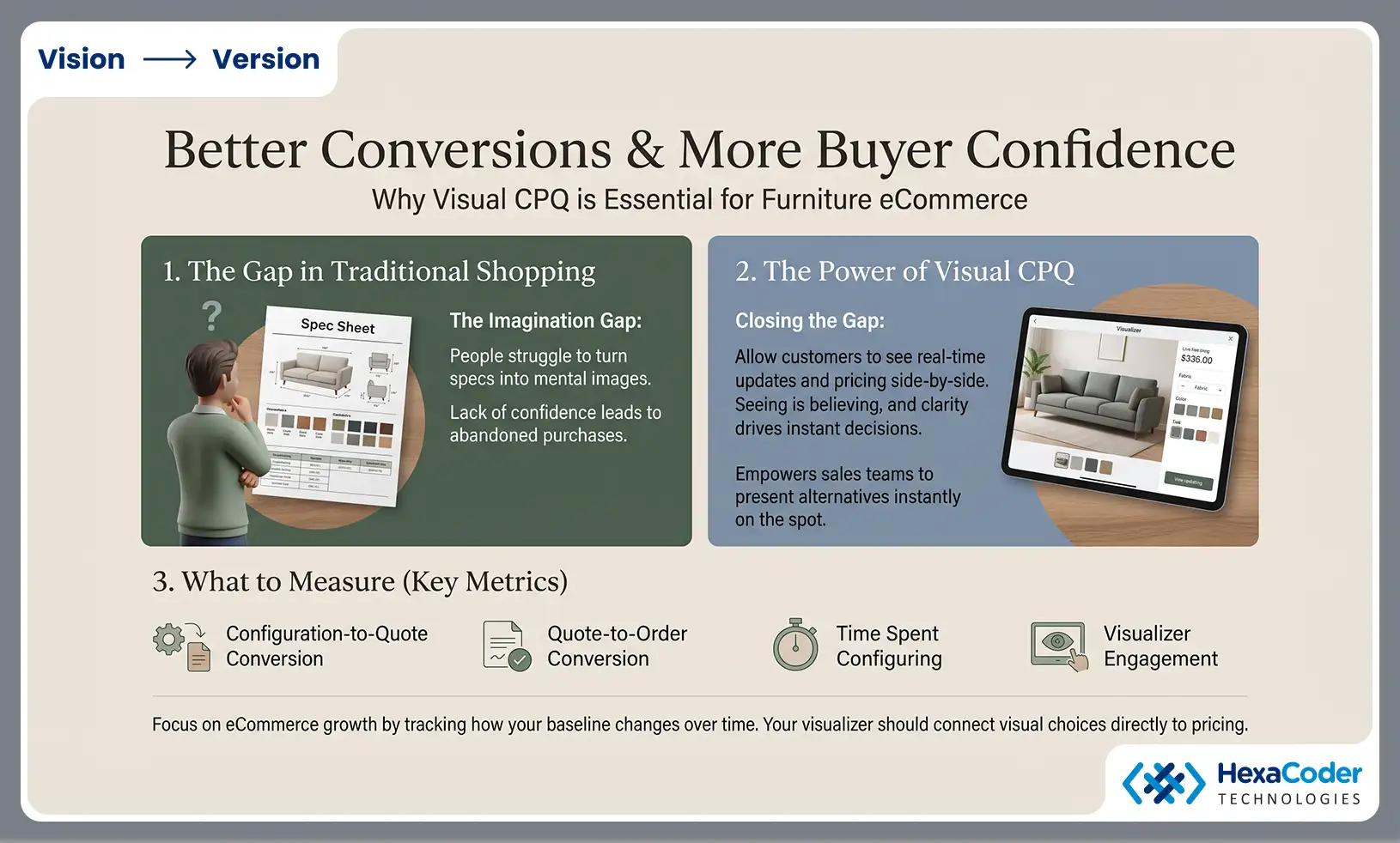
When it comes to furniture, people need to see it before they purchase it. Spec sheets list dimensions, fabric, and finish, but they don't show a customer how their choices will look together in their living room. The majority of people aren't good at translating specs into mental images, so when they're not confident about what they're getting, they walk away and look at other options.
The purpose of Visual CPQ is to close that gap by allowing customers to view product updates while making choices, along with pricing directly tied to what they're seeing. When people see something and know how much it costs at the same time, they're more likely to commit, since there is no gap between their imagination and what they get. Additionally, it makes it much easier for sales representatives to guide a hesitant customer by presenting alternatives on the spot rather than describing them.
eCommerce leaders should focus on these two numbers - configuration-to-quote conversion and average order value.
A few metrics worth measuring are configuration-to-quote conversions, quote-to-order conversions, the amount of time people spend configuring, and how often customers are actually using the visualizer. The configurator is not responsible for every conversion bump, so do not give it credit. You should measure against your own baseline rather than a number from someone else's case study since promotions, pricing changes, and traffic shifts can affect those numbers as well.
Automation of sales and production
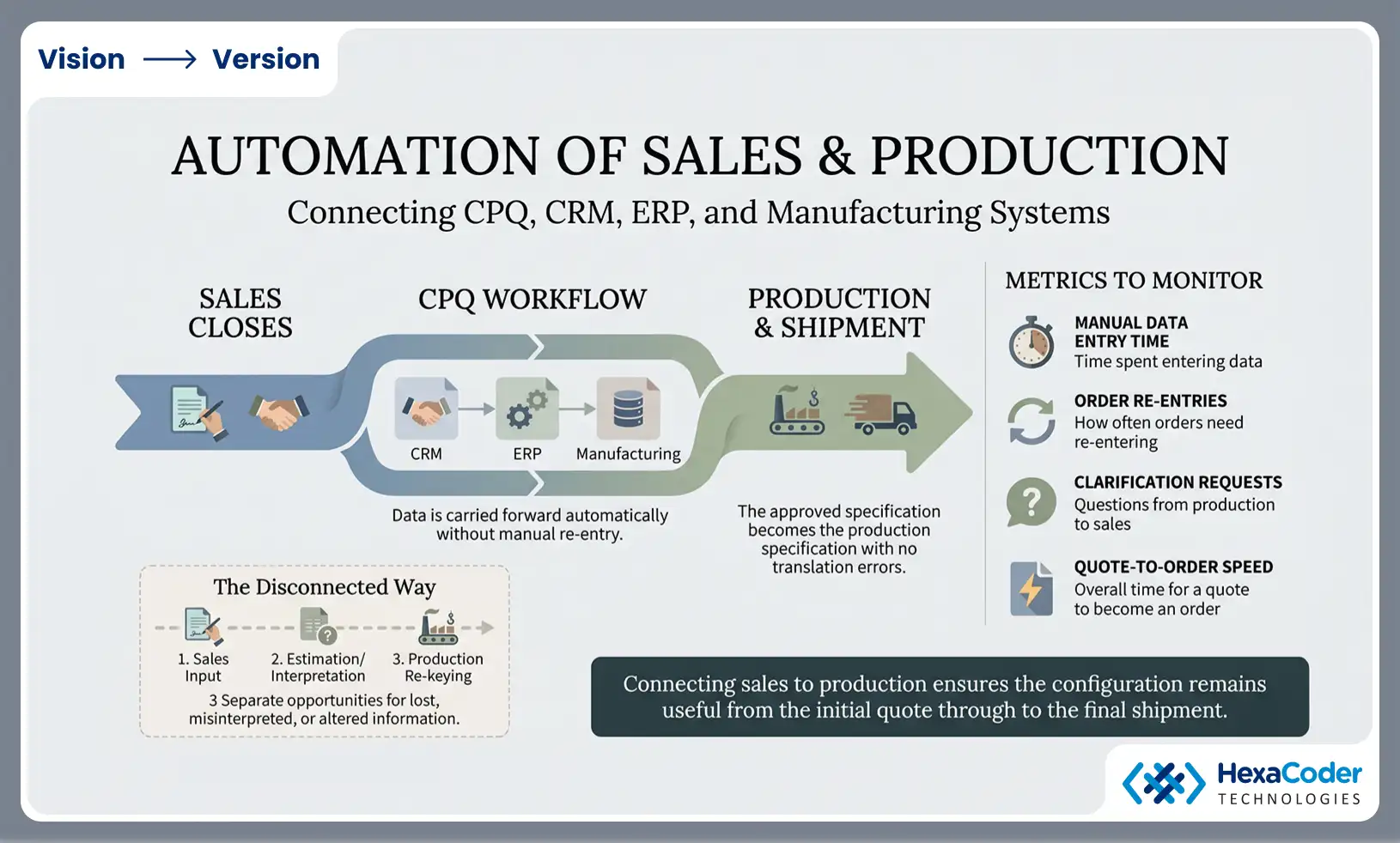
The closing of the sale is not the end of the process - it is only the point at which the configuration needs to become something that production can utilize. When sales enter details into one system, an estimator interprets them, and production re-keys everything elsewhere, you have created three separate opportunities for information to be lost, misinterpreted, or quietly altered.
With a connected CPQ workflow, configuration data is carried forward from ERP, CRM, and manufacturing systems without having to be re-entered manually. There is no translation, summarization, or reinterpretation between the specification approved by the customer and the specification used by production.
There are several metrics worth monitoring: the amount of time it takes for people to manually enter data, how often orders need to be re-entered, how many clarification requests production sends back to sales, and the overall time it takes for quotes to become orders. In the end, automating the front end of the sale will get you halfway there, but the real benefit will come when the configuration remains useful well after the quote has been signed, and will last right through to the shipment.
Increased sales across eCommerce and dealers
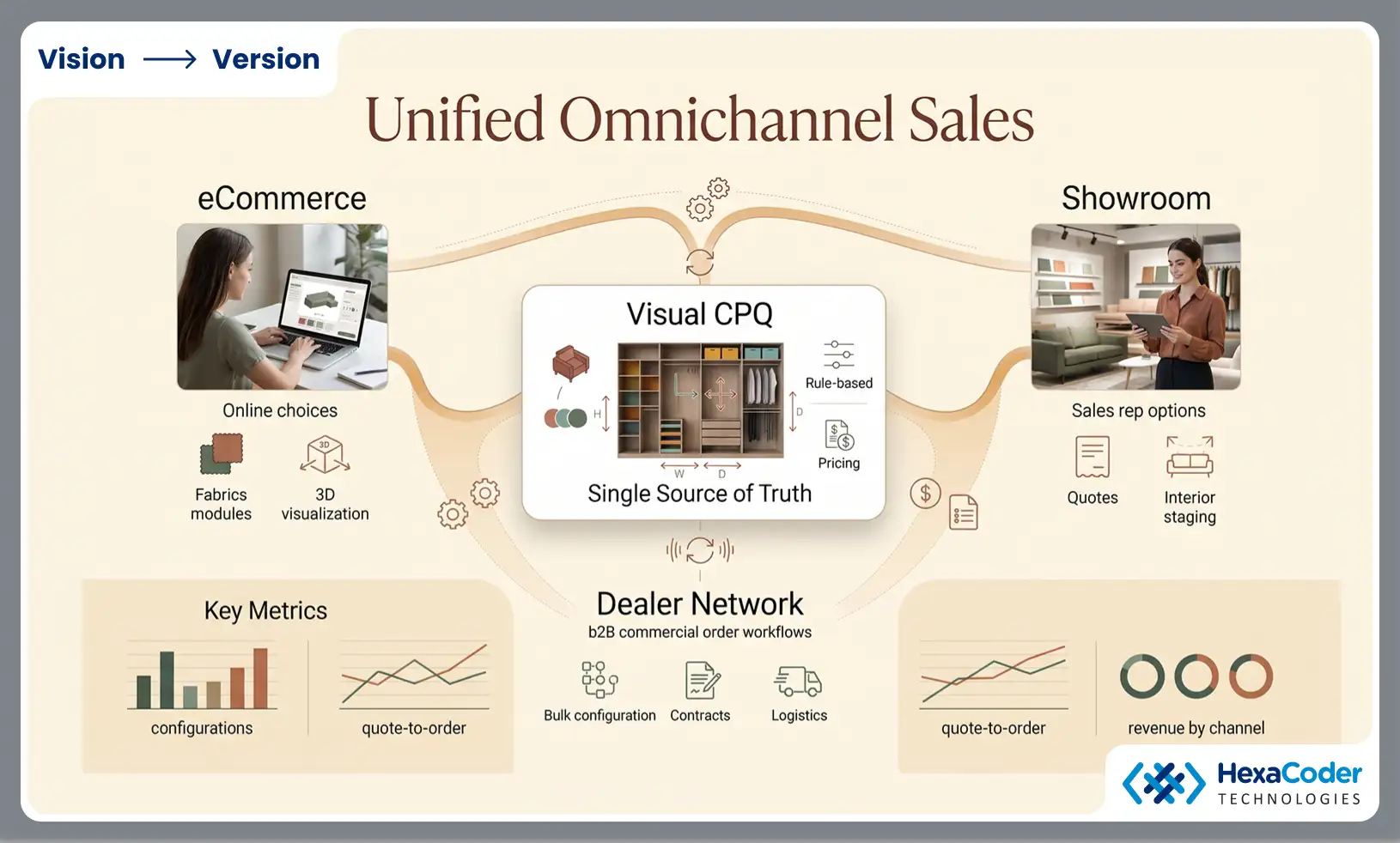
Today, most furniture businesses do not sell exclusively through one channel. It should not be necessary to rebuild your pricing logic three separate times if the same product is configured online by the customer, quoted in the showroom by the sales representative, and configured by the dealer for a commercial client. When each channel is run to its own rules and pricing sheet, aligning everything becomes a constant challenge, and inconsistencies between channels are soon noticed and complained about by customers.
A dealer quotes off an outdated price sheet for an entire quarter before finance notices the discrepancy, by which time it's a pattern, not an error.
With Visual CPQ, the same underlying rules apply to all channels, so customers, sales teams, and dealers can all work from the same underlying rules, regardless of the appearance of the user experience. When you make a change to a price or a rule, it will appear everywhere - online, in the showroom, and across your dealer network - without the need for anyone to manually sync the changes.
We recommend tracking configurations completed online, dealer-generated quotes, dealer quote-to-order conversion, self-service versus assisted sales, and revenue by channel. In terms of strategy, the advantage is straightforward - you get to add channels without multiplying your quoting processes, which is important as more furniture purchases are being made online.
Calculated ROI
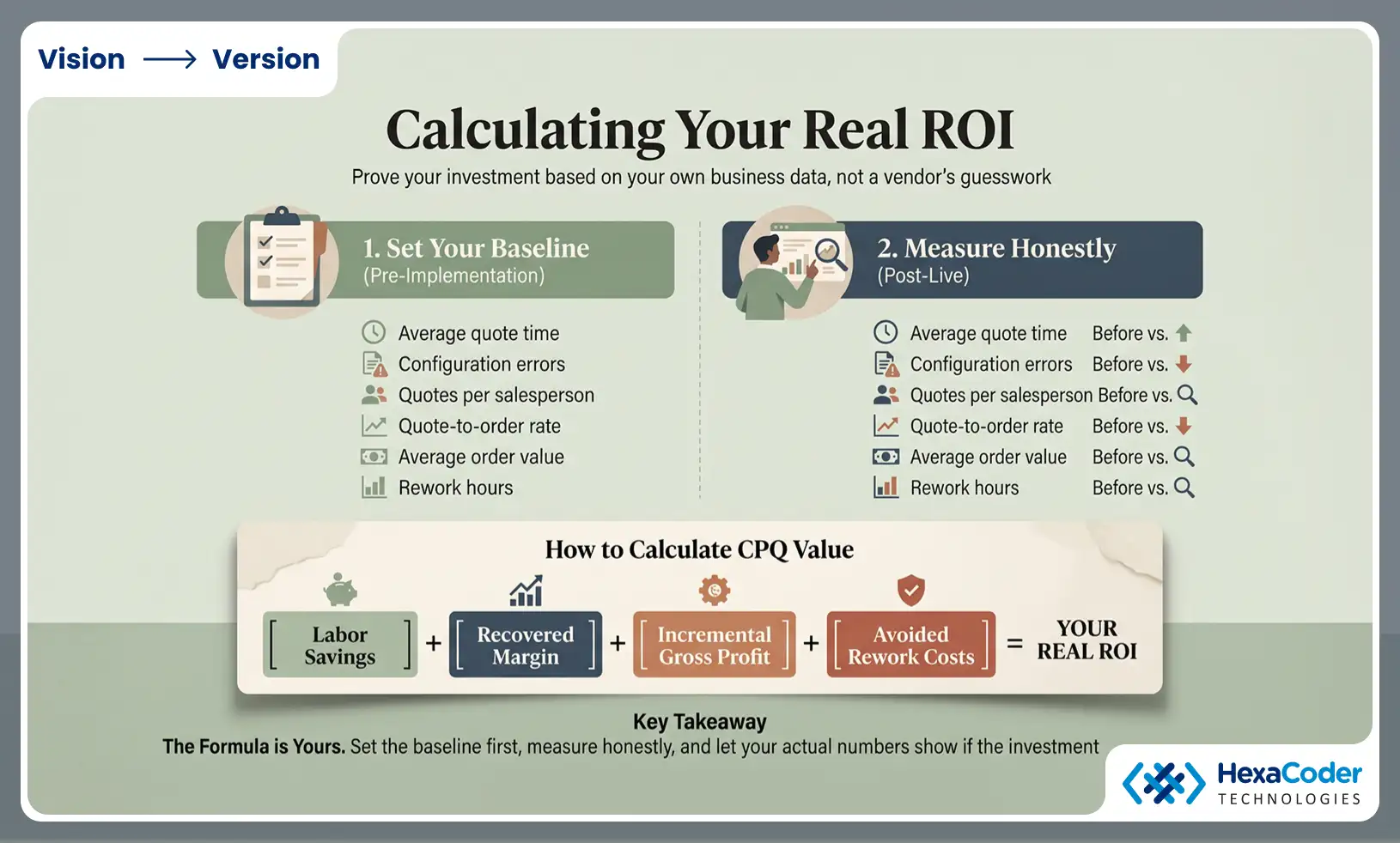
A final benefit ties everything together: proving the benefits of your investment, not just quoting a number from a vendor's presentation.
Anyone who gives you a flat ROI figure hasn't seen your quoting volume, your error rate, or your margins. In order to calculate furniture configurator ROI, you must start from your own baseline.
Before you begin implementation, identify your own baselines for average quote time, configuration errors, quotes per salesperson, quote-to-order rate, average order value, and rework hours. Once you go live, measure the same things again and you'll have a business case that's based on how your operation actually operates.
CPQ value is calculated by adding labor savings, recovered margin, incremental gross profit, and avoided rework costs together. For every business, the formula will vary depending on where the biggest inefficiencies are, but the principle remains the same - set the baseline first, then measure honestly, and let the numbers tell you if the investment was worthwhile.
Wrapping up!
All of these benefits work together - a faster quote isn't much use if it's still wrong, and fewer errors aren't much help if pricing is inconsistent. Visual CPQ is worth the investment because it integrates all of these steps into one workflow: configure, visualize, validate, price, quote, and hand off to production without having to retype all the information.
Furniture executives and sales operations managers shouldn't focus on the fact that customers enjoy spinning 3D sofas on screens. What matters is if the visual layer can actually improve the path from the first question to the profitable, buildable order, and whether you can prove it with your own numbers.
Discover how visual CPQ can transform your business
Interested in making your furniture quote process faster, more accurate, and more scalable?
Frequently asked questions
What is visual CPQ, and how does it differ from regular CPQ?
Visual CPQ is Configure, Price, Quote software that adds a real-time 3D or visual layer. Customers only see a spec sheet when using regular CPQ, since configuration rules and pricing logic are handled in the background. With Visual CPQ, customers can watch the actual product change as they select materials, finishes, and dimensions, while the same rules determine the price and validity.
2. Is visual CPQ compatible with ERP and CRM systems?
Yes, most visual CPQ platforms are built to integrate with ERP, CRM, and eCommerce systems. Configuration data can be imported directly into production and order management, so specs don't have to be manually re-entered at every stage. You can integrate your systems in different ways depending on the specific platform.
How long does it take for a furniture manufacturer to implement visual CPQ?
In general, implementation timelines vary based on the complexity of the catalog, the number of configuration rules, and the number of systems that need to be integrated. In most cases, a single product line with straightforward rules can be launched within a few weeks, whereas a full catalog with dealer networks and multiple integrations typically requires more time. The majority of vendors recommend starting with one product family and expanding from there.
Do small or mid-sized furniture manufacturers need to use visual CPQ?
It can be, especially for manufacturers who offer heavy customization, where manual quoting already takes up a lot of time. In most cases, you'll see the return in fewer configuration errors, faster quote turnarounds, and more consistent pricing - not just a nicer-looking tool. It's best to measure your own quoting time and error rate before comparing platform costs.
Is visual CPQ capable of handling highly customized or modular furniture products as well as standard products?
Yes, visual CPQ is generally designed to manage large numbers of material, finish, and dimension combinations that would be impossible to track manually. Modular furniture manufacturing often fails because of incompatible combinations (like a motor that doesn't fit a frame). The configuration rules prevent that from happening.