

Introduction
Traditionally, furniture, especially custom or semi-custom furniture, has been sold based on catalog photos, fabric swatches, and the salesperson’s ability to describe what the finished piece will look like.
The buyer says what he wants. A sales representative checks the availability of fabrics and finishes. Someone manually works out pricing. A quote comes back days later, and sometimes it needs a revision once production confirms what can actually be done.
That model is getting harder to maintain.
Furniture product lines have become more, not less configurable. Now, frame style, fabric, wood finish, dimensions and hardware interact in ways that are really hard to track by hand, let alone over a catalog that spans dozens of collections.
Visual CPQ for furniture manufacturing tackles this head on. A connected system takes a business from disconnected steps to a single, continuous quote-to-production flow where buyers can see a piece being built through a real 3D Product Configurator while validating, pricing and quoting it at the same time without routing every configuration through manual review.
For sales, operations and digital leaders in the furniture business the opportunity is even bigger. The right visual CPQ platform can shorten sales cycles, lower estimating overhead, avoid costly configuration errors and offer a scalable approach to selling an increasingly complex product catalog.
But not every platform offers the same value.
A basic 3D viewer could let a shopper spin a model around or change a color. A modern solution should be much more than that.
What is visual CPQ in furniture production?
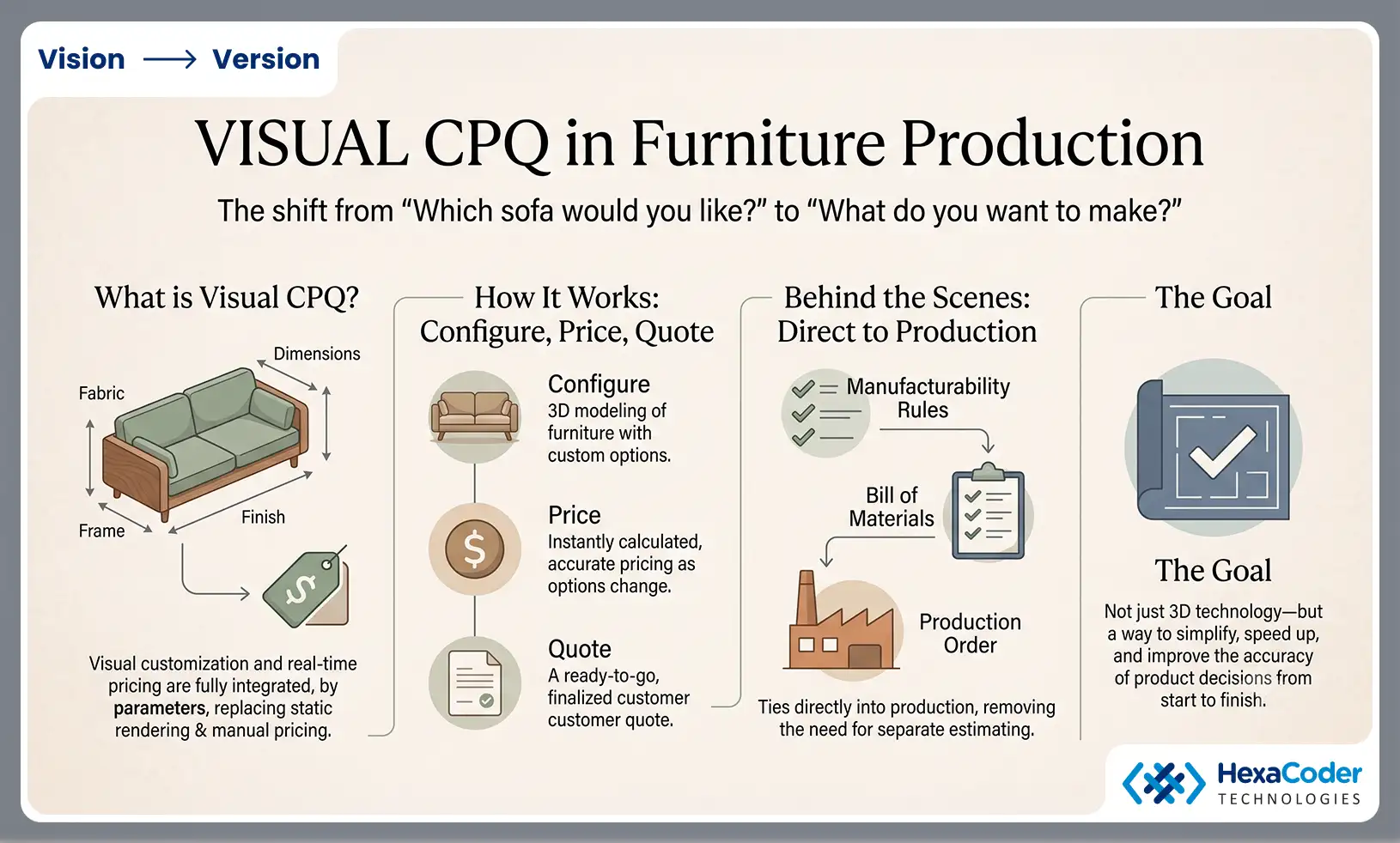
Visual CPQ brings together Configure Price Quote logic and a 3D furniture configurator, two things that have never been combined before.
Visual CPQ enables a buyer to configure a piece, fabric, frame, dimensions, finish and see the model and the price update together, instantly, rather than showing a buyer a static rendering and then routing pricing through a separate manual process.
This transforms the buying experience from: Which sofa would you like?
To: "What do you want to make?"
Behind that visual experience is a true furniture CPQ solution platform that applies manufacturability rules, calculates accurate pricing, and produces a bill of materials that ties directly into production, removing the need for a separate estimating step after the visual configuration is completed.
The goal isn't to blow buyers away with 3D technology.
The goal is to simplify, speed up and improve the accuracy of product decisions, from the initial configuration to the final production order.
How a 3D Furniture Configurator Integrates into CPQ
A 3D furniture configurator by itself is a visualization solution. It does not, by itself solve a quoting or production problem.
Buyers should be able to change fabric, frame style, wood finish, dimensions and hardware and see an accurate model update in real time.
But without the CPQ logic tied under it, that visual experience ends at the image. The buyer sees a nice rendering, then still has to wait for a separate quote, which might be generated by a totally different system or team.
Visual CPQ fills that void. The 3D furniture configurator and the pricing engine are connected by the same data beneath. So when the buyer makes a visual change, the price and the configuration record are updated at the same time.
This link lets a configuration go straight from customer exploration to quoting, approval and production without having to be reentered manually at each stage.
Rules-based Furniture Product Configuration
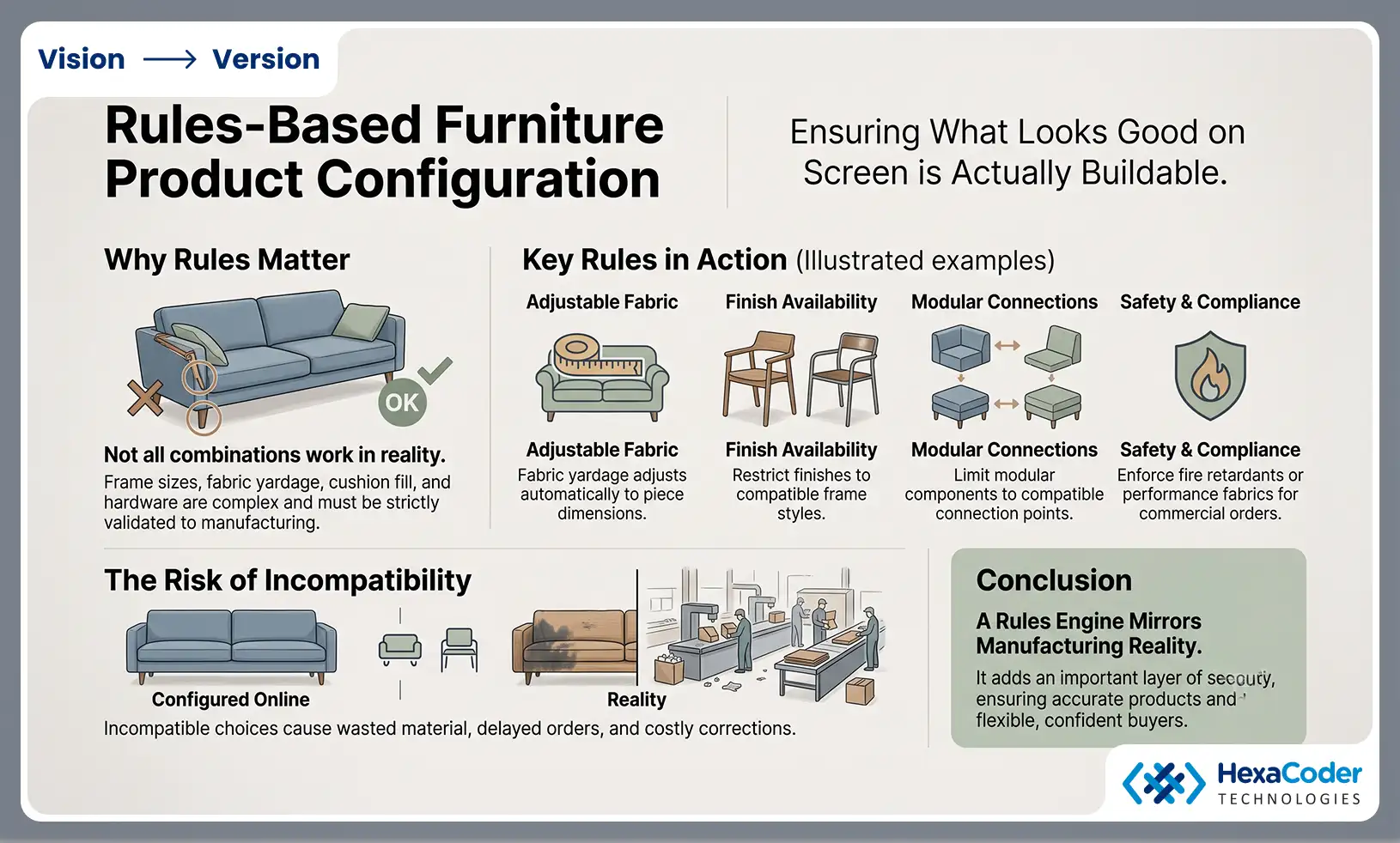
Furniture items are not simple single-variant products, especially in the upholstered and modular categories.
Frame sizes, fabric yardage, cushion fill and hardware all play off one another and not every combination is actually buildable within standard tolerances.
So, the Genuine Product configuration must set rules to determine the valid combinations.
For instance:
- Fabric yardage requirements can be automatically adjusted according to piece dimensions.
- Not all finishes are available on all frame styles.
- Modular components can be limited to compatible connection points.
- Can automatically prevent incompatible leg/arm/hardware combinations.
- Fire retardant or performance fabric can be required for commercial orders.
In evaluating a platform, furniture manufacturers should not only look at what the visual interface looks like, but whether the rules engine that drives it truly mirrors manufacturing reality, and not just what looks plausible on screen.
This is more important than you might at first think. Allowing a fabric and frame combination that is not compatible in a configurator creates not only an inconvenience, but the potential for wasted material, a delayed order or a costly correction after cutting and upholstery have begun.
This adds an important layer of security for a manufacturer. The business is accurate in product and manufacturing, and buyers are flexible.
Dynamic, Rules-Based Pricing
One of the biggest reasons furniture quoting remains manual for so long is pricing complexity.
The final number will depend on factors like fabric grade, wood species, dimensions and dealer-specific arrangements. All of this should be automated in a modern platform. There should be no need for a separate spreadsheet or manual lookup table.
Across same applies:
- Base frame and construction price
- Upgrades to fabric and finish
- Dimensional and customization surcharges
- Dealer and distributor discount levels
- Assembly & delivery add-ons
So pricing is no longer a manual bottleneck, but an automated, repeatable part of every quote regardless of which sales rep or dealer is involved.
Real Time Quote from Configuration
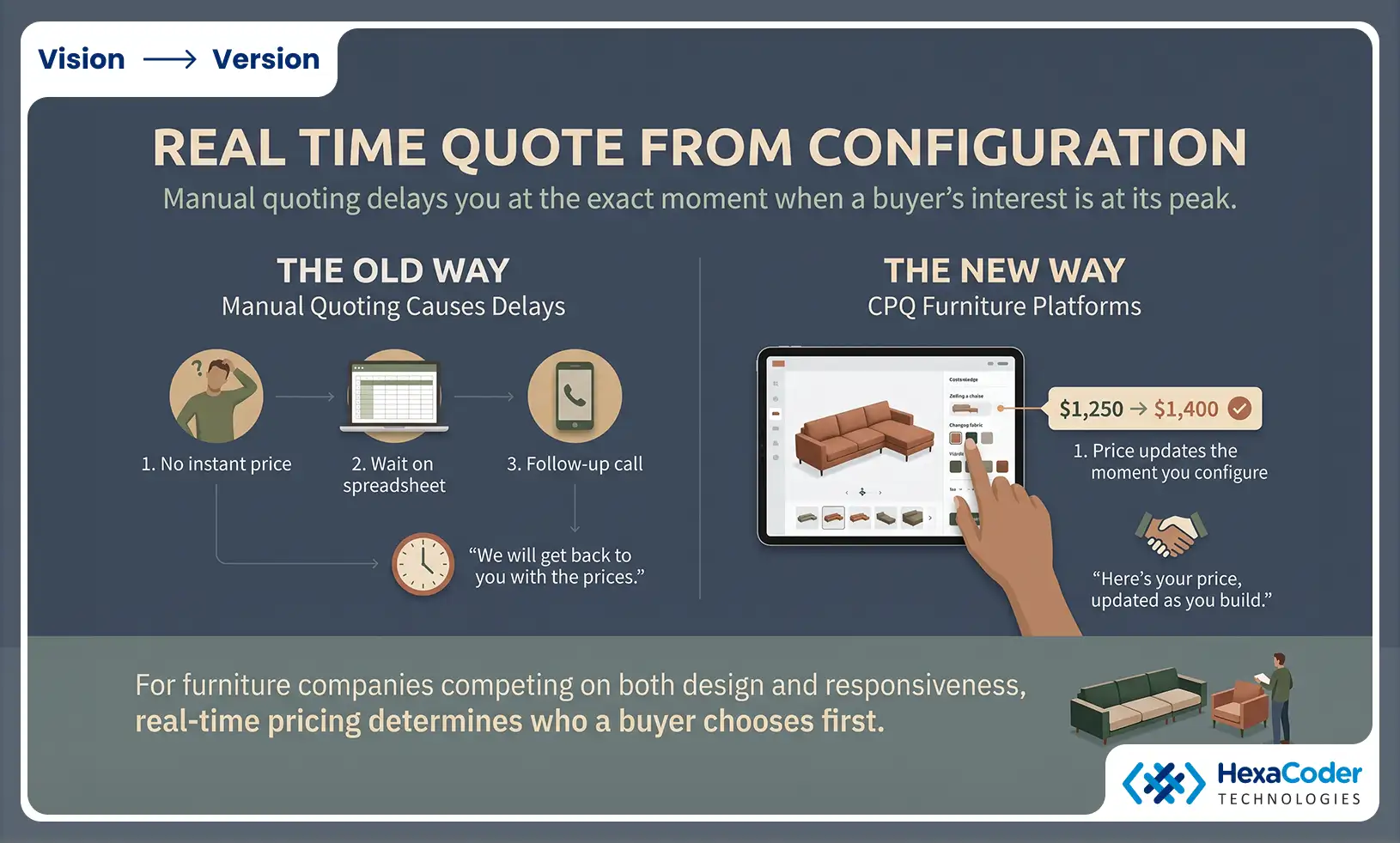
Manual quoting delays you at the exact moment when a buyer's interest is at its peak.
Configure price quote furniture platforms remove that delay by calculating pricing the moment a configuration changes, no separate estimating step, no waiting on a spreadsheet, no follow-up call just to confirm a number.
This changes the sales conversation from: “We will get back to you with the prices.”
To: "Here’s your price, updated as you build.”
For furniture companies competing on both design and responsiveness, that change alone often determines which manufacturer a buyer first chooses.
Precise Bill of Materials & Production Handoff
Visualization comes into its own. Adoption gains operational precision.
For a furniture manufacturer, one of the most valuable capabilities is to take a configured piece and convert it into usable production information.
What Can Visual CPQ Predict for Manufacturing?
| Component | Purpose |
|---|---|
| Fabric/Upholstery | Calculate yardage needed |
| Material of frame | Estimate structural needs |
| Foam and cushion stuffing | Find required quantity |
| Hardware & Fasteners | Identify your configuration needs |
| Finish & coating | Add finishing materials. |
| Package | Add fulfillment requirements |
That makes a sales conversation a production-ready order.
The correlation between quoting and estimating is very useful to manufacturers where a configuration must move from sales to cutting, upholstery and assembly without re-keying at each step.
Guided Selling for Sales Teams & Dealers
A sophisticated visual CPQ platform should be more than just a price calculator. It should lead the person writing the quote to a valid, sellable configuration.
Imagine a sales rep picking out a style of frame. The system should then immediately eliminate all available fabrics, finishes and hardware that are not compatible.
That means guided selling, not open-ended guesswork.
Instead of having to rely on a senior product specialist’s memory for each out-of-the-ordinary configuration, the system ensures accuracy behind the scenes, for every rep, on every quote.
This is especially true for expanding dealer networks. New sales staff can be trusted with accurate quotes from their first week on the job, rather than having to endure months of product training before they can be trusted with anything but the simplest configurations.
Integration with the Sales & Production Ecosystem
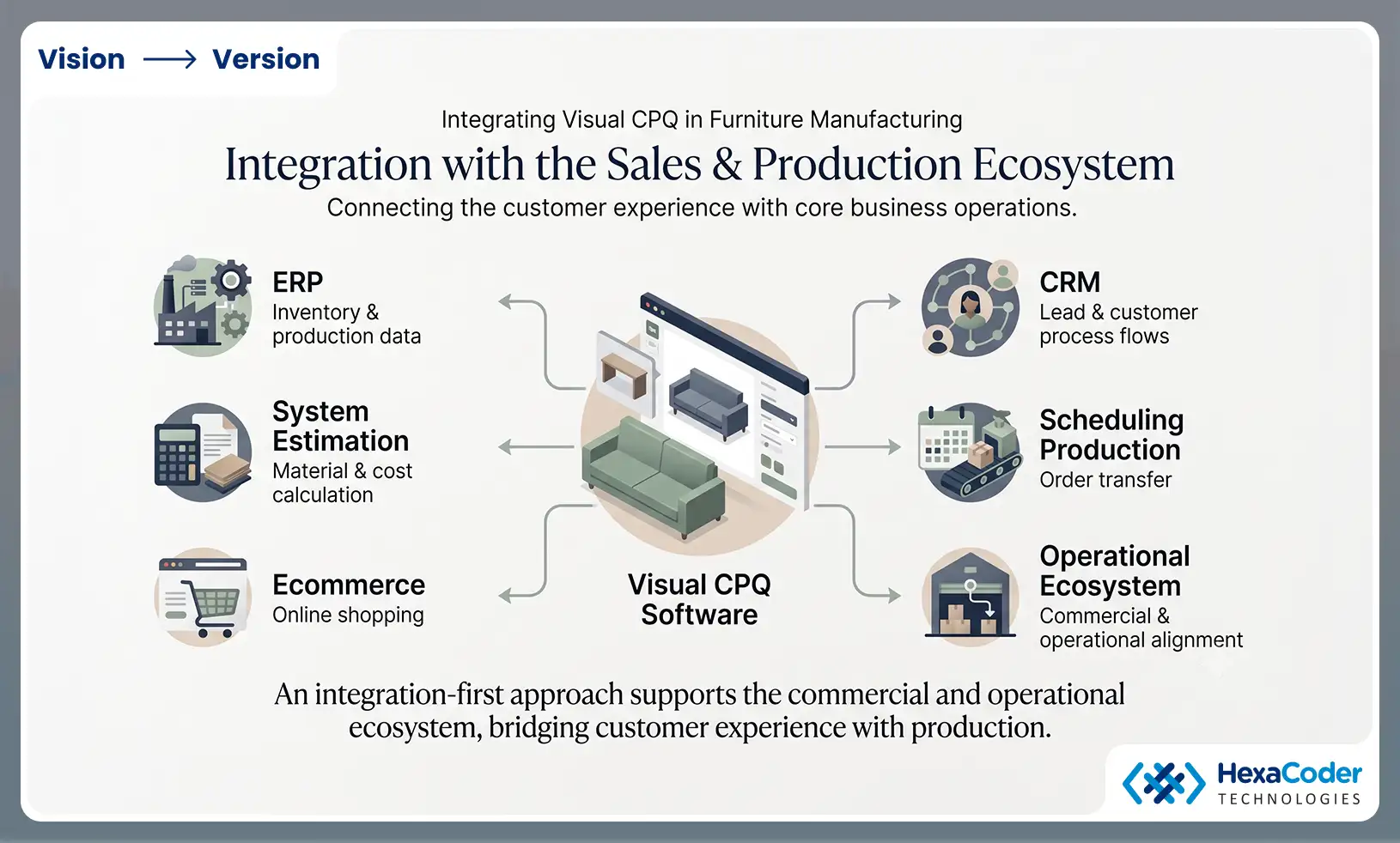
From an operations leader’s point of view, the last piece of visual CPQ may be the most important.
A configurator should not be another standalone digital tool.
It needs to be integrated into the existing business ecosystem and connect the customer experience with systems in sales, estimation, CRM, ERP and production planning.
What can furniture CPQ software integrate with?
| Integration | Supports |
|---|---|
| ERP | Inventory and production data |
| CRM | Lead and customer process flows |
| System estimation | Material and cost calculation |
| Scheduling production | Order transfer |
| Ecommerce | Shopping Online |
The integration-first approach is especially relevant for furniture manufacturers. The platform should be there to support the commercial and operational ecosystem, not be another disconnected front-end app.
What to Anticipate from Visual CPQ in Furniture Production
The biggest mistake is to judge platforms mostly by how they look.
A good configurator helps but it’s not enough.
Decision-makers should consider the platform in light of five broader questions:
- Will it really reflect our products? The system needs to include the dimensions, materials and rules that really make the manufacturer’s furniture line special, not some generic template designed for a totally different category.
- Self-configuration by buyers and dealers? The interface should be simple enough that the buyer can learn about a product on his or her own, without the help of sales staff, and reach a purchase decision armed with enough information.
- Can it handle our entire sales process? The platform needs to be able to take it from configuration to quoting to approval to production handoff. It shouldn’t stop at the visual step and leave everything after that to manual coordination.
- Can it grow with our catalog? Manufacturers often add collections, fabrics and finishes, and the platform should scale to that complexity instead of requiring a rebuild every time the catalog expands.
- Can it be incorporated into what we already use? A platform, which is disconnected from the ERP, CRM and production systems, replicates the same friction it was meant to take away, covertly reintroducing manual coordination in a different avatar.
A good evaluation step is to request a proof of concept based on the manufacturer’s own real product data, rather than a generic demo catalog. This tells us a lot more about how a platform will actually perform when faced with real complexity and real order volume.
Why This Matters to Owners and Leadership Teams
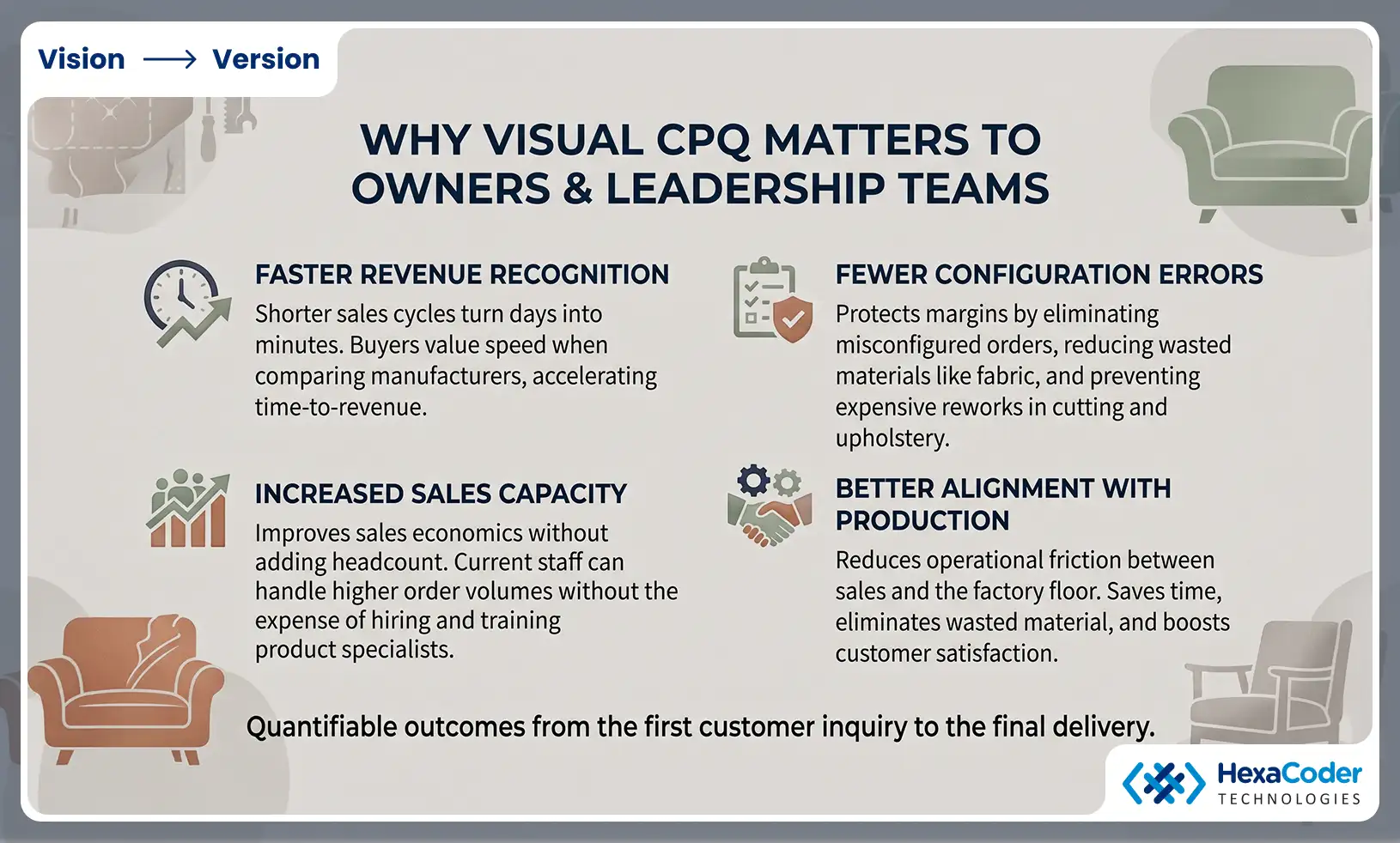
For visual CPQ, the case is often made in terms of outcomes that translate directly to performance for furniture business owners, sales leaders, and operations and digital leaders.
Faster revenue recognition due to shorter sales cycles, a quote that used to take days now takes minutes and buyers value speed especially when comparing multiple furniture manufacturers for the same order.
Fewer configuration errors protect margin Every misconfigured order, whether that’s a wasted fabric, a rejected order, or an expensive rework after cutting and upholstery have already begun, comes with real avoidable cost multiplied over a year’s worth of order volume.
By increasing sales capacity without adding headcount, the underlying economics of the sales organization improve as current staff can handle significantly higher volumes without the expense of hiring and training more product specialists.
And better alignment between sales and production reduces the operational friction that otherwise quietly erodes both customer satisfaction and factory efficiency, friction that is easy to underestimate until it is measured against lost time and wasted material.
None of these outcomes require a leap of faith. They are quantifiable and directly related to how the platform is deployed and utilized throughout the organization from the first customer inquiry to the last delivery.
The Strategic Opportunity Behind Visual CPQ
The future of furniture sales technology isn’t merely about faster quoting.
It's about connecting configuration, pricing and production into one seamless system.
For furniture manufacturers, that means the buyer and business journey may be like this:
Set Up → Validate → Price → Quote → Approve → Produce → Fulfill
A 3D furniture configurator for manufacturers can be the digital layer that connects those stages, instead of being just a visual tool that lives in a vacuum disconnected from everything that happens after a buyer hits “request quote.”
The business case is particularly strong when the platform is built around a manufacturer's real product architecture and production process, rather than an off-the-shelf visual gimmick.
The same technology can also support dealers, distributors and internal sales teams, providing a shared, accurate language on pricing and configuration across the entire business.
Conclusion
Furniture manufacturing is going to a faster, more precise, more connected sales process.
Buyers want to see and trust exactly what they are ordering, not have to imagine it from a swatch and a catalog photo.
Sales teams and dealers want tools that allow them to quote with confidence, without having to escalate every configuration question.
Manufacturers need a scalable way to sell a more and more complex customizable catalog.
And owners and leadership teams want technology investments that deliver measurable business outcomes, not just a more modern looking configurator.
When a true 3D furniture configurator is integrated with real-time configuration, rule-based validation, dynamic pricing and production integration in a single, connected quote-to-production system, Visual CPQ software for furniture manufacturers can address all of these requirements.