

What Are the Top Features Every 3D Configurator Should Have?
Initially, brands are attracted to 3D configurators as a tool to make their product pages look better, to become more visually appealing and interactive. This is an overly simplified perception of what this technology actually implies.
The fact of the matter is that a 3D configurator is not just a design element. It is a decision framework.
It serves as the link between discovering a product and purchasing it. It is the place where ambiguity is either resolved or magnified. In the age of eCommerce, where websites like Shopify are becoming the norm and competition is tough, this distinction is key to performance.
Today’s customers do not need more choices. They need clarity. Pictures, even though highly realistic, cannot convey everything there is about products that have many variations. As soon as personalization comes into play – be it customizing colors, materials, size, or configuration, the gap between the two becomes hard to ignore.
This is where hesitance exists. Hesitance is why people don’t convert.
A good 3D configurator gets rid of that gap. It transforms imagination into interaction. Rather than having consumers imagine the end-product, it gives them the ability to assemble their custom creation and view it in full detail right away.
However, some configurators aren’t able to accomplish this.
What sets an effective configuration tool apart from an aesthetic one is the combination of features and architecture within it, as well as behavioral design principles.
We at Hexacoder Technologies see 3D configurators as commerce tools, not visuals. Everything we do centers around eliminating any potential friction between intent and action.
Real-Time Interaction That Feels Instant, Not Processed

The first thing that users expect from a configurator is neither complexity nor details. Users expect responsiveness.
Every action that users take in relation to a configurator should have an almost instant effect. Changing color schemes, choosing different materials, or altering parts of the configuration process should happen in real time without any delays.
This is about more than just performance. This is a psychological need.
The faster response times will make users feel like they're in control. They'll try out things freely and explore all the options that a configurator offers. But mostly, responsiveness allows users to spend more time using the configurator. As soon as there's a delay, their feeling of being in control diminishes. The configurator starts feeling like regular software and less like the product itself.
On Shopify, where the vast majority of visitors use mobile devices and different Internet connection speeds, responsiveness is crucial. A configurator that runs well only on a desktop and high-speed connections can never be used in production.
That's what often fails unnoticed about a lot of configurators. They might be sophisticated but they will simply crash in real world usage.
Seamless Integration Into the Shopify Experience
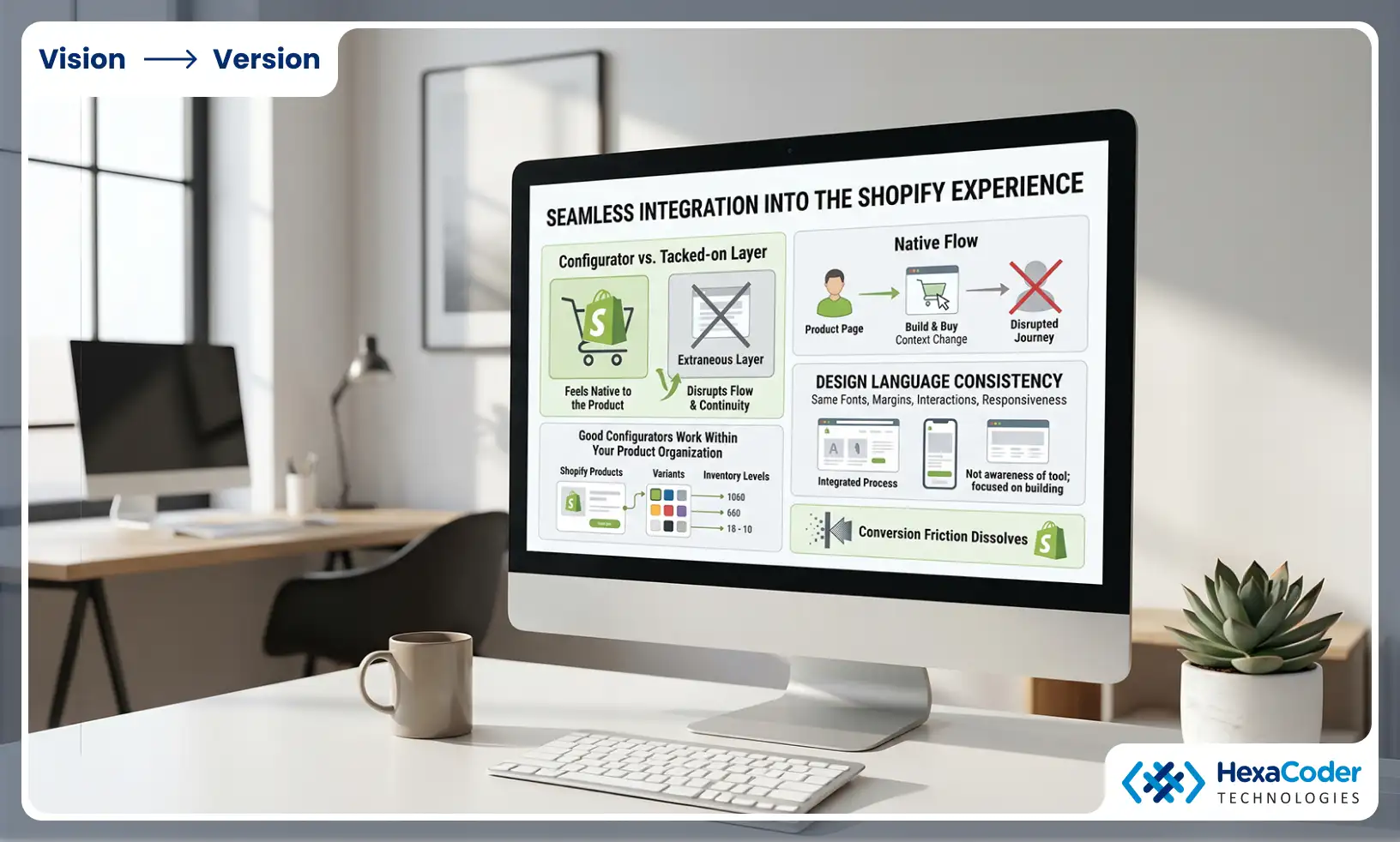
A configurator should never be an extraneous layer tacked on top of your store. It needs to feel native to the product.
As customers navigate their way through a product page, they aren’t expecting to jump to a different environment. Anything that disrupts their flow and continuity causes resistance, even if only subtly.
Good configurators integrate seamlessly with Shopify. It works within the confines of how you organize products, variants, and inventory, while never demanding your customers change context.
Most importantly, it must adhere to the same design language you already established. It should use the same fonts, have the same margins, interactions, and even responsiveness.
This level of consistency ensures that the tool feels integrated into the shopping process rather than just another feature to use. You’re not making customers aware of the configurator; they are fully focused on what they are building.
It is from here that conversion friction dissolves.
Configuration Logic That Mirrors Real Product Constraints
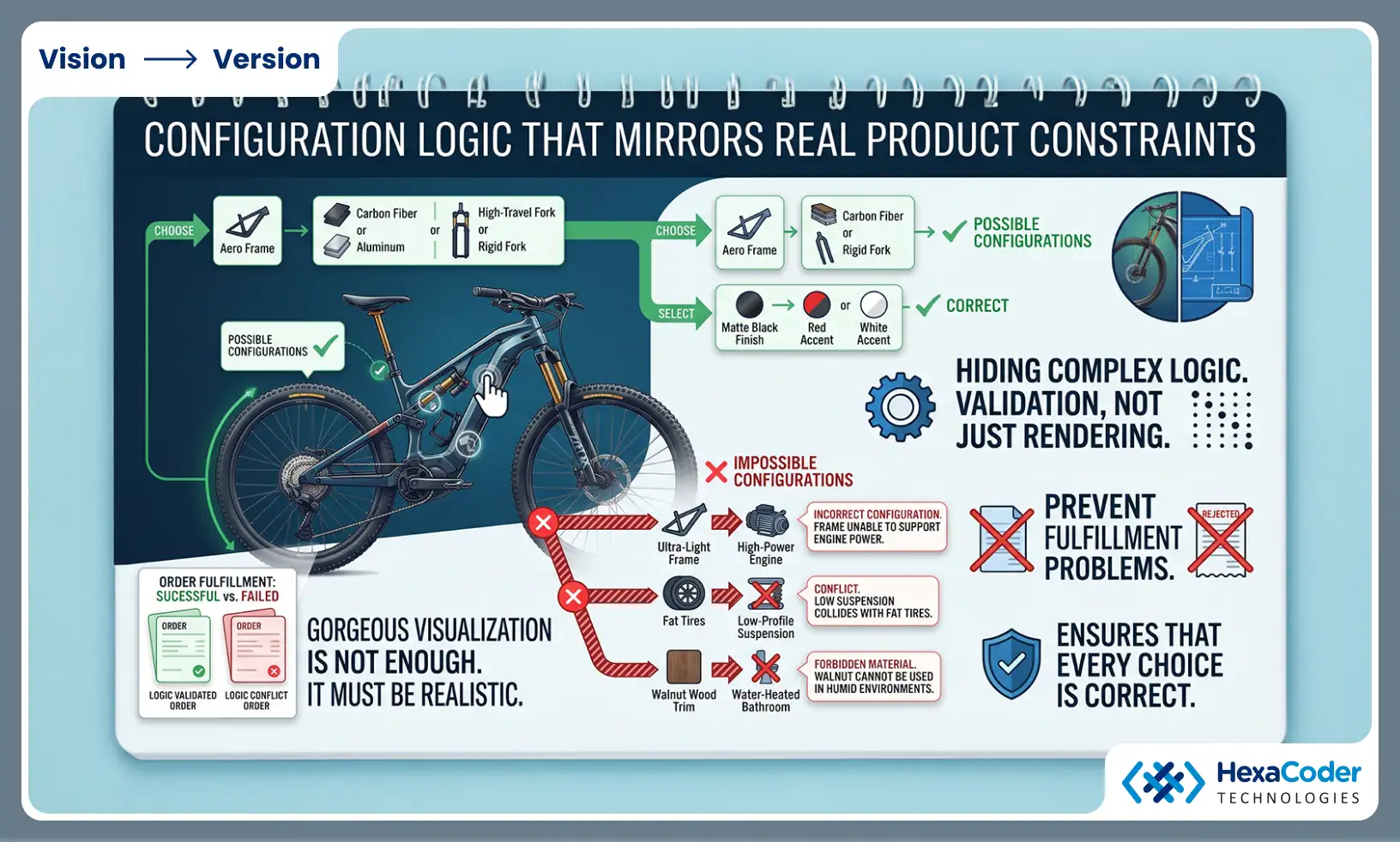
The stunning visual aspect of a configurator does not matter if it provides a user with impossible configurations.
Every high-end configurator hides complex logic of possible and impossible combinations under its gorgeous visualization capabilities. And it is all about that, not rendering but validation of the selection possibilities.
The products sold on today’s e-commerce platforms are hardly ever static items. They are complex systems, where one element depends on another. A certain material can be used only for a particular frame. A color can be chosen only for some specific finishes. An upgrade changes the price and availability of a product.
If there are no proper logic algorithms implemented in the configurator, the customer will make an incorrect configuration that is simply impossible. That will cause problems with fulfilling his order.
A properly developed configurator does not allow him to do that at all, and makes sure that every choice is correct.
Performance Architecture That Supports Scale
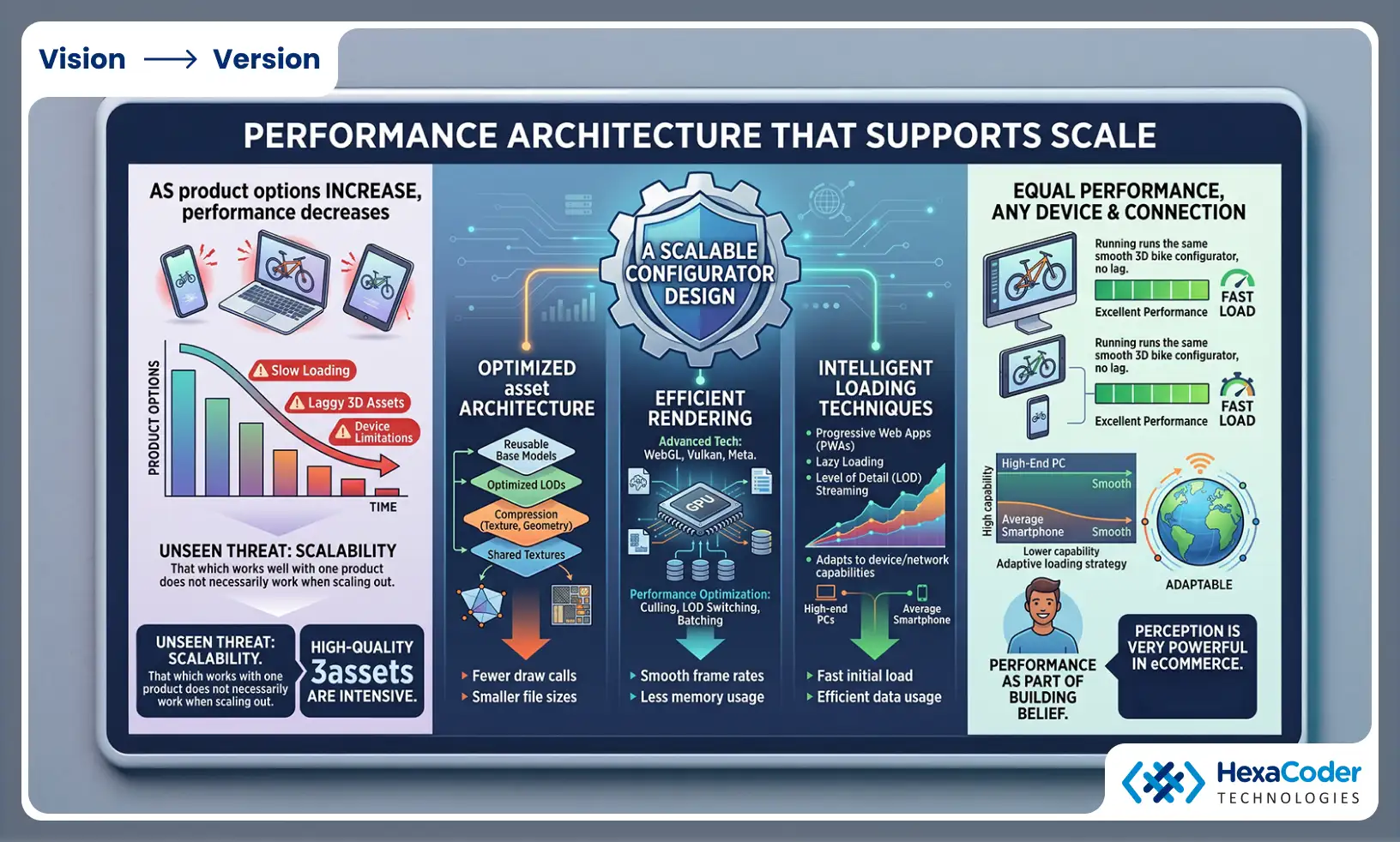
As the number of product options increases, configurators encounter an unseen threat – scalability.
That which works well with one product does not necessarily work as well when scaling out to multiple variations. Large, high-quality 3D assets are intensive, and without proper optimization, their impact on performance is felt immediately.
A scalable configurator design takes all of these elements into account right from the start. It employs optimized asset architecture, efficient rendering, and intelligent loading techniques that adapt to the capabilities of any device or network connection.
It will perform equally well whether it is run on a high-end PC or an average smartphone.
Performance has an immediate effect on perception. Users will not buy products they don’t believe in. Performance is part of building that belief.
Perception is very powerful in eCommerce.
Dynamic Pricing That Builds Transparency Into the Experience
One of the most compelling benefits of using a contemporary configurator is real-time price changes.
As the user makes modifications, the price must be updated immediately. It gives them instant feedback on how their choices affect price.
Without this capability, price becomes the source of frustration for many customers. They configure the product only to find out that prices have changed unexpectedly after adding all the necessary items. It is enough to discourage them from purchasing the item.
If pricing is visible and interactive, it impacts customer behavior positively. It helps customers understand how different choices influence the total value of what they get and stay within set boundaries.
However, the biggest benefit is that it increases trust, which is one of the main factors driving conversions among high-involvement products.
Mobile-First Experience Design
Today's eCommerce traffic consists mostly of mobile users. A configurator that isn't optimized for mobile is always incomplete out of the box.
Mobile and desktop interactions differ fundamentally. Mobile interaction needs optimized touch-based navigation, reduced cognitive load.
A good configurator doesn't only work with smaller screens. It changes the interaction flow completely.
That means:
- Simplified controls optimized for one-handed use
- Fast-loading assets optimized for mobile connections
- Optimized visual hierarchy that minimizes confusion
- Smooth interactions and gestures for rotating and exploring
If mobile is implemented successfully, the configurator works much better. When done wrong, configurators become completely non-functional.
Behavior Tracking and Conversion Intelligence
Configurators aren't just products; they are also data systems. Every action taken in a configurator is an indication of intent. The options being changed, exploration times, points of hesitation all of that gives information about customer behavior.
With advanced tracking in place, the brand learns:
- The most popular options in a configurator
- Where users get stuck in the process
- Which elements encourage spending time on a page
- How customization influences the purchasing decision
The results are used to optimize the products and marketing processes.
AR (Augmented Reality) Product Preview
One of the most useful features that can be implemented in modern 3D configurators is the integration of augmented reality technology, which allows displaying products in the customer's real environment.
This makes it possible to integrate the product into its surroundings by placing it via a mobile application in the same environment where the customer will use it.
It solves the problem of estimating the scale of the object. In fact, many people do not buy things online due to the inability to estimate their real size.
AR helps to solve this problem by displaying them in the real world. When used effectively, it can help boost confidence in the product and reduce return rates significantly.
Multi-Product Bundling and System Configuration
As modern eCommerce evolves, we can clearly see that single products are no longer popular among customers.
They prefer bundles, sets of items that complement each other. A modern eCommerce platform must allow such complex configuration of objects and display their interaction in the environment. This is especially true for furniture stores, accessory shops, clothing companies, etc.
The ability to create multi-component systems will automatically increase orders and profits.
Embedded Product Storytelling Layer
Effective interaction is one of the aspects of a well-designed configurator.
However, many customers cannot understand all the differences between various configurations. This may result in confusion and inability to make a proper choice.
The concept of embedded product storytelling helps solve this problem. Customers will be provided with valuable information about the products they interact with in the course of interaction.
This can consist in explaining material qualities or use cases of the product.
Advanced Lighting and Material Simulation
One of the most underrated capabilities of the configurators is material realism under varying light conditions.
Products do not exist by themselves; their appearance depends on environmental conditions, reflection, depth, and angle of light. High-end configurators take these variables into account, providing a preview of how a product will look under real-life conditions.
It becomes especially important for premium products whose material characteristics make the bulk of the purchase decision criteria. Small differences in glossiness, reflectance, and material texture may greatly affect perception of the product's worth.
Scaling Up with Increasing Numbers of Products
As more products get added to the lineup of configurable items, the configurators must cope with scaling up, while keeping their performance and efficiency levels consistent.
There are many configurations that perform quite well with a small number of configurable options but show serious problems if implemented on a large scale.
In order to cope with that, configurator systems should have scalability potential that enables adding new items without slowing down performance or making it difficult to use.
Conversion-Focused Analytics Layer
Beyond interaction, an intelligent configurator should be able to analyze user behavior.
Everything users do in interaction mode, changes they make, how much time they spend in certain configurations, and when they abandon their session, allows us to understand user decision-making process directly.
Modern analytics help us understand more than what customers purchase. They help us know why they purchased something.
This data is important in designing products, setting prices, and refining user experiences in the future.
Why Hexacoder Technologies Is the Leader in 3D Configurator Creation
Hexacoder Technologies does not see itself as a simple plug-in or visualization software. It aims to build a complete configurator experience layer that is tailored to work with modern eCommerce systems such as Shopify.
The strength of Hexacoder Technologies comes from its multidisciplinary approach rather than from a single innovation.
This is the combination of:
- State-of-the-art 3D rendering systems
- Native Shopify architecture
- Configuration logic engines
- Conversion-oriented UX
- Interaction frameworks optimized for mobile devices
- Asset management systems
- Behavioral analysis and tracking tools
Configurator tools typically focus on only one level of the user experience. Some focus on visuals. Some focus on logic. And some focus on integrations.
What makes Hexacoder different is that it has been engineered from the ground up to integrate performance, usability, and commercial logic into a cohesive ecosystem.
It is what makes it possible for brands to go beyond simply presenting the products visually and deliver a full interactive shopping experience.
The end result is not a more visually appealing product page. The end result is an increase in customer engagement, decreased hesitance, and improved conversion performance.
Designing Next-Level Product Experiences
In the eCommerce world, tomorrow belongs to interactive browsing and shopping.
Customers don't need imagination to buy products anymore. What they need is the ability to interact with the product before they actually make the purchase.
If you still believe that it's okay to describe customizable and high-consideration products using static visuals, you might be behind times.
Hexacoder Technologies has the tools you need to change that and present products through an interactive configurator system.
Hexacoder Technologies can help your brand achieve next-level product experience design.