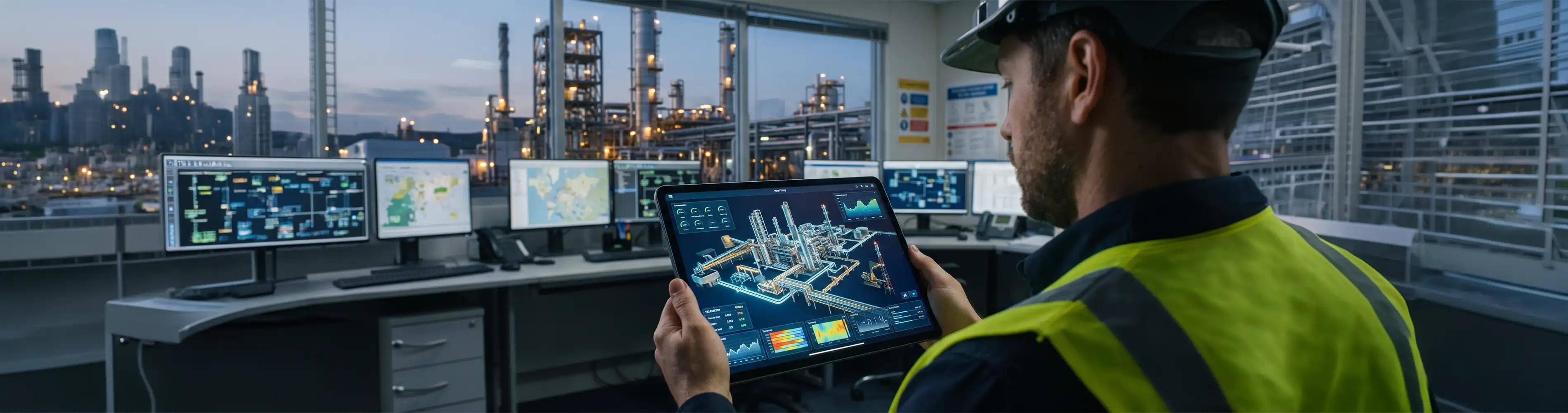
Digital twin manufacturing solutions that connect your factory, equipment, and data
See what's happening across your production environment with custom digital twin software. Connect machinery, production systems, and operational data to improve equipment visibility, identify potential issues, and make more informed manufacturing decisions.
What is a digital twin in manufacturing and how does it work?
A manufacturing digital twin is a digital representation of physical equipment, production processes, or factory systems connected to relevant engineering and operational data.Consider a production line with several interconnected machines. Each machine generates operating information, while maintenance records, equipment specifications, and production reports exist in separate systems.A digital twin connects this information to a representation of the physical production environment, making it easier to understand equipment conditions and investigate operational issues.Unlike a static 3D model, an industrial digital twin can incorporate changing equipment data, historical records, and supported analytical functions.
01
Physical manufacturing assets
Machines, production lines, industrial equipment, and factory infrastructure form the foundation of the digital twin.
02
Digital equipment representation
Interactive 3D models represent machinery, components, and their relationships within the production environment.
03
Connected operational data
Sensors, monitoring systems, and manufacturing applications provide relevant equipment and production information.
04
Monitoring and analysis
Connected information helps users examine equipment conditions, investigate performance trends, and evaluate supported operational scenarios.
Manufacturing challenges
What manufacturing challenges can digital twin technology solve?
Manufacturing operations generate valuable information every day. The difficulty is often connecting that information to the equipment and processes it describes.
Unexpected equipment downtime
Machinery issues can develop between scheduled inspections. Without accessible condition information, potential problems may remain unnoticed until production is interrupted.
Limited production visibility
Traditional dashboards display measurements and production figures but may not explain how individual machines relate to the wider production environment.
Disconnected manufacturing information
Engineering specifications, maintenance histories, equipment measurements, and production records often exist across separate applications.
Difficult process evaluation
Changing equipment settings, production sequences, or factory layouts can require costly physical testing and operational adjustments.
Complex equipment maintenance
Understanding recurring machinery problems becomes difficult when component information, operating history, and maintenance records cannot be examined together.
Manufacturing digital twin solutions
Manufacturing digital twin solutions we develop
HexaCoder develops custom digital twin software for industrial equipment, production systems, and manufacturing facilities. Each solution is built around existing machinery, available data, and specific operational requirements.
Industrial equipment digital twin
Create interactive representations of manufacturing machinery with connected equipment specifications, component information, operating measurements, and maintenance records.
Factory digital twin solutions
Develop digital representations of manufacturing facilities, including machinery locations, production areas, and relevant infrastructure. Connect available operational information to supported assets.
Production line digital twin
Visualize interconnected machines and workstations within a production line. Access equipment status, recorded events, and relevant production information through a connected interface.
Manufacturing process digital twin
Represent selected production processes and integrate suitable analytical models to examine operating conditions or evaluate proposed process changes.
Smart factory digital twin
Connect supported industrial equipment, monitoring platforms, and manufacturing systems within a digital environment designed for equipment visibility and operational analysis.
Software capabilities
Key features of our manufacturing digital twin software
Our digital twin software development combines interactive visualization, connected equipment information, and custom functionality designed around manufacturing requirements.
Interactive 3D factory visualization
Explore manufacturing equipment, production areas, and supported machinery components through detailed digital representations.
Real-time equipment monitoring
Display available machine measurements, operating conditions, and equipment status through connected monitoring interfaces.
Production performance dashboards
View selected equipment indicators, operating trends, and relevant production information within customized dashboards.
Equipment hierarchy management
Organize factories, production lines, machines, assemblies, and individual components into structured asset relationships.
Historical data analysis
Review recorded equipment measurements, operational events, and performance trends across selected periods.
Alerts and event visualization
Display relevant equipment notifications and defined monitoring events alongside their corresponding digital assets.
Predictive analytics integration
Connect suitable analytical models to support equipment anomaly detection and potential failure assessment when reliable data is available.
Simulation and scenario analysis
Visualize results from appropriate engineering or process simulation models to support evaluation of selected manufacturing changes.
Development process
How we develop and implement manufacturing digital twins
Successful digital twin implementation starts with understanding the physical production environment and identifying the information needed to support operational decisions.
01
Understand your manufacturing environment
We identify the machinery, production processes, operational challenges, and available information within the project scope.
02
Create the digital asset models
We prepare digital representations using available CAD files, engineering specifications, equipment information, and suitable 3D assets.
03
Design the software architecture
We define the asset relationships, data structures, application interfaces, and technical components required for the digital twin.
04
Connect manufacturing systems
We integrate supported equipment monitoring platforms, industrial sensors, databases, and existing manufacturing applications.
05
Test and deploy the solution
We validate digital asset representations, data connections, application functionality, and agreed workflows before deployment.
06
Support future improvements
We help extend the application as production equipment, available data, and operational requirements change.
Industrial system integrations
Manufacturing digital twin integration with existing industrial systems
A useful digital twin should connect with your existing manufacturing infrastructure rather than introduce another disconnected application.HexaCoder develops custom integration workflows that bring relevant engineering, production, and equipment information into a connected digital environment.
01
Industrial IoT sensors
Connect supported equipment measurements, including temperature, vibration, pressure, and operating status, through available sensor infrastructure.
02
PLC and SCADA systems
Access relevant machine states, process measurements, and equipment information through approved industrial monitoring interfaces.
03
Manufacturing execution systems
Integrate supported production records, equipment events, and manufacturing information to provide operational context.
04
ERP applications
Connect relevant inventory, equipment, maintenance, and business information through supported enterprise interfaces.
05
CAD and PLM systems
Use available engineering models, component structures, and technical specifications to maintain digital asset representations.
06
Maintenance management systems
Associate equipment histories, inspection records, and service information with the corresponding machinery.
07
Cloud platforms and custom APIs
Develop controlled data exchange services for supported databases, enterprise applications, and cloud infrastructure.
Benefits of digital twin technology for manufacturing operations
Digital twin technology for manufacturing companies can improve how equipment information is accessed, interpreted, and used. The practical results depend on data quality, integration capabilities, and implementation scope.
01
Reduce unplanned equipment downtime
Connected monitoring and suitable analytical models can help identify developing machinery issues earlier, supporting more proactive maintenance planning.
02
Improve production visibility
Understand selected equipment conditions and operating information within the context of the physical production environment.
03
Support manufacturing process optimization
Analyze available operating information and suitable simulation results to identify opportunities for improving selected production processes.
04
Make maintenance planning more informed
Combine equipment histories, operating measurements, and relevant technical records to support maintenance scheduling and investigations.
05
Evaluate changes before implementation
Use validated engineering or process models to examine selected equipment adjustments, operating scenarios, or layout modifications.
06
Improve access to equipment information
Connect relevant engineering specifications, maintenance records, and operational data through consistent digital asset references.
07
Support industrial asset lifecycle management
Maintain useful relationships between equipment models, technical information, and service records as machinery is modified or replaced.
08
Build a foundation for connected factory operations
Extend the digital twin to additional production assets, monitoring systems, or analytical capabilities as manufacturing requirements evolve.



 Digital Twin